PRE-REGISTERED NURSES’ PERCEPTIONS OF THE OBJECTIVE
STRUCTURED CLINICAL EXAMINATION:
A MIXED METHODS STUDY
Yu-Hsin Wang, Ph.D., RN1, Li-Lan Chuang, Ph.D. RN2, Chiu-Tzu Lin, M.S.N., RN3, Lee-Fen Ni, Ph.D., RN1*
1
Affiliation: Associate Professor&Associate Research Fellow Department of Nursing, Chang Gung University of Science and Technology, Taiwan &LinkouChang Gung Memorial Hospital, Taiwan 2
Affiliation: Associate Professor &Associate Research Fellow Department of Emergency Medicine, Chang Gung University of Science and Technology, Taiwan &LinkouChang Gung Memorial
Hospital, Taiwan 3
Affiliation: Deputy DirectorDepartment of Nursing &Lectuter, LinkouChang Gung Memorial Hospital, Taiwan&Chang Gung University of Science and Technology, Taiwan
*Corresponding Author: E-mail: [email protected]
ABSTRACT
This study explored the perceptions of objective structured clinical examination (OSCE) among pre-registered nurses before their last-mile practicum in their fourth year of undergraduate study. A mixed methods approach was used to capture the pre-registered nurses‟ perceptions after taking the OSCE. A total of 167 students participated in the study and attended the OSCE consisting of eight stations that lasted eight minutes each. After completing all eight stations, the students were immediately invited to a nearby classroom to fill in a structured questionnaire anonymously and write down their perceptions after taking the OSCE on a piece ofA4 paper. Nine items of the questionnaire were analyzed by calculating the frequencies of each response. Content analysis was used to analyze the qualitative data. The results revealed that 58% to 90% of the students selected “agree” and “strongly agree” for items including “Contents of the stations were relevant to the curriculum,” “Question had clear descriptions of the task to be performed” , “The process was smooth and orderly,” “Examiners‟ attitude did not disrupt my exam” and “Standardized patients acted like real patients,” and 58% of the students considered the questions to be difficult or very difficult. Analysis of the qualitative data summarized four themes, which were “feeling nervous throughout,” “feeling frustrated due to inadequate techniques,” “feeling a sense of confidence spontaneously,” and “perceiving oneself as a registered nurse for the first time.” The study concluded that the students gave positive feedback about different components of the OSCE. Despite the negative feelings, such as being nervous and frustrated, the students gradually gained confidence and established their
International Research Journal of Natural and Applied Sciences
ISSN: (2349-4077)
Impact Factor 5.46 Volume 6, Issue8, August 2019
awareness as a registered nurse. Therefore, it is beneficial to implement the OSCE before the last-mile practicum of pre-registered nurses.
KEYWORDS-Mixed methods study, Nursing education, Objective structured clinical examination, Pre-registered nurses, Qualitative content analysis
INTRODUCTION
Working at the forefront of health care, nursing personnel have the inescapable duty to provide safe care of excellent quality (Lewis et al., 2016). In pace with the increasingly aging population, changes to the public disease pattern, and advances in healthcare technology, care needs have become multivariate and complex. During the transition to employment, pre-registered nurses often face “reality shocks” and issues caused by the gap between theory and practice or find that the training of talents fails to meet the needs of the industry (Lee and Chang, 2012). Therefore, the training of nursing personnel with “clinical competence” is the most important part of nursing education. In nurse training education, how to assess students‟ “clinical competence” is regarded as a great challenge for nurse educators (Norman et al., 2002). The traditional skills tests have been criticized for only simply stressing the memorization of knowledge and ability by students and ignoring their capacities in problem solving, critical thinking, and communication (Ross, et al., 1988). The emergence of several forms of structured examinations in the past 20 years has improved the aforesaid deficiency, among which the most commonly adopted form is the Objective Structured Clinical Examination (OSCE).
The OSCE was developed in 1975 by Harden, a British professor. It is a structured, objective method used to assess clinical competence and was initially used to assess the three aspects of a physician‟s “clinical competence,” namely knowledge, skill, and attitude (Harden et al., 1975). Based on the framework for clinical assessment proposed by Dr. Miller in 1990 to enable students from medical care-related fields to exert professional “clinical competence” independently, the training process should be operated in successive steps, from the levels of knows, knows how, shows how to the level of does (Miller, 1990). The OSCE is at the level of shows how, which mainly assesses the performance of learners and has been broadly applied in health-related educational fields to verify whether students are able to apply the theoretical knowledge in clinical practices.
on practices that are mostly commonly encountered clinically; (C) to evaluate a student‟s performance based on their overall practice, rather than discrete actions; (D) to require students to perform tasks in an integrated rather than piecemeal fashion by combining assessments of discrete skills in an authentic manner; (E) to focus on practices that are structured and combines the knowledge, skills, and clinical normality as desired by the programs; (F) to ensure that the timing and order of students‟ learning are appropriate, which reinforces the integration of different program contents and reduces piecemeal learning; and (G) to allow the integration of ongoing practice assessment and technical operations and to ensure the provision of appropriate and timely feedback to guide students‟ development. Based on the implementation of the OSCE in undergraduate midwifery and nursing programs, Henderson et al. (2013) further proposed an implementation framework for using the OSCE in nursing curricula, which consisted of four stages. The first stage is Opportunity, which is to verify whether the practices provided by the OSCE used in the inspected curricula are the most common ones and whether the knowledge, attitude, and skills assessed by the OSCE of the program are the most appropriate for learning. The second stage is Organization, which ensures that the student‟s learning is structured, ordered, and integrated and combines the knowledge, skills, and practices commonly encountered clinically as desired by the curricula to reduce piecemeal learning. The third stage is Oversight, which requires students to perform integrated tasks that allow assessments of their discrete skills in an authentic manner. The fourth stage is Outcome, where students‟ knowledge, attitude, and skills are all demonstrated to be safe and patient-centered and students may integrate assessments and technical operations as an ongoing practice in a safe environment and receive appropriate feedback.
Examples of implementing the OSCE in nursing education include the skills evaluation of pre-registered nurses before practicum and the training of new hospital staff (Lin, 2011), assessment of problem-based learning (Salinitri et al., 2012), and assessment of undergraduate students from the “psychiatric nursing and mental health” program in the fourth year of study (Selim et al., 2012). In the context of helping pre-registered nurses acquire clinical competence before joining the workforce, the OSCE assessment has become the trend. However, most studies have adopted a quantitative approach; very few have explored the perceptions of examinees. Therefore, this study aims to explore the perceptions of the OSCE among pre-registered nurses before the last-mile practicum in their fourth year of undergraduate study.
METHODS Research Design
This study employed a combination of qualitative and quantitative methodologies, including a questionnaire, and wrote information about the participants‟ perceptions on sheets of paper.
The participants were a total of 167 nursing students in their fourth year of study before their last-mile practicum from a university of science and technology in the northern part of Taiwan.
Ethical Considerations
This study was exempted by the Ethics Committee of the Institutional Review Board of the Chang Gung Medical Foundation, Taoyuan, Taiwan.
Procedure
The research team developed a questionnaire with a total of nine items for the students to complete after the OSCE assessment. The questionnaire content covered the alignment between questions and the learning program, satisfactions with different OSCE components, and the difficulty level of questions as perceived by the students. The questionnaire was scored using the Likert 5-point scale and asked the students to write down their perceptions of experiencing the OSCE with such directions as “Please write down your feelings or opinions of participating in this OSCE.”An eight-station OSCE, which had been tested for reliability and validity, were used as theeight-stations for this study. Five of them were technical operation stations, concerning “intramuscular injection,” “intermittent catheterization,” “wet dressing for wound,” “sputum suction,” and “intravenous administration (IV drip).” Another station, “Diabetes mellitus assessment & instruction,” was about the communications between nursing staff and patients and health education. “Abdominal pain assessment” was about physical assessments and the demonstration of love and care. “Left-side paralysis” was about physical assessments and health education. For the technical operation stations, students were asked to operate on a model, while the other three stations, which covered aspects of physical assessments, communication, attitude, and health education, involved the participation of standardized patients (SP). The principal investigator (PI) explained the purposes and methods of the study toparticipantsin person four months before the examination and conducted examiner marking consistency and SP training one month prior. The examination was held at the Clinical Competence Center of the university where theparticipants studied, with a total of 32 examination sites (32 examiners), and was completed within one day. Each examinee attended eight stations of examinations lasting eight minutes each, and one minute each was given for the changing of stations and reading the task of stations. As a result, each station lasted 10 minutes and a total of 80 minutes for eight stations. After completing all eight stations, students were asked to go immediately to a nearby classroom to fill in the questionnaire anonymously and write down their perceptions of experiencing the OSCE on a piece of A4 paper.
Results
A total of 153 female and 14 male pre-registered nurses in their fourth year of undergraduate study participated in this study.
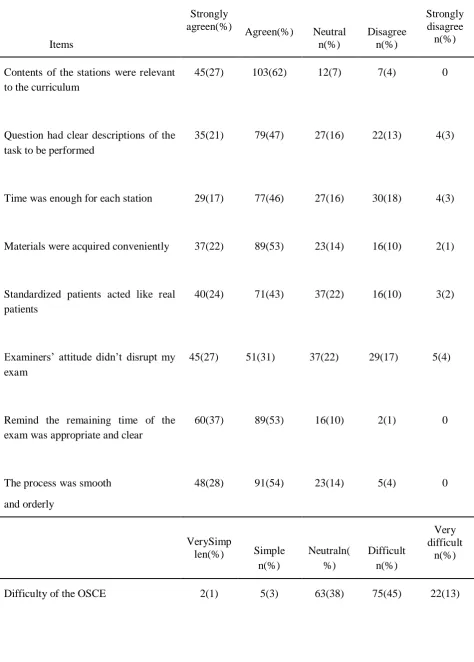
The quantitative data results are shown in Table 1. Overall, with respect to the degree of agreement, all questions showed high degrees of “agree” and “strongly agree.” Among them, “Remind the remaining time of the exam was appropriate and clear,” being the highest, achieved 90%, which was followed by 89% for “Contents of the stations were relevant to the curriculum” and 82% for “The process was smooth and orderly.” “Examiners‟ attitude did not disrupt my exam” was 58%, showing a lower degree of agreement compared to other items. In terms of the difficulty level of the questions, 58% of students thought that they were “difficult” or “very difficult.”
Qualitative Results
This part of the data was collected from the statements of 152 students, as 15 out of 167 students did not write down any word. Content analysis was used to analyze the perceptions of the OSCE among students through the inductive approach. Meaning units were first identified from the content of students‟ statements and numbered. Afterwards, four themes were summarized, which were “feeling nervous throughout,” “feeling frustrated due to inadequate techniques,” “feeling a sense of confidence spontaneously,” and “perceiving oneself as a registered nurse for the first time.”
Feeling nervous throughout
The OSCE has eight stations of examinations and there is one “task” behind the door of each
station for me to complete. Each station is attended by a different examiner and tests different
techniques with different patients. There has never been an examination that is so variable like this
one. I felt really nervous, very nervous, from the first station to the last. Just nervous.
Today’s temperature didn’t reach 20 degrees Celsius. I was in a short-sleeved training uniform and
even sweated! My hands could not help trembling and I started to stammer too. I was so nervous!
Since the time of gathering to wait for the examination, I felt that my heartbeat had sped
up…when talking with the patients, I placed my hands on my chest, trying to slow down my heartbeat a bit and kept talking to myself in my mind, “don’t be nervous, don’t be nervous,” but it just didn’t work…
Feeling frustrated due to inadequate techniques
I forgot to pull back the plunger after inserting the needle during intramuscular injection and didn’t perform the aseptic procedure well when changing the wet dressing of the wound. I also forgot
to perform the palpation during the physical assessment and couldn’t complete the intermittent
I was defeated by the eight stations! I probably didn’t practice enough and familiarize myself enough with the technical operation procedures…not sure about the answers to patients’ questions and
assessment items. I felt like collapsing after the examination and felt extremely frustrated.
Is the OSCE a test meant to knock people down? Eight stations of examinations at once, full of
techniques, together with assessments and health education questions. I didn’t familiarize myself
enough with the technical operations and communication skills and failed to cover all aspects of the
health education questions…feeling really sad and frustrated.
Feeling a sense of confidence spontaneously
I completed eight stations of the OSCE, which lasted as long as 80 minutes. Regardless of the
results, good or bad, even I wanted to give myself an applause after the last station. I really made it
and feel more confident about joining the nursing workforce in the near future.
I’ve heard that the OSCE is a characteristic of the medicine/nursing field and it seems that every
student of the medicine/nursing field has to go through this examination. I finally experienced it
today. Eight stations, all sorts of tasks awaited me, and I completed them one after another. It felt like
taking up challenges in the world of video games. I completed one challenge after another and
gradually built up my confidence…
Perceiving oneself as a registered nurse for the first time
The OSCE stations come in certain situation. It feels like every time when entering a station, you
provide services to the patients inside. Especially those with standard patients, they looked real. I
provided physical assessments, health education, and dietary instructions and taught them how to
avoid falls. It made me feel like a real registered nurse.
Although I have cared for patients during thepracticum, there were supervisors beside me to give
directions. All situation encountered in the OSCE required one’s own responses, just like working as
a registered nurse. It was the first time I had such feelings…
Every station is equipped with different tasks, including technical questions, health education
questions, patient visit questions, and physical assessment questions. It was really like nursing
practices carried out in a clinical setting. Today’s examination made me feel like working at the
DISCUSSION
The OSCE is a performance-based test, which can be used to assess a specific clinical competence of the learner. Before the students‟ last-mile practicum, practices or examinations in aspects including technical operations, communication skills, and deductions and decision making may improve their coping capacity in facing clinical situations (Wang et al., 2013). By adopting a methodology combining quantitative and qualitative approaches, this study explored the perceptions of pre-registered nurses when participating in the OSCE in their fourth year of undergraduate study. In the part of the quantitative data regarding satisfactions, “agree” and “strongly agree” accounted for 58% and 90% among all items, respectively, suggesting that students were highly satisfied with the alignment between exam and the learning program, as well as different OSCE components. Among the students, 89% agreed that “Contents of the stations were relevant to the curriculum,” suggesting that the questions were aligned with the learning program. This accords with the results of Taylor et al., which reported that nurse practitioner students agreed that there was “constructive alignment between the course and the exam” (Taylor et al., 2019). The percentages of students who agreed with “The process was smooth and orderly,” “Materials wereacquired conveniently,” and “Question had clear descriptions of the task to be performed” were 82%, 78%, and 68%, respectively. This is similar to the results shown by Majumder et al. (2019) that students from medical schools held positive views with respect to “instructions were clear and unambiguous,” “sequence of stations was logical and appropriate,” and “setting and context at each station felt authentic.” Brighton et al. (2017) designed a 30-minute OSCE concerning the situation of drug administration and analyzed the perceptions of the OSCE written by 102 students after the examination. Among them, two thirds of the students believed that the grader‟s attitude was “kind” or “supportive,” sharing the same connotation as “Examiners‟ attitude didn‟t disrupt my exam,” which was supported by 58% of the participants in our study. Standardized patients had received multiple training sessions before the examination; thus, 67% of the participants of this study agreed that the “Standardized patients acted like real patients.” The acting of the standardized patients has usually been presented as qualitative data in the previous studies. For instance, in a study of students from traditional Chinese medicine school, students mostly stated, “I think the standardized patients‟ acting was very good…” regarding the acting of the standardized patients (Chen et al., 2015). Among the students, 45% considered the OSCE to be difficult and 38% thought that they were appropriate. In addition, the fact that 89% of the students agreed that “Contents of the stations were relevant to the curriculum” also echoed the statement of students shown in the qualitative data, who attributed the reason for finding the questions to be difficult to be their lack of practice.
participated in the focus interviews mentioned that “the OSCEs gave them the knowledge base that was essential to their role as midwifery students” (Mitchell et al., 2014). This has a similar connotation as “perceiving oneself as a registered nurse for the first time” expressed by the students in our study.
CONCLUSION
Overall, students participating in this study provided positive feedback in terms of “Contents of the stations were relevant to the curriculum,” “Question had clear descriptions of the task to be performed” “The process was smooth and orderly,” “Examiners‟ attitude did not disrupt my exam” and “Standard patients acted like real patients.” The eight-station OSCE of this study offered students the nursing activities required for caring for patients in clinical settings. Despite the negative feelings, such as “feeling nervous throughout” and “feeling frustrated due to inadequate techniques,” students also expressed positive aspirations, such as “feeling a sense of confidence spontaneously” and “perceiving oneself as a registered nurse for the first time.” The use of the OSCE in nursing education has become a trend. It is recommended that nurse educators establish a series of models to implement the OSCE in different years of the undergraduate curricula to integrate various programs before the end of the study, so that students are offered more chances to practice and gradually improve their performances by offering “shows how” in familiar situation. A longitudinal study could also be conducted to understand the changes in the consciousness and perceptions of students during their participation in a series of OSCEs.
ACKNOWLEDGMENTS
This study was sponsored by the Ministry of Science and Technology (MOST 1032511S255 -004) in Taiwan. There are no potential conflicts of interest relevant to this article to report. We would like to thank Uni-edit (www.uni-edit.net) for editing and proofreading this manuscript.
REFFRENCES
1.Bani-issa, W., Tamimi, M. A., Fakhry, R., & Tawil, H. A. (2019). Experiences of nursing students and examiners with the Objective Structured Clinical Examination method in physical assessment education: A mixed methods study. Nurse Education in Practice, 35, 83-89. https://doi.org/10.1016/j.nepr.2019.01.006
2.Brighton, R., Mackay, M., Brown, R. A., Jans, C., & Antoniou, C. (2017). Introduction of Undergraduate Nursing Students to an Objective Structured Clinical Examination. Journal of Nursing Education, 56(4), 231-234. doi: 10.3928/01484834-20170323-08
Complementary Therapies in Clinical Practice, 21, 147-153. http://dx.doi.org/10.1016/j.ctcp.2015.06.002
4.Harden, R. M., Stevenson, M., Downie, W. W., & Wilson, G. M. (1975). Assessment of clinical competence using objective structured clinical examination (OSCE). British Medical Journal, 1(5955), 447-451.
5.Henderson, A et al. (2013). An implementation framework for using OSCEs in nursing curricula. Nurse Education Today, 33(12), 1459-1461. doi: 10.1016/j.nedt.2013.04.008
6.Jay A.(2007). Students‟ perceptions of the OSCE; a valid assessment tool? British Journal of Midwifery, 15(91), 32–7.
7.Jo, K. H., & An, G. J. (2014). Qualitative content analysis experiences with objective structured clinical examination among Korean nursing students. Japan Journal of Nursing Science, 11,79-86. doi: 10.1111/jjns.12006
8.Lee, S. & Chang, T. (2012). A Taiwan Nursing Perspective on Current Imbalances in Educating, Licensing and Hiring New Nurses. The Journal of Nursing, 59(5),16-23. doi:10.6224/JN.59.5.16
9.Lewis, D. Y., Stephens, K. P., &Ciak, A. D. (2016). QSEN: Curriculum integration and bridging the gap to practice. Nursing Education Perspectives, 37(2), 97-100. doi:10.5480/14-1323
10.Lin, Y. C. (2011). Clinical Scenario Simulation-Objective Structured Clinical Examination Application on Nursing Education. Tzu Chi Nursing Journal, 10(3), 19-27.
11.Majumder, M.A.A., Kumar, A., Krishnamurthy, K., Ojeh, N., Adams, O.P., & Sa, B.(2019). An evaluative study of objective structured clinical examination (OSCE): students and examiners perspectives. Advances in Medical Education and Practice, 5(10), 387-397. doi: 10.2147/AMEP.S197275
12.Miller, G. (1990). The assessment of clinical skills/competence/ performance. Academic Medicine, 65 (Suppl. 9), S63-67.
13.Mitchell, M.L., Henderson, A., Groves, M., Dalton, M. &Nulty, D. (2009). The objective structured clinical examination (OSCE): optimizing its value in the undergraduate nursing curriculum. Nurse Education Today, 29(4), 398-404. doi: 10.1016/j.nedt.2008.10.007
14.Mitchell, M.L., Jeffrey, C.A., Henderson, Amanda., Glover, P., Nulty. D.D., Kelly, M. A., Groves, M., & Knight, S. (2014). Using an Objective Structured Clinical Examination for Bachelor of Midwifery students‟ preparation for practice. Women and Birth, 27(2), 108-113. doi: 10.1016/j.wombi.2013.12.002
16.Norman, I. J., Watson, R., Murrells, T., Calman, L., & Redfern, S. (2002). The validity and reliability of methods to assess the competence to practise of pre-registration nursing and midwifery students. International Journal of Nursing Studies, 39(2), 133-145.
17.Nulty, D.D., Mitchell, M.L., Jeffrey, C.A., Henderson, A., & Groves, M. (2011). Best practice guidelines for use of OSCEs: maximising value for student learning. Nurse Education Today, 31(2), 145–151. doi:10.1016/j.nedt.2010.05.006
18.Ross, M., Carroll, G., Knight, J., Chamberlain, M., Fothergill-Bourbonnais, F., & Linton, J. (1988). Using the OSCE to measure clinical skills performance in nursing. Journal of Advanced Nursing, 13(1), 45-56.
19.Salinitri , F. D., O'Connell , M. B., Garwood, C. L., Lehr, V. T., & Abdallah, K.(2012). An objective structured clinical examination to assess problem-based learning. American Journal of Pharmaceutical Education, 76(3), 44. doi: 10.5688/ajpe76344.
20.Selim, A.A., Ramadan, F.H., El-Gueneidy, M.M., &Gaafer, M.M. (2012). Using objective structured clinical examination (OSCE) in undergraduate psychiatric nursing education: is it reliable and valid? Nurse Education Today, 32(3), 283–288. doi: 10.1016/j.nedt.2011.04.006 21.Tsai, L. H. (2018). Implementation of Objective Structured Clinical Examination-integrated Long
Station Design in the Clinical Practice Group of Nursing Program. Chang Gung Journal of Sciences, 28, 29-45. doi: 10.6192/CGUST.201806(28).5
22.Taylor, I., Bing-Jonsson, P.C., Johansen, E., Levy-Malmberg, R., &Fagerström, L. (2019). The Objective Structured Clinical Examination in evolving nurse practitioner education: A study of students' and examiners' experiences. Nurse Education in Practice, 37, 115-123. doi 10.1016/j.nepr.2019.04.001.
23.Walsh, M., Bailey, P. H., &Koren, I. (2009). Objective structured clinical evaluation of clinical competence: an integrative review. Journal of Advanced Nursing, 65(8), 1584-1595.doi: 10.1111/j.1365-2648.2009.05054.x
Table 1. Students’ responses about the OSCE
Items
Strongly
agreen(%) Agreen(%) Neutral n(%)
Disagree n(%)
Strongly disagree
n(%)
Contents of the stations were relevant to the curriculum
45(27) 103(62) 12(7) 7(4) 0
Question had clear descriptions of the task to be performed
35(21) 79(47) 27(16) 22(13) 4(3)
Time was enough for each station 29(17) 77(46) 27(16) 30(18) 4(3)
Materials were acquired conveniently 37(22) 89(53) 23(14) 16(10) 2(1)
Standardized patients acted like real patients
40(24) 71(43) 37(22) 16(10) 3(2)
Examiners‟ attitude didn‟t disrupt my exam
45(27) 51(31) 37(22) 29(17) 5(4)
Remind the remaining time of the exam was appropriate and clear
60(37) 89(53) 16(10) 2(1) 0
The process was smooth and orderly
48(28) 91(54) 23(14) 5(4) 0
VerySimp
len(%) Simple n(%)
Neutraln( %)
Difficult n(%)
Very difficult
n(%)