S T U D Y P R O T O C O L
Open Access
An investigation of motor learning during
side-step cutting, design of a randomised controlled
trial
Anne Benjaminse
1,2*†, Koen APM Lemmink
1,2, Ron L Diercks
3, Bert Otten
1†Abstract
Background:Of all athletic knee injuries an anterior cruciate ligament (ACL) rupture results in the longest time loss from sport. Regardless of the therapy chosen, conservative or reconstructive, athletes are often forced to reduce their level of physical activity and their involvement in sport. Moreover, a recent review reported prevalences of osteoarthritis ranging from 0% to 13% for patients with isolated ACL-deficient (ACL-D) knees and respectively 21% to 48% in patients with combined injuries. The need for ACL injury prevention is clear. The identification of risk factors and the development of prevention strategies may therefore have widespread health and economic implications. The focus of this investigation is to assess the role of implicit and explicit motor learning in optimising the performance of a side-step-cutting task.
Methods/design:A randomized controlled laboratory study will be conducted. Healthy basketball players, females and males, 18 years and older, with no previous lower extremity injuries, playing at the highest recreational level will be included. Subjects will receive a dynamic feedback intervention. Kinematic and kinetic data of the hip, knee and ankle and EMG activity of the quadriceps, hamstrings and gastrocnemius will be recorded.
Discussion:Female athletes have a significantly higher risk of sustaining an ACL injury than male athletes. Poor biomechanical and neuromuscular control of the lower limb is suggested to be a primary risk factor of an ACL injury mechanism in females. This randomized controlled trial has been designed to investigate whether individual feedback on task performance appears to be an effective intervention method. Results and principles found in this study will be applied to future ACL injury prevention programs, which should maybe more focus on individual injury predisposition.
Trial registration:Trial registration number NTR2250.
Background
Of all athletic knee injuries an anterior cruciate ligament (ACL) rupture results in the longest time loss from sport [1]. Regardless of the therapy chosen, conservative or reconstructive, athletes are often forced to reduce their level of physical activity and their involvement in sport [2]. Moreover, a recent review reported preva-lences of osteoarthritis ranging from 0% to 13% for patients with isolated ACL injury and 21% to 48% in
patients with combined injuries [3], indicating additional long-term medical expenses [4]. The identification of risk factors and the development of prevention strategies may therefore have widespread health and economic implications.
The majority of research into noncontact ACL injury risk factors and the accompanying gender disparity has focused on the neuromuscular and biomechanical risk factors because of their potential for modification. Neu-romuscular training strategies focussing on warm-up, technique, balance, strengthening and agility exercises have continued to evolve and represent an ever-increas-ing and equally important research focus [5-11]. Recent epidemiological data, however, suggest that in spite of these ongoing initiatives and reported early successes * Correspondence: [email protected]
†Contributed equally
1University Medical Center Groningen, Faculty of Medical Sciences, Center
for Human Movement Sciences, University of Groningen, Antonius Deusinglaan 1, 9713 AV Groningen, The Netherlands
Full list of author information is available at the end of the article
[5,8,12,13], ACL injury rates and the associated gender disparity have not diminished [14-16]. The disparity between positive laboratory results and actual effects on injury outcomes in high-risk female populations suggests a missing link between current research and clinical applications for neuromuscular training interventions [17]. One problem could be the difficulties with the measurements of injury rates and the difficulties with the implementation of thorough large scale injury pre-vention programs. Another issue could be the fact that the transition from conscious awareness during training sessions to unexpected and automatic movements dur-ing a traindur-ing or game involves complicated motor con-trol adaptations. Post-intervention lower extremity positions in the laboratory do not necessary reflect those on the field. The transition from conscious aware-ness during training sessions on technique in the labora-tory to unexpected and automatic movements during a training or game involves complicated motor control adaptation. The purpose of this research project is to highlight the issue of motor learning in optimising sports performance in a manner consistent with ACL injury prevention.
Instructions can be an effective means of conveying goal-related information and educators commonly use them to teach and refine motor performance at all levels of skill [18]. During our intervention we will use the concept of implicit and explicit learning. Implicit motor learning refers to the acquisition of a motor skill with-out the concurrent acquisition of explicit knowledge about the performance of a skill that is normally pro-cessed in an automatic way, while explicit motor learn-ing does refer to acquirlearn-ing motor skills with an internal focus and specific knowledge about the performance of a skill [19]. The performance and learning of motor skills has been shown to be enhanced if the performer adopts an external focus of attention (focus on the movement effect) compared to an internal focus (focus on the movements themselves) [20].
There are ACL injury prevention programs addressing explicit rules regarding desired landing positions by emphasizing proper alignment of the hip, knee, and ankle [8-12,21-28]. However, the use of explicit strate-gies may be unsuitable for the control of complex motor skills [19]. It has been shown, that instructions that direct performers’ attention to his or her own movements can actually have a detrimental effect on performance and learning and disrupt the execution of automatic skills, particularly in comparison with an externally directed attentional focus [20,29-32]. The exact reasons for the beneficial effects of an external focus of attention are still relatively unclear. However, trying to consciously control one’s movements might interfere with the normal, automatic motor control
processes, leading to a breakdown in the natural coordi-nation of the movement [32,33]. Motor skills that are acquired explicitly tend to be less resilient under psy-chological [33-37] and physiological pressure [38,39], tend to interfere with the normal automatic processing of the motor schema [33,40], tend to be less durable [41] and less robust [42] when a fast response is required and explicit learning may be affected to a greater extent by an individual’s intelligence than impli-cit learning [43-45]. Taking these benefits into account, implicit learning should be made more appealing in modern sporting arenas, since motor skills are often performed in anxiety-provoking competitions, under fatigued conditions. Having to consciously control a movement is considered to be a great disadvantage for athletes where attention to the game, players and ball and fast acting is required and thus very little or no attention could be given to a most optimal lower extre-mity position. A high-cognitive task will be vulnerable during a game.
In the ACL injury enigma in particular, psychological and physiological pressure is an important factor. Myk-lebust et al. reported that athletes are at a higher risk of suffering an ACL injury during a game than during practice [9]. Fatigue has also been proposed to be a con-tributor to non-contact ACL injuries [46-48]. For obvious reasons, a game constitutes more psychological and physiological stress compared to a practice session. Especially in later stages of competition, fatigue may have a cumulative, unfavorable effect on neuromuscular control and may potentially result in hazardous move-ment strategies [49]. The decreased capacity for control-ling body movements after fatigue will potentially be more prominent when appropriate landing techniques have been taught in an explicit manner. Also, the possi-bility that implicit learning may immunize the athlete against the often debilitating influence of psychological stress on motor output should not be ignored.
an action is performed and when a similar or identical action is passively observed [52]. A template of the movement becomes active through the mirror neurons by which the movement itself becomes clear in terms of motor actions, without high cognitive reflections [53]. This automatically induced, motor representation of the observed action corresponds to that which is spontaneously generated during active action and whose outcome is known to the acting individual. An important functional aspect of mirror neurons is there-fore the relation between their ability to link visual and motor properties.
When observers see a motor event that shares features with a similar motor event present in their motor reper-toire, they are primed to repeat it. The greater the simi-larity between the observed event and the motor event, the stronger the priming is [54]. The activation of motor representations through mere observation could have important applications in enhancing skill learning and in motor rehabilitation [55]. We therefore want to apply an intervention in which the subjects see their own performance, implicitly or explicitly. Priming will be strong, as seeing one’s own performance will result in great similarity between the observed event and the executed event.
The goal of this research project is to investigate how we can train athletes individually to use certain motor patterns, that eventually become automatic. Motor learning that is offered in an implicit manner, will potentially be more robust once on the field. Our research project might give more insight in the ongoing problem of ACL injuries and might give the opportunity to more effectively implement prevention programs tar-geted towards the individual needs. If individual visual implicit feedback on task performance appears to be an effective intervention method, this could be applied to larger populations participating in team sports with a high risk of sustaining an ACL injury. Results and prin-ciples found in this study will be applied to future ACL injury prevention programs.
Methods/Design
Study design
This will be a randomised controlled laboratory study with two between-subject factors (gender and interven-tion group (ie. implicit, explicit and control group)) and one within-subject factor (time, ie. pretest, one week posttest and one month posttest). After consent to parti-cipate, subjects will be randomly assigned to a group based on the order in which they sign up for the initial baseline testing session. As an equal number of males and females per group (2 × intervention group and 1 × control group) is essential, stratified sampling will be carried out. The study design, procedures and informed
consent are approved by the local Medical Ethical Com-mittee (registration number 2009-142).
Study population
Because the magnitude of the gender discrepancy in ACL injury rate is not consistent across sports [56-58], it is essential to study a specific group of athletes. As basketball is a high risk sport in terms of ACL injury [14,56,59], basketball athletes will be investigated in this study. Basketball players will serve as the control group, which will be an age- and activity level-matched will be included for this study. Inclusion criteria are: 18 years or older, playing basketball at the highest recreational level, no history of major lower extremity injury or sur-gery, no current or recent (6 months) injury to the entire lower extremity and able to participate in training and games for 100% at time of testing. Subjects will be excluded if they have had: any hip, knee or other rele-vant injury in the last 6 months prior to testing, any relevant previous injury or surgery at any joint of the lower extremity or any history of neurological, vestibular or visual impairment. Potential subjects will be recruited from regional basketball clubs and schools. Subjects will contact the primary investigator to schedule the testing session. Prior to testing, the subjects will be screened by the physical therapist (A.B.) on ACL status (ie. lesion, partial lesion, no lesion) The Lachman test and pivot shift test will be performed. The Lachman test has a very high sensitivity (85%) and specificity (94%). The pivot shift test is very specific, namely 98% [60]. In case of a lesion or partial lesion of the ACL, subjects will be excluded from the study. Furthermore, subjects may ter-minate participation under each circumstance.
G*Power for Mac, Version 3.1.2 has been used to calcu-late the needed sample size.
Intervention
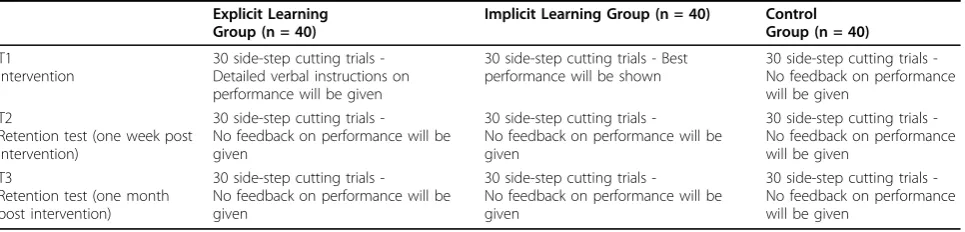
Two types of immediate visual feedback will be given (Table 1):
1) Explicit feedback: After each sidestep cutting man-oeuvre, subjects will immediately receive explicit instructions to improve their performance. Potential ACL injury risk factors include: 1) Increased knee valgus angle [61], 2) Decreased knee flexion angle [62-64], 3) Increased anterior tibial shear force [65,66], 4) Decreased hip flexion angle [62,64,67,68], 5) Increased hip internal rotation angle [62], 6) Increased knee inter-nal rotation angle [69]. Items to improve these potential risk factors above will be mentioned to the subjects and subjects will be requested to minimise the load at the knee.
2) Implicit feedback: Subjects will undergo a dynamic visual feedback intervention. Each time after a subject has performed the task, a visual representation of the best performance so far of the whole body (3D posterior view) will be shown to the subject with the Basler recordings (Darwinian learning). No explicit feedback or instructions at all will be given, however subjects will know in advance that there are superior and inferior ways to perform the task. The subject will search by him-/herself for the solution that fits best in their body; they explore and then select the performance which fits best.
The best performance so far will be based on the peak valgus moment, which needs to be as low as pos-sible. The total training session consists of 30 trials. As we need to make sure that the improvements in land-ing performance (if any) are permanent rather than temporary, a retention test will be conducted one week (similar to Onate et al.) [70] and one month later. During the retention tests no feedback at all will be given to either group. The control group will perform the exact same tasks as the intervention groups. The control group, however, will not receive any feedback
during any trial. To make sure three homogeneous groups are participating, five trials with no feedback will be performed prior to the real intervention (ie. in addition to the 30 trials).
Measurements
Screening for inclusion and exclusion criteria will occur at the laboratory setting and will be performed by the primary investigator (A.B.) of this study. All subjects will sign an informed consent form in accordance with the University of Groningen Medical Ethics Committee prior to participation.
Lower extremity kinematic, kinetic and EMG data of subjects performing a sidestep-cutting manoeuvre in the laboratory will be analysed. The primary outcome mea-surements will be as follows:
1) Knee abduction moment
2) Loading rate of knee abduction moment over time Secondary outcome parameters will be as follows: 3) Average EMG pattern of the gluteus maximus (GM), vastus medialis (VM), vastus
lateralis (VL), medial hamstring (MH), lateral ham-string (LH), medial gastrocnemius
(MG) and lateral gastrocnemius (LG)
4) Muscle onset time (ie. the first burst in EMG as detected by the Santello algoritm prior
to landing [66]) of the GM, VM, VL, MH, LH, MG and LG
5) Muscle activity of the GM, VM, VL, MH, LH, MG and LG integrated over the interval from 100 millise-conds prior to foot contact to foot contact (preparatory interval) and from foot contact to the point of peak knee flexion (weight acceptance)
[image:4.595.58.541.610.726.2]6) Muscle co-contraction (ie. using the integrated EMG of each muscle and the formula: [(less active mus-cle/more active muscle) X (sum of the integrated activ-ity of both muscles)]) of VL-MG, VL-LH, VM-LG and VM-MH over the interval from 100 milliseconds prior to foot contact to foot contact (preparatory interval) and from foot contact to the point of peak knee flexion (weight acceptance)
Table 1 Testing schedule
Explicit Learning Group (n = 40)
Implicit Learning Group (n = 40) Control Group (n = 40)
T1 Intervention
30 sidestep cutting trials -Detailed verbal instructions on performance will be given
30 side-step cutting trials - Best performance will be shown
30 sidestep cutting trials -No feedback on performance will be given
T2
Retention test (one week post intervention)
30 sidestep cutting trials -No feedback on performance will be given
30 sidestep cutting trials -No feedback on performance will be given
30 sidestep cutting trials -No feedback on performance will be given
T3
Retention test (one month post intervention)
30 sidestep cutting trials -No feedback on performance will be given
30 sidestep cutting trials -No feedback on performance will be given
7) Hip, knee and ankle angles at IC, peak posterior GRF and the maximum values for each of those vari-ables
a. Abduction/adduction b. Flexion/extension
c. External/internal rotation (only for hip and knee)
8) Knee angular displacement flexion angle
9) Joint moments of hip, knee and ankle at IC, peak posterior GRF and the maximum values for each of those variables
a. Abduction/adduction (not for knee, see primary outcome measurement)
b. Flexion/extension
c. External/internal rotation (only for hip and knee)
In addition we will record the history on injuries and/ or surgeries, the Tegner activity level questionnaire [69,70] and activity between intervention and follow up tests.
Subject preparation
In order to calculate the hip, knee and ankle joint angles and moments, anthropometric measurements will first be taken in preparation of the 3D motion analysis test-ing. Anthropometric measurements will include body weight and height, knee and ankle diameter and leg length (ASIS - medial malleolus). Subjects will then have reflective markers placed over the heel, lateral mal-leolus, second metatarsal head, femoral epicondyle and ASIS and PSIS bilateral. Another four markers will be placed bilaterally on the lateral side of the mid-thigh and mid-calf. EMG signals will be recorded using silver-silver chloride, pre-gelled bipolar surface electrodes (ZeroWire EMG, Aurion, Italy). Electrode locations will be located via palpation of the subject’s anatomy and will be placed over the appropriate muscle belly in line with the direction of the fibres with an interelectrode distance of approximately 20 mm, which is in accor-dance with the work of Delagi and Perotto [71]. Elec-trode sites will be shaved, abraded and cleaned with isopropyl alcohol to reduce impedance. The electrodes will be secured to the subject’s skin with tape to mini-mise motion artefact. Electrode placement will be con-firmed through visual inspection of signals on the computer screen using Vicon Nexus Software (Version 1.6, Vicon Motion Systems, Inc., Centennial, CO) during standardised manual muscle testing [29]. Two seconds of maximal voluntary isometric contraction (MVIC) EMG signals will be collected from each muscle before data collection. These data will be processed and used for normalisation of the corresponding muscle’s EMG
activity during the dynamic task. The same investigator (A.B.) will perform all electrode and marker placements. All the subjects will wear tight-fitting shorts and their own indoor basketball shoes.
An unanticipated cutting task will be carried out in the laboratory. Each athlete will complete a practice session that includes several anticipated and unanticipated trials of each of the two tasks to familiarise his-/herself with the experimental setup as well as to reduce the effect of target-ing the force platform. The athlete will randomly perform cutting trials. The straight run and cross-step are catch tasks so as to present the athletes with three options. Con-sequently, the cutting manoeuvre becomes an unantici-pated task. Specifically, the cutting manoeuvre consists of an approach run, followed by a plant-and-cut manoeuvre at a 45° angle with the dominant foot on the force plat-form. The cutting direction will be to the right for left-footed subjects and to the left for right-left-footed subjects. Each angle will be measured from the centre of the force plate and the corresponding line will be marked (using tape) so that it can be clearly seen by the subjects. As for the straight ahead run, the subjects continue the approach run through the experimental setup, with a change in neither direction nor speed.
Two infrared timing gates will be used to ensure that the approach speed will be 4.5-5.5 m/s and 0.5 seconds before the subjects land on the force platform and make the cut, a 3-light guiding system will be used to ran-domly cue the subjects; one light will turn on, indicating the direction the subject should go. Each subject will be given 1 minute between trials to reduce the potential effects of fatigue. To make sure there is pressure on the performance, the exit speeds needs to be 4.0-5.0 m/s, measured by the infrared timing gaits, 5 meters beyond the force plat form.
Only successful trials will be kept. A cutting trial is deemed successful if the subjects approaches the force platform with the required speed, performs the man-oeuvre with the target board illuminating a light, makes IC with the force platform and either runs straight ahead or changes direction at a 45° cut angle with the required exit speed. Subjects will be required to con-tinue running after sidestep execution for 5 meters. Cut-ting trials during which the subject modifies his/her stride length (i.e., stutter-step) to make contact with the force platform will also be discarded. The stutter-step will be discarded as these trial will not be comparable with the other trials; the speed will in all likelihood decrease and will not be between 4.5-5.5 m/s anymore. Approach speed is based on previous studies [69,72].
Instrumentation
Centennial, CO) will be used to collect and calculate the kinematic and kinetic data. GRF data will be collected at 1200 Hz by 2 force plates (Bertec Corporation, Colum-bus, Ohio) that are located within a custom-built floor-ing system in which the force plates are flush with the surrounding surface. Surface electromyographic (EMG) signals will be collected with the Noraxon Telemyo Telemetry EMG System (Noraxon USA Inc, Scottsdale, AZ) using ZeroWire. Signals will be passed from the electrodes to the transmission unit. After amplification, the telemetry signals will then be passed from the trans-mitter to the receiver for further amplification (overall gain of 2000) and filtered with a bandwidth filter (10 Hz low pass 500 Hz high pass Butterworth filter, common mode rejection ratio of 130 db). Signals from receiver will be collected with the data acquisition package Vicon Nexus Software (Version 1.6, Vicon Motion Sys-tems, Inc., Centennial, CO). The analog signal from the EMG receiver will be converted to a digital signal via a DT3010/32 (32 channel, 24 bit) A/D board (Data Trans-lation, Inc., Marlboro, MA). Basler camera’s (640 × 480, 210 fps, Vicon Motion Systems, Inc., Centennial, CO) with a 25 mm C-mount lens will be used to collect ana-log high-speed data.
Data acquisition and statistical analysis
Hip, knee and ankle joint kinematics will be evaluated at IC, peak posterior GRF and the maximum values for each of those variables. IC will be defined as the point in time when 5% of the subject’s body weight is upon the force plate. The raw coordinate data will be filtered using an optimised cut off frequency.
Raw analog data from the MVICs and synchronised raw analog data (joint kinematic, joint kinetic data and GRF data) from the jump trials will be imported into Matlab (release 12, The MathWorks, Natick, MA) for data processing and identification of the variables of interest. The mean value of each MVIC will be used for normalisation of the EMG during the jump trials. Both the MVIC and trial EMG data will be processed with a linear envelope before filtering by a Butterworth filter (fourth-order, zero-phase shift, cut off frequency of 20 Hz).
Raw analog data from the force plates will be used to calculate the GRF data for each jump trial. The raw coordinate data will be filtered using an optimised cut off frequency. The GRF will be filtered using a fourth-order Butterworth filter at a cut off frequency of 100 Hz. The GRF data will be used to calculate the maxi-mum posterior GRF during the initial-stance phase of the jump tasks.
Only the dominant leg will be analysed. In addition to the 30 trials during the intervention and retention tests,
all subjects will perform five trials to begin with. These five baseline trials (without feedback) prior to the inter-vention will be conducted to assure homogeneity across groups on the primary outcome measures (knee abduc-tion moment and the loading rate of knee abducabduc-tion moment over time). The results of these five trials will be compared to each other using a one-way ANOVA. Multilevel analysis will be applied to examine the within and between subject effects. The learning curve with implicit versus explicit versus no feedback of the pri-mary outcome measures over time will be analysed using SPSS 18.0 (SPSS Inc., Chicago, IL). The secondary outcome measurements will be used as explanatory vari-ables. In addition, post-hoc Bonferroni adjustments will be conducted for the within, between and interaction effects. An alpha level of 0.05 will be set a priori.
Discussion
Female athletes have a significantly higher risk of sus-taining an anterior cruciate ligament (ACL) injury than male athletes. The identification of risk factors and the development of prevention strategies may have wide-spread health and economic implications. Poor biome-chanical and neuromuscular control of the lower limb is suggested to be a primary risk factor of an ACL injury mechanism in females [61]. These are modifiable char-acteristics, which may potentially reduce the ACL injury rate after proper intervention. But even though a lot of effort is put in the prevention of noncontact ACL inju-ries, the incidence remains high [14,15,56]. The purpose of this research project is to highlight the issue of motor learning in optimising sports performance in a manner consistent with ACL injury prevention. If individual visual feedback on task performance appears to be an effective intervention method, this could be applied to larger populations participating in team sports with a high risk of sustaining an ACL injury. Results and prin-ciples found in this study will be applied to future ACL injury prevention programs, which should maybe more focus on individual injury predisposition.
Author details
1University Medical Center Groningen, Faculty of Medical Sciences, Center
for Human Movement Sciences, University of Groningen, Antonius Deusinglaan 1, 9713 AV Groningen, The Netherlands.2Hanze University Groningen, University of Applied Sciences, School of Sports Studies, SportsFieldLab Groningen, Zernikeplein 11, 9747 AS, Groningen, The Netherlands.3Department of Orthopaedic Surgery, University Medical Center
Groningen, University of Groningen, PO Box 30.001, 9700 RB, Groningen, The Netherlands.
Authors’contributions
Competing interests
The authors declare that they have no competing interests.
Received: 13 March 2010 Accepted: 13 October 2010 Published: 13 October 2010
References
1. Hootman JM, Dick R, Agel J:Epidemiology of collegiate injuries for 15 sports: summary and recommendations for injury prevention initiatives.
J Athl Train2007,42:311-319.
2. Daniel DM, Stone ML, Dobson BE, Fithian DC, Rossman DJ, Kaufman KR:
Fate of the acl-injured patient. A prospective outcome study.Am J Sports Med1994,22:632-644.
3. Oiestad BE, Engebretsen L, Storheim K, Risberg MA:Knee osteoarthritis after anterior cruciate ligament injury: a systematic review.Am J Sports Med2009,37:1434-1443.
4. Gillquist J, Messner K:Anterior cruciate ligament reconstruction and the long-term incidence of gonarthrosis.Sports Med1999,27:143-156. 5. Caraffa A, Cerulli G, Projetti M, Aisa G, Rizzo A:Prevention of anterior
cruciate ligament injuries in soccer. A prospective controlled study of proprioceptive training.Knee Surg Sports Traumatol Arthrosc1996,4:19-21. 6. Chimera NJ, Swanik KA, Swanik CB, Straub SJ:Effects of plyometric
training on muscle-activation strategies and performance in female athletes.J Athl Train2004,39:24-31.
7. Lephart SM, Abt JP, Ferris CM, Sell TC, Nagai T, Myers JB, Irrgang JJ:
Neuromuscular and biomechanical characteristic changes in high school athletes: a plyometric versus basic resistance program.Br J Sports Med 2005,39:932-938.
8. Mandelbaum BR, Silvers HJ, Watanabe DS, Knarr JF, Thomas SD, Griffin LY, Kirkendall DT, Garrett W Jr:Effectiveness of a neuromuscular and proprioceptive training program in preventing anterior cruciate ligament injuries in female athletes: 2-year follow-up.Am J Sports Med 2005,33:1003-1010.
9. Myklebust G, Engebretsen L, Braekken IH, Skjolberg A, Olsen OE, Bahr R:
Prevention of anterior cruciate ligament injuries in female team handball players: a prospective intervention study over three seasons.
Clin J Sport Med2003,13:71-78.
10. Olsen OE, Myklebust G, Engebretsen L, Holme I, Bahr R:Exercises to prevent lower limb injuries in youth sports: cluster randomised controlled trial.BMJ2005,330:449.
11. Pollard CD, Sigward SM, Ota S, Langford K, Powers CM:The influence of in-season injury prevention training on lower-extremity kinematics during landing in female soccer players.Clin J Sport Med2006,
16:223-227.
12. Hewett TE, Stroupe AL, Nance TA, Noyes FR:Plyometric training in female athletes. Decreased impact forces and increased hamstring torques.Am J Sports Med1996,24:765-773.
13. Silvers HJ, Mandelbaum BR:Prevention of anterior cruciate ligament injury in the female athlete.Br J Sports Med2007,41(Suppl 1):i52-59. 14. Agel J, Arendt EA, Bershadsky B:Anterior cruciate ligament injury in
national collegiate athletic association basketball and soccer: a 13-year review.Am J Sports Med2005,33:524-530.
15. Griffin LY, Albohm MJ, Arendt EA, Bahr R, Beynnon BD, Demaio M, Dick RW, Engebretsen L, Garrett WE Jr, Hannafin JA, Hewett TE, Huston LJ, Ireland ML, Johnson RJ, Lephart S, Mandelbaum BR, Mann BJ, Marks PH, Marshall SW, Myklebust G, Noyes FR, Powers C, Shields C Jr, Shultz SJ, Silvers H, Slauterbeck J, Taylor DC, Teitz CC, Wojtys EM, Yu B:
Understanding and preventing noncontact anterior cruciate ligament injuries: a review of the Hunt Valley II meeting, January 2005.Am J Sports Med2006,34:1512-1532.
16. Renstrom P, Ljungqvist A, Arendt E, Beynnon B, Fukubayashi T, Garrett W, Georgoulis T, Hewett TE, Johnson R, Krosshaug T, Mandelbaum B, Micheli L, Myklebust G, Roos E, Roos H, Schamasch P, Shultz S, Werner S, Wojtys E, Engebretsen L:Non-contact ACL injuries in female athletes: an International Olympic Committee current concepts statement.Br J Sports Med2008,42:394-412.
17. Myer GD, Ford KR, Brent JL, Hewett TE:Differential neuromuscular training effects on ACL injury risk factors in"high-risk”versus“low-risk”athletes.
BMC Musculoskelet Disord2007,8:39.
18. Hodges NJ, Franks IM:Modelling coaching practice: the role of instruction and demonstration.J Sports Sci2002,20:793-811.
19. Maxwell JP, Masters RSW, Eves F:From novice to no know-how: a longitudinal study of implicit motor learning.J Sports Sci2000,
18:111-120.
20. Wulf G, Prinz W:Directing attention to movement effects enhances learning: a review.Psychon Bull Rev2001,8:648-660.
21. Hewett TE, Lindenfeld TN, Riccobene JV, Noyes FR:The effect of neuromuscular training on the incidence of knee injury in female athletes. A prospective study.Am J Sports Med1999,27:699-706. 22. Holm I, Fosdahl MA, Friis A, Risberg MA, Myklebust G, Steen H:Effect of
neuromuscular training on proprioception, balance, muscle strength, and lower limb function in female team handball players.Clin J Sport Med2004,14:88-94.
23. Irmischer B, Harris C, Pfeiffer R, DeBeliso M, Adams K, Shea K:Effects of a knee ligament injury prevention exercise program on impact forces in women.J Strength Cond Res2004,18:703-707.
24. Myer GD, Ford KR, Brent JL, Hewett TE:The effects of plyometric vs. dynamic stabilization and balance training on power, balance, and landing force in female athletes.J Strength Cond Res2006,20:345-353. 25. Myer GD, Ford KR, McLean SG, Hewett TE:The effects of plyometric versus
dynamic stabilization and balance training on lower extremity biomechanics.Am J Sports Med2006,34:445-455.
26. Noyes FR, Barber-Westin SD, Fleckenstein C, Walsh C, West J:The drop-jump screening test: difference in lower limb control by gender and effect of neuromuscular training in female athletes.Am J Sports Med 2005,33:197-207.
27. Petersen W, Braun C, Bock W, Schmidt K, Weimann A, Drescher W, Eiling E, Stange R, Fuchs T, Hedderich J, Zantop T:A controlled prospective case control study of a prevention training program in female team handball players: the German experience.Arch Orthop Trauma Surg2005,
125:614-621.
28. Pfeiffer RP, Shea KG, Roberts D, Grandstrand S, Bond L:Lack of effect of a knee ligament injury prevention program on the incidence of noncontact anterior cruciate ligament injury.J Bone Joint Surg Am2006,
88:1769-1774.
29. Wulf G, Lauterbach B, Toole T:The learning advantages of an external focus of attention in golf.Res Q Exerc Sport1999,70:120-126. 30. Wulf G, Weigelt C:Instructions about physical principles in learning a
complex motor skill: to tell or not to tell.Res Q Exerc Sport1997,
68:362-367.
31. Masters RSW, Poolton JM, Maxwell JP, Raab M:Implicit motor learning and complex decision making in time-constrained environments.J Mot Behav 2008,40:71-79.
32. McNevin NH, Wulf HG, Carlson C:Effects of attentional focus, self-control, and dyad training on motor learning: implications for physical rehabilitation.Phys Ther2000,80:373-385.
33. Masters RSW:Knowledge,“knerves”and know-how: The role of explicit versus implicit knowledge in the breakdown of a complex motor skill under pressure.Br J Psych1992,83:343-358.
34. Hardy L, Mullen R, Jones G:Knowledge and conscious control of motor actions under stress.Br J Psychol1996,87:621-636.
35. Mullen R, Hardy L, Oldham A:Implicit and explicit control of motor actions: revisiting some early evidence.Br J Psychol2007,98:141-156. 36. Beilock SL, Carr TH:On the fragility of skilled performance: What governs
choking under pressure?J Exp Psychol: Gen2001,130:701-725. 37. Gray R:Attending to the execution of a complex sensorimotor skill:
Expertise differences, choking, and slumps.J Exp Psychol: Appl2004,
10:42-54.
38. Masters RSW, Poolton JM, Maxwell JP:Stable implicit motor processes despite aerobic locomotor fatigue.Conscious Cogn2008,17:335-338. 39. Poolton JM, Masters RSW, Maxwell JP:Passing thoughts on the
evolutionary stability of implicit motor behaviour: Performance retention under physiological fatigue.Conscious Cogn2007,16:456-468.
40. Hardy L, Mullen R, Martin N:Effect of task-relevant cues and state anxiety on motor performance.Percept Mot Skills2001,92:943-946.
41. Allen R, Reber A:Very long-term memory for tacit knowledge.Cognition 1980,8:175-185.
42. Turner CW, Fischler IS:Speeded tests of implicit knowledge.J Exp Psychol: Learn Mem Cogn1993,19:1165-1177.
43. Reber AS, Walkenfeld FF, Hernstadt R:Implicit and explicit learning: individual differences and IQ.J Exp Psychol Learn Mem Cogn1991,
44. Gebauer GF, Nicholas JM:Psychometric Intelligence Dissociates Implicit and Explicit Learning.J Exp Psychol Learn Mem Cogn2007,33:34-54. 45. Nemeth D, Janacsek K, Balogh V, Londe Z, Mingesz R, Fazekas M, Jambori S,
Danyi I, Vetro A:Learning in Autism: Implicitly Superb.PLoS One2010,5: e11731.
46. Hiemstra LA, Lo IK, Fowler PJ:Effect of fatigue on knee proprioception: implications for dynamic stabilization.J Orthop Sports Phys Ther2001,
31:598-605.
47. Nyland JA, Shapiro R, Caborn DN, Nitz AJ, Malone TR:The effect of quadriceps femoris, hamstring, and placebo eccentric fatigue on knee and ankle dynamics during crossover cutting.J Orthop Sports Phys Ther 1997,25:171-184.
48. Rodacki AL, Fowler NE, Bennett SJ:Multi-segment coordination: fatigue effects.Med Sci Sports Exerc2001,33:1157-1167.
49. McLean SG, Fellin RE, Suedekum N, Calabrese G, Passerallo A, Joy S:Impact of fatigue on gender-based high-risk landing strategies.Med Sci Sports Exerc2007,39:502-514.
50. Brass M, Heyes C:Imitation: is cognitive neuroscience solving the correspondence problem?Trends Cogn Sci2005,9:489-495. 51. Cattaneo L, Rizzolatti G:The mirror neuron system.Arch Neurol2009,
66:557-560.
52. Rizzolatti G, Craighero L:The mirror-neuron system.Annu Rev Neurosci 2004,27:169-192.
53. Rizzolatti G, Fogassi L, Gallese V:Neurophysiological mechanisms underlying the understanding and imitation of action.Nat Rev Neurosci 2001,2:661-670.
54. Prinz W:Experimental approaches to imitation.InThe Imitative Mind. Development, Evolution and Brain Bases.Edited by: Prinz M. Cambridge, UK: Cambridge Univ. Press; 2002:143-162.
55. Calvo-Merino B, Glaser D, Grèzes J, Passingham R, Haggard P:Action observation and acquired motor skills: an FMRI study with expert dancers.Cereb Cortex2005,15:1243-1249.
56. Arendt E, Dick R:Knee injury patterns among men and women in collegiate basketball and soccer. NCAA data and review of literature.Am J Sports Med1995,23:694-701.
57. Arendt EA, Agel J, Dick R:Anterior cruciate ligament injury patterns among collegiate men and women.J Athl Train1999,34:86-92. 58. Mihata LC, Beutler AI, Boden BP:Comparing the incidence of anterior
cruciate ligament injury in collegiate lacrosse, soccer, and basketball players: implications for anterior cruciate ligament mechanism and prevention.Am J Sports Med2006,34:899-904.
59. Prodromos CC, Han Y, Rogowski J, Joyce B, Shi K:A meta-analysis of the incidence of anterior cruciate ligament tears as a function of gender, sport, and a knee injury-reduction regimen.Arthroscopy2007,
23:1320-1325, e1326.
60. Benjaminse A, Gokeler A, van der Schans CP:Clinical diagnosis of an anterior cruciate ligament rupture: a meta-analysis.J Orthop Sports Phys Ther2006,36:267-288.
61. Hewett TE, Myer GD, Ford KR, Heidt RS Jr, Colosimo AJ, McLean SG, van den Bogert AJ, Paterno MV, Succop P:Biomechanical measures of neuromuscular control and valgus loading of the knee predict anterior cruciate ligament injury risk in female athletes: a prospective study.Am J Sports Med2005,33:492-501.
62. Chappell JD, Creighton RA, Giuliani C, Yu B, Garrett WE:Kinematics and electromyography of landing preparation in vertical stop-jump: risks for noncontact anterior cruciate ligament injury.Am J Sports Med2007,
35:235-241.
63. Malinzak RA, Colby SM, Kirkendall DT, Yu B, Garrett WE:A comparison of knee joint motion patterns between men and women in selected athletic tasks.Clin Biomech (Bristol, Avon)2001,16:438-445. 64. McLean SG, Walker KB, van den Bogert AJ:Effect of gender on lower
extremity kinematics during rapid direction changes: an integrated analysis of three sports movements.J Sci Med Sport2005,8:411-422. 65. Chappell JD, Yu B, Kirkendall DT, Garrett WE:A comparison of knee
kinetics between male and female recreational athletes in stop-jump tasks.Am J Sports Med2002,30:261-267.
66. Sell TC, Ferris CM, Abt JP, Tsai YS, Myers JB, Fu FH, Lephart SM:Predictors of proximal tibia anterior shear force during a vertical stop-jump.J Orthop Res2007,25:1589-1597.
67. Landry SC, McKean KA, Hubley-Kozey CL, Stanish WD, Deluzio KJ:
Neuromuscular and lower limb biomechanical differences exist between
male and female elite adolescent soccer players during an unanticipated run and crosscut maneuver.Am J Sports Med2007,
35:1901-1911.
68. Landry SC, McKean KA, Hubley-Kozey CL, Stanish WD, Deluzio KJ:
Neuromuscular and lower limb biomechanical differences exist between male and female elite adolescent soccer players during an
unanticipated side-cut maneuver.Am J Sports Med2007,35:1888-1900. 69. McLean SG, Lipfert SW, van den Bogert AJ:Effect of gender and defensive
opponent on the biomechanics of sidestep cutting.Med Sci Sports Exerc 2004,36:1008-1016.
70. Onate JA, Guskiewicz KM, Marshall SW, Giuliani C, Yu B, Garrett WE:
Instruction of jump-landing technique using videotape feedback: altering lower extremity motion patterns.Am J Sports Med2005,
33:831-842.
71. Delagi EF, Perotto A, ed:Anatomic guide for the electromyographer-the limbs.Springfield, Ill: Thomas, 2 1980.
72. McLean SG, Huang X, van den Bogert AJ:Association between lower extremity posture at contact and peak knee valgus moment during sidestepping: implications for ACL injury.Clin Biomech (Bristol, Avon)2005,
20:863-870.
Pre-publication history
The pre-publication history for this paper can be accessed here: http://www.biomedcentral.com/1471-2474/11/235/prepub
doi:10.1186/1471-2474-11-235
Cite this article as:Benjaminseet al.:An investigation of motor learning during side-step cutting, design of a randomised controlled trial.BMC Musculoskeletal Disorders201011:235.
Submit your next manuscript to BioMed Central and take full advantage of:
• Convenient online submission
• Thorough peer review
• No space constraints or color figure charges
• Immediate publication on acceptance
• Inclusion in PubMed, CAS, Scopus and Google Scholar
• Research which is freely available for redistribution