
R E S E A R C H A R T I C L E
Open Access
The effectiveness of land based exercise
compared to decompressive surgery in the
management of lumbar spinal-canal stenosis: a
systematic review
Mark S Jarrett
1,2†, Joseph F Orlando
1,3*†and Karen Grimmer-Somers
1Abstract
Background:Lumbar spinal stenosis (LSS) is prevalent in those over the age of 65 years and the leading cause of spinal surgery in this population. Recent systematic reviews have examined the effectiveness of conservative
management for LSS, but not relative to surgical interventions. The aim of this review was to systematically examine the effectiveness of land based exercise compared with decompressive surgery in the management of patients with LSS.
Methods:A systematic review of randomised controlled trials and clinical trials was undertaken. The databases MEDLINE, Embase, CINAHL, PEDro and Cochrane Library Register of Controlled Trials were searched from January 2000 to June 2011. Only studies that included subjects with lumbar spinal canal stenosis were considered in this review. Studies also had to use a patient reported functional outcome measure for a land based exercise intervention or lumbar decompressive surgery.
Results:Only one study compared the effectiveness of exercise and decompressive surgery for LSS. Surgery demonstrated statistically significant improvements in patient reported functional outcome scores at 6, 12 and 24-months post-intervention (p< 0.01). To facilitate further analysis, the results from 12 exercise and 10 surgical intervention arms were compared using percentage change in patient reported functional outcome measure scores. Exercise interventions showed initial improvements, ranging from 16 to 29% above baseline. All
decompressive surgical interventions demonstrated greater and sustained improvements over 2-years (range 38-67% improvement) with moderate to large effect sizes. The most commonly reported complications associated with surgery were dural tears, while details of adverse effects were lacking in exercise interventions.
Conclusions:This systematic review of the recent literature demonstrates that decompressive surgery is more effective than land based exercise in the management of LSS. However, given the condition’s slowly progressive nature and the potential for known surgical complications, it is recommended that a trial of conservative management with land based exercise be considered prior to consideration of surgical intervention.
Background
Degenerative lumbar spinal stenosis (LSS) is a prevalent condition with 47% of people between 60 and 69 years demonstrating radiographic findings [1]. Whilst the inci-dence of people who develop symptoms is unknown, LSS is the leading cause of spinal surgery in adults
greater than 65 years of age [2]. LSS can impact a per-son’s quality of life, lead to activity and participatory restrictions and affect psychosocial wellbeing. Managing these health impacts and therefore improving health sta-tus becomes a primary goal of self-management [3].
There has been a growing movement towards self-management of chronic conditions in the past decade, including from policy makers due to the increasing cost and utilisation of healthcare resources from an ageing population and rising incidence of chronic conditions
* Correspondence: [email protected]
†Contributed equally
1
International Centre for Allied Health Evidence, University of South Australia, North Terrace, Adelaide, SA 5000, Australia
Full list of author information is available at the end of the article
[4]. The understanding of pain and stress sciences has also developed this past decade [5,6] and helped to explain the influences of psychosocial variables in a pain or stress experience. Such variables may potentially explain the poor correlation between LSS radiographic and clinical findings [7]. Given that LSS is a slow to progress, degenerative condition and commonly sought for surgical opinion [2], it seems appropriate that self-management options be offered, which may include physiotherapy.
Exercise is a core component of physiotherapy that promotes self-management. It aims to improve the flex-ibility or mobility of the spine and combats both physi-cal and psychologiphysi-cal effects of deconditioning associated with pain and functional restrictions. Exercise based interventions can be delivered in a low cost man-ner and continued as a home program [8-10].
There have been a number of recent systematic reviews that have examined the effectiveness of exercise for LSS with mixed results. Reiman and colleagues [11] and Iversen and colleagues [12] reported preliminary evidence that manual therapy when combined with exercise therapy is of potential benefit in LSS, while Watters and colleagues [13] concluded that there was insufficient evidence for exercise. The latter provided additional evidence, albeit low level and poor quality, to support lumbar surgery over conservative management, including physiotherapy and medical intervention. Despite this, formal comparison of exercise and decom-pressive surgery has not been undertaken. Although there is a limited evidence base, in clinical practice it appears that a trial of self-management is preferred prior to surgical interventions to avoid the risks asso-ciated with surgery [10,14,15].
In light of the potential benefits of exercise for LSS, we systematically reviewed the current evidence regard-ing the effectiveness of land based exercise interventions compared to surgical decompression in the management of LSS. The secondary aim of this review was to report on the adverse effects associated with the use of these two interventions.
Methods
Search strategy
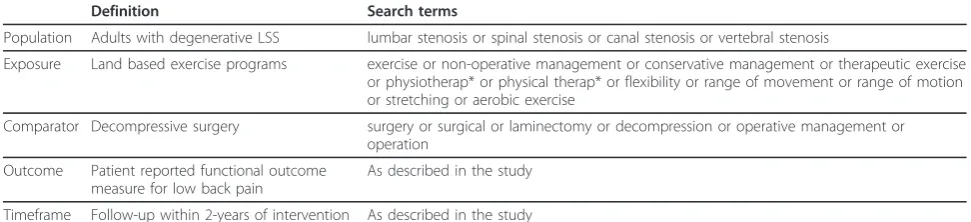
This review was reported in line with the PRISMA Statement [16]. The databases MEDLINE, Embase, CINAHL, PEDro and Cochrane Library Register of Con-trolled Trials were searched from January 2000 to June 2011. The limit to recent years intended to capture interventions in line with the development of self-man-agement models. Table 1 outlines the search question and the keywords used in the search strategy. The refer-ence list of all included studies were also searched for any relevant studies not located by the electronic search.
Study design
All prospective experimental studies, which described measurements taken pre and post-interventions for exercise and/or surgical decompression were considered for inclusion. Secondary evidence such as systematic reviews and retrospective studies were excluded. The reference lists of systematic reviews were searched for additional studies for inclusion.
Population
Studies were only considered if they included subjects with degenerative LSS as diagnosed by MRI/CT and clinical presentation. Symptoms typically include but-tock or lower extremity pain with or without back pain, aggravated by lumbar extension and ambulation and relieved by lumbar flexion and sitting [13]. Studies that included subjects with a concurrent diagnosis of spon-dylolisthesis or foraminal stenosis were excluded, as were studies that investigated subjects with non-specific low back pain. Studies were also excluded if subjects were diagnosed with other spinal conditions, including congenital stenosis, fracture, infection, tumour, inflam-matory disease or osteoporosis.
Exposure
[image:2.595.55.541.615.726.2]Studies were included if one of the intervention arms was land based exercise or decompressive surgery. Stu-dies were only included if they specified the exercise
Table 1 Search strategy (PECOT) and search terms
Definition Search terms
Population Adults with degenerative LSS lumbar stenosis or spinal stenosis or canal stenosis or vertebral stenosis
Exposure Land based exercise programs exercise or non-operative management or conservative management or therapeutic exercise or physiotherap* or physical therap* or flexibility or range of movement or range of motion or stretching or aerobic exercise
Comparator Decompressive surgery surgery or surgical or laminectomy or decompression or operative management or operation
Outcome Patient reported functional outcome measure for low back pain
type such as flexibility, range of movement, strengthen-ing and/or general conditionstrengthen-ing. Aquatic exercises were excluded. Studies that combined other forms of conser-vative intervention, such as manual therapy, electrother-apy or medication, were included provided an exercise intervention was also undertaken.
For surgical interventions, only studies where the sur-gical aim was decompression of neurovascular structures in the lumbar spinal canal, such as laminectomy, were included. Minimally invasive approaches to decompres-sive surgery were also included. Studies that incorpo-rated lumbar fusion for management of pre-operative instability (spondylolisthesis) were excluded, as were stu-dies that did not describe surgical intervention.
Outcome measures
Studies were included if they utilised a patient reported functional outcome measure for low back pain, such as Oswestry Disability Index (ODI) or Roland-Morris Dis-ability Questionnaire (RMQ).
Time
Studies were included if they reported an outcome within 2-years of completing the intervention. Studies that only investigated outcomes with follow-up periods greater than 2-years were excluded to limit the impact of con-founding variables associated with longer-term follow-up. Studies were also excluded if outcome data for all sub-jects was not collected at predetermined timeframes.
Search of literature
After establishing a review protocol, two authors (MJ, JO) divided the database searches and screening of titles and abstracts. Studies were excluded if they were pub-lished in languages other than English. Whilst this may present a source of publication bias, the evidence to support this is in the literature is equivocal [17,18]. All potentially included abstracts and full texts were reviewed independently by the authors if studies appeared to meet the inclusion criteria. Disagreement regarding inclusion was resolved through discussion.
Methodological quality
The methodological quality of studies was assessed using the McMaster Critical Review Form for Quantita-tive Studies [19]. The tool allows for the critical apprai-sal of studies of different quantitative study designs. It comprises 15 items that assess study purpose, design, sample, outcomes, interventions, results and clinical implications. Fourteen of the items allow o for‘yes’,‘no’, ‘not addressed’ or ‘not applicable’ responses, while the remaining item is a descriptive assessment pertaining to type of study design. Of the 14 quantitative criteria, the authors awarded one point for each ‘yes’response and
zero points for‘no’or‘not addressed’responses and cal-culated a raw score. ‘Not applicable’ responses were omitted. The raw score was expressed as a percentage of fulfilled criteria.
The hierarchy of evidence for each study was assessed according to the National Health and Medical Research Council (NHMRC) Designation of Levels of Evidence [20]. The authors (MJ, JO) independently appraised the quality of the included articles. Discrepancies in scores were resolved through discussion.
Data extraction and analysis
Relevant information was extracted from the studies by two authors (MJ, JO) working collaboratively. Data included study design, inclusion/exclusion criteria, sam-ple characteristics (samsam-ple size, mean age, gender), intervention details, outcome measures, follow-up peri-ods and results. Ninety-five per cent confidence intervals were calculated for mean age of intervention arms. This enabled examination of homogeneity of age between intervention arms.
Percentage change in outcome scores was calculated for individual intervention arms to facilitate comparison between surgery and exercise. This was calculated by dividing the change in outcome scores by the baseline out-come score, then multiplied by 100 [21]. Effect sizes of interventions were calculated where possible (mean differ-ence of intervention and control divided by the standard deviation of the control at baseline) for intervention versus control studies or exercise versus decompressive surgery studies. Strength of effect sizes is reported as small (< 0.4), moderate (0.4-0.8) and strong (≥0.8) [22].
Results
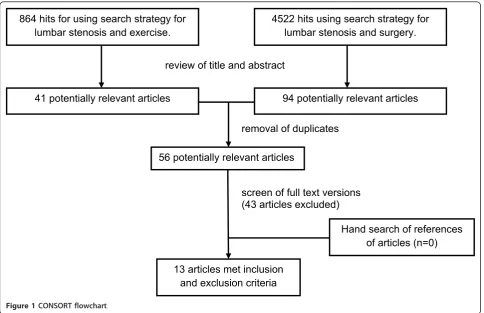
The study selection process is summarised in Figure 1. From a review of titles and abstracts, 56 potentially rele-vant studies were identified from the electronic search. No further studies were identified from reference lists of systematic reviews.
Excluded studies
Of these 56 studies, 13 fulfilled the inclusion and exclu-sion criteria. Studies excluded from the review are pre-sented in a table in Additional file 1. The main reasons for exclusion were:
•outcomes were not patient reported functional out-come measures (n = 12);
•non-experimental research design (n = 10);
• populations with lumbar pathological diagnoses other than degenerative LSS (n = 9);
• recording outcomes at variable timeframes or at greater than 2-years post intervention (n = 6);
•languages other than English (n = 2).
Methodological quality
The included studies were generally of moderate metho-dological quality. The McMaster Critical Appraisal Tool raw scores varied from 8 to 12 out of a possible 15, and percentages from 64.3% to 85.7% (mean 73.7%, SD 7.1). There were no discrepancies between the authors. A summary of the critical appraisal scores is provided in Table 2.
Of the 13 included studies (see Table 2), there were two randomised controlled trials and five randomised clinical trials (Level II), one pseudo-randomised trial (Level III-1), two prospective cohort trials (Level III-2) and three before-and-after trials (Level III-3) [20]. Com-mon aspects affecting the studies’quality included not reporting reliability and validity of outcome measures, sample sizes not well justified and of those that did calcu-late sample size, the studies were commonly under pow-ered [10,23-25]. Most studies reported drop-out rates; however intention to treat analysis was rarely reported.
Study characteristics
Six studies were identified that included a land based exer-cise intervention [10,24-28]. As detailed in Table 3, 12 relevant exercise arms were identified. The mean age of
subjects who participated in an exercise intervention was 59.4 (SD 6.1) years. Eight studies were identified that included decompressive surgery [10,23,29-34]. Table 3 also summarises the ten decompressive surgical interven-tion arms identified. The mean age of subjects in surgical interventions was 66.4 (SD 4.27) years. Comparison of mean age with 95% confidence intervals across all included intervention arms demonstrated homogeneity across exer-cise and surgical intervention arms (see Figure 2).
Types of intervention
Exercise for the management of LSS
Flexibility exercises were included in all exercise inter-vention arms either as part of a formal physiotherapy-supervised or home exercise program. Strengthening exercises were included in nine of the exercise interven-tion arms [10,25-28]. Specific details of these exercises were not included in any of the studies. Aerobic exercise was included in some studies [24-26] and not others.
Outpatient exercise interventions ranged in duration from 3-weeks [26,28] to 6-weeks [24,25]. One study’s exercise intervention [27] was undertaken with inpati-ents, but all three intervention arms in this study included an ongoing home exercise program. Ten of the 12 exercise intervention arms included a home exercise program. Adherence to and duration of the home 864 hits for using search strategy for
lumbar stenosis and exercise.
review of title and abstract
4522 hits using search strategy for lumbar stenosis and surgery.
94 potentially relevant articles 41 potentially relevant articles
56 potentially relevant articles
13 articles met inclusion and exclusion criteria
screen of full text versions (43 articles excluded) removal of duplicates
[image:4.595.57.542.88.401.2]Hand search of references of articles (n=0)
Table 2 Methodological quality of studies based on the McMaster Critical Appraisal Tool [19]
Item Score
Authors 1 2 3 4 5 6 7 8 9 10 11 12 13 14 15 Raw %
Level II
Goren et al. 2010 ✓ ✓ RCT ✓ x ? ? ✓ ✓ ✓ ✓ ✓ ✓ ✓ ✓ 12 85.7 Koc et al.2009 ✓ ✓ CT ✓ x ? ? ✓ ✓ ? ✓ ✓ ✓ ✓ ✓ 10 71.4 Malmivaara et al. 2007 ✓ ✓ CT ✓ ✓ ? ? ✓ x x ✓ ✓ ✓ ✓ ✓ 10 71.4 Pua et al. 2007 ✓ ✓ CT ✓ ✓ ? ? ✓ ✓ ? ✓ ✓ ✓ ✓ ✓ 11 78.6 Thome et al. 2005 ✓ ✓ CT ✓ x ? ✓ ✓ ✓ x ✓ ✓ ✓ ✓ ✓ 11 78.6 Weinstein et al. 2008 ✓ ✓ RCT ✓ ✓ ? ? ✓ x x ✓ ✓ ✓ ✓ ✓ 10 71.4 Whitman et al. 2006 ✓ ✓ CT ✓ ✓ ? ? ✓ ✓ ✓ ✓ ✓ ✓ ✓ ✓ 12 85.7
Level III-1
Sahin et al.2009 ✓ ✓ C ✓ x ? ? ✓ ✓ x ✓ ✓ ✓ x ✓ 9 64.3
Level III-2
Athiviraham & Yen 2007 ✓ ✓ C ✓ ✓ ? ? ✓ ✓ ? ✓ ✓ ✓ ✓ ✓ 11 78.6 Sobottke et al. 2010 ✓ ✓ C ✓ x ? ? ✓ x ? ✓ ✓ ✓ ✓ ✓ 9 64.3
Level III-3
Cavusoglu et al. 2007 ✓ ✓ AB ✓ x ? ? ✓ n/a x ✓ ✓ ✓ ✓ ✓ 9 69.2 Chopko & Caraway 2010 ✓ ✓ AB ✓ x ? ? ✓ n/a ? ✓ ✓ ✓ ✓ ✓ 9 69.2 Yasar et al. 2009 ✓ ✓ AB ✓ x ? ? ✓ n/a x ✓ ✓ ✓ ✓ ✓ 9 69.2
✓= yes; x = no; ? = not addressed; n/a = not applicable; AB = before and after; RCT = randomised controlled trial; CT = randomised clinical trial; C = prospective cohort
McMaster Items: 1. study purpose clearly stated; 2. background literature reviewed; 3. research design; 4. sample described in detail; 5. sample size justified; 6. outcome measure reliability reported; 7. outcome measure validity reported; 8. intervention described; 9. contamination avoided; 10. co-intervention avoided; 11. results reported in terms of statistical significance; 12. analysis methods appropriate; 13. clinical significance reported; 14. drop-outs reported; 15. conclusions appropriate.
Level of evidence based on NHMRC Designation of Levels of Evidence [20].
Table 3 Table of description of main aspects of studies
Study Participants Intervention arms Outcome measure
Exercise
Goren et al. (2010) n = 34 1 Exercise and ultrasound ODI
2 Exercise and sham ultrasound
Koc et al. (2009) n = 29 1 Exercise and electrotherapy RMQ
2 Exercise and epidural steroid 3 Exercise only
Malmivaara et al. (2007) n = 44 1 Exercise ODI
Pua et al. (2007) n = 68 1 Treadmill mODI, RMQ
2 Cycling
Sahin et al. (2009) n = 45 1 Exercise RMQ
2 Exercise and calcitonin
Whitman et al. (2006) n = 58 1 Flexion exercise and walking mODI
2 Exercise and manual therapy
Decompressive surgery
Athiviraham & Yen (2007) n = 54 1 Bilateral laminectomy RMQ
Cavusoglu et al. (2007) n = 50 1 Laminectomy ODI
Chopko & Caraway (2010) n = 78 1 Minimally invasive decompression ODI
Malmivaara et al. (2007) n = 50 1 Segmental decompression ODI
Sobottke et al. (2010) n = 25 1 Minimally invasive decompression ODI
Thome et al. (2005) n = 40 1 Bilateral laminotomy RMQ
2 Unilateral laminotomy 3 Laminectomy
Weinstein et al. (2008) n = 398 1 Laminectomy mODI
Yasar et al. (2009) n = 125 1 Laminectomy ODI
[image:5.595.61.540.428.733.2]exercise programs were poorly described. A wide range of co-interventions was administered in conjunction with exercise, including medication (analgesics, non-steroidal anti-inflammatories), epidural steroid, manual therapy and electrotherapy.
Decompressive surgery for the management of LSS
Two studies described a minimally invasive technique for lumbar decompression [30,31], whereas all other sur-gical studies reported laminectomy via varying approaches. Two intervention arms reported bilateral foraminotomies as part of their surgical approach [23,34] and five intervention arms reported partial med-ial facetectomies [10,32,34]. Although studies that included subjects with degenerative spondylolisthesis were excluded, three studies reported a proportion of subjects managed with fusion in addition to their decompressive surgery; although reasons for this were not described [10,33,34].
Effect of exercise compared to decompressive surgery
The study by Malmivaara and colleagues [10] was the only study that directly compared the effect of decom-pressive surgery and a non-operative intervention that included an exercise component. The study reported a global difference in ODI over 2-years in favour of decompressive surgery (p = 0.01). The effect sizes at respective follow-up periods were 0.55 at 6-months, 0.81 at 12-months and 0.56 at 24-months.
Across the 22 intervention arms, baseline and post-intervention data were available for all studies except the three intervention arms in the study by Koc and col-leagues [27]. The percentage change in patient reported functional outcome scores was calculated for 32 instances and is shown graphically in Figure 3.
Effect of exercise
Data was available from five out of the six studies that examined exercise, enabling calculation of percentage
change in patient reported functional outcome scores [10,24-26,28]. Eight separate instances from four studies reported an improvement (range 16-29%) in the first 3-months [24-26,28]. At 6-3-months, only one instance was reported (18%) [10], three at 12-months (13-20%) [10,25] and one at 24-months (16%) [10].
Goren and colleagues [26] was the only study that examined exercise against a control. One intervention arm received exercise and ultrasound, a second received exercise and sham ultrasound, while a third acted as a control. The two exercise intervention arms demon-strated statistically significant differences compared to the control (p< 0.05) at the completion of the interven-tion. Effect sizes for the exercise and ultrasound arm and the exercise and sham ultrasound arm were calcu-lated as 0.04 and 0.44, respectively.
Effect of decompressive surgery
Data was available for all ten surgical arms, enabling cal-culation of percentage change in patient reported func-tional outcome scores. Nineteen instances of outcome reporting were available from 6-weeks to 24-months post intervention.
Five instances reported improvements in patient reported functional outcome scores (range 37-58%) in the first 3-months [29,30,33,34]. At 6-months, there were three instances of reported improvement (39-65%) [10,31,33], seven at 12-months (36-67%) [10,31-34], and four at 24-months (38-67%) [10,23,33,34].
Decompressive surgery was compared to a control in two studies [23,33]. The calculation of effect sizes was only possible in the Weinstein study [33], which favoured the surgical intervention arm at all timeframes: effect size of 0.58 at 6-weeks, 0.77 at 3-months, 0.79 at 6-months, 0.69 at 12-months and 0.63 at 24-months. These results are from the as-treat analysis of randomised and observa-tion cohorts. The intenobserva-tion-to-treat analysis did not demonstrate significant differences between decompres-sive surgery and control, likely due to the large number of subject cross-overs between groups.
Adverse effects
Surgery with decompressive laminectomy was associated with adverse events, with an overall complication rate in the largest surgical intervention arm (n = 394) of 12% [33]. The most common complication was intra-opera-tive dural tear, ranging from 3% [29] to 14% [10]. Other complications reported included wound infection, ongoing neural dysfunction and re-operation. It was also apparent that some subjects were no better or worse after decompressive surgery [10]. Detailed reporting of adverse effects was not described for exercise interven-tions, other than in one study, which noted no compli-cations or side effects [26].
0 10 20 30 40 50 60 70 80
Ag
e
(y
ears
)
[image:6.595.55.292.88.238.2]Surgery Exercise
Discussion
This review found that there is strong evidence for improvement in patient reported functional outcomes in those who undergo decompressive surgery for LSS. There is relative consistency between studies across multiple timeframes with sustained improvements through to 2-years post-surgery. All studies that exam-ined surgical decompression reported statistically sig-nificant improvements in favour of surgery, with moderate to large effect sizes in two studies [10,33]. Conversely, there was an overall small initial improve-ment in patient reported functional outcomes in sub-jects with LSS who participated in an exercise intervention. These improvements subsided over a 2-year period; however there was limited data for exer-cise interventions at 2-years.
Given the above findings, it is reasonable to question the use of exercise in the management of patients with LSS. Current guidelines support a trial of conservative management prior to surgery [13]. Malmivaara’s study [10] reported that only four of 44 subjects conservatively managed proceeded to surgery, while remaining subjects appeared to self-manage their condition. Weinstein and colleagues [33] also found that the majority of subjects managed without surgery showed small improvements
in all outcomes. The selection of exercise for LSS may also be given preference over surgery due to underlying surgical risks, including mortality, particularly in the older population who often present with multiple co-morbidities [35]. Despite the significant and sustained improvements in patient reported functional outcomes shown with decompressive surgery in this systematic review, self-management may still be a worthwhile option prior to consideration of surgical intervention.
A number of issues within included studies may have influenced the results of this systematic review. There were four surgical studies in this review that only included subjects who had failed conservative manage-ment [23,29,30,32]. These studies may represent samples with more disabling cases of LSS. This creates the possi-bility of the surgical outcomes being biased towards sub-jects who had failed conservative management.
[image:7.595.58.541.89.397.2]The results from the included exercise studies were limited by the implementation of poor quality interven-tions. Exercise interventions were likely of inadequate duration to demonstrate change in outcome scores. There was also an absence of tailored exercise towards subjects’individual impairments in all but two studies [10,25]. Subjects’ adherence to exercise also varied between studies.
The moderate methodological quality of included stu-dies was also likely to affect the results of this review. Common issues were small sample sizes, lack of sample size calculations, inadequate description of interventions and numerous co-interventions. There appeared to be a discrepancy in mean age between exercise and surgical intervention arms (59.4 and 66.4 years, respectively); however, testing of homogeneity did not demonstrate a significant bias in sampling.
The availability of only two randomised controlled trials limited calculation of effect sizes. More so, there was only one study that directly compared decompres-sive surgery and exercise for LSS [10]. Ideally, this review would have limited its study inclusion criteria to randomised controlled trials and therefore represent a collation of the highest level of evidence. Given the sparseness of high level evidence in this topic, the meth-odology of this systematic review was modified to include lower levels of evidence. This systematic review of current best available evidence is therefore able to provide useful information to inform clinical practice and future research.
Implications for clinical practice
Due to the heterogeneity of the land based exercise interventions and numerous co-interventions reported in the included literature, this systematic review is not able to provide guidance as to whether certain types of exercise (mode, intensity, duration, location) are more effective in managing patients with LSS. It is however apparent from the randomised clinical trials that investi-gated numerous exercise interventions that there were statistically significant improvements (p< 0.05) within each group relative to baseline, but no significant differ-ences between groups when different interventions were compared. The authors would suggest that the literature therefore supports a broad approach to exercise inter-ventions rather than supporting a particular exercise type. This review supports the findings of previously reported literature that a trial of conservative manage-ment with land based exercise be considered [10,13].
Implications for research
Further research of land based exercise interventions for LSS would benefit from more accurate descriptions of intervention, including type, duration and intensity. Co-interventions should also be minimised. Future research should also continue to embrace the use of reliable and valid outcome measures.
More consistent follow-up through to 2-years would provide valuable insights as to whether the smaller initial gains reported with exercise are maintained. Ana-lysis of subgroups within exercise interventions as to predictors of good and poor response, such as outcome
measure score, age or walking distance, would assist with understanding which LSS patients may more read-ily benefit from land based exercises. Understanding of subgroups may also assist in determining patients that may benefit from other management options, including surgery.
Ideally further research in this patient group would directly compare decompressive surgery and conserva-tive management with land based exercise, with the addition of a control group. However, as demonstrated by Weinstein’s review [33], the challenges of implement-ing a randomised controlled study design of sufficient power, with long term follow-up is limited by both sub-ject non-adherence to randomisation and the ethical considerations around use of a true control group.
Conclusions
Decompressive surgery is more effective (larger treat-ment effect) in the managetreat-ment of LSS than land based exercise; however, whilst patients wait for surgery and given the risks of surgery, there are potential benefits in functional improvements from land-based exercise inter-ventions. A self-management program with a land based exercise intervention prior to consideration of surgical intervention for patients with LSS is supported.
Due to the significant heterogeneity of the land-based exercise interventions investigated in the included stu-dies, this systematic review is unable to provide any spe-cific recommendations regarding the most effective forms of exercise.
Additional material
Additional file 1: Studies excluded from the review. Table summarising studies excluded from the systematic review and the reasons for exclusion.
Acknowledgements
The authors’would like to acknowledge the constructive comments gained during the writing process from iCAHE Writers’Group.
Author details
1International Centre for Allied Health Evidence, University of South Australia,
North Terrace, Adelaide, SA 5000, Australia.2Eastwood Physiotherapy,
Fullarton Road, Eastwood, SA 5063, Australia.3Physiotherapy Department, Royal Adelaide Hospital, North Terrace, Adelaide, SA 5000, Australia.
Authors’contributions
MJ and JO worked together to conceptualise the topic, devise the search strategy, carry out the initial search and assess inclusion of studies into review. Quality of studies was independently assessed by MJ and JO. Data extraction for the characteristics of interventions was done by MJ and JO. MJ and JO contributed equally to the initial draft. KGS together with MJ and JO were equally involved in the editing and review of the manuscript. All authors read and approved the final manuscript.
Competing interests
Received: 25 July 2011 Accepted: 28 February 2012 Published: 28 February 2012
References
1. Kalichman L, Cole R, Kim DH, Li L, Suri P, Guermazi A, Hunter DJ:Spinal stenosis prevalence and association with symptoms: the Framingham study.Spine J2009,9:545-550.
2. Chad D:Lumbar spinal stenosis.Neurol Clin2007,25:407-418. 3. Lorig K, Sobel D, Stewart A, Brown BW, Andura A, Itter P, Gonzalez G,
Laurent D, Holmanm A:Evidence suggesting that a chronic disease self-management program can improve health status while reducing hospitalization: a randomized trial.Med Care1999,37:5-14.
4. Battersby MW:Health reform through coordinated care: SA HealthPlus.
BMJ2005,330:662-665.
5. Melzac R:Pain and the neuromatrix in the brain.Journal of Dental Education1999,65:1378-1382.
6. Moseley GL:A pain neuromatrix approach to patients with chronic pain.
Manual Therapy2003,8:130-140.
7. Sirvanci M, Bhatia M, Ganiyusufoglu KA, Duran C, Tezer M, Ozturk C, Aydogan M, Hamzaoglu A:Degenerative lumbar spinal stenosis: correlation with Oswestry Disability Index and MR Imaging.Eur Spine J
2008,17:679-685.
8. Critchley DJ, Ratcliffe J, Noonan S, Jones RH, Hurley MV:Effectiveness and cost-effectiveness of three types of physiotherapy used to reduce chronic low back pain disability: a pragmatic randomized trial with economic evaluation.Spine2007,32:1474-1481.
9. Lewis JS, Hewitt JS, Billington L, Cole S, Byng J, Karayiannis S:A
randomized clinical trial comparing two physiotherapy interventions for chronic low back pain.Spine2005,30:711-721.
10. Malmivaara A, Slatis P, Heliovaara M, Sainio P, Kinnunen H, Kankare J, Dalin-Hirvonen N, Seitsalo S, Herno A, Kortekangas P, Niinimaki T, Ronty H, Tallroth K, Turunen V, Knekt P, Harkanen T, Hurri H, Finnish Lumbar Spinal Research Group:Surgical or nonoperative treatment for lumbar spinal stenosis? a randomized controlled trial.Spine2007,32:1-8.
11. Reiman MP, Harris JY, Cleland JA:Manual therapy interventions for patients with lumbar spinal stenosis: a systematic review.NZ J Physiother
2009,37:17-36.
12. Iversen MD, Choudhary VR, Patel SC:Therapeutic exercise and manual therapy for persons with lumbar spinal stenosis.Intl J Clin Rheumatol
2010,5:425-437.
13. Watters WC, Baisden J, Gilbert T, Kreiner DS, Resnick D, Bono C, Ghiselli G, Heggeness M, Mazanec D, O’Neill C, Reitman C, Shaffer WO, Summers J, Toton J:North American Spine Society: evidence-based clinical guidelines for multidisciplinary spine care: diagnosis and treatment of degenerative lumbar spinal stenosis.[http://www.spine.org/Documents/ NASSCG_Stenosis.pdf].
14. Carreon LY, Puno RM, Dimar JR, Glassman SD, Johnson JR:Perioperative complications of posterior lumbar decompression and arthrodesis in older adults.J Bone Joint Surg2003,85A:2089-2092.
15. Zak PJ:Surgical management of spinal stenosis.Phys Med Rehabil Clin N Am2003,14:143-155.
16. Liberati A, Altman DG, Tetzlaff J, Mulrow C, Gøtzsche PC, Ioannidis JPA, Clarke M, Devereaux PJ, Kleijnen J, Moher D:The PRISMA statement for reporting systematic reviews and meta-analyses of studies that evaluate health care interventions: explanation and elaboration.PLoS Med2009,6: e1000100.
17. Jüni P, Holenstein F, Sterne J, Bartlett C, Egger M:Direction and impact of language bias in meta-analyses of controlled trials: empirical study.Int J Epidem2002,31:115-123.
18. Schlosser RW:Appraising the quality of systematic reviews.Focus: Technical Briefs2007,17:1-8.
19. Law M, Stewart D, Pollock N, Letts L, Bosch J, Westmorland M:Critical review form-quantitative studies.[http://www.srs-mcmaster.ca/Portals/20/ pdf/ebp/quanreview.pdf].
20. Merlin T, Weston A, Tooher R:Extending an evidence hierarchy to include topics other than treatment: revising the Australian‘levels of evidence’.
BMC Med Res Methodol2009,9:34.
21. Little DG, MacDonald D:The use of percentage change in Oswestry Disability Index Score as an outcome measure in lumbar surgery.Spine
1994,19:2139-2143.
22. Rubin A:Statistics for evidence-based practice and evaluationBelmont: Thomson Brooks/Cole; 2007.
23. Athiviraham A, Yen D:Is spinal stenosis better treated surgically or nonsurgically?Clin Orthop Relat Res2007,458:90-93.
24. Pua YH, Cai CC, Lim KC:Treadmill walking with body weight support is no more effective than cycling when added to an exercise program for lumbar spinal stenosis: a randomised controlled trial.Aust J Physiother
2007,53:83-89.
25. Whitman JM, Flynn TW, Childs JD, Wainner RS, Gill HE, Ryder MG, Garber MB, Bennett AC, Fritz JM:A comparison between two physical therapy treatment programs for patients with lumbar spinal stenosis: a randomized clinical trial.Spine2007,31:2541-2549.
26. Goren A, Yildiz N, Topuz O, Findikoglu G, Ardic F:Efficacy of exercise and ultrasound in patients with lumbar spinal stenosis: a prospective randomized controlled trial.Clin Rehabil2010,24:623-31. 27. Koc Z, Ozcakir S, Sivrioglu K, Gurbet A, Kucukoglu S:Effectiveness of
physical therapy and epidural steroid injections in lumbar spinal stenosis.Spine2009,34:985-989.
28. Sahin F, Yilmaz F, Kotevoglu N, Kuran B:The efficacy of physical therapy and physical therapy plus calcitonin in the treatment of lumbar spinal stenosis.Yonsei Med J2009,50:683-688.
29. Cavusoglu H, Turkmenoglu O, Kaya RA, Tuncer C, Colak I, Sahin Y, Aydin Y:
Efficacy of unilateral laminectomy for bilateral decompression in lumbar spinal stenosis.Turk Neurosurg2007,17:100-108.
30. Chopko B, Caraway DL:MiDAS I (mild decompression alternative to open surgery): a preliminary report of a prospective, multi-center clinical study.Pain Physician2007,13:369-378.
31. Sobottke R, Rollinghoff M, Siewe J, Schlegel U, Yagdiran A, Spangenberg M, Lesch R, Eysel P, Koy T:Clinical outcomes and quality of life 1 year after open microsurgical decompression or implantation of an interspinous stand-alone spacer.Minim Invasive Neurosurg2010,53:179-183. 32. Thome C, Zevgaridis D, Leheta O, Bazner H, Pockler-Schoniger C, Wohrle J,
Schmiedek P:Outcome after less-invasive decompression of lumbar spinal stenosis: a randomized comparison of unilateral laminotomy, bilateral laminotomy, and laminectomy.J Neurosurg Spine2005,3:129-141. 33. Weinstein JN, Tosteson TD, Lurie JD, Tosteson ANA, Blood E, Hanscom B,
Herkowitz H, Cammisa F, Albert T, Boden SD, Hilibrand A, Goldberg H, Berven S, An H, for the SPORT Investigator:Surgical versus nonsurgical therapy for lumbar spinal stenosis.N Engl J Med2008,358:794-810. 34. Yasar B, Simsek S, Er U, Yigitakanli K, Eksioglu E, Altug T, Belen D, Kars ZH,
Bavbek M:Functional and clinical evaluation for the surgical treatment of degenerative stenosis of the lumbar spinal canal.J Neurosurg Spine
2009,11:347-352.
35. Aalto TJ, Malmivaara A, Kovacs F, Herno A, Alen M, Salmi L, Kroger H, Andrade J, Jimenez R, Tapaninaho A, Turunen V, Savolainen S, Airaksinen O:
Preoperative predictors for postoperative clinical outcome in lumbar spinal stenosis.Spine2006,31:E648-E663.
Pre-publication history
The pre-publication history for this paper can be accessed here: http://www.biomedcentral.com/1471-2474/13/30/prepub
doi:10.1186/1471-2474-13-30
![Table 2 Methodological quality of studies based on the McMaster Critical Appraisal Tool [19]](https://thumb-us.123doks.com/thumbv2/123dok_us/202360.1018825/5.595.61.540.428.733/table-methodological-quality-studies-based-mcmaster-critical-appraisal.webp)
![Figure 2 Mean age (± 95% CI*) for each intervention arm. *CIsnot calculable for two intervention arms [23,30].](https://thumb-us.123doks.com/thumbv2/123dok_us/202360.1018825/6.595.55.292.88.238/figure-mean-age-intervention-cisnot-calculable-intervention-arms.webp)

