Computers ind. Engng Vol. 21, Nos 1-4, pp. 11%121, 1991 0360-8352/91 $3.00 + 0.00
Printed in Great Britain. All rights reserved Copyright © 1991 Pergamon Press plc
DATA FLOW MODEL OF A
TOTAL SERVICE QUALITY MANAGEMENT SYSTEM
Chla-hao Chang
Dept. of Industrial & Systems Eng. University of Michigan-Dearborn
Dearborn, Michigan
Jimming T. Lin Faculty of Administration
University of Ottawa Ottawa, Ontario
ABSTRACT
A total service quality management model was developed in this paper. The design integrated the pre-service delivery stage, service delivery stage and post-service delivery stage into one single model, similar to the structure of a total manufactu- ring quality management system. The design specification was described by means of data flow diagrams (DFD). The model can be used as the base for further development toward a computer integrated service quality management
information system.
IKT.BOg_tlG3,[~[
In recent years, companies in the U.S., big or small, are faced with keen competitions both at home and from abroad. Product defect free alone is not enough to guarantee customer satisfaction and competitiveness. The search for quality is arguably the most important customer trend of the 1980s as customers are now demanding higher quality. More and more customers are looking for products that are tailored to their needs and preference. To assure that a product will be well accepted by customers, industries have to identify the customer requirements, convert them into finished product quality characteristics, and deploy those quality characteristics into process
operations and production planning. A process called Quality Function Deployment (QFD), formally adopted by some Japanese industries more than fifteen years ago, is used to direct company planning and design by the customer needs.
While the business of managing quality has been fairly well established in the manufacturing sector, such has not been the case with
organizations engaged in the business of providing largely intangible services. Yet like manufacturing industries, service industries have also been changing their views of quality in the recent years. The delivery of quality in service has become a marketing priority. Though marketers of
tangible goods have defined and measured quality with increasing level of precision, marketers of service experience difficulty in understanding and controlling quality. Most services cannot be counted, measured,
inventoried, tested and verified in advance of sale to ensure quality delivery. Furthermore, the performance of services often differs among employees, customers, and from day-to-day. Regardless of the difficulty, clients do evaluate the "quality" of professional services. Though an evaluation is known to occur, what is lacking is a clear understanding of the various components of the service encountered to the evaluation outcome. An understanding of the nature of service quality and how it is achieved in
organizations has become a priority for research. Unfortunately few academic researchers have succeeded to define and model service quality because of the difficulties involved in delimiting and measuring the construct. A structured service quality model with detail information flow will provide a conceptual framework in an area where little prior research has been done. Such a model and the propositions emerging from it imply a rich agenda for future research.
TOTAL SERVICE QUALITY MANAGEMENT MODEL
Qgalit v Function DeDIovment
Service industry is not the only one whose view of quality has been changing in the recent years. Manufacturing industries, by large, have changed their view of quality from defect-free towards customer satisfaction. A technique called Quality Function Deployment (QFD) is being gradually accepted by the manufacturing industries to identify their customer requirements and deploy those requirements to drive all company operations. The activities of Quality Function Deployment process can be grouped into Product Quality Design and Deployment of Quality Function. Product Quality Design refers to the activities needed to convert ill-defined or
118 Proceedings of the 13th Annual Conference on Computers and Industrial Engineering
incomplete customer-required quality into specific quality characteristics. Deployment of Quality Function refers to the activities needed to assure that customer-required quality is achieved. It involves deploying quality-related job functions step by step with both the series of objectives and means down to the finest detail.
A total service quality management function can be viewed as an integration of four major components, namely the Design of Service Quality, Deployment of Service Quality, Service Delivery and Service Quality Evaluation. The Design of Service Quality and Deployment of Service Quality comprise the Quality Function Deployment (QFD) activities in the service organization.
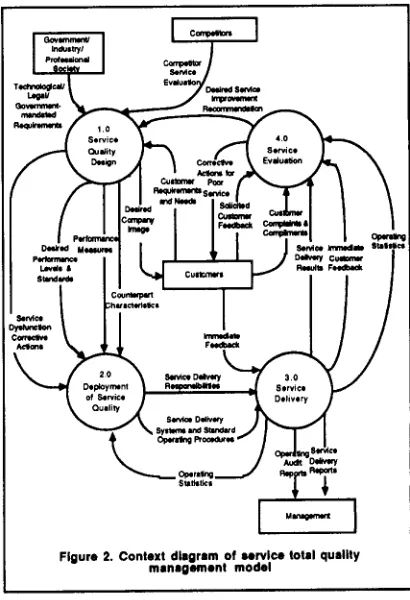
Design of Service Quality refers to the activities converting specific customer expressed needs, wants, and expectations into final service quality performance levels and standards. On the other hand, Deployment of Service Quality involves activities deploying an overall support systems plan and defining the service mechanism of the service organization. All these activities occur during the pre-service delivery stage of the quality system. Together with Service Delivery and Service Evaluation, which correspond to the production and post-production activities in a manufacturing environment, these components complete the Total Service Quality Management Function. Figure 1 is the visual table of content (VTOC) of the model. An in-depth description of the design framework and the system's data flow diagrams (DFDs) depicting the flows of information within the general design of the Total Service Quality Management Model are shown in the following.
Figure 2. Context diagram of service total quality
management model
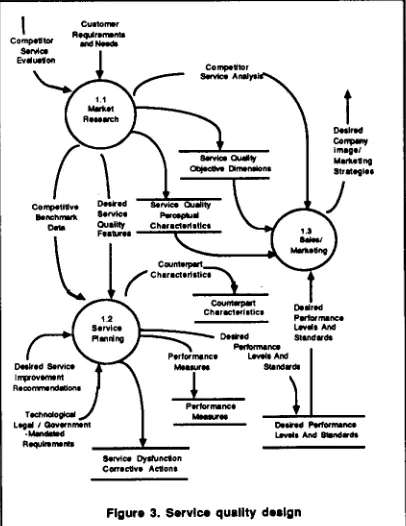
The Market Research function is basically the same as that of the manufacturing industry. It is tasked with collecting from all available sources what is known as voice of the customer. This consists of the customer needs, wants, and expectations. At the same time, information about the same service offered by competitors found in market surveys, industry publications, etc. are also gathered. This information includes analyses of the above services as well as competitive benchmark data.
SERVICE QUALITY MANAGEMENT
SYSTEM
I
i-=.,=..11
.-,o. i I -°
I
Figure 1. Service quality management system
In Service Planning, counterpart characteristics are generated for the desired quality features defined in the previous function. In generating these characteristics, desired service improvements translated from service
improvement recommendations provided by the Service Evaluation function are also incorporated. This can be taken to be similar to the engineering change function in the manufacturing company. As with product planning, strength in relations between wants and counterpart characteristics are determined as well as correlations among the quality features themselves.
Deslon of Service Quality
Design of Service Quality is composed of three functions : Market Research, Service Planning, and Sales-Marketing. It corresponds to the Product Planning function in the manufacturing system.
Service planning next identifies performance measures and critical service dysfunction modes based on the the wants-characteristics
relationships. Performance measures are used to deploy specific target values (or service levels) that then help establish desired performance
[image:2.533.267.472.61.361.2] [image:2.533.55.258.489.632.2]Chang and Lin: Data Flow Diagram 119
Critical service dysfunction mode analysis corresponds to the failure mode and effects analysis of the manufacturing system. These are links in the service discharge function in which a service delivery failure or failures are most likely to occur. As with the manufacturing system,
recommended corrective actions for these dysfunction modes are established.
Along with the deployment of desired service levels and the service dysfunction mode analysis is the determination of technical control items that bear significantly on the manner in which the service is discharged. These include legal, technological, and government mandated requirements under which the service
organization is bound. The result of the Service Planning function is a set of desired performance levels and standards which are next deployed in the Deployment of Service Quality stage.
The Sales and Marketing function is tasked with the development of marketing strategies and the definition of the desired corporate image. Both activities are based on the analyses of
competitors' services as well as the objectives and perceptual quality characteristics of the particular service. Also, desired performance levels and standards generated from the previous function serve as input to these two activities. Much importance is placed on the image that
accompanies the particular service being offered. This is because image is recognized as a quality characteristic that creates customer expectations about the service. Unlike a product which can
customer R ~ m n ~ n t l m
Co pellto¢ and Nwde
T
E-v~ua~ee Cornl~Utor
An~ys
C e m p ~ image/
84wvlce o~Jlty Mldurd i~ I
B ~ n l k ~ n l lltr llt(Hllo I
IIIr~hml~ 8 o r v ~ ~ c e ~ J /
... '%
"-F
C h i t Icte'riltl¢l ~ J P m n l a ~ c e
perforrr~lnca L ~ I And
D ~ a d 84,vice M e m = ~ ~ r ~ u ~ IR~Ow~ent
I | Plffotmlnce ~ I
Legld I Gov~nrnent O e m d P l ~ x m l r c e
serwce Oyltuaclion
Correc~vl Ac~ons
Figure 3. Service quality delllgn
CAIE 21 : I - 4 - I
easily be inspected and judged based on tangible features, such tangible features rarely exist, if at all, in a service. Most of the time, the characteri- stics on which customers base their evaluation of a service may have nothing to do with the delivery of the service itself but largely on whether their expectations were met. Image therefore plays a very important role in shaping the customers' minds as to what kind of service to expect.
DeDIovment of Service Quality
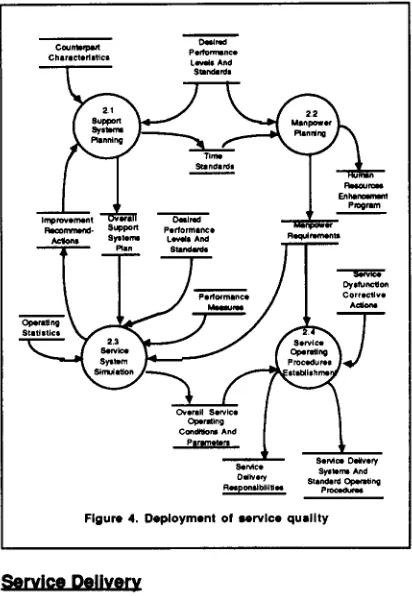
Deployment of Service Quality consists of four major functions: Support Systems Planning, Manpower Planning, Service System Simulation, and Service Machinery Definition.
Support Systems Planning is responsible for the development of an integrated overall support systems plan that serves to provide the
'background' activities and environment
necessary for the efficient delivery of the service.
The first step to this is the definition of detailed service delivery procedures that determine the sequence of steps to be followed when
discharging the particular service. Based on this, a service delivery process chart is developed. Then comes the identification of critical control points and the definition of control procedures along this process. This corresponds to the determination of control and check points in the manufacturing system, only this time, no physical properties of the product is being controlled but rather, the manner in which a particular step in the service delivery process is being performed.
Manpower Planning performs the human resource management function in the service organization. It includes defining both required personnel qualifications and desired supervision requirements in the delivery of the service offered. Alongside with the determination of these qualifications is the activity of determining technical training requirements in order to ensure the maintenance of these personnel skills.
Based on the time standards defined for all the service delivery procedures, an overall manpower requirements plan is developed. This plan configures the proper amount of personnel to be used in the delivery of the particular service.
[image:3.533.56.259.448.711.2]120 Proceedings of the 13th Annual Conference on Computers and Industrial Engineering
The result of the system simulation function is a set of validated service operating conditions and system parameters that have been shown to produce optimum results in the conduct of discharging the particular service the firm offers.
The next step establishes standard operating procedures as well as the final service delivery systems and responsibilities. These standard operating procedures are prepared based on overall service operating conditions and parameters generated by the system simulation studies. At the same time, alternative operating procedures are also defined for contingency situations that arise out of the ordinary routine.
The corrective actions for non-standard output are defined at this time. Non-standard or
"defective" service output occurs as a result of the service delivery procedures not being followed or simply because of inadvertent errors as predicted in the service dysfunction mode analysis.
The result of this function is a consolidated set of standard operating procedures designed for the effective delivery of the kind of service defined by the voice of the customer.
performln~ ChllrllCfeflltlcs L e ~ And s
StBf~ fell
I=~¢omm~- Penormsl~¢*
/ ¢ ~ s Sylteml L ~ S And Requl~mTMmts
T T T _
7]-
O ~ d n g
C ~ And
• SoMce Delivery
SeMce sylternl And
O~ery Standar¢ Oper~ng
R~pomdbi,U~ p ~
F i g u r e 4. D e p l o y m e n t o f s e r v i c e q u a l i t y
Service Dellverv
The Service Delivery stage correponds to the "Production Stage" of the manufacturing system in which the firm's product (or service) is manufactured (or rendered) for the customer. A notable difference is that the service quality control system must consider the presence of the
customer in the service delivery process. This is unlike the manufacturing system where the process is controlled such that defective products do not reach the customer.
Three functions in this stage are Service Delivery Dispatching, Service Delivery Process Monitoring and Collection of Service Measures.
Service Delivery Dispatching basically involves the operational task of defining service delivery schedules and assignments. In manufacturing, this corresponds to dispatching production orders and process instructions.
Service Delivery Process Monitoring involves real time observation of service delivery events. This includes direct supervision of personnel and monitoring of immediate customer feedback. This step corresponds to the in-process inspection activity in the manufacturing environment except for the presence of the customer which renders the situation more difficult. Different customers require different renditions of the same service and this requires more extensive techniques for monitoring conformance to standards.
Collection of Service Measures generally proceeds from the results of past service delivery activities. Based on these results, operating statistics that depict the overall service discharge function in measureable terms are generated. These include labor productivities, resource utilizations, cost figures, etc. At the same time, operating audits which include, among others, a periodic review of the service firm's records and written procedures and inspection of the
organization's facilities, may be conducted. These audits are used to determine the organization's readiness for future business. Along with collection of service measures, this step also generates the management reports on actual service performance and operating audits.
Service Evaluation
Service Evaluation is the post-service delivery component of the Total Service Quality System
Function. This stage leads back to the Service Design stage of the system and thus completes the Total Service Quality System life cycle for the customer-driven service organization.
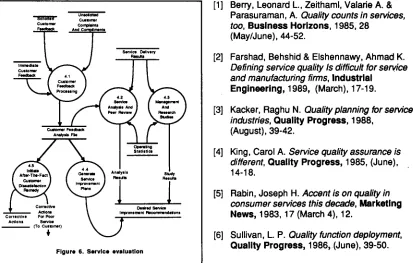
The service evaluation function involves tasks such as processing of both solicited and
unsolicited customer feedback on the firm's service, service analysis and peer review, and management or research studies regarding the service organization. It has a tight relationship with the function of service design. During the service design stage, the criteria are developed.
[image:4.533.54.260.356.654.2]Chang and Lin: Data Flow Diagram 121
Sendce Delivery Service ( ~ l v c y ~ l O n l And
R~po~e~lle= StmcWd Oper=l~
cmr~ I m r ~ a t e ~sendce O~bver/ Rolult=
I " ...
I
~ a l n ~ q
~ d ~
St~sUcs
F i g u r e 5. S e r v i c e d e l i v e r y
the measures are collected. The results are service improvement recommendations that are submitted for incorporation into the service design function. This stage also involves the initiation of after-the-fact remedies for customer
dissatisfaction which arose as a result of a poorly-rendered service. This activity ensures that customers are appeased in spite of a service failure (or defect) on the part of the company.
UnlO~cit0d
so;,c~teo cultomlr
customlr Compares
FNct~k And C ~nom=
fmmo~l~
Anl
Sl¢/Icl Dtlivl~t R~UnI
S t l t l l t l ~
Analysis Study
t l
Correc~ve
ovoment R l c o m m l ~ o n l COtrlctivo For Poor
Actionl Swvice
(To Customer)
F i g u r e 6, S e r v i c e e v a l u a t i o n
In the paper, a total service quality management model was developed using the principles of Quality Function Deployment (QFD), an approach which has found success largely in manufacturing applications and demonstrates the versatility and effectiveness of Quality Function Deployment in service industries as well and its applicability in a wide range of product design and development activities. The general design specification of the model was described by means of Data Flow Diagrams (DFD) in which information flows were depicted as channels of communication between organizational units involved in the service quality management function. Towards the development of the general design, the attributes that define service quality were identified, and steps and methods were recommended to aid the total service quality management.
Implementation of total service quality management function leads to cost control and provides better management information. It improves the quality of service, a goal desired by most today's service industries. The design in this paper, different from most of the service model thus far developed, provides a structured and systematic approach to model the total service quality management function, and the design also can be used as the base for further development such as a computer integrated service quality management information system.
BEEEBEKC, E~
[1]
Berry, Leonard L., Zeithaml, Valarie A. & Parasuraman, A. Quality counts in services,too, Business Horizons, 1985, 28 (May/June), 44-52.
[2]
Farshad, Behshid & Elshennawy, Ahmad K.Defining service quality Is difficult for service and manufacturing firms, Industrial
Engineering, t 989, (March), 17-19.
[3] Kacker, Raghu N. Quality planning for service industries, Quality Progress, 1988,
(August), 39-42.
[4]
King, Carol A. Service quality assurance is different, Quality Progress, 1985, (June), 14-18.[5]
Rabin, Joseph H. Accent is on quality in consumer services this decade, Marketing News, 1983, 17 (March 4), 12.[6] Sullivan, L P. Quality function deployment,
[image:5.533.58.262.65.359.2] [image:5.533.61.474.457.720.2]