Insulin modulation of an endothelial nitric oxide
component present in the alpha2- and
beta-adrenergic responses in human forearm.
G Lembo, … , D Fontana, B Trimarco
J Clin Invest.
1997;
100(8)
:2007-2014.
https://doi.org/10.1172/JCI119732
.
We explored in 51 normal subjects, distributed in various series of experiments, whether
endothelium nitric oxide may play a role in insulin modulation of alpha2- and
beta-adrenergic- evoked vascular responses. In particular, we examined the forearm blood flow
response (FBF, ml.min-1.dl-1) to intrabrachial infusion of BHT-933 (0.5, 1, and 2
microg.min-1.dl-1) or isoproterenol (1, 3, and 6 ng. min-1.dl-1) in control conditions, during
intrabrachial infusion of insulin alone (0.05 mU.kg-1.min-1) and associated with
l-N-monomethylarginine (L-NMMA) (0.05 microg.min-1.dl-1), a nitric oxide synthase inhibitor. In
control conditions both BHT-933 and isoproterenol induced a dose-dependent vascular
response. Local hyperinsulinemia (deep venous plasma insulin 68.5+/-4 microU/ml) did not
change basal FBF whereas attenuated BHT-933 vasoconstriction and enhanced
isoproterenol vasodilation. L-NMMA reduced basal FBF and abolished the insulin effect on
BHT-933 and isoproterenol response. To clarify whether a nitric oxide component is
included in alpha2- and beta-adrenergic response and may be responsible for insulin
vascular effect, we further examined BHT-933 and isoproterenol responses during nitric
oxide inhibition. Interestingly, L-NMMA potentiated the BHT-933 vasoconstriction and
attenuated the isoproterenol vasodilation and, in these conditions, insulin was no more able
to exhibit its vascular effects. Finally, to rule out the possibility that the conteracting effect of
L-NMMA may not be specifically related to insulin action, dose-response curves to
phenylephrine (0.5, 1, and 2 microg.min-1.dl-1) or sodium nitroprusside (1, […]
Research Article
Find the latest version:
J. Clin. Invest.
© The American Society for Clinical Investigation, Inc. 0021-9738/97/10/2007/08 $2.00
Volume 100, Number 8, October 1997, 2007–2014 http://www.jci.org
Insulin Modulation of an Endothelial Nitric Oxide Component Present in the
a
2- and
b
-Adrenergic Responses in Human Forearm
Giuseppe Lembo,* Guido Iaccarino,‡ Carmine Vecchione,* Emanuele Barbato,‡ Raffaele Izzo,‡ Dario Fontana,‡
and Bruno Trimarco
*IRCCS “INM NEUROMED,” Pozzilli (IS) and ‡Department of Internal Medicine, School of Medicine, “Federico II” University, Naples, 86077 Italy
Abstract
We explored in 51 normal subjects, distributed in various series of experiments, whether endothelium nitric oxide may play a role in insulin modulation of a2- and b-adrenergic–
evoked vascular responses. In particular, we examined the forearm blood flow response (FBF, ml·min21·dl21) to
intra-brachial infusion of BHT-933 (0.5, 1, and 2 mg·min21·dl21)
or isoproterenol (1, 3, and 6 ng·min21·dl21) in control
condi-tions, during intrabrachial infusion of insulin alone (0.05 mU·kg21·min21) and associated with L-N-
monomethylargi-nine (L-NMMA) (0.05mg·min21·dl21), a nitric oxide synthase
inhibitor. In control conditions both BHT-933 and isopro-terenol induced a dose-dependent vascular response. Local hyperinsulinemia (deep venous plasma insulin 68.564 mU/ml) did not change basal FBF whereas attenuated BHT-933 vasoconstriction and enhanced isoproterenol vasodilation. L-NMMA reduced basal FBF and abolished the insulin ef-fect on BHT-933 and isoproterenol response. To clarify whether a nitric oxide component is included in a2- and b-adrenergic response and may be responsible for insulin vascular effect, we further examined BHT-933 and isopro-terenol responses during nitric oxide inhibition. Interest-ingly, L-NMMA potentiated the BHT-933 vasoconstriction and attenuated the isoproterenol vasodilation and, in these conditions, insulin was no more able to exhibit its vascular effects. Finally, to rule out the possibility that the conteract-ing effect of L-NMMA may not be specifically related to in-sulin action, dose–response curves to phenylephrine (0.5, 1, and 2 mg·min21·dl21) or sodium nitroprusside (1, 2, and
4 mg·min21·dl21) were also performed. Both insulin and
L-NMMA were unable to alter the phenylephrine-induced vasoconstriction and the sodium nitroprusside vasodilation. In conclusion, our data demonstrate an endothelial nitric oxide component in the a2- and b-adrenergic vascular
re-sponses which is the target of the insulin vascular action. (J.
Clin. Invest. 1997. 100:2007–2014.) Key words: adrenergic
re-ceptors• endothelium • insulin • sympathetic nervous sys-tem • forearm blood flow
Introduction
Among the broad variety of effects evoked by insulin, its abil-ity to modulate the vascular tone has recently been the focus of a growing body of studies. The attention for this issue comes from the evidence that essential hypertension and other vascu-lar diseases show a strong association with resistance to insulin action (1–6). Thus, the accurate definition of mechanisms by which insulin exerts its vascular effects could help to unveil the meaning of such association.
Actually, it has been clearly evidenced that insulin, at level physiologically reached postprandially, induces a reflex in-crease in sympathetic skeletal muscle outflow (7–9). However, interestingly, in presence of insulin, the vasoconstriction typi-cally generated by the sympathetic activation is markedly blunted. The analysis of this phenomenon has been the object of many recent studies, which have attempted to dissect the mechanisms by which insulin is able to exert its vascular ef-fects.
Using the euglycemic hyperinsulinemic clamp technique, which raises peripheral insulin levels in the physiological range, maintaining the blood glucose concentration at its basal value, several groups have observed an unequivocal vasodilator ef-fect of insulin, which is abolished by nitric oxide inhibition (10, 11). Nevertheless, this technique prevents only the hypoglyce-mia, while a number of other hormonal and substrate changes systemically occur that may be actually responsible for the vas-cular effects ascribed to insulin.
In contrast, another approach is to deliver insulin directly in the brachial artery limiting the increase of plasma levels of the hormone to the forearm. This setting circumvents the per-turbations induced by systemic insulin administration, reflect-ing solely the direct influence of insulin per se on vascular function. In these experimental conditions, we and others were not able to disclose any direct vasodilator effect of insulin, at least when the hormone was raised in the physiological range (12–16). However, even in this setting, we were able to reveal that insulin itself is able to attenuate the sympathetic-evoked vasoconstriction, through a crosstalk with a2 and the b
-adren-ergic signal transduction pathways (16–18).
Such conclusions were also supported by studies performed in more elementary models of vascular function, such as rat aortic rings, where it is possible to evaluate the direct vascular effect of test substances. In particular, this kind of study has further attested that insulin is able to attenuate the norepi-nephrine-induced contractile response interacting both with the a2 and the b-adrenergic vascular response (19, 20) in
hu-mans. Furthermore, such an approach has also revealed that
Portions of this work were presented at the 50th Annual Fall Confer-ence and Scientific Session of the Council for High Blood Pressure in Chicago, IL on 17–20 September 1996.
Address correspondence to Giuseppe Lembo, IRCCS “INM Neuromed,” Localitá Camerelle, 86077 Pozzilli (IS), Italy. Phone: 0039-865-915244; FAX: 0039-865-927575; E-mail: [email protected]
insulin vascular effects on these adrenergic responses were en-dothelium nitric oxide dependent, since enen-dothelium removal as well as nitric oxide inhibition is able to abolish them (20).
There exist indications, also in humans, that the endothe-lium may account for the insulin vascular effects. In particular, it has been recently reported that intraarterial infusion of insulin, although incapable to evoke a direct vasodilation, can enhance the endothelial response to increasing doses of acetylcholine (21). However, it is still not clear how insulin can interfere with the a2 and the b-adrenergic vascular responses in humans.
To address this issue, we first studied in the forearm of healthy subjects the effect of nitric oxide inhibition on the in-sulin modulation of a2 and the b-adrenergic vascular responses.
Furthermore, since in vitro studies had demonstrated a2
and b-adrenergic receptors also on the endothelium (22, 23), where they activate nitric oxide production, we extended our analysis to clarify whether the nitric oxide inhibition may un-veil in the a2 and b-adrenergic vascular response an
endothe-lial component which may be the target of the vascular effect of insulin.
Methods
Subjects
The study group consisted of 51 normal volunteers (35 males and 16 females) whose ages ranged from 20 to 38 yr, average 2761 yr. Medi-cal history, physiMedi-cal examination, and laboratory analyses were per-formed to evaluate subjects’ normalcy. Renal, liver, and endocrine functions were normal. Body weight and body mass index were 7262 kg and 24.160.4 kg/m2, respectively. No subject had recent changes in
body weight or dietary habits, nor was engaged in competitive sports or did intense physical activity during the days before the study. Writ-ten informed consent was obtained from all participants. The experi-mental protocol was in accordance with the institutional guidelines for human research.
Experimental procedures
The study began at 8:00 a.m. in a quiet room with a constant tempera-ture of 22 to 248C. All subjects were studied in a postabsorptive state in the supine position, after a 12–15-h overnight fast. No premedica-tion was administered. On a subject’s arrival at the laboratory, forearm volume was measured by water displacement. The forearm perfusion technique was performed as previously described (24). A plastic can-nula was introduced in a retrograde manner into a large antecubital vein and threaded as deeply as possible. In the same arm, a second double lumen catheter (Arrow International Inc., Reading, PA), with the distal hole separated by z 3 cm from the proximal one was
intro-duced into the brachial artery. The distal hole was used for the infu-sion of test substances, and the proximal lumen was used to sample arterial blood entering the forearm, uncontaminated by solutions in-fused downstream, and to measure arterial blood pressure, by means of a Statham P23Db pressure transducer (Statham Instruments, Cleveland, OH). Systolic and diastolic blood pressure were recorded on a multichannel polygraph (Gould Instruments, Oxford, CA). Heart rate was determined from a simultaneously obtained electro-cardiographic signal and calculated from R–R interval. Forearm blood flow (FBF,1 expressed in ml·min21·dl21 of foream tissue) was
measured by strain gauge plethysmography (25), using a Digimatic DM2000 (Medimatic, Copenhagen, Denmark) with a calibrated mer-cury-in-Silastic strain-gauge, applied on the arm z 5 cm below the
an-tecubital crease. Both arms were supported above heart level. FBF
was measured from the rate of the increase in forearm volume while venous return from the forearm was prevented by inflating a cuff around the upper arm. The intrasubject coefficient of variation was 7%, based on two consecutive measurements taken at a one minute in-terval. After complete instrumentation, all subjects rested at least 30 min to establish a stable baseline before data collection.
All the test substances were dissolved in NaCl 0.9% on the day of the study. Infusion rates of drugs were normalized to decaliter of arm tissue and were chosen to act selectively in the experimental fore-arm without causing systemic effects.
The a2-selective agonist BHT 933 (infusion rate of 0.5, 1.0, and
2.0 mg·min21·dl21 forearm tissue; Research Biochemical Inc., Natick,
MA), the selective b-adrenergic agonist isoproterenol (1, 3, and 6 ng·min21·dl21 forearm tissue; Sigma Chemical Co., St. Louis, MO),
the a1 selective agonist phenylephrine (0.5, 1, and 2 mg·min21·dl21
forearm tissue; Sigma Chemical Co.), the vasodilator sodium nitro-prusside (1, 2, and 4 mg·min21·dl21 forearm tissue; Malesci, Florence,
Italy) and the sympathetic neurotransmitter norepinephrine (140, 280, and 560 ng·min21·dl21 forearm tissue; Sigma Chemical Co.) were
utilized as test substances to produce dose–response curves. Each drug dose was maintained for 10 min to analyze the vascular response at the steady state. At the end of each dose–response curve a recov-ery period of at least 50 min was allowed. The intrabrachial infusion of insulin was performed at a rate of 0.05 mU·kg21·min21 able to
reach increments in the forearm of z 60 mU/mL and was started 30
min before performing the dose–response curves of the test sub-stances. For each insulin infusion, simultaneous arterial and venous samples were obtained before the start and at the end of the 30-min prime for the measurement of plasma insulin concentration. Insulin in-fusion was continued throughout the drug response curves. Intra-brachial infusion of the nitric oxide synthase competitive inhibi-tor L-N-monomethylarginine (L-NMMA; Sigma Chemical Co.; 0.05
mg·min21·dl21) was aimed to obtain constant nitric oxide inhibition in
the forearm, throughout the dose–response curves. In particular, we started L-NMMA infusion 15 min before each drug response curve and continued throughout. This dose of L-NMMA has been shown to effectively blunt endothelium-dependent vasodilator response to ace-tylcholine in the human vasculature (26, 27) and such effect was con-firmed in our pilot studies.
Experimental design
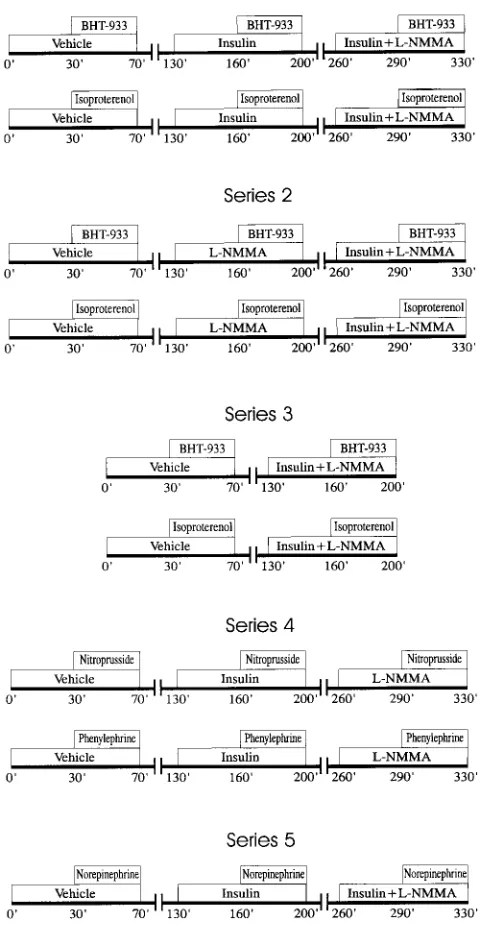
Series 1: Effects of L-NMMA on insulin modulation of forearm a2
-and b-adrenergic response. Fig. 1 shows flow diagrams of the proto-col. To verify whether the inhibition of nitric oxide may influence the insulin effect on a2- and b-adrenergic responses, in two groups of six
subjects each, we assessed a dose–response curve to BHT-933 or iso-proterenol in control conditions (i.e., during intrabrachial infusion of saline), during intrabrachial infusion of insulin and, finally, during concomitant infusion of insulin plus L-NMMA.
Series 2: Effects of L-NMMA on forearm a2- and b-adrenergic
re-sponse.To clarify whether in both a2 and b-adrenergic-evoked
vas-cular response is present a vasorelaxant component, nitric oxide de-pendent, which may interact with insulin accounting for its effect on the overall a2- and b-adrenergic vascular response, we studied two
groups of healthy subjects: seven with BHT-933 and five with isopro-terenol. Dose–response curves to these drugs were performed in trol conditions, during infusion of L-NMMA and, finally, during con-comitant infusion of insulin plus L-NMMA.
Series 3: Effects of insulin plus L-NMMA on forearm a2- and
b-adrenergic response. To examine the effect of insulin plus L-NMMA by eliminating other potential sources of noise represented by prelim-inary interventions such as insulin or L-NMMA alone, in two other groups of five normal subjects each, we tested dose–response curves to BHT-933 or to isoproterenol in control conditions and during insu-lin plus L-NMMA intrabrachial infusion.
Series 4: Effects of insulin or L-NMMA on forearm phenylephrine and sodium nitroprusside response. To rule out that L-NMMA could not specifically interact with the a2- and b-adrenergic vascular
re-1. Abbreviations used in this paper: FBF, forearm blood flow; L-NMMA,
sponses, in two other groups of six normal subjects each, we tested dose–response curves to phenylephrine, a vasoconstrictive a1
-adren-ergic agonist, or to sodium nitroprusside, a vasodilator agent acting directly on smooth muscle, in control conditions, during insulin and finally, during L-NMMA intrabrachial infusion.
Series 5: Effects of insulin and insulin plus L-NMMA on forearm norepinephrine response. To confirm that insulin modulatory effect on a2- and b-adrenergic response is also physiologically relevant, we
tested further in five normal subjects the effect of insulin alone and insulin plus L-NMMA on the forearm response evoked by norepi-nephrine, which represents the physiological neurotransmitter of the sympathetic nervous system.
Analytical procedures. Insulin was measured in plasma by a stan-dard radioimmunossay method (INCSTAR Corp., Stillwater, MN).
Data analysis. Because mean arterial blood pressure and heart rate did not change significantly throughout the study, data were
ana-lyzed in terms of changes in FBF. Because L-NMMA altered resting FBF, data were analyzed as percent change from baseline. Contralat-eral FBF did not change in the diverse experimental series.
Comparison of plasma insulin levels obtained in basal state and during intraarterial infusion of the hormone was accomplished by paired t test. Two-way analysis of variance was performed to estimate the changes on FBF responses to BHT-933, isoproterenol, phenyl-ephrine, and sodium nitroprusside. Post hoc simultaneous multiple comparisons were done by Bonferroni’s analysis. Results are pre-sented as mean6SE.
Results
Mean blood pressure and heart rate of all subjects were 9162 mmHg and 7062 bpm, respectively. No differences in these parameters could be detected between different study groups nor in the same group throughout the experimental protocol. In all series of experiments intrabrachial insulin infusion in-duced an increase in deep venous insulin concentration (from 4.861 to 65.363 mU/ml, n5 51, P, 0.01) without affecting the systemic levels of the hormone (from 6.261 to 7.961 mU/ ml, NS). Furthermore, pooling all experiments where insulin or L-NMMA were administered alone, we observed that intra-brachial insulin administration did not significantly modify basal FBF in the experimental arm (2.5460.12 vs. 2.6660.15 ml·min21·dl21, n5 29, NS) whereas this latter was significantly
reduced by L-NMMA infusion (1.8960.16 vs. 2.2960.15 ml·min21·dl21, n5 24, P, 0.05). The combined infusion of
in-sulin plus L-NMMA was able to provoke a decrease in FBF similar to that observed with L-NMMA alone (21862% vs. 21964%, n5 12, NS).
Series 1: Effects of L-NMMA on insulin modulation of
fore-arm a2- and b-adrenergic response. In control conditions the
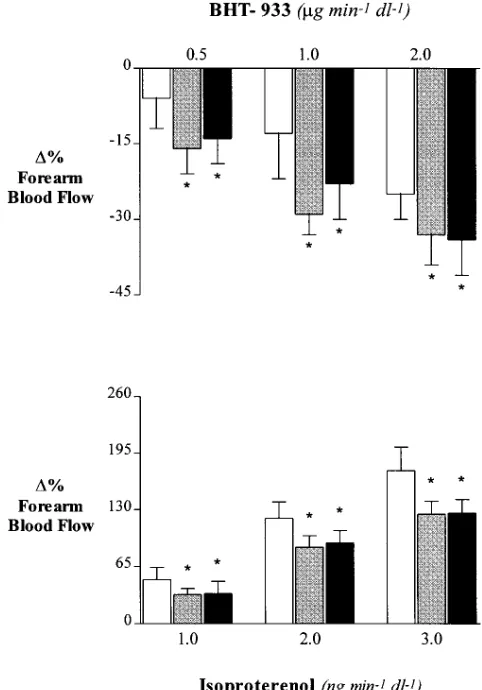
infusion of increasing amounts of BHT-933 in the brachial ar-tery induced a dose-dependent vascular response in the exper-imental arm (FBF decreased from 2.6460.14 to a minimum of 1.9660.16 ml·min21·dl21; Fig. 2). As previously observed,
insu-lin infusion blunted significantly the FBF response elicited by BHT-933 (from 2.8060.27 to a minimum of 2.5960.23 ml·min21·dl21; P, 0.01 when compared to control conditions).
The administration of L-NMMA in the brachial artery during insulin infusion was able to completely restore the full forearm response to BHT-933, which was no longer different in magni-tude from that observed in control conditions (from 2.6460.29 to a minimum of 2.0460.26 ml·min21·dl21).
Similarly, the infusion of increasing amounts of isoprotere-nol in the brachial artery induced a dose-dependent vascular response in the experimental arm (FBF increased from 2.6160.19 to a maximum of 6.2760.44 ml·min21·dl21; Fig. 2).
As expected, the isoproterenol-induced vasodilator response was significantly increased in presence of insulin (from 2.9260.25 to a maximum of 8.8260.70 ml·min21·dl21; P ,
0.01). However, even in these conditions, the simultaneous in-fusion of L-NMMA and insulin was capable to restore the re-sponse to isoproterenol to that observed in control conditions (from 2.2760.16 to a maximum of 5.0660.46 ml·min21·dl21; NS
when compared to control conditions).
Fig. 3 shows that the reversal of insulin influence on a2- and
b-adrenergic response by L-NMMA was a common denomi-nator of all subjects.
Series 2: Effects of L-NMMA on forearm a2- and
b-adrener-gic responses. In these subjects both BHT-933 and
[image:4.612.57.298.72.537.2]isoprotere-nol intrabrachial infusion induced in the experimental arm
dose-dependent vascular responses similar to those observed in the previous series (BHT-933: from 2.4360.22 to a mini-mum of 1.8460.20 ml·min21·dl21; isoproterenol: from 2.5660.46
to a maximum of 6.3760.11 ml·min21·dl21; Fig. 4). However, in
presence of L-NMMA, the BHT-933-evoked vasoconstrictive response was significantly potentiated (from 2.0560.39 to a minimum of 1.2760.19 ml·min21·dl21, P , 0.05 when
com-pared to control conditions) while, the isoproterenol-evoked vasodilator response was significantly attenuated (from 1.9560.27 to a maximum of 4.0660.71 ml·min21·dl21, P,
0.05 when compared to control conditions). Finally, in these series of experiments the intrabrachial infusion of L-NMMA was able to restrain the insulin vascular effect on a2- and
b-adrenergic elicited response (BHT-933: from 2.3160.42 to a minimum of 1.4060.17 ml·min21·dl21; isoproterenol: from
1.9560.25 to a maximum of 4.1260.61 ml ·min2·dl2; P, 0.05 when compared to control conditions for both responses).
Series 3: Effects of insulin plus L-NMMA on forearm a2
-and b-adrenergic response. As previously observed in series 1
and 2, both BHT-933 and isoproterenol intrabrachial infu-sion induced in the experimental arm a dose-dependent
vascu-lar response (BHT-933: from 3.1960.32 to a minimum of 2.3160.26 ml·min21·dl21; isoproterenol: from 3.0760.14 to a
maximum of 8.0460.25 ml·min21·dl21; Fig. 5). The exposure to
insulin plus L-NMMA, without preliminary interventions, con-firmed the previous results obtained in series 2. In particular, the BHT-933–evoked vasoconstrictive response was signifi-cantly potentiated (from 2.2960.03 to a minimum of 1.4260.19 ml·min21·dl21, P, 0.05 when compared to control conditions)
while, the isoproterenol-evoked vasodilator response was sig-nificantly attenuated (from 2.3560.11 to a maximum of 4.5360.28 ml·min21·dl21, P, 0.05 when compared to control
conditions).
Series 4: Effects of insulin or L-NMMA on forearm
phen-ylephrine- and sodium nitroprusside-evoked responses.As
ex-pected, both phenylephrine and sodium nitroprusside intra-brachial infusions induced dose-dependent vascular responses in the experimental arm (phenylephrine: from 2.2760.24 to a minimum of 1.1460.25 ml·min21·dl21; sodium nitroprusside:
from 2.0160.12 to a maximum of 5.4860.69 ml·min21·dl21; Fig.
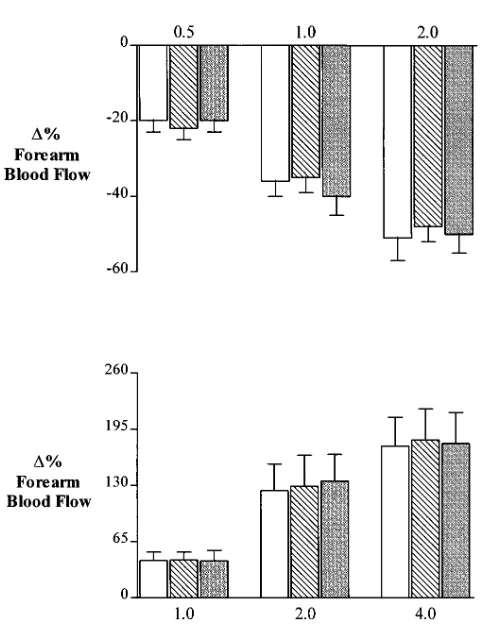
[image:5.612.55.296.57.401.2]6). However, unlikely to that previously observed with BHT-933 and isoproterenol, insulin was unable to modify such vas-cular responses (phenylephrine: from 2.4560.23 to a mini-mum of 1.2860.20 ml·min21·dl21; sodium nitroprusside: from
Figure 2. Changes in forearm blood flow response to intrabrachial in-fusions of BHT-933 (top) and isoproterenol (bottom) in control con-ditions (open bars) during intraarterial (i.a.) infusion of insulin (striped bars) and during i.a. infusion of insulin plus L-NMMA (solid bars). Each point represents mean6SEM. *P, 0.05 as compared to control conditions.
[image:5.612.314.548.337.692.2]1.9960.11 to a maximum of 5.5660.64 ml·min21·dl21; NS
when compared to control conditions). Furthermore, the dose–response curves obtained both with phenylephrine and sodium nitroprusside remained unmodified also during L-NMMA intrabrachial administration (phenylephrine: from 1.9560.22 to a minimum of 1.0160.22 ml·min21·dl21; sodium
nitroprusside: from 1.5960.1 to a maximum of 4.4560.57 ml·min21·dl21; NS when compared to control conditions).
Series 5: Effects of insulin and insulin plus L-NMMA on
forearm norepinephrine response.As expected
norepineph-rine intrabrachial infusion induced a dose-dependent vascular response in the experimental arm (from 2.9660.16 to a mini-mum of 1.3360.16 ml·min21·dl21; Fig. 7). Insulin intrabrachial
infusion was able to blunt norepinephrine-induced vaso-constriction (from 2.9060.28 to a minimum of 1.8960.22 ml·min21·dl21; P, 0.05 when compared to control conditions).
Finally, when the experimental arm was exposed to insulin in combination with L-NMMA the norepinephrine-induced vaso-constriction was no longer different from that observed in con-trol conditions (from 2.1760.21 to a minimum of 0.9760.14 ml·min21·dl21; NS when compared to control conditions).
Discussion
In this study we investigated in human forearm whether endo-thelium nitric oxide plays a role in the direct insulin vascular effect on a2- and b-adrenergic–evoked responses. Two major
observations were noted. First, insulin modulation of a2 and
b-adrenergic vascular response is suppressed by nitric oxide in-hibition. Second, the dose–response curves produced both with a2- or b-adrenergic selective agonists are significantly
al-tered in presence of a competitive antagonist of nitric oxide synthase, suggesting the existence of an endothelium nitric ox-ide component in their overall vascular responses. More im-portant, this nitric oxide component is essential for the insulin modulation of a2- and b-adrenergic responses.
[image:6.612.55.296.60.405.2]Several recent studies have investigated the hemodynamic effects of insulin. In particular, we and others have examined the direct hemodynamic effect of insulin by intrabrachial infu-sion of the hormone, which realizes no systemic perturbation, and, therefore, the response measured in the forearm must re-flect the net effect of insulin per se. In these conditions, insulin does not exhibit a direct vasodilator effect (12–15) whereas it does blunt the sympathetic-evoked vasoconstriction (16). This
[image:6.612.315.553.330.678.2]Figure 4. Changes in forearm blood flow response to intrabrachial in-fusions of BHT-933 (top) and isoproterenol (bottom) in control con-ditions (open bars) during i.a. infusion of L-NMMA (shaded bars) and during i.a. infusion of insulin plus L-NMMA (solid bars). Each point represents mean6SEM. *P, 0.05 as compared to control con-ditions.
phenomenon can be explained by the ability of insulin to selec-tively interact with a2- and b-adrenergic vascular responses
(17, 18). In particular, insulin is able to attenuate the a2
-adren-ergic vasoconstriction and to potentiate the b-adrenergic va-sodilation, whereas no significant effects are realized by insulin on the a1-adrenergic evoked response. Furthermore, in vitro
studies support this evidence, suggesting that the insulin inter-action with a2- and b-adrenergic response may occur at the
en-dothelial level (19, 20). On this issue, Gros et al. have clearly demonstrated in rat aortic rings that insulin-mediated en-hancement of vascular b-adrenergic responsiveness is com-pletely abolished by endothelial removal (19). Additionally, in the same experimental model, we have recently observed that insulin interacts with the a2-adrenergic endothelium
depen-dent vasorelaxation (20).
Recent data in humans have depicted a facilitating action of insulin on endothelium-dependent vasodilation mediated by activation of the L-arginine nitric oxide pathway, when the hormone is infused locally (21). Thus, we decided to verify in human forearm whether the interaction among insulin and the a2 and b-adrenergic vascular responses might be mediated by
an endothelial nitric oxide production. In particular, we
hy-pothesized the presence of an endothelial nitric oxide compo-nent which could be positively modulated by insulin and could account for both the attenuation of a2-evoked vasoconstriction
and the potentation of b-adrenergic vasodilation.
Our results confirm previous observations. In particular (a) forearm exposure to insulin, raising the plasma levels of the hormone within the physiological range, does not significantly affect forearm blood flow; (b) the hormone significantly alters the responses to a2 and b-adrenergic stimulation but not those
to phenylephrine or sodium nitroprusside.
A novel observation was that L-NMMA, which inhibits the endothelial formation of nitric oxide in a stereospecific man-ner, completely abolishes both the facilitating effect of insulin on the b-adrenergic evoked vasodilation and the negative ef-fect of the hormone on the a2-evoked vasoconstriction. This
suggests that a common endothelial nitric oxide–dependent mechanism may be involved in the insulin effect on a2 and
b-adrenergic receptors mediated vascular response.
However, the counteracting effect of L-NMMA on insulin modulation of a2 and b-adrenergic responses may be also a
merely pharmacological effect. Actually, any perturbation of vascular tone may trigger the release of nitric oxide from endothelium and, consequently, the neutralizing effect of L-NMMA on the insulin vascular action may be not specific. On this issue, our data clearly indicate that only the a2- and
b-adrenergic–evoked responses are modulated by endothelial nitric oxide release, whereas the vasoconstriction obtained by a1-adrenergic selective agonist and the vasodilation induced by
sodium nitroprusside are entirely unaffected by the inhibition of nitric oxide production. Thus, insulin effect on the selective adrenergic receptor–mediated responses becomes evident only for those responses which include an endothelial nitric oxide component in their overall vascular response.
A careful perusal of the results obtained in the first two series revealed slight differences exhibited by simultaneous in-fusion of insulin and L-NMMA compared with control condi-tions. In particular, while in series 2 insulin in presence of L-NMMA significantly modified the a2- and b-adrenergic–
[image:7.612.56.296.71.388.2]evoked responses, the same intervention of insulin plus L-NMMA was unable to determine a significant change of the a2- and Figure 6. Changes in forearm blood flow response to intrabrachial
in-fusions of phenylephrine (top) and sodium nitroprusside (bottom) in control conditions (open bars) during i.a. infusion of insulin (striped bars) and during i.a. infusion of L-NMMA (shaded bars). Each point represents mean6SEM.
Figure 7. Changes in forearm blood flow response to intrabrachial in-fusions of norepinephrine in control conditions (open bars) during i.a. infusion of insulin (striped bars) and during i.a. infusion of insulin plus L-NMMA (solid bars). Each point represents mean6SEM. *P,
[image:7.612.313.549.531.682.2]b-adrenergic responses in comparison with control conditions in series 1. It is important to note that such discrepancy is real-ized after a previous intervention that was different between the two series. In fact, in series 1, insulin was administered twice: the first time alone and, subsequently, in addition to L-NMMA. In contrast, in series 2, insulin was administered only once in conjuction with L-NMMA. The results of series 3, where no preliminary interventions were performed, confirms that during insulin plus L-NMMA exposure, the a2- and b
-adren-ergic responses are significantly modified in comparison to the same adrenergic-mediated responses obtained in control con-ditions, suggesting that the increased variability between the first two series may be the price of a double closed insulin ex-posure accomplished in series 1. On the other hand, the ad-ministration of the hormone activates molecular events which may be not easily removed even if a recovery period is al-lowed.
The effect of insulin is not limited to the pharmacological adrenergic agonists but is also clearly detectable on the vascu-lar effects evoked by norepinephrine, the major sympathetic neurotransmitter, which realizes a1, a2, and b receptor
activa-tion, thus indicating the physiological relevance of our find-ings. On this issue, we have also to consider that in spite of the insulin modulatory effect on norepinephrine-induced vasocon-striction when this latter is infused in the brachial artery, we were not able to disclose any direct effect of insulin on the basal vascular tone which is indubitably also adrenergic depen-dent. However, it is likely that in resting conditions the main adrenergic influences on vascular tone are mediated through a signaling of a1 adrenergic pathway on which insulin is unable
to exert any modulatory influence. In contrast, a2 and b
adren-ergic pathway may have a marginal role in the control of the resting vascular tone and, therefore, it is necessary to challenge them to reveal the whole insulin effect.
It is important to emphasize that our results represent the first evidence in humans of an endothelial nitric oxide compo-nent in the a2- and the b-adrenergic–evoked vascular
re-sponses. In particular, the overall vascular responses evoked by the activation of these specific adrenergic receptors have to be considered as the result of influences both on the smooth muscle and on endothelial cells. In fact, isoproterenol-induced vasodilation is obtained with a contribution of both a direct re-laxing action on the smooth muscle and an indirect rere-laxing ac-tion mediated through the release of nitric oxide from endo-thelium. Analogously, the vascular response obtained with a selective a2-adrenergic agonist, such as BHT-933, is the net
re-sult of a direct vasoconstrictive action on the smooth muscle and of an indirect endothelial nitric oxide relaxing action. Our data are strongly supported by the evidence attained in endo-thelial cells which have clearly revealed that endothelium con-tains both a2- and b-adrenergic receptors (22, 23). Moreover,
on isolated vessels Miller and Vanhoutte have demonstrated that removal of the endothelium causes a significant potentia-tion of the concentrapotentia-tion–response curve to the selective a2
-adrenergic agonist UK14,304 but not of that to the selective a1-adrenergic vasoconstrictor phenylephrine (28). In the same
experimental model, it has been shown that the vasorelaxation induced by isoproterenol is attenuated by endothelium re-moval (29).
It should be noted that in the smooth muscle the stimula-tion of a2 and b-adrenergic signals are able to provoke
oppo-site effects, while in endothelial cells these adrenergic signals
converge positively on the release of nitric oxide. This suggests that the intracellular molecular events generated by a2 and
b-adrenergic receptor activation may have peculiar features in endothelial cells which allow to couple these two distinct ad-renergic receptors to a common pathway stimulating the re-lease of nitric oxide. Insulin is likely able to sensitize this en-dothelial pathway modifying the overall vascular response evoked by a2 and b-adrenergic agonists. More important, since
the vasoconstriction resulting from the sympathetic nervous system activation represents the balance of opposite actions on the various adrenergic receptors present on smooth muscle and endothelium, it is reasonable to speculate that the attenua-tion of sympathetic vasoconstricattenua-tion induced by insulin may be also the result of this sensitizing action of the hormone on the endothelial adrenergic component which realizes a new equi-librium among the opposite actions evoked by adrenergic re-ceptors stimulation.
In summary, this study demonstrates that both a2 and
b-adrenergic receptors include in their overall vascular re-sponse an endothelial nitric oxide component which is the tar-get of insulin action. The definition of such a mechanism could be very important just in diseases like essential hypertension where both an exaggerated sympathetic nerve activity in re-sponse to various stimuli such as insulin itself (9, 30) and a gen-eralized impairment of endothelial nitric oxide vasodilator function have been clearly demonstrated (31). Actually, in in-sulin-resistant hypertensive patients the lack of insulin sensiti-zation of the endothelial component existing in the a2 and
b-adrenergic signals may result in an impairment of the equi-librium between endothelial and vascular smooth muscle ad-renergic signaling, thus contributing to the increase of vascular resistance, a pivotal phenotypical trait of essential hyperten-sion.
References
1. Ferrannini, E., G. Buzzigoli, R. Bonadonna, M.A. Giorico, M. Oleggini, L. Graziadei, R. Pedrinelli, L. Brandi, and S. Bevilacqua. 1987. Insulin resis-tance in essential hypertension. N. Engl. J. Med. 317:350–357.
2. Modan, M., H. Halkin, S. Almog, A. Lusky, A. Eshkol, M. Shefi, A. Shitrit, and Z. Fuchs. 1985. Hyperinsulinemia. A link between hypertension, obesity and glucose intolerance. J. Clin. Invest. 75:809–817.
3. Reaven, G.M. 1991. Insulin resistance, hyperinsulinemia, and hyper-trigliceridemia in the etiology and clinical course of hypertension. Am. J. Med.
90(Suppl. 2):7–12.
4. Ferrari, P., P. Weidmann, S. Shaw, D. Giachino, W. Riesen, Y. Allemann, and G. Heynen. 1991. Altered insulin sensitivity, hyperinsulinemia, and dyslipi-demia in individuals with a hypertensive parent. Am. J. Med. 91:589–596.
5. Botker, H.E., N. Moller, P. Ovesen, A. Mengel, O. Schmitz, H. Orskov, and J.P. Bagger. 1993. Insulin resistance in microvascular angina (syndrome X).
Lancet. 342:136–140.
6. Suzuki, M., K. Shinozaki, A. Kanazawa, Y. Hara, Y. Hattori, M. Tsushima, and Y. Harano. 1996. Insulin resistance as an independent risk factor for ca-rotid wall thickening. Hypertension (Dallas). 28:593–598.
7. Anderson, E.A., R.P. Hoffman, T.W. Balon, C.A. Sinkey, and A.L. Mark. 1991. Hyperinsulinemia produces both sympathetic neural activation and vasodilation in normal humans. J. Clin. Invest. 87:2246–2252.
8. Berne, C., J. Fagius, T. Pollare, and P. Hjemdahl. 1992. Sympathetic re-sponse to euglycaemic hyperinsulinemia. Diabetologia. 35:873–879.
9. Lembo, G, R. Napoli, B. Capaldo, V. Rendina, G. Iaccarino, M. Volpe, B. Trimarco, and L. Saccà. 1992. Abnormal sympathetic overactivity evoked by insulin in the skeletal muscle of patients with essential hypertension. J. Clin. In-vest. 90:24–29.
10. Steinberg, H.O., G. Brechtel, A. Johnson, N. Fineberg, and A.D. Baron. Insulin-mediated skeletal muscle vasodilation is nitric oxide dependent. 1994. A novel action of insulin to increase nitric oxide release. J. Clin. Invest. 94:1172– 1179.
12. Louard, R.J., D.A. Fryburg, R.A. Gelfand, and E.J. Barrett. 1992. Insu-lin sensitivity on protein and glucose metabolism in human forearm skeletal muscle. J. Clin. Invest. 90:2348–2352.
13. Chisholm, D.J., G.A. Klassen, J. Dupre, and T. Pozefsky. 1975. Interac-tion of secretin and insulin on human forearm metabolism. Eur. J. Clin. Invest.
5:487–494.
14. Natali, A., G. Buzzigoli, S. Taddei, D. Santoro, M. Cerri, R. Pedrinelli, and E. Ferrannini. 1990. Effects of insulin on hemodynamics and metabolism in human forearm. Diabetes. 39:490–500.
15. Capaldo, B., R. Napoli, P. Di Bonito, G. Albano, and L. Saccà. 1991. Dual mechanism of insulin action on human skeletal muscle: identification of an indirect component not mediated by FFA. Am. J. Physiol. 260:E389–E394.
16. Lembo, G., V. Rendina, G. Iaccarino, F. Lamenza, M. Volpe, and B. Trimarco. 1993. Insulin reduces reflex forearm sympathetic vasoconstriction in healthy humans. Hypertension (Dallas). 21:1015–1019.
17. Lembo, G., G. Iaccarino, V. Rendina, M. Volpe, and B. Trimarco. 1994. Insulin blunts sympathetic vasoconstriction through the a2-adrenergic pathway
in humans. Hypertension (Dallas). 24:429–438.
18. Lembo, G., G. Iaccarino, C. Vecchione, V. Rendina, L. Parrella, and B. Trimarco. 1996. Insulin modulation of b-adrenergic pathway in human forearm.
Circulation. 93:1403–1410.
19. Lembo, G., G. Iaccarino, C. Vecchione, V. Rendina, and B. Trimarco. 1995. Insulin selectively enhances endothelial a2-adrenergic vasorelaxation. Hypertension (Dallas). 26:578a. (Abstr.)
20. Gros, R., K.R. Borkowski, and R.D. Feldman. 1994. Human insulin-medi-ated enhancement of vascular b-adrenergic responsiveness. Hypertension (Dal-las). 23:551–555.
21. Taddei, S., A. Virdis, P. Mattei, A. Natali, E. Ferrannini, and A. Salvetti. 1995. Effect of insulin on acetylcholine-induced vasodilation in normotensive
subjects and patients with essential hypertension. Circulation. 92:2911–2918. 22. Angus, J.A., T.M. Cocks, and K. Satoh. 1986. The alpha2-adrenoceptors on endothelial cells. Fed. Proc. 45:2355–2359.
23. Graf, K., M. Grafe, U. Dummler, A. O’Connor, V. Regitz-Zagrosek, G. Kunkel, R. Auch-Schwelkw, and E. Fleck. 1993. Regulation of beta-adrenergic receptors on endothelial cells in culture. Eur. Heart J. 14:173–176.
24. Lembo, G., B. Capaldo, V. Rendina, G. Iaccarino, R. Napoli, R. Guida, B. Trimarco, and L. Saccà. 1994. Acute noradrenergic activation induces insulin resistance in human skeletal muscle. Am. J. Physiol. 266:E242–E247.
25. Trimarco, B., G. Lembo, B. Ricciardelli, N. De Luca, V. Rendina, G.L. Condorelli, and M. Volpe. 1991. Salt-induced plasticity in cardiopulmonary baroreflexes in salt-resistant hypertensives. Hypertension (Dallas). 18:483–493.
26. Vallance, P., J. Collier, and S. Moncada. 1989. Effects of endothelium-derived nitric oxide on peripheral arterial tone in man. Lancet. ii:997–1000.
27. Panza, J.A., P.R. Casino, C.M. Kilcoyne, and A.A. Quyumi. 1993. Role of nitric oxide in the abnormal endothelium-dependent vascular relaxation of patients with essential hypertension. Circulation. 87:1468–1474.
28. Miller, V.M., and P.M. Vanhoutte. 1985. Endothelial alpha2-adrenocep-tors in canine pulmonary and systemic blood vessels. Eur. J. Pharmacol. 118: 123–129.
29. Gray, D.W., and T. Marshall. 1992. Novel signal transduction pathway mediating endothelium-dependent beta-adrenoceptor vasorelaxation in rat thoracic aorta. Br. J. Pharmacol. 107:684–690.
30. Mark, A. L. 1990. Regulation of sympathetic nerve activity in mild hu-man hypertension. J. Hypertens. 8:S67–S75.