© 2016, IRJET | Impact Factor value: 4.45 | ISO 9001:2008 Certified Journal | Page 990
Optimization of Elevator Services Using Machine Learning
Nagendra Prasad B D
Final year student, M.Tech. (Computer Networks), SIT College, Karnataka, India
---***---Abstract -
Elevators are used in a large amount of buildings all over the world for fast and comfortable transportation. Today it is becoming increasingly important for people and products to be time efficient, and with technological development new solutions are created to answer this rising demand. To do this in an elevator context, elevator control strategies are implemented as optimal as possible. Machine learning is a relatively new concept, but it is already used in attempts to improve the performance of elevator control strategies. Machine learning algorithms can learn from both the current and past environments. Also the Zoning division technique is proposed to improve the speed of operation. Conclusion drawn is that the current environment is most valuable in the user travel pattern down-peak, while information about previous days especially can improve the performance in the user travel pattern up-peak.Key Words: Elevator, Machine Learning, Optimization, Up-peak, Down-Up-peak, zoning division technique.
1. INTRODUCTION
Over a long period of time elevators have developed significantly into the complex systems used today. Elevator control strategies are used to increase performance and by extension also user satisfaction. Many such control strategies have been developed and continue to be developed today, but a universal best strategy is yet to be found [1]. Older elevator control strategies have the restriction of being static, meaning they have a set response to every event. Modern control strategies may instead optimize performance by collecting data about its environment and make decisions suitable for that environment [2]. However, constantly making the optimal decision is proven to be NP-complete [1]. The requirement for adaptation makes elevator systems a viable field of application for machine learning. Machine learning as a concept concerns algorithms that learn from data to increase performance in the future. In the context of elevators the algorithms are the control strategies and the data is the users travelling patterns. The data is used to
minimize the time spent by users in the elevator system.Time is in an elevator context often measured in three categories: waiting time, travel time and the sum of the waiting time and the travel time, called
system time. Designers of elevator control systems strive to minimize the time spent in the system, whether it is waiting, travel or system time. That machine learning can improve the performance of an elevator system has already been suggested by Crites and Barto [3]. The objective of this paper is however to examine how much machine learning can increase time efficiency for an elevator system compared to the alternative of using static elevator control strategies.
2.GENERAL PROPERTIES OF AN ELEVATOR CONTROL SYSTEM
2.1 Elevator Control System Definition
An elevator control system handles one or more elevator cars. If it handles more than one the term
group control, as defined by Siikonen [4], is used. A group control records hall calls, calls made from the call halls at different floors, and assigns the calls to the cars according to the strategy used [4].
2.2 Decision Constraints
There are constraining factors for an elevator control system, concerning user satisfaction, that have to be considered regardless of the strategy used for managing the elevator cars. Crites and Barto [5] write about two such constraints. A car should not move past a desired exit floor for any current passengers without stopping. Additionally a car has to serve all calls made within the car, car calls, in the current direction before reversing direction.
2.3 Home-landing
© 2016, IRJET | Impact Factor value: 4.45 | ISO 9001:2008 Certified Journal | Page 991 or learn from the environment. The latter configuration
is more adaptable, but also more complex. To determine the suitable floors the system has to know where most users enter. Only registering the hall calls is not adequate since usually only the first person to arrive at the call hall presses the button. Koehler and Ottiger suggest two alternative methods for counting users arriving at floors: use a camera or calculate the weight of the car before and after stops and use the data to estimate the number of users [7].
2.4 Call Hall Buttons
In the call hall, there are several possible button configurations. For instance there could only be one button at each floor, meaning a user can signal a car but not specify travel direction or destination from the call hall. To enable users to signal their intended transportation direction, each call hall could have two buttons: one for up and the other for down. The precision could be increased further with a digit keypad in every call hall, which allows users to indicate their intended exit floor [8].
2.5 Travel Patterns
There are often patterns in the users’ usage of an elevator. These are called travel patterns. Three main travels patterns exist for users in elevator systems: up-peak, down-peak and interfloor [3].
Up-peak: Most users enter at a specific floor, most
commonly the ground floor, and exit at any other floor.
Down-peak: Most users enter at different floors and
exit at a specific floor, which again usually is the ground floor.
Interfloor: No floor is significantly more frequent than
the others for either entering or exiting the elevator system.
3. OPTIMIZATION BY GROUP CONTROL
3.1 Group Control
Modern elevator systems are often composed of multiple elevator shafts and cars with the purpose of transporting passengers to their destinations in the building. In order to make the system operate efficiently and safely a group control is implemented.
Figure 1. The architecture of an elevator control system.
The basic functionality of an elevator system group control is to appropriately coordinate the group of elevators by assigning cars to the incoming calls, sent by the passengers, and serving them as optimal as possible. [12]
3.2 Group Control Examples
There is a wide range of solutions to the elevator group control problem, however most existing group control algorithms are patented or kept secret by different elevator manufacturer companies. Many algorithms are based on the same principles. Following are some of the fundamental algorithms mostly used as a starting point.[13]
3.3 Nearest Car (NC)
The perhaps most basic solution used to solve the elevator scheduling problem is the nearest car approach. It assumes that the person can choose to call for an elevator to travel upwards and downwards. This means that the elevator will know if the caller desires to move up or down when it receives the call. When the call for an elevator is made a value called the figure of suitability (FS) is calculated for each elevator in the same elevator group. The elevator with the highest FS will be the elevator assigned to pick the person up. The FS is being calculated depending on which state the elevator currently is in which results in four different rules. In these rules d is the distance between the car and the landing floor, d=|car floor -landing floor| and
N is the number of floors. [13]
1. FS = N + 1 - (d - 1) = N + 2 - d
© 2016, IRJET | Impact Factor value: 4.45 | ISO 9001:2008 Certified Journal | Page 992 the same direction.
2. FS = N + 1 - d
This rule will come into effect if the elevator car is moving towards the landing call but the call is set to the opposite direction.
3. FS = 1
This rule will come into effect if the elevator car is already moving away from the landing call (the elevator is responding to some other call).
4. FS = N + 1 - d
This rule will come into effect if the elevator car is idle.
4. ZONING DIVISION TECHNIQUE
The division zoning technique is used for adapting the group controller of the elevators to the traffic conditions in the building. Here the Zoning Division Technique is considered for floors and two elevators.
Figure 2. Zoning Division Technique
4.1 No zoning
Both elevators:
i. The elevator stops at floor i, if the destination position of some passenger is i.
ii. The elevator serves the passengers in the order of direction: if there are passengers with destinations i and j and i < j, then the elevator stops at i before j.
iii. If all passengers in the elevator are served and the elevator is empty, the elevator changes direction and moves to the ground floor.
Figure 3. No Zoning
4.2 zoning odd/even
i. Elevator A allows only passengers with an odd destination floor (1 or 3)
ii. Elevator B allows only passengers with an even destination floor (2 or 4)
iii. The elevator stops at floor i, if the destination position of a passenger is i.
iv. The elevator serves the passengers in the order of direction: if there are passengers with destinations i and j and i < j, then the elevator stops at i before j.
v. If all passengers in the elevator are served and the elevator is empty, the elevator changes direction and moves to the ground floor.
Figure 4. Zoning odd/even
© 2016, IRJET | Impact Factor value: 4.45 | ISO 9001:2008 Certified Journal | Page 993
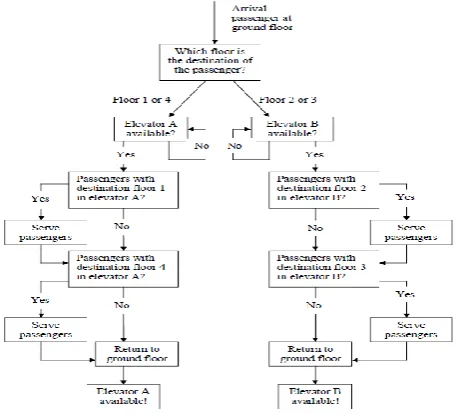
i. Elevator A allows only passengers with a specific destination floor, namely the floor numbers 1 and 4.
ii. Elevator B allows only passengers with a specific destination floor, namely the floor numbers 2 and 3.
iii. The elevator stops at floor i, if the destination position of a passenger is i.
iv. The elevator serves the passengers in the order of direction: if there are passengers with destinations i
and j and i < j, then the elevator stops at i before j.
v. If all passengers in the elevator are served and the elevator is empty, the elevator changes direction and moves to the ground floor.
Figure 5. Nested zoning
In No zoning, both elevators serve all passengers, so they can stop on every floor. An advantage of this strategy is that passengers with a certain destination floor can use both elevators; this can reduce the waiting time. But a disadvantage is, that the elevator makes more stops. Stop is a time consuming feature and because no zoning serves all the floors with both elevators, it performs worse in a high intensity situation where as zoning odd/even and Nested zoning works better. The difference between zoning odd/even and nested zoning is that we can group particular floor into particular zones, but in odd/even zoning only odd and even floors are zoned.
[image:4.595.38.269.287.494.2]5. MACHINE LEARNING AND ELEVATOR CONTROL SYSTEMS
Figure 6. Machine learning process
Artificial Intelligence, AI, is intelligence in machines or software. One area within AI is machine learning. The principle of machine learning is that a machine is able to learn from its environment and adapt. A machine learning framework is reinforcement learning, which includes a concept of having a scalar value corresponding to each action, with the goal to carry out actions that maximizes the scalar values. The machine has predefined environmental depending formulas which values an action with a scalar value [10].With the help of Machine learning we can adjust the speed of operation of car depending upon traffic pattern. Also, we can make the car to wait in particular floor in the particular time of the day. That is in morning time, passengers are always intended to above the floor if the building is office. Whereas, in apartments passengers are always intended to move down. So, in office buildings the car are always placed in ground floor at morning time, in apartments car is placed in higher floor with the help of Machine Learning if the car is idle. Similarly at lunch time the car is placed in middle floor of the building. For this Machine learning needs to learn. Learning happens from the environment, data has to be collected, stored and evaluated by the elevator control system as illustrated in Figure 2. All the information about the environment builds up a database, which can be used to be flexible during operation and thereby make the system as efficient as possible [11].
6. ALGORITHM IMPLEMENTATION
© 2016, IRJET | Impact Factor value: 4.45 | ISO 9001:2008 Certified Journal | Page 994 algorithms, or creating models. MATLAB provides an
environment that invites exploration and discovery.
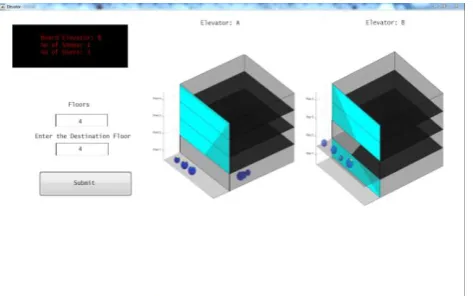
Figure 7. The GUI of Elevator model created in MATLAB
6.1 Pseudo Code NC
Call =current call FS = 1
N = number of floors
SelectedCar = first car in building
for Every car C in building do
d abs(Car.location − Call.Location)
if C is idle then
newFS == N + 1 − d
else if C is going down then
if Call is above then
newFs == 1
else if Call is below and Call direction is same as C
then
newFs == N + 2 − d
else if Call is below and Call direction is not same as
C then
newFs == N + 1 − d
end if
else if C is going up then
if Call is below then
newFs == 1
else if Call is above and Call direction is same as C
then
newFs == N + 2 − d
else if Call is above and Call direction is not same as
C then
newFs == N + 1 − d
end if end if
if newFS > FS then
SelectedCar C FS = newFS
end if
end for
return SelectedCar
The explanation of the above pseudo code is as follows- When the user comes and enters the destination floor to which he/she has to go .The code process the input as follows. Consider Figure 7 as an example, which has four floor and two elevators i.e. Elevator A and Elevator B. In Figure 7 user is making the request from 3rd floor
to move towards 4th floor. The Elevator A is in floor 1
[image:5.595.36.273.140.288.2]and picking the passenger and is ready to go in the above direction. The Elevator B is in floor 2dropping the passenger and it is also going the above direction. The FS of Elevator B values more than the FS of Elevator A. So the Algorithm selects Elevator B as the best car to serve the request and displays the information to the user regarding which elevator car that he/she as to board to reach their destination with minimum stops as quickly as possible as shown in Figure 7.
7. CONCLUSION
The group control can make many good decisions from the current environment it is possible for the elevator control system to determine the number of passengers that are waiting at different floors, how long they have waited and where the cars are currently positioned. With this data the elevator control system can make good decisions in down-peak. However data about the current environment does not improve time efficiency significantly during up-peak. It is difficult to provide a definite percentage, but the fact is that machine learning can increase time efficiency sufficiently to be considered a valuable approach for elevator control strategies in office buildings. Future studies can continue to investigate machine learning and its impact in the more general case.
REFERENCES
[1] Koehler J, Ottiger D. An AI-Based Approach to Destination Control in Elevators. AI Magazine. 2002; 23(3): 59-77. p. 66.
© 2016, IRJET | Impact Factor value: 4.45 | ISO 9001:2008 Certified Journal | Page 995 [3] Crites RH , Barto AG. Elevator Group Control Using
Multiple Reinforcement Learning Agents. Machine Learning. 1998; 33: 235-262. p. 246-253.
[4] Siikonen M-L . Planning and Control Models for Elevators in High-Rise Buildings. Helsinki University of Technology. 1997. Report No: A68. p. 6-7.
[5] Crites RH , Barto AG. Elevator Group Control Using Multiple Reinforcement Learning Agents. Machine Learning. 1998; 33: 235-262. p. 245.
[6] Strakosch G, Caporale R . The Vertical Transportation Handbook. Fourth ed. USA: John Wiley & Sons, Inc; 2010. p. 160-162.
[7] Koehler J, Ottiger D. An AI-Based Approach to Destination Control in Elevators. AI Magazine. 2002; 23(3): 59-77. p. 60-61.
[8] Koehler J, Ottiger D. An AI-Based Approach to Destination Control in Elevators. AI Magazine. 2002; 23(3): 59-77. p. 64.
[9] Crites RH , Barto AG. Elevator Group Control Using Multiple Reinforcement Learning Agents. Machine Learning. 1998; 33: 235-262. p. 242-251.
[10] Kamal A.S. Task-Oriented Reinforcement Learning [Master thesis]. Japan: KyushuUniversity; 2003. p. 1-8. Available
from:http://www.researchgate.net/profile/Mas_Kamal/ publication/239717074_Task
Oriented_Reinforcement_Learning/links/0a85e53c7875 b3a1bc000000.pdf
[11] Strakosch G, Caporale R . The Vertical Transportation Handbook. Fourth ed. USA: John Wiley & Sons, Inc; 2010. p. 133. Rong Aiying; Hakonen Henri; Lahdelma Risto. Estimated time of arrival (ETA)
[12] based elevator group control algorithm with more accurate estimation, Turku Centre for Computer Science, 2003.
[13] Barney Gina Carol. Elevator traffic handbook: theory and practice, Routledge,2003.
Author Profile