Iran J Public Health, Vol. 46, No.1, Jan 2017, pp.35-43
Original Article
Model-based Recursive Partitioning for Survival of Iranian
Female Breast Cancer Patients: Comparing with Parametric
Survival Models
Mozhgan SAFE
1, Javad FARADMAL
1, 2, Jalal POOROLAJAL
1, 2, *Hossein MAHJUB
1, 31. Dept. of Biostatistics, School of Public Health, Hamadan University of Medical Sciences, Hamadan, Iran 2. Modeling of Non-Communicable Diseases Research Center, Hamadan University of Medical Sciences, Hamadan, Iran
3. Research Center for Health Sciences, Hamadan University of Medical Sciences, Hamadan, Iran
*Corresponding Author: Email: [email protected]
(Received 24 Mar 2016; accepted 10 Sep 2016)
Introduction
Breast cancer, as the leading cause of women's cancer death throughout the world (1); is the second most common cancer among Iranian women (2). The progressive incidence of the dis-ease and consequently its heavy imposed psycho-logical and medical costs have enforced the health systems to search for efficient solutions in order to reduce this destructive burden. Surely, accurate diagnosis of protective and risk factors is the primary step for health care systems to
im-prove their clinical decision making in therapeutic and care strategies (3). Statistical survival models are scientific tools to assess the proficiency of applied treatments and to survey the effective-ness of diagnosed medical indicators. Although, various classical survival techniques have been introduced to model time to death of breast can-cer patients (4-6), but the superiority of machine learning algorithms has been proved recently in many survival studies (7-10). The higher
preci-Abstract
Background: Precise diagnosis of disease risk factors via efficient statistical models is the primary step for
re-ducing the heavy costs of breast cancer, as one of the most highly prevalent cancer throughout the world. There-fore, the aim of this study was to present a recently introduced statistical model in order to assess its proficiency for model fitting.
Methods: The information of 1465 eligible Iranian women with breast cancer was used for this retrospective
cohort study. The statistical performances of exponential, Weibull, Log-logistic and Lognormal, as the most proper parametric survival models, were evaluated and compared with 'Model-based Recursive Partitioning' in order to survey their capability of more relevant risk factor detection.
Results: 'Model-based Recursive Partitioning' recognized the largest number of significant affective risk factors,
whereas, all four parametric models agreed and unable to detect the effectiveness of 'Progesterone Receptor' as an indicator; 'Log-Normal-based Recursive Partitioning' could provide the paramount fit.
Conclusion: The superiority of'Model-based Recursive Partitioning' was ascertained; not only by its excellent
fitness but also by its susceptibility for classification of individuals to homogeneous severity levels and its impres-sive visual intuition potentiality.
sion of these novel methods has made them proper candidates to be compared with their tra-ditional counterparts. 'Model-Based Recursive Partitioning' (MoBRP) is a special hybrid tree al-gorithm (11). MoBRP susceptibility for classifica-tion of individuals to homogeneous severity le-vels should be mentioned as its prominent ability, in addition to its impressive visual intuition po-tentiality.
Practically, the semi-parametric Cox proportional hazard (CPH) model is the most widely used rep-resentative of regression models for survival data (12). There have been designed a lot of studies for identifying the risk factors which are threaten-ing the survival of Iranian women with breast cancer. Two pairs of model comparisons con-ducted; CPH versus shared frailty CPH, and CPH versus time-dependent CPH (6, 13). Para-metric survival modeling also forms some parts of organized investigations (14). Further to these long-established models, some newly introduced learning algorithms have been used recently (15-17). However, the only application of MoBRP, in the field of survival modeling, refers to German breast cancer data (11).
Actually, this investigation was designed to assess the MoBRP capacity for identifying more rele-vant risk factors other than those recognized by previously applied parametric survival models. The MoBRP performance was evaluated and compared with proper survival models under the assumptions of four statistical distributions as the most frequently used distributions for time to event analysis. MoBRP has not ever been com-pared to the parametric survival models. Briefly, the aim of this study was to present practically the MoBRP in order to model the survival time of Iranian women with breast cancer.
Materials and Methods
Patients
The information of 1465 eligible Iranian women with breast cancer was used for this retrospective cohort study. Patients had been followed for nearly 30 yr, by the 'Comprehensive Cancer
Con-trol Center' of Shahid Beheshti University of Medical Sciences, Tehran, Iran. Although this center is placed in Tehran, but is a comprehen-sive center and responsible for admission of every referring patient; therefore, patients from different parts of Iran are participated this study. Patients were diagnosed and classified by the 'International Classification of Diseases for On-cology 3rd edition sites C50.0-C50.9' and survival time was considered as the follow up period from surgical operation to the death of breast cancer. The applied dataset for this survey was heavy censoring such that 86% of patients did not ex-perience the death of breast cancer within the follow-up period. This investigation participated factors include some baseline and pathological prognostic characteristics as age, 'Human Epi-dermal growth factor Receptor 2' (HER2), 'Progesterone Receptor Status' (PR), 'Estrogen Receptor Status'(ER)
Model-Based Recursive Partitioning
Actually, MoBRP is a hybrid tree that refines classical modeling by the use of modern learning techniques of partitioning. Simply, if an overall model in the root node could not provide an ap-propriate fit to the total population, then obser-vations are partitioned in a manner that a proper specific model could be associated with each terminal node. In addition, to MoBRP interpre-tability and precise prediction, its capability to recognize nonlinear relationships, has made it illustrious for analyzing complex structures (18). The participated covariates in MoBRP algorithm could be considered from two classes; partition-ing covariates used for splitting, and model cova-riates used for node modeling. These two classes may be partially or completely the same (18). Fol-lowing is the systematic MoBRP processes:
I. A global model consists of model cova-riates, is fitted to the total population. II. The stability of estimated model
split-ting the total population. The stability as-sessments are according to the completely estimated model parameters.
III. At this step, the splitting point for the partitioning variable is determined in such way that an objective function is mini-mized; this function could be the error sum of squares or negative log-likelihood of the tree calculated through all terminal nodes.
IV. The two previous steps are repeated at each terminal node and the tree would be grown.
Statistical Analysis
Parametric survival models and MoBRP were fitted and their statistical performances were checked under the assumptions of four most common survival distributions (19-21); as expo-nential, Weibull, Log-logistic, and Lognormal. The effects of probable risk factors were assayed through these pointed statistical methods and homogeneous groups of Iranian breast cancer patients were formed by the use of MoBRP algo-rithm.
Since MoBRPs could be considered as high inte-raction models nested in parametric models, 'Likelihood Ratio Test' (LRT) was used to com-pare MoBRPs with routine survival models for each of the named distributions. Additionally, 'Akaike Information Criterion' (AIC) was em-ployed to verify the supremacy between different models of different distributions.
Results
The mean (SE) and median of survival time of female breast cancer patients were 4.16 (0.10) and 3.07 yr and the five-yr survival was 84% (95%CI: 81%-87%), respectively. The youngest participant was twenty yr old and the median of patients' age was 54 yr. Approximately, 90% of individuals were older than 39 yr and according to the de-scriptive analysis 75.8%, 72.5% and 19% were ER+, PR+ and HER2+, respectively.
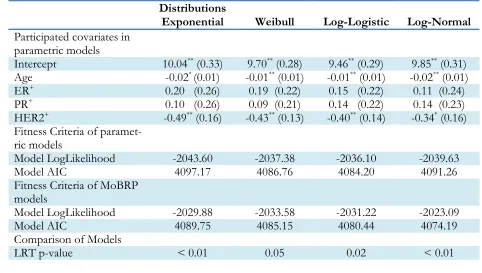
Table 1 presents the results of model fitting. The first part of this Table regards to parametric model estimations; the significant negative coef-ficients of age and HER2 certify their adverse effects confirmed by all four models. Comparing parametric survival models for different statistical distributions, verified the minimum 'AIC' was attributed to Log-logistic model; following Wei-bull, Lognormal and then the exponential mod-els. LRT confirmed the supremacy of Weibull to exponential model (LRT P-value=0.01).
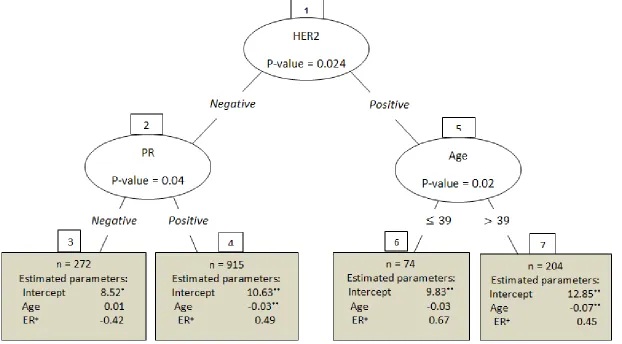
In contrast to parametric models, LRT declared no significant differences between Weibull and exponential recursive partitioning. However, in accordance with parametric models, age and HER2 were known as effectual factors for sur-vival modeling for each of the four distribution assumptions. Since exponential is the simplest survival distribution, Fig. 1 displays the tree parti-tioning in the case of exponential survival time assumption. As can be seen from this visualiza-tion; MoBRP was grown by splitting through HER2, PR and age; where ER and age were used for node modeling. Other than ER, all of the named covariates (as partitioning or modeling) were recognized significant affective risk factors for classification or modeling. Although, age was applied for classification and node model stabili-ty, but it was also significant within two of the four formed terminal nodes; such that demon-strated P-value< 0.01 for both of the second and fourth terminal nodes.
The second section of Table 1 that Lognormal, Log-logistic, Weibull, and exponential were, re-spectively the statistical distributions for which MoBRP provided lower 'AIC' and therefore, bet-ter fits for survival time of females with breast cancer.
to exponential distribution; the next places were allocated to Log-Logistic and Weibull, respective-ly.
Finally, the Lognormal recursive partitioning had the smallest AIC among the eight fitted models and, in this sense, was the best fitting model.
Table 1: Comparison of models for different survival times distributions
Distributions
Exponential Weibull Log-Logistic Log-Normal Participated covariates in
parametric models
Intercept 10.04** (0.33) 9.70** (0.28) 9.46** (0.29) 9.85** (0.31) Age -0.02* (0.01) -0.01** (0.01) -0.01** (0.01) -0.02** (0.01)
ER+ 0.20 (0.26) 0.19 (0.22) 0.15 (0.22) 0.11 (0.24)
PR+ 0.10 (0.26) 0.09 (0.21) 0.14 (0.22) 0.14 (0.23)
HER2+ -0.49** (0.16) -0.43** (0.13) -0.40** (0.14) -0.34* (0.16) Fitness Criteria of
paramet-ric models
Model LogLikelihood -2043.60 -2037.38 -2036.10 -2039.63
Model AIC 4097.17 4086.76 4084.20 4091.26
Fitness Criteria of MoBRP models
Model LogLikelihood -2029.88 -2033.58 -2031.22 -2023.09
Model AIC 4089.75 4085.15 4080.44 4074.19
Comparison of Models
LRT p-value < 0.01 0.05 0.02 < 0.01
*Significant at 5% level; **Significant at 1% level; PR+: being progesterone receptor positive breast cancer patient; ER+: being estrogen receptor positive breast cancer patient; HER2+: being epidermal growth factor receptor-2 positive breast cancer patient; AIC: Akaike Information Criterion; MoBRP: Model-Based Recur-sive Partitioning; LRT: Maximum Likelihood Ratio Test
According to this tree-terminal-node fit, patients were classified by their PR and HER2 status; PR -individuals formed the first terminal node while the remains, divided by their HER2 status, formed the second and third terminal nodes. The longest predicted survival time (i.e. 41.32 yr) was associated to the second terminal node, where the patients were PR+ and HER2-; versus, PR- or PR+ and simultaneously HER2+ patients (i.e. the first and third terminal nodes) confirmed almost the same and lower length of survival time. Therefore, this best fitting model has intro-duced the simultaneously PR+ and HER2- pa-tients as the low risk group. In agreement with parametric models, this recursive partitioning also
failed to recognize any significant effect for ER. This learning method additionally clarified that 22-yr acceleration in disease formation would cause a fraction of size 50% to the patients' sur-vival length time; In other words, the earlier crea-tion of the breast tumor, for almost 22 yr, would reduce the behalf of survival time.
Discussion
hidden interactions and classified patients to ho-mogeneous severity subsets. As can be seen from its prominent visual description, MoBRP identi-fied one more prognostic factor (i.e. PR) addition to those recognized by proper parametric models. Since the effectiveness of this partitioning factor was previously certified in many clinical types of research regarding breast cancer prognostication in Iran (13, 22), therefore, the MoBRP more pro-ficiency for detecting significant factors, was proved from the experimental perspective; the validation of this risk factor detection was also ascertained by LRT, from the statistical perspec-tive. Following is a more detailed discussion of both medical and statistical aspects.
Regarding the resemblance of parametric model estimated parameters and their proximate AICs, all four models demonstrated the same perfor-mances as each other's. The most observed dif-ference between estimated parameters, associated to risk factors, was 0.15 and referred to HER2+
under the two assumptions of exponential and Lognormal. Moreover, all models determined the protective or risk effect of factors, the same way. The effects of covariates, recognized as signifi-cant factors, have been confirmed by many pre-vious researches. Surely, there are numerous stu-dies proven the adverse effects of age and HER2+ in the field of breast cancer (6, 13).
Additionally, the correct recognition of risk fac-tors could be observed for all significant effects associated with terminal nodes of MoBRP. The estimated parameters were negative for every sig-nificant age effect (Fig. 1); introducing age as a risk factor.
Another worth noting marvel of MoBRP was its cut point selection of the age partitioning cova-riate (i.e. 39 yr). This cut point is almost the same as '40 yr' chosen by many articles previously. The burden of disease bothers younger patients more than usual; In other words, they were divided the Iranian breast cancer patients to two subpopula-tions as young and old. The burden of the disease does not follow the common distribution, as Ira-nian patients with breast cancer are younger than the western countries (23). Therefore, "Special
programs should be considered for women under 40 yr old"
(2). This cut point was chosen according to expe-rimental physicians' experiences through some other researches (24, 25).
The split through PR, was the common feature of the current investigation and the previous ex-clusive applied of MoBRP algorithm, in the sur-vival analysis (Fig. 1) (11). The information of 686 women from positive-node breast cancer was analyzed via the mentioned research. Patients were from German and eight prognostic factors were involved in MoBRP, two of them were used as model covariates and the remains, including age, ER, and PR, were employed as partitioning covariates. Weibull distribution was assumed for survival time and the tree was grown by just one split through PR. This two-terminal-node tree had nine parameters and its AIC was 1637.85. Unlike the current Iranian survey, in the German usage of MoBRP, the progesterone receptor was measured and treated as a numerical variable (i.e. fmol cytosol protein/mg) and the tree was sub-ject to find the proper cut point for PR partition-ing. Considering the MoBRP skill for finding cut points through maximizing likelihood, the availa-ble information on the current dataset only con-tains negative/positive state of patients' PR; therefore, the binary partitioning would be cer-tain after the selection of PR and this would limit the MoBRP excellent operation.
The most similar scientific method to current practical survey could be referenced to exponen-tial tree (26). As is obvious by its name, the un-derlying exponential failure distribution was as-sumed for tree but the main difference between mentioned and current applied recursive parti-tioning is the statistical modeling in each node that is the exclusive ability of MoBRP. All the subjects in each node of the exponential tree have the same hazard rate, in other words, all the participated covariates in exponential tree are partitioning, while the hazard for subjects in a specific node of MoBRP could be different and would be determined by individual characteris-tics, which model the location parameter of the node distribution.
MoBRP and exponential tree. Although, MoBRP cut point selection is through maximizing likelih-ood but partitioning variable selection is accord-ing to the stability of estimated parameters. How-ever, for exponential tree, variable and simulta-neously optimal cut point selection is according to maximizing the likelihood of interval-censored survival times; simply, the exponential tree is grown by examining every allowable split on each covariate and therefore, numerous statistical tests and consequently selection bias are imposed to the algorithm (26, 27).
Limitations
Unfortunately, the available patients' medical records only contain their negative/positive sta-tus of PR, ER, and HER2, however, MoBRP was plausibly able to provide better fits if it was sup-ported by the underlying numerical measurement of these risk factors.
Conclusion
Our study reveals the newly introduced machine-learning algorithm, Model-based Recursive Parti-tioning, performed superior to the usual parame-tric models. Actually, the MoBRP potentiality to diagnose complex interactions and high order effects, supplemented with its impressive visual intuition has made it as a worthy complement in the context of survival model fitting. Moreover, its talent for regression modeling accompanied by simultaneous classification has famed it as an ex-clusive evolutionary fashion.
Ethical considerations
Ethical issues (Including plagiarism, informed consent, misconduct, data fabrication and/or fal-sification, double publication and/or submission, redundancy, etc.) have been completely observed by the authors.
Acknowledgments
We appreciate Vice Chancellor for Research and Technology of Hamadan University of Medical Sciences for financial support of this study. The authors declare that they have no conflicts of in-terest to declare.
References
1. Liang B, Yunhui L (2014). Prognostic Significance of VEGF-C Expression in Patients with Breast Cancer: A Meta-Analysis. Iran J Public Health, 43(2):128-35.
2. Mousavi SM, Mohaghegghi MA, Mousavi-Jerrahi A, Nahvijou A, Seddighi Z (2006). Burden of breast cancer in Iran: a study of the Tehran population-based cancer registry.
Asian Pac J Cancer Prev, 7(4):571-4.
3. Cui J, Zhou L, Wee B, Shen F, Ma X, Zhao J (2014). Predicting Survival Time in Noncurative Patients with Advanced Cancer: A Prospective Study in China. J Palliat Med, 17(5):545-52. 4. Baneshi M, Talei A (2012). Assessment of
Internal Validity of Prognostic Models through Bootstrapping and Multiple Imputation of Missing Data. Iran J
Public Health, 41(5):110-5.
5. Rashidian A, Barfar E, Hosseini H, Nosratnejad S, Barooti E (2013). Cost effectiveness of breast cancer screening using mammography; a systematic review. Iran J Public Health, 42(4):347-57.
6. Faradmal J, Talebi A, Rezaianzadeh A, Mahjub H (2012). Survival analysis of breast cancer patients using cox and frailty models. J Res Health Sci,
12(2):127-30.
predicting coronary artery disease.
Expert Syst Appl, 34(1):366-74.
8. Süt N, Şenocak M (2007). Assessment of the performances of multilayer perceptron neural networks in comparison with recurrent neural networks and two statistical methods for diagnosing coronary artery disease.
Expert Syst, 24(3):131-42.
9. Nilsson J, Ohlsson M, Thulin L, Höglund P, Nashef SA, Brandt J (2006). Risk factor identification and mortality prediction in cardiac surgery using artificial neural networks. J Thorac
Cardiovasc Surg, 132(1):12-9.
10.Shi HY, Hwang SL, Lee KT, Lin CL (2013). In-hospital mortality after traumatic brain injury surgery: a nationwide population-based comparison of mortality predictors used in artificial neural network and logistic regression models: clinical article. J Neurosurg, 118(4):746-52. 11.Zeileis A, Hothorn T, Hornik K (2006).
Evaluating model-based trees in practice
(Tech. Rep. No. 32). Vienna, Austria: Vienna University of Economics and Business, Department of Statistics and Mathematics.
12.Hothorn T, Bühlmann P, Dudoit S, Molinaro A, Van Der Laan MJ (2006). Survival ensembles. Biostatistics, 7(3):355-73.
13.Faradmal J, Mafi M, Sadighi-Pashaki A, Karami M, Roshanaei G (2014). Factors Affecting Survival in Breast Cancer Patients Referred to the Darol Aitam-e Mahdieh Center. J Zanjan Univ
Med Sci, 22(93):105-15.
14.Baghestani A, Moghaddam S, Majd H, Akbari M, Nafissi N, Gohari K (2015). Survival Analysis of Patients with Breast Cancer using Weibull Parametric Model. Asian Pac J Cancer
Prev, 16(18):8567-71.
15.Ahmad LG, Eshlaghy AT, Poorebrahimi A, Ebrahimi M and Razavi AR (2013).
Using three machine learning techniques for predicting breast cancer recurrence. J Health Med Inform, 4:124. 16.Faradmal J, Soltanian AR, Roshanaei G,
Khodabakhshi R, Kasaeian A (2014). Comparison of the performance of log-logistic regression and artificial neural networks for predicting breast cancer relapse. Asian Pac J Cancer Prev,
15(14):5883-8.
17.Salehi M, Gohari M, Vahabi N, Zayeri F, Yahyazadeh S, Kafashian M (2013). Comparison of artificial neural network and cox regression models in survival prediction of breast cancer patients. J Ilam Univ Med Sci, 21(2):120-8.
18.Zeileis A, Hothorn T, Hornik K (2008). Model-based recursive partitioning. J
Comp Graph Stat, 17(2):492-514.
19.Corbiere F, Joly P (2007). A SAS macro for parametric and semiparametric mixture cure models. Comput Methods
Programs Biomed, 85(2):173-80.
20.Basu S, Tiwari RC (2010). Breast cancer survival, competing risks and mixture cure model: a Bayesian analysis. J R
Stat Soc Ser A, 173(2):307-29.
21.Woods L, Rachet B, Lambert P, Coleman M (2009). ‘Cure’from breast cancer among two populations of women followed for 23 yr after diagnosis. Ann
Oncol, 20(8):1331-6.
22.Jafari-Koshki T, Mansourian M, Mokarian F (2014). Exploring Factors Related to Metastasis Free Survival in Breast Cancer Patients Using Bayesian Cure Models. Asian Pac J Cancer Prev,
15(22):9673-8.
23.Mousavi SM, Montazeri A, Mohagheghi MA, Jarrahi AM, Harirchi I, Najafi M, Ebrahimi M (2007). Breast cancer in Iran: an epidemiological review. Breast J, 13(4):383-91.
logistic regression and recursive partitioning to predict chemotherapy response of breast cancer based on clinical pathological variables. Breast
Cancer Res Treat, 117(2):325-31.
25.Rondeau V, Schaffner E, Corbière F, Gonzalez JR, Mathoulin-Pélissier S (2013). Cure frailty models for survival data: Application to recurrences for breast cancer and to hospital
readmissions for colorectal cancer. Stat
Methods Med Res, 22(3):243-60.
26.Yin Y, Anderson SJ (2001). Exponential Tree-Structured Modeling for Interval-Censored Survival Data. Proc Am Stat
Assoc, Biometrics Section. Alexandria, VA:
American Statistical Association. 27.Kim H, Loh WY (2011). Classification
trees with unbiased multiway splits. J