http://dx.doi.org/10.4236/jamp.2015.32031
Evaluation of the Surface of Nitinol after MR
Polishing Process
Byung-Chan Kim1, Jung-Won Lee1, Seok-Jae Ha1, Yong-Kyu Cho1, Dong-Sung Kang2,
Myeong-Woo Cho1
1Department of Mechanical Engineering, Inha University, Incheon, Republic of Korea 2WISYS, Gunpo-si, Republic of Korea
Email: [email protected]
Received 17 December 2014
Abstract
Nitinol is used in various industries, especially for biomaterials. Generally, the surface integrity of sub-micron level and non-surface flaw is required in nitinol for biomaterial. However, surface flaws, such as scratches, pits, and residual stress, can occur on the polished surface, and it is diffi-cult to remove these surface flaws. The corrosion is accelerated continuously and causes bad in-fluence in the body. Therefore, in this study, conventional polishing and MR polishing were used to minimize the corrosion and residual stress when the nitinol is used as biomaterial. X-ray diffrac-tion and Tafel extrapoladiffrac-tion were used to investigate the residual stress and the corrosion, and the strain hardening was investigated by nanoindentation. Surface integrities were also evaluated by SEM image and surface roughness results. As a result, the increased residual stress in conven-tional polishing was decreased by MR polishing. The result of corrosion test was improved from −301 mV to −280 mV. The residual stress was improved from −38.18 MPa to −31.17 MPa. Finally, it is certified that MR polishing can be used to minimize surface flaws and to improve the corrosion properties.
Keywords
Nitinol, MR Polishing, Corrosion Test, Residual Stress, Strain Hardening
1. Introduction
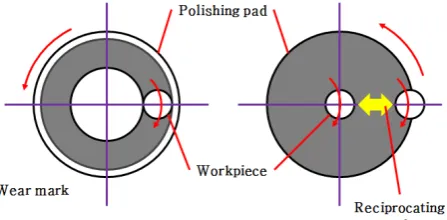
tion between workpiece and polishing pad. Mirror and flattening surface can be obtained. The polishing system consists of sandpaper, polishing head (fixation and uniform pressure), holder, rotating plate and abrasive. To minimize the deformed layer, the pressure between polishing pad and workpiece is increased, occasionally. To obtain high polishing effect, the repetitive motion in radial direction is acquired (Figure 1). Figure 2 is a system that is used to experiment conventional polishing (MECAPOL P320). Rotational speed (100 rpm), polishing time (5 min), and pressure (1.0 N) were fixed, constantly.
2.2. MR Polishing Process
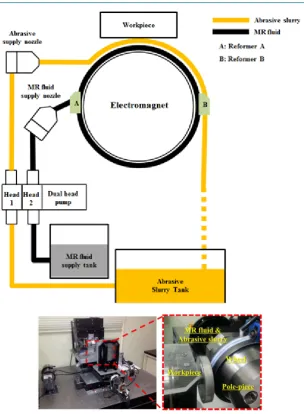
[image:2.595.188.412.445.555.2]In MR polishing process, the form accuracy obtained by conventional polishing can be retained and the surface roughness can be improved. Also, MR polishing process can control the shear force through the viscosity changes with magnetic field. Figure 3 shows the principle of MR polishing process and experimental system. A magnetic field is applied to the rotating wheel, then, the rotating wheel is magnetized. MR fluid is supplied on the wheel surface and is stiffened by the applied magnetic field. Stiffened MR fluid layer acts as a polishing pad. The polishing area is formed when MR fluid is supplied into the gap size between workpiece and wheel. The abrasives can be reused by circulation system and is supplied onto the rotating MR fluid layer. To fix height of
Figure 1. Principle of conventional polishing.
[image:2.595.186.410.590.704.2]Figure 3. Experimental setup for MR polishing.
MR fluid for obtaining the uniform polishing results, the reformer was applied. In this study, the experimental conditions which can be obtained very fine surface roughness in previous study were selected. The investigation of surface roughness, residual stress, and corrosion characteristics were carried out in experiments. Experimental conditions were listed in Table 1 and Table 2.
3. Results and Discussions
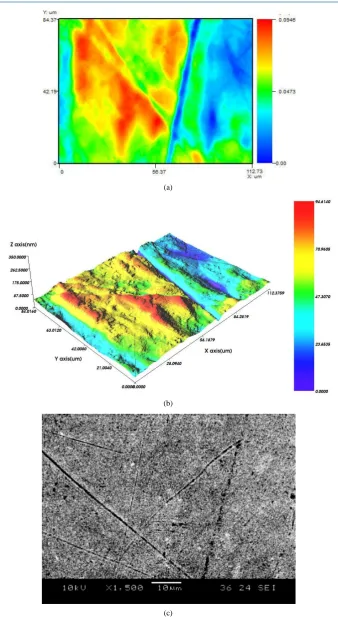
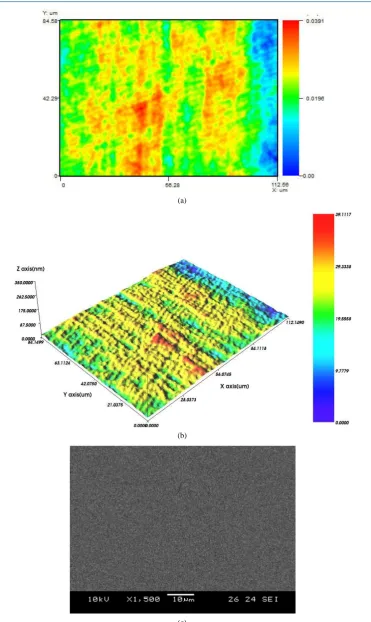
3.1. Analysis of Surface RoughnessFigure 4 and Figure 5 show the measured 3D profile and the SEM image for the surface roughness after each process. As a result, surface roughness as Ra = 12.91 nm, Rmax = 94 nm can be obtained. However, although SiC particle is small, surface flaw was still existed in SEM image because of the scratch and pit. It can be seen that conventional polishing process can cause increase the surface flaws.
(a)
(b)
[image:4.595.129.468.76.694.2](c)
(a)
(b)
[image:5.595.115.487.76.699.2](c)
after MR polishing process, but lower than that of conventional polishing. It means that both processes can eliminate the work-hardening layer and generated deformed layer. The stress corrosion crack is generated in tensile residual stress. However, the compressive residual stress is existed in surface both processes. As a result, the problem according to residual stress cannot be occurred.
3.3. Analysis of Work Hardening
Work hardening has advantage as increasing mechanical hardness and strength, but decreasing corrosion resis-tance and elongation. This can be seen in contact mechanical polishing process such as conventional polishing, and can be generated due to deformed layer by the mechanical stress in polishing process.
Nanoindentation is used to measure the hardness for analysis of work hardening property. Using CMS module of Nano Indentor G200 (Agilent Technologies, USA), the hardness and Young’s modulus according to pressing depth are measured each polished work pieces. Pressing depth is by 2000 nm.
As Figure 7, the deviation is gradually decreased and consistent between 200 nm and 500 nm in conventional polished work piece. While, the deviation can be seen consistent from the beginning press and decreased with increasing the depth after MR polishing process. The reason of large deviation after conventional polishing process is non-consistent surface roughness, increase of dislocation density by mechanical stress and generated work hardening in deformed layer.
Figure 8 shows the Young’s modulus after each process. The Young’s modulus of conventional polished work piece is not consistent rather than that of MR polished, and the deviation is not decreased with increasing pressing depth. Figure 9 and Figure 10 show the load-distance curve of material surface of each process. The curve is obtained smooth and continuous after MR polishing, but the free from curve is seen after conventional polishing. This phenomenon, which is sharply changed in any load, is called Pop-in. Because of increasing dis-location and crack of material surface in critical load and the disdis-location activities of pressed material result in Pop-in. In contrast the Pop-in is not seen in MR polishing process.
The reason of increasing hardness and Young’s modulus as Table 3 is the deformed property according to the characteristic of shape memory alloy of nitinol. In polishing process, the Phase transform is generated and in-creased the hardness. The martensite, the component of nitinol, is transformed to detwinned martensite, which of hardness is higher than that of martensite. After MR polishing process, the measured hardness is nearly same as that of raw workpiece, which means that the mechanical stress and material removal rate to workpiece is small. As a result of this, the work hardening is seldom generated. The material removal rate of MR polishing accord-ing to nitinol is 550 nm/min and the deformed layer generated by conventional polishaccord-ing is removed. Also, by measuring through nanoindentation, it can be seen that the work hardening is not generated in material for MR polishing.
3.4. Analysis of Corrosion Test
Figure 6. Measured residual stress of raw, conven-tional polished and MR polished workpiece.
[image:7.595.140.490.235.363.2]
(a) (b)
Figure 7. Measured hardness after conventional polishing and MR polishing. (a) Conventional po-lishing; (b) MR polishing.
[image:7.595.140.490.405.530.2]
(a) (b)
Figure 8. Measured Young’s modulus after conventional polishing and MR polishing. (a) Conven-tional polishing; (b) MR polishing.
[image:7.595.134.463.573.703.2]Figure 10. Load-displacement curve after MR polishing.
Table 3. Result of nanoindentation test.
Hardness Moulus
Conventional polishing 3.91 GPa ± 0.37 GPa 71.2 GPa ±5.4 GPa
MR polishing 3.06 GPa ± 0.27 GPa 61.9 GPa ± 3.4 GPa
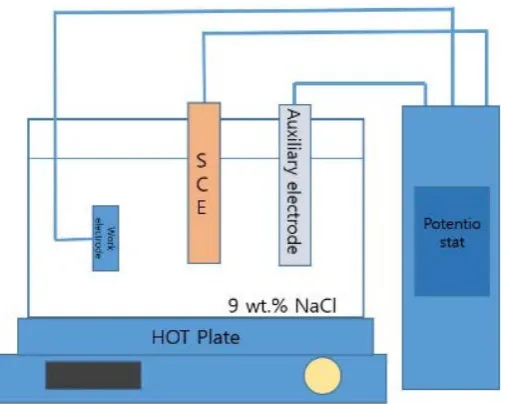
In this study, Potentiostat (EG&G, PAR 273A, USA) with three-electrode was used to preform corrosion test as Figure 11. Nitinol was used as work electrode, and counter and reference electrode were adopted platinum and Ag/AgCl. NaCl (9 wt%) was selected as electrolyte [6]. Nitrogen gas was input to remove the dissolved oxygen, and a series of experiment was performed to create a similar atmosphere of human body.
The results of corrosion test were shown in Figure 12. After conventional polishing, corrosion potential (Ecorr) was −301 mV, but that of MR polishing was −280 mV. It seems to be increased the corrosion potential due to improving the surface roughness. After MR polishing, corrosion current (Icorr) was lower than that of conven-tional polishing. Current was kept constantly with the increasing voltage, which is called Passivation region. This is also seen at low current density. It can be seen that the corrosion resistance is more improved by MR po-lishing process than conventional popo-lishing process. The improved corrosion resistance can be obtained from the stability of corrosion due to very fine surface roughness [7].
4. Conclusions
In this study, conventional polishing and MR polishing process were carried out to investigate the improvement of surface integrity and the surface flaws. Surface roughness, residual stress, work hardening and corrosion properties were investigated. Conclusions of this study are as follows.
1) Surface roughness (Ra = 12.91 nm) was obtained by conventional polishing process. However, scratches and tool marks still existed. That is, conventional polishing process cannot be used to get a fine surface integrity. In case of MR polishing process, very fine surface roughness (Ra = 3.72 nm) could be obtained, and scratches and tool mark did not exist.
2) After conventional polishing process, compressive residual stress (38 MPa) was appeared. Existed grinding and polishing process can form compressive residual stress. Therefore, stress corrosion crack from tensile residual stress will appear on the surface. However, MR polishing process was carried out to remove surface flaws. As a result, compressive residual stress (34 MPa) existed. It means that residual stress was eliminated by MR polishing process.
[image:8.595.85.538.299.342.2]Figure 11. Schematic diagram of corrosion test.
Figure 12. Result of corrosion test with polishing processes.
4) Corrosion potential was −301 mV after conventional polishing, and in case of MR polishing, it was −280 mV. From this result, it was identified that corrosion resistance was improved. Passivation region whose current has been kept constantly with the increasing voltage was also generated at low current density after MR polishing. It can be seen that MR polishing process is better polishing process than conventional polish-ing process.
Acknowledgements
This work was supported by Inha University Research Grant and also partially supported by National Research Foundation of Korea grants funded by the Korean government (NRF-2011-0022129).
References
[1] Wu, M.H. (2001) Fabrication of Nitinol Materials and Components. Proc. of the Int. Conf. Shape Memo. and Sup. Elas. Tech, 517-521.
[image:9.595.156.444.315.510.2]