© 2016, IRJET | Impact Factor value: 4.45 | ISO 9001:2008 Certified Journal | Page 611
Comparison of Seismic Behavior of Building with Fixed Base, Base
Isolator and Shear Wall
Thriveni P
1, Dr Manjunath N Hegde
21
Mtech Structural Student, Dept of Civil Engineering, Dr Ambedkar Institute of Technology, Bangalore, Karnataka,
India
2
Professor and Dean , Dept of Civil Engineering, Dr Ambedkar Institute of Technology, Bangalore, Karnataka, India
---***---Abstract -
Earthquake is the frequently occurring vibrationof earth surface which results in damaging of structures and causes loss of lives. This leads to need of structural design based on seismic responses by adopting suitable methods to increase strength and stability of structures. Earthquake on the structures is reduced by using base isolators, shear walls and minimize the damage of structure. In this research an attempt is made to study the results for building with fixed base, base isolator (rubber isolator), and damper and shear wall. Here irregular plan building of (G+7) floor is taken for analysis. For seismic zone IV by considering type II (medium) soil using ETABS Software. Analysis is carried out by both equivalent static method and response spectrum method. Results like time period, displacement, storey drift and base shear are compared for building with base isolator and shear wall with fixed base building.
Key Words: Base Isolator, Shear Wall, Response Spectrum Analysis, Equivalent Static Analysis.
1. INTRODUCTION
Structures are constructed to perform `various functions related to residence, office, education, healthcare, sports and recreation, transportation, storage etc. The structures should sustain load coming on them during their service life by possessing adequate strength and stiffness by limiting the deformation.
The strength of the structure depends on the geometry of the structure. Multi-storied buildings are affected by lateral forces due to wind or earthquake forces and they play an important role in design of structure. The dominant structural design requirement is therefore provision for appropriate internal layout for the structure and it is essential for the architect to satisfy the client. The layout will be within a structural mesh that must be less obstructive.
Earthquakes are the shaking of surface of the earth caused due to sudden energy release in the earth crust and it leads to cause seismic waves. Earthquakes are most dangerous natural hazards, which cause great losses of life and livelihood. The main reasons for earthquakes are the collision of tectonic plates colliding and volcanic eruption. Most of earthquake losses are due to building collapses and
also earthquake effects are like landslides, fire, floods etc. Earthquake effects depend on the shape, size and geometry of the buildings. Therefore good building configuration is to be chosen. The main aim of earthquake resisting construction is that the structure does not collapse during earthquake. Earthquakes originate at the depth below the earth surface and cause ground motion with various amplitude and time period. As a result of ground motion, building above the ground starts vibrating. The magnitude of vibration depends on the ground motion intensity. The intensity of earthquake depends on magnitude of earthquake, distance from epicentre, duration of earthquake, water table depth. To minimize earthquake risks many techniques are adopted like base isolation, dampers, shear walls.
1.1 Base Isolation
Base Isolation is the most established application of the passive control approach. It is most widely accepted to protection of system in earthquake prone area. The aim of Base Isolation is to reduce the story drift and base shear due to earthquake. It is applied to the superstructure of the building by installing base isolators at the foundation level. When the building is mounted on low lateral stiffness material like rubber leads flexible base to the structure. When earthquake occurs the flexible base of the structure will be able to filter out high frequencies from the ground motion and it also prevents collapse of building.
1.3 Shear wall
© 2016, IRJET | Impact Factor value: 4.45 | ISO 9001:2008 Certified Journal | Page 612
2. METHODOLOGY
During earthquake the loads in the structure reach to collapse load and the stresses in the materials will reach above yield stresses. The following methods are used for analysis.
2.1 EQUIVALENT STATIC ANALYSIS
Equivalent static method is used for calculating static load for low rise buildings. In this method only one mode is considered. Analysis of high rise building needs more than two modes and is analyzed by dynamic analysis. It starts with the computation of base shear load and its distribution on each storey using formulas given in code. The equivalent static analysis suites for low to medium-rise buildings without coupled lateral torsional modes in which first mode is considered in each direction.
2.2 RESPONSE SPECTRUM ANALYSIS
A Response spectrum is a plot of maximum value of response like displacement, velocity or acceleration of a series of oscillator of varying period or natural frequency and that are forced into motion by same shock. When the earthquake force acts on foundation of building it will move along the ground motion but the movement of building is more than ground motion. The movement of building depends on the natural frequency of vibration. IS 1893 (Part I):2002 is used for seismic analysis. This method is used for those buildings having more than two modes other than fundamental one which affect the response of building. In this method each modal response obtained by spectral analysis of single degree freedom systems are combined and expressed in multi degree freedom system to compute total response.
3 STRUCUTRAL MODELLING
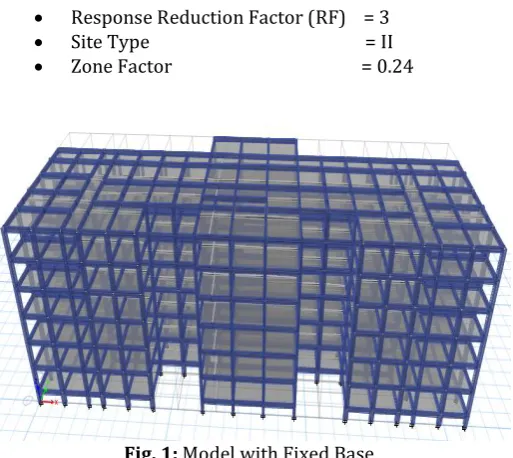
Modeling and Analysis were carried out by using ETABS 2015 software. In this analysis, an attempt is made to study the effect of different earthquake reducing technologies like base isolator, and shear wall on building and compared the results obtained. The analysis is carried out for two seismic zones, zone II and zone IV in both equivalent static and response spectrum method. The plan dimension of the model is 64.7m X 17.12m
3.1 PRELIMINARY DATA:
Number of stories = 7
Typical storey height = 3m
Bottom storey height = 1.5m
Grade of Concrete = 30N/mm2
Slab thickness (S1) = 200mm
Wall thickness (W1) = 250mm
Beam size (B1) = 450*200mm
Beam size (B2) = 400*400mm
Column size (C1) = 300*300mm
Column size (C2) = 600*300mm
Seismic Zone =IV
Importance Factor (I) = 1.5
Response Reduction Factor (RF) = 3
Site Type = II
[image:2.595.303.568.97.570.2] Zone Factor = 0.24
Fig. 1: Model with Fixed Base
Fig. 2: Model with Rubber Isolator
[image:2.595.309.566.121.350.2]© 2016, IRJET | Impact Factor value: 4.45 | ISO 9001:2008 Certified Journal | Page 613
4 RESULTS and Discussions:
The results obtained by both static and dynamic analysis are tabulated and various parameters such as displacement, storey drift, storey stiffness, and time period are discussed for model with fixed base, model with base isolator and model with shear wall.
[image:3.595.308.558.99.238.2]4.1 TIME PERIOD:
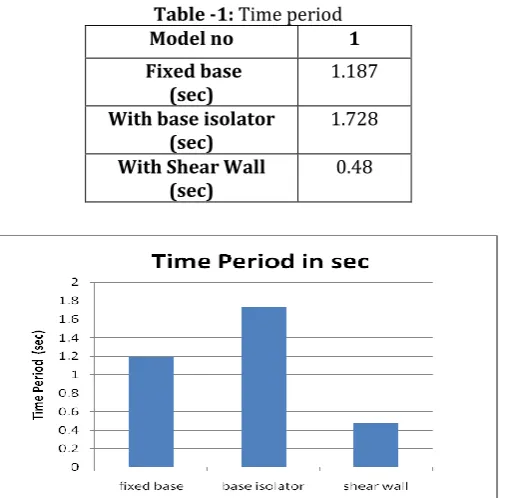
Table -1: Time period
Model no 1
Fixed base
(sec) 1.187 With base isolator
(sec) 1.728 With Shear Wall
[image:3.595.37.291.204.453.2](sec) 0.48
Fig. 4: Time period plot for model with fixed base, base isolator and shear wall
Fig 5.22.1 shows the plot of time period of building for models with fixed base, base isolator, and shear wall obtained by analysis. Here it is observed that model with base isolator has maximum value of time period compare to models with fixed base and shear wall respectively.
4.2 STOREY DISPLACEMENT:
4.2.1 EQUIVALENT STATIC ANALYSIS:
[image:3.595.306.553.284.432.2]Fig. 5: Storey displacement plot obtained from equivalent static analysis for different cases in X direction
Fig. 6: Storey displacement plot obtained from equivalent static analysis for different cases in Y direction 4.2.2 RESPONSE SPECTRUM ANALYSIS:
Fig. 7: Storey displacement plot obtained from response spectrum analysis for different cases in X direction
Fig. 8: Storey displacement plot obtained from response
[image:3.595.311.557.477.619.2] [image:3.595.37.279.553.728.2]© 2016, IRJET | Impact Factor value: 4.45 | ISO 9001:2008 Certified Journal | Page 614 4.3 STOREY DRIFT:
4.3.1 EQUIVALENT STATIC ANALYSIS:
[image:4.595.39.282.103.291.2][image:4.595.307.549.115.256.2]
Fig. 9: Storey drift plot obtained from equivalent static analysis for different cases in X direction
Fig. 10: Storey drift plot obtained from equivalent static analysis for different cases in Y direction
4.3.2 RESPONSE SPECTRUM ANALYSIS:
[image:4.595.42.282.340.493.2]Fig.11: Storey drift plot obtained from response spectrum analysis for different cases in X direction
Fig.12: Storey drift plot obtained from response spectrum analysis for different cases in Y direction.
From fig 9 to 12 the plot of each storey drift of building in X and Y direction for models with fixed base, base isolator and shear wall obtained by equivalent static analysis and response spectrum for zone IV. Here it is observed that model with base isolator has maximum drift value compare to models with fixed base and shear wall respectively.
4.4 BASE SHEAR:
4.4.1 EQUIVALENT STATIC ANALYSIS:
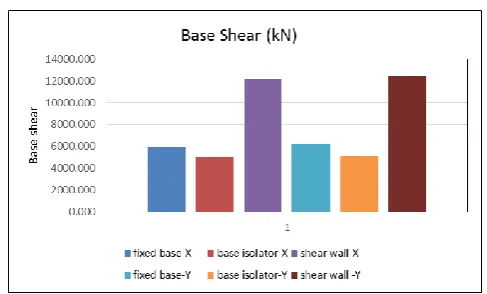
Fig. 13: Base shear plot obtained from equivalent static analysis for different cases in X and Y direction 4.4.2 RESPONSE SPECTRUM ANALYSIS:
[image:4.595.307.551.396.538.2] [image:4.595.37.269.556.729.2] [image:4.595.311.555.586.733.2]© 2016, IRJET | Impact Factor value: 4.45 | ISO 9001:2008 Certified Journal | Page 615 Fig 13 and 14 shows the plot of base shear of building in X
and Y direction for models with fixed base, base isolator,
shear wall obtained by equivalent static analysis and response spectrum analysis for zone IV models. Here it is observed that model with shear wall has maximum value of base shear compare to models with, fixed base, and base isolator respectively.
5. CONCLUSIONS
From the above study following conclusions are drawn.
By providing base isolator to the building time period increased by 31% compared to fixed base building. Hence seismic performance of building with isolator is better than fixed base.
Response spectrum analysis has less base shear compared to equivalent static method analysis.
Building provided with base isolator has more displacement than compared to fixed and shear wall. When compared to fixed base building base shear is
reduced in base isolated building, thus seismic response of building with base isolator is better than fixed base. Model with shear wall was found to be increased storey
stiffness compared to models with fixed base, base isolator.
Building with shear wall has more base shear compared to fixed base and base isolator.
REFERENCES
[1]. Anusha R Reddy and Dr. V Ramesh “Seismic Analysis of Base Isolated Building in RC Framed Structures”, International Journal of Civil and Structural Engineering Research Vol. 3, Issue 1 Month: April 2015 - September 2015.
[2]. Chandak N. R. “Effect of Base Isolation on the Response of Reinforced Concrete Building” Journal of Civil Engineering Research 2013,
[3]. Meena Noorzai and M.N.Bajad “Study Response of Fixed Base and Isolation Base” International Journal of Innovative Research in Science, Engineering and Technology, Vol. 4, Issue 5, May 2015.
[4] Evany Nithya S and Dr. Rajesh Prasanna P ” Moment Resisting Frame With Rubber Base Isolation For Development Of Earthquake Resisting Structures” (IJMER), Vol.2, Issue.4, July-Aug. 2012.
[5] Ankit Jain and R. S. Talikoti “Survey Paper on Study the Performance of High Rise Structure with Dampers at different Location” International Research Journal of Engineering and Technology (IRJET) Volume: 03 Issue: 04 Apr-2016.
[6]. Prasad Ramesh Vaidya “Seismic Analysis of Building with Shear Wall on Sloping Ground” International Journal of Civil and Structural Engineering Research. 2, Issue 2, Month: October 2014 - March 2015.
[7]. Anil Baral and Dr. SK.Yajdani “Seismic Analysis of RC Framed Building for Different Position of Shear wall” International Journal of Innovative Research in Science, Engineering and Technology, Vol. 4, Issue 5, May 2015.
[8]. Shirule Pravin Ashok and Niraj Mehta “Response Spectrum Analysis Of Multi Storeyed Base-Isolated Building” International Journal of Civil, Structural, Environmental and Infrastructure Engineering Research and Development (IJCSEIERD)
ISSN 2249-6866 Vol.2, Issue 3, Sep 2012 66-75.