© 2015, IRJET ISO 9001:2008 Certified Journal
Page 674
FINITE ELEMENT SOLUTION OF POISSON’S EQUATION IN A
HOMOGENEOUS MEDIUM
T. U. Chaudhari
1, D. M. Patel
21
Assistant Professor, College of Agriculture, Navsari Agricultural University, Waghai, Gujarat, India
2
Assistant coordinator, IGNOU study centre (0905), Surat, Gujarat, India
---***---Abstract - In this paper, we proposed a Finite element
method for obtaining the numerical solution of non-linear Poisson’s equation in a homogeneous medium with appropriate initial and boundary conditions. This method is based on the approximation of the derivatives of the unknown functions involved in the differential equation at the mess point of the solution domain. It is efficient discretization technique in solving initial and/or boundary value problems accurately using a considerably small number of grid points. The novelty of the method is that it is easy to apply.
Key Words:
Poisson’s equation, non-linear partial
differential equation, Finite element method.
1. INTRODUCTION
In this paper, we proposed a Finite element method for obtaining the numerical solution of non-linear Poisson’s equation with appropriate initial and boundary conditions. This method is based on the approximation of the derivatives of the unknown functions involved in the differential equations at the mess point of the solution domain. It is efficient discretization technique in solving initial and/or boundary value problems accurately using a considerably small number of grid points. It produces many simultaneous algebraic equations, which are generated and solved on a digital computer. Finite element calculations are performed on personal computers, mainframes, and all sizes in between. Results are rarely exact. However, errors are decreased by processing more equations, and results accurate enough for engineering purposes are obtainable at reasonable cost. The novelty of the method is that it is easy to apply.
Several approximate numerical analysis methods have evolved over the years; a commonly used method is the finite difference. The familiar finite difference model of a
problem gives a point wise approximation to the governing equations. This model (formed by writing difference equations for an array of grid points) is improved as more points are used. With finite difference techniques we can treat some fairly difficult problems; but, for example, when we encounter irregular geometries or an unusual specification of boundary conditions, we find that finite difference techniques become difficult to use. Unlike the finite difference method, which envisions the solution region as an array of grid points, the finite element method envisions the solution region as built up of many small, interconnected sub-regions or elements. A finite element model of a problem gives a piecewise approximation to the governing equations. The basic premise of the finite element method is that a solution region can be analytically modelled or approximated by replacing it with an assemblage of discrete elements. Since these elements can be put together in a variety of ways, they can be used to represent exceedingly complex shapes. The finite element method is a powerful computational technique for approximate solutions to a variety of “real world” engineering problems having complex domains subjected to general boundary conditions.
© 2015, IRJET ISO 9001:2008 Certified Journal
Page 675
2. MATHEMATICAL FORMULATION
Paragraph Obtaining Poisson’s equation is exceedingly simple.
From the point form of Gauss’s law,
(2.1)
where D is theelectric displacement field
is the charge density
The definition of ,
(2.2)
And the gradient relationship
(2.3)
By substitution we have
(2.4)
For a homogeneous region in which ∊ is constant.
Equation (2.4) is Poisson’s Equation, but the “double ” operation must be interpreted and expanded, at least in Cartesian coordinates, before the equation can be useful. In Cartesian coordinates,
. (2.5)
charge density
permittivity
3. MATHEMATICAL FORMULATION
Majority of the physical problems are represented by linear / non-linear partial differential equation. Out of these linear problems can be solved with the help of analytical methods. But in general non-linear problems can not be solved by the exact methods. Thus it is not always possible to find the exact solution of such problem. Therefore we have to determine an approximate numerical solutions of these problems. Here we are using the specific finite element method.
The construction of a Finite Element model for an arbitrary n-node element in terms of interpolation functions. For one dependent variable, the interpolation functions are of the Lagrange type, that is, they could be constructed from Lagrange interpolating polynomials [3], [5]. Yovonovich and Muzychka have discussed the solution of Poisson equation within singly and doubly connected prismatic domains [10]. In this paper, only 3-nodetriangularelements are considered. For 2 dependent variables, the interpolation functions could be constructed in terms of Hermite polynomials [4].
Assembly of element equations for the problem, in order
to ensure that continuity requirements in the Primary Variables, flux terms and source terms are satisfied between elements. We create of the condensed equations in order to satisfy Essential Boundary Conditions on the Primary Variable, and the solution of the condensed equations. Post processing of the results and the computation of derived results are also discussed.3.1 Statement of the problem
We consider the following boundary value problem associated with the Poisson equation:
(3.1)
3.2 Weak form
In the development of the weak form we need only consider a typical element. We assume that is a typical triangular element. We develop the weak form of equation (3.1) over the typical element . The first step is to multiply
© 2015, IRJET ISO 9001:2008 Certified Journal
Page 676
Where,Here,
(3.2)
3.3 Finite Element Model
Finite element models of time dependent problems can be developed in two alternative ways:
Coupled formulation in which the time is treated as an additional coordinate along with the spatial coordinate, and Decoupled formulation where time
and spatial variations are assumed to be separable.
We obtain solution in the form,
(3.3)
Where, (ujs)e is the value of u(x, t) at time t=ts and node j of
the element Ωe
Substituting (to obtain the ith equation of
the system) and equation no (3.3) into equation no (3.2), we obtain
(3.4)
Where,
© 2015, IRJET ISO 9001:2008 Certified Journal
Page 677
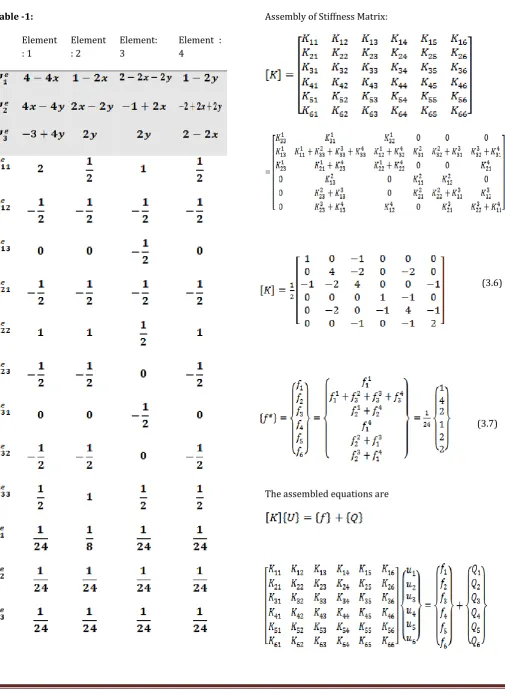
Table -1:Element : 1
Element : 2
Element: 3
Element : 4
Assembly of Stiffness Matrix:
(3.6)
(3.7)
© 2015, IRJET ISO 9001:2008 Certified Journal
Page 678
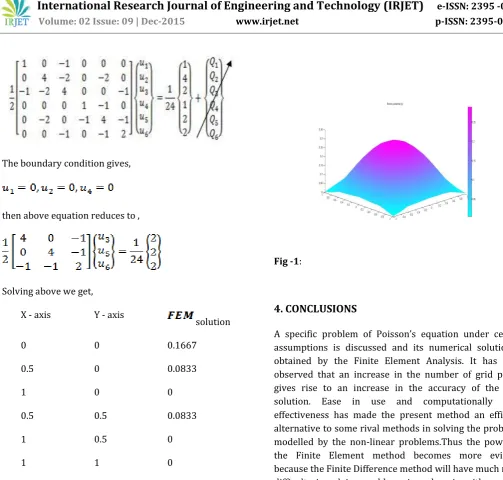
The boundary condition gives,then above equation reduces to ,
Solving above we get,
X - axis Y - axis
solution
0 0 0.1667
0.5 0 0.0833
1 0 0
0.5 0.5 0.0833
1 0.5 0
1 1 0
The Poisson’s equation is non-linear partial differential equation and hence it is bit difficult to find its analytic solution. The numerical solution of Poisson’s equation is obtained for particular values of the parameters by FEM for some countable meshes, which we calculate easily, to get much effective result we have to derive result for more number of mashes, for that we using MATLAB pde solver and its graphical representation is given in below diagrams which shows the behaviour of the electric potential.
Solution of Poisson’s equation for 178 mashes, where
.
Fig -1:
4. CONCLUSIONS
A specific problem of Poisson’s equation under certain assumptions is discussed and its numerical solution is obtained by the Finite Element Analysis. It has been observed that an increase in the number of grid points gives rise to an increase in the accuracy of the FEM solution. Ease in use and computationally cost-effectiveness has made the present method an efficient alternative to some rival methods in solving the problems modelled by the non-linear problems.Thus the power of the Finite Element method becomes more evident, because the Finite Difference method will have much more difficulty in solving problems in a domain with complex geometries.
REFERENCES
[1] Ames W. F. (1965), “Non linear Partial differential equations in Engineering, Volume 18”, pages 315 – 467.
[2] Brenner, S. and Scott, L. R., (2008),“The Mathematical Theory of Finite Element Methods, 3rd Ed., Springer, New York.
[image:5.595.34.538.50.530.2]© 2015, IRJET ISO 9001:2008 Certified Journal
Page 679
[4] Faires, Douglas, J. and Burden, Richard,(2003),Numerical Methods, 3rdEd.,Thomson ISBN 0-534-40761-7, pages 85-88.
[5] Hughes, Thomas, R., (2000),The Finite Element Method (Linear Static and Dynamic Finite Element Analysis), Dover Publications, New York ISBN 0-486- 41181-8. Pages 126-131.
[6] HUNT R. E.,(1997-2002) " Lecture notes, Mathematical methods II – Chapter 2, http://www.damtp.cam.ac.uk”.
[7] Moaveni, S.,(2008), Finite Element Analysis: Theory and Application with ANSYS, 3rd Ed., Pearson Prentice Hall, New Jersey.
[8] Reddy, J. N.,(2006) “An Introduction to the Finite Element method,” 3rd Ed.,McGraw Hill, ISBN 0-07-246685.
[9] Vardhan S.R.S.,(1989),“Lectures on Diffusion Problems and Partial Differential Equations”, pages 129 – 132.