© 2016, IRJET |
Impact Factor
value
: 4.45|
ISO 9001:2008 Certified Journal
| Page 706
A SURVEY ON LOCAL FEATURE BASED FACE RECOGNITION METHODS
Neethu Krishnan s
1, Sonia George
21
Student, Computer science and Engineering, Lourdes matha college of science and technology, Kerala,India
2Assistant professor, Computer science and Engineering, Lourdes matha college of science and technology, Kerala
---***---Abstract -
– Great progress has been achieved in facerecognition. But it is still challenging to differentiate the people with similar appearance and to recognize the same person who has different appearance due to different facial expression, pose, occlusion, illumination and aging. This paper provides some of the local feature based methods that tackle these problems. The two main approaches of local feature analysis are LBP and Gabor wavelets. The extension of the LBP is LTP. The combination of both LBP and Gabor wavelets provide more discriminative information which improves the face recognition performance. Combining information from different domain is beneficial for FR. Two methods under this are GV LBP TOP and Effective GV LBP.Then MBC is provided which hasmuch less time and space complexity than the widely used Gabor transformation methods. Then GOM, a promising solution to handle intra-class variation and inter-class similarity is provided. Extensive experiments on face image databases such as FERET demonstrate that GOM provides better recognition rate as compared to other methods.
Key Words:
Key Words: Local feature analysis, Local
BinaryPattern(LBP),LocalTernaryPattern(LTP),Mono
genic
Binary
Coding(MBC)
,Gabor
Ordinal
Measure(GOM).
1. INTRODUCTION
In today’s networked world, the way of crime is becoming easier than before. For this reason network security is becoming a major concern in various fields in the society. We all know that bank and computer system uses PIN, password, ID,key for identification and security clearances. When credit and ATM cards are lost or stolen, an unauthorized user can use the card with easily guessed PIN and passwords. Recent cases of identity theft have heightened the need for technology to prove authenticity. One such technology that we use nowadays is Biometrics.
Biometric systems identify an individual by both behavioral and biological characteristics.
Facial Recognition Technology (FRT) has emerged as an attractive solution to address the identification and verification of identity claims. The face recognition have application in various field such as information security, smart cards, access and border control in government, e-health and e-commerce service, criminal identification, law enforcement and surveillance purposes such as search for wanted criminals and suspected terrorist.
Face recognition is chosen over other biometric such as iris, fingerprint due to number of reasons.1) It requires no interaction on behalf of the user. 2) It is accurate and allows for high enrolment and verification rates.3) It does not require an expert to interpret the comparison result.4) It is the only biometric that allows to perform passive identification.5) It is easy to use, embed and also inexpensive compared to iris and fingerprint.
Face recognition techniques have always been a very challenging task for researches because of its difficulties and limitations. One problem of face recognition is the fact that different faces could seem very similar (inter class similarity). Therefore a discrimination task is needed to recognize people with similar appearance. On the other hand, when we analyze the same face, many characteristics may have changed (intra person differences) due to changes in illumination, facial expressions, occlusion, pose, aging and the presence of accessories. Therefore how to extract robust and discriminate features which makes the inter-person faces compact and enlarge the margin among different persons become a critical and difficult problem in face recognition. Feature extraction is one of the most important steps in the process of face recognition in order to overcome these problems.
© 2016, IRJET |
Impact Factor
value
: 4.45|
ISO 9001:2008 Certified Journal
| Page 707
In this paper experiment on FERET database are considered to analyse the recognition performance of various methods against different factors such as facial expression, illumination changes and aging.
fa set, used as a gallery set, contains frontal images of 1196 people.
fb set (1195 images). The subjects were asked for an alternative facial expression than in fa photograph.
fc set (194 images). The photos were taken under different lighting conditions.
dup I set (722 images). The photos were taken later in time.
dup II set (234 images). This is a subset of the dup I set containing those images that were taken at least a year after the corresponding gallery image.
2. LOCAL FEATURE BASED METHODS
Using the statistical Local Feature Analysis (LFA) technique, a set of feature points is extracted from each face image.Local feature analysis has achieved better performance in different face recognition tasks which is characterized by the following reasons: 1) local features can characterize the facial details for personal identification; 2) there are some local features designed with illumination robust property such as LBP.3) statistical histograms of local features are used as facial descriptors, being robust against partial variations of local features; 4) local methods provide more flexibility for recognizing faces with partial occlusions.
Two representative methods of local feature analysis in face biometrics are Gabor wavelets [4] and Local Binary Patterns (LBP) [5]. Gabor wavelets can extract the local features of facial regions on multiple channels of frequencies and orientations. Both magnitude and phase information of Gabor wavelets can be used for face recognition. Gabor features are discriminative and robust to illumination and expression changes and it can explore the neighbouring relationship in spatial, frequency and orientation domain. Gabor transformation has high computational cost and storage space because Gabor transformation of an input image needs to be implemented in multiple scale and orientation. The general shortcoming of the Gabor wavelet is high dimensionality of the feature vector. To address this problem, dimensionality reduction techniques such as kernel PCA, LDA etc are used.
2.1. Local Binary Pattern
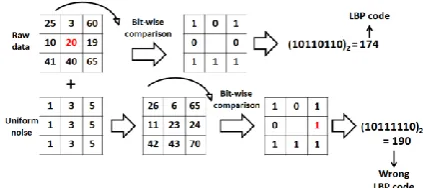
[image:2.595.315.527.102.196.2]Local binary pattern is a means of summarizing local grey level structure. The LBP operator takes a local neighborhood around each pixel, thresholds the pixels of the neighborhood at the value of the central pixel and uses
Fig. 1. Illustration of the sensitivity of local binary patterns to noise.
the resulting binary-valued image patch as a local image descriptor. Initially 3 ×3 neighborhoods are used which gives 8-bit integer LBP code. Formally, the LBP operator takes the form,
where in this case n runs over the 8 neighbors of the central pixel c, ic and in are the gray-level values at c and
n, and s(u) is 1 if u≥0 and 0 otherwise. The LBP encoding process is illustrated in Fig. 1.LBP features are completely invariant to monotonic grey scale transformation. Therefore LBP is simple and effective way to represent face image because of its robustness with respect to facial expression, aging, illumination and alignment.
LBP based methods achieved a recognition rate of 93% in the case of recognizing faces under different facial expressions (fb set). Under different lighting conditions (fc
set), the LBP has also achieved the best performance with arecognition rate of 51%. The relatively poor results on the fc set confirm that illumination change is still a challenge to face recognition.
2.2. Local Ternary Pattern
LBP have proven to be highly discriminative features for texture classification and they are resistant to lighting effects. However because they threshold exactly at the value of the central pixel ic they tend to be sensitive to noise, particularly in near-uniform image regions such as cheeks and foreheads .So a generalization of LBP called local ternary patterns (LTP)[6] is introduced that is more discriminant and less sensitive to noise in uniform regions. LTP extends LBP to 3-valued codes in which gray-levels in a zone of width ±t around ic are quantized to zero, ones above this are quantized to +1 and ones below it to -1, i.e., the indicator s(u) is replaced with a 3-valued function,
© 2016, IRJET |
Impact Factor
value
: 4.45|
ISO 9001:2008 Certified Journal
| Page 708
Fig 2. Illustration of the basic LTP operator
The binary LBP code is replaced by a ternary LTP code.Eventhough LTP codes are more resistant to noise, they are no longer strictly invariant to gray-level transformations. The LTP encoding procedure is illustrated in Fig. 2.
2.3 LBP AND GABOR WAVELET
LBP is good at coding fine details of facial appearance and texture, whereas Gabor features encode facial shape and appearance over a range of coarser scales. Both representations are rich in information and computationally efficient, and their complementary nature makes them good candidates for fusion. Both Gabor and LBP feature increases the recognition rate by 30% relative to LBP features alone and by 10% relative to Gabor features alone. So the combinations of LBP and Gabor features have improved the FR performance significantly compared to the individual representation.
Combining information from different domains is usually beneficial for face recognition [7].First, the multiscale and multiorientation representations are derived by convolving the face image with a Gabor filter bank and formulated as a third-order volume. Second, LBP operator is applied on the three orthogonal planes of Gabor volume, respectively, named GV-LBP-TOP. In this way, neighboring information is encoded not only in image space but also among different scales and orientations of Gabor faces.
Advantages
1) Gabor feature is applied to the face images to alleviate the variations of facial expression and illumination. 2) LBP is utilized to model the neighboring relationship jointly in spatial, frequency and orientation domains. In this way, discriminant and robust information, as much as possible, could be explored.
2.3.1. Gabor Volume Based LBP on Three
Orthogonal Planes (GV-LBP-TOP)
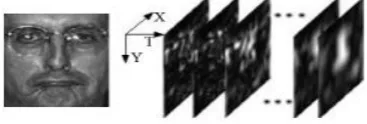
Discriminative information is explored by modeling the neighboring relationship among spatial, frequency and orientation domain. For a face image, the derived Gabor faces are assembled by the order of different scales and orientations to form a third-order volume as illustrated in Fig. 3 where the three axes X, Y, T denote the different
[image:3.595.332.516.138.200.2]rows, columns of face image and different types of Gabor filters respectively.
Fig.3. Face image and its corresponding third-order Gabor volume.
It first applies LBP analysis on the three orthogonal planes (XY, XT, and YT) of Gabor face volume and then combines the description codes together to represent faces. The codes from three planes are different and, hence, may supply complementary information helpful for FR. After that, three histograms corresponding to GV-LBP-XY,GV-LBP-XT, and GV-LBP-YT codes are computed.
The GV-LBP-TOP histogram H is finally derived by concatenating these three histograms H=[H1,H2,H3] to represent the face.
2.3.2. Effective GV-LBP
The aforementioned GV-LBP-TOP is of high computational complexity. The length of the histogram feature vector and the computational cost are threefold compared to those of LGBPHS. So it is not very efficient in practical application. To address this problem, we propose an effective formulation of GV-LBP (E-GV-LBP) which encodes the information in spatial, frequency and
Orientation domains simultaneously and reduces the computational cost. Fig. 4 shows the definition of E-GV-LBP coding. For the central point, Ic, I0 and I4 are the
orientation neighboring pixels; I2 and I6 are the scale
neighboring ones;I1,I3,I5 and I7 are the neighboring pixels
in spatial domains.
[image:3.595.310.546.579.708.2]© 2016, IRJET |
Impact Factor
value
: 4.45|
ISO 9001:2008 Certified Journal
| Page 709
The E-GV-LBP value have the form,
Where S(IP-IC) is a threshold function defined as
Regarding to the complexity and accuracy, E-GV-LBP is the best method for face representation and recognition. Unlike PCA, LDA etc. whose performances greatly depend on the training set, for GV-LBPTOP and E-GV-LBP methods, once the weight for every block is fixed, no further training procedure is needed.
2.4. MONOGENIC BINARY CODING
Local feature based face recognition methods, such as Gabor features encoded by local binary pattern, could achieve state-of-the-art FR results in large-scale face database such as FERET. Gabor filter based FR methods are very expensive: both the computational cost and the storage space are high because Gabor filtering is usually applied at five different scales and eight different orientations.So an efficient local feature extraction scheme, namely monogenic binary coding (MBC)[8], for face representation and recognition is proposed.
Monogenic signal representation decomposes an original signal into three complementary components: local amplitude, local orientation and local phase. . The local orientation and local phase compose monogenic phase. It does not use steerable filters to extract multiple-orientation features, and thus it has much lower time and space complexity than Gabor transformations.It encode the monogenic variation in each local region and monogenic feature in each pixel, and then calculate the statistical features (e.g., histogram) of the extracted local features.To exploit the discrimination information embedded in the amplitude, phase and orientation components monogenic binary coding (MBC) is used to encodes the local pattern in different monogenic feature maps.
The proposed algorithm of coding the monogenic signal features contains two parts: monogenic local variation coding and monogenic local intensity coding. The first part encodes the variation between the central pixel and its surrounding pixels in a local patch, while the second part encodes the value of central pixel itself. Obviously, these two parts are complementary.
The local amplitude of monogenic signal representation is a measurement of local energetic information. For example, high amplitude usually indicates higher energetic local features (e.g., edges, lines, textures). Therefore, the
local variation of monogenic amplitude could be coded by comparing the amplitude value of central location with those of its neighbours.
For 2D signals, monogenic phase is decomposed into local orientation and local phase. The local orientation describes the geometric information, more specifically the main orientation of the local structure, and the local phase describes the information of the local structure along the main orientation. The imagery part of monogenic signal representation is used to encode the local feature intensity information of the central pixel.
2.4.1. Monogenic binary code (MBC)
For each of the amplitude, phase and orientation components of the monogenic signal representation, we can have a monogenic binary code (MBC) map. The code maps for amplitude, phase and Orientation are denoted by MBC-A, MBC-P and MBC-O respectively. At each location, MBC-A, MBC-P and MBC-O are formed by combining the local imagery intensity code and the local variation code. After computing the multi-scale MBC-A, MBC-P and MBC-O feature maps of the face image, we can construct three histograms, HMBC-A, HMBC-P and HMBC-O, through the following procedures. For each kind of pattern map on each scale, it is partitioned into multiple non-overlapping regions, and then the local histogram is built for each sub-region. Finally, all the local histograms across different scales and different regions are concatenated into a single histogram vector to represent the face image.
© 2016, IRJET |
Impact Factor
value
: 4.45|
ISO 9001:2008 Certified Journal
| Page 710
2.5 GABOR ORDINAL MEASURES
LBP only considers the qualitative relationship between two pixels rather than ordinal measures among multiple image regions. By combining advantages of both Gabor wavelets and some kinds of ordinal filters, a novel local feature analysis method named Gabor Ordinal Measures (GOM) is introduced [9]. It uses di-lobe and tri-lobe ordinal filters to effectively encode Gabor magnitude and phase images. The basic idea of GOM is to integrate distinctiveness of Gabor features and robustness of this kind of ordinal measures as a promising solution to jointly handle inter-person similarity and intra-person variations in face images.
2.5.1 Ordinal Measure
Ordinal measure (OM) is defined as the relative ordering Information of multiple variables [10]. Ordinal measure can be used to encode the information in intensity level or feature level. For example, intensity level ordinal measure may be the qualitative relationship between the average intensity values of two image regions. If region A is brighter than region B, the ordinal measure is “A > B” and represented by one bit feature code “1”. Otherwise “B < A” and the ordinal code is “0”. Feature level ordinal measure is the qualitative information computed on the image features, e.g. Gabor features.
A straightforward idea of ordinal feature extraction is to compare the weighted average intensity value of dissociated image regions. Such a process can be implemented by ordinal filtering. If the filtering result is positive, the derived ordinal code is “1”. Otherwise it is “0”. An ordinal filter is usually constituted by multiple positive lobes and negative lobes. So Multi-lobe differential filters (MLDF) is used for ordinal feature extraction
When comparing MLDF with the original LBP operator, it is more robust to uniform noise. This is shown in Figure 6 . Ordinal measures from image intensity values have shown some robustness on face recognition. However, different from other texture rich biometrics modalities such as iris pattern, it is difficult to find enough robust and identity related ordinal relationships in a face image. Firstly, local intensity variations are not significant in face region because of the similar reflection ratio of facial skin. Secondly, the discriminating power of image intensity ordinal measures is limited because of the similarity between inter-class facial appearances. A good solution to this problem is to derive ordinal measures from feature level, after encoding some of the face information. The use of Gabor filters first in order to enhance the local details of face texture.
The benefit is twofold: on the one hand, local variations of Gabor images are significant so that we can derive more stable ordinal measures from them; on the other hand,
multi-channel Gabor filters can selectively obtain the texture information at a given orientation and scale
.
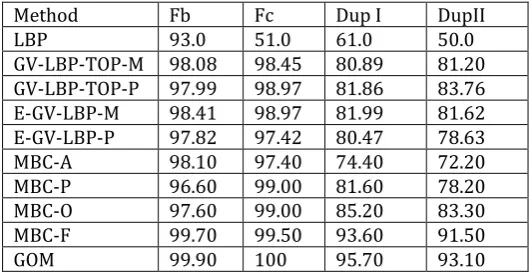
TABLE I. RECOGNITION RATE OF DIFFERENT METHODS ON FERET DATABASE
Method Fb Fc Dup I DupII
LBP 93.0 51.0 61.0 50.0
GV-LBP-TOP-M 98.08 98.45 80.89 81.20
GV-LBP-TOP-P 97.99 98.97 81.86 83.76
E-GV-LBP-M 98.41 98.97 81.99 81.62
E-GV-LBP-P 97.82 97.42 80.47 78.63
MBC-A 98.10 97.40 74.40 72.20
MBC-P 96.60 99.00 81.60 78.20
MBC-O 97.60 99.00 85.20 83.30
MBC-F 99.70 99.50 93.60 91.50
GOM 99.90 100 95.70 93.10
Hence, the face image is decomposed into multiple spectrum channels and the feature space of ordinal measures is enlarged to discriminate face images with inter-class similarity.
The ordinal measures derived from Gabor images are named Gabor Ordinal Measures (GOM).
The following reasons motivated the proposal of a novel face recognition method:
1) Ordinal measures are robust image descriptors for face feature representation.
2) GOM integrates the robustness advantage of ordinal measures and distinctiveness advantage of Gabor wavelets, providing a promising solution for face image analysis.
3) By combining ordinal measures derived from image intensity level and feature level, a better face recognition performance can be achieved.
The procedure Gabor Ordinal Measures (GOM) is as follows.First, Ordinal Measures on Gabor (GOM) magnitude, phase, real and imaginary responses at different orientations and scales are extracted. Then, the ordinal information of multiple orientations is encoded into GOM maps. Finally, spatial histograms are extracted from each of the encoded maps. Besides, the use of LDA makes the representation more compact.
The main contributions of this method are
[image:5.595.293.558.162.300.2]© 2016, IRJET |
Impact Factor
value
: 4.45|
ISO 9001:2008 Certified Journal
| Page 711
TABLE II. COMPARISON OF GOM WITH OTHER METHODS
The recognition performances of the aforementioned methods are summarized in table I. From the table LBP has lesser Fc value.ie; LBP is more sensitive to noise. GV-LBP-TOP phase feature provides high recognition rate as compared to magnitude feature except image with different facial expression. But in the case of Effective GV-LBP magnitude information achieves better recognition performance than phase information for entire probe sets(fb,fc,dup I and dupII).The MBC-A provides better recognition rate than MBC-P and MBC-O in different facial
expressions .The fused MBC (MBC-F) achieved better recognition rate than individual MBC codes. From the table we can analyse that GOM achieves better recognition performance than other methods. So it is a promising solution to jointly handle inter-person similarity and intra-person variations in face images.
Table II list the advantages and disadvantages of aforementioned methods.
Methods
Advantages
Disadvantages
LBP
Robust to noise in non uniform region. Degrade the performance due tochanges of lighting direction and shadowing.
Sensitive to noise in uniform regions.
Gabor wavelet
Extract features from multiple orientation and scale. High dimensionality of feature vector.high computational cost and storage space
LTP
More discriminative and less sensitive to noise inuniform regions. Not strictly invariant to grey level transformation.
LBP and Gabor
wavelet
a)GV-LBP-TOP
Discriminative and robust information is extracted fromthree domains. High computational complexity.
b) E-GV-LBP
Reduced computational cost.MBC
Higher accuracy and low cost.Less time and space complexity than other Gabor based methods.
Complex in terms of
implementation.
GOM
Promising solution for face image analysis.Better performance and higher accuracy.
Matching process is highly efficient.
© 2016, IRJET |
Impact Factor
value
: 4.45|
ISO 9001:2008 Certified Journal
| Page 712
3. CONCLUSIONS
In this paper various local feature based approaches are discussed. Two representative methods of local feature analysis in face biometric are Gabor wavelet and LBP.LBP is basically a fine descriptor which captures small texture details, in contrast to Gabor feature, which encodes the facial shape and appearance over a range of scales. The process of extracting LBP features is much faster than that of Gabor based feature. The LBP is sensitive to noise in uniform regions. So a generalization of LBP, Local Ternary Pattern (three valued code) is introduced.
To improve the FR performance both Gabor wavelet and LBP are combined.GV-LBP-TOP is one such method in which information are obtained by assembling scale, orientation and spatial domain to form third order
volume. This domain provides complementary
information, which is useful for FR. Shortcoming of GV-LBP-TOP is the high computational complexity. To address this problem Effective GV-LBP (E-GV-LBP) is introduced. This method encodes the information in spatial, frequency and orientation domain simultaneously and reduces computational cost. One of the shortcomings of Gabor wavelets is that it is computationally expensive in terms of cost and storage. So MBC is introduced, which achieves less time and space complexity than the Gabor based methods. Then, finally GOM is provided which outperforms all the method mentioned here .The idea of GOM is to integrate distinctiveness of Gabor features and robustness of this kind of ordinal measures as a promising solution to jointly handle inter-person similarity and intra-person variations in face images.
REFERENCES
[1] M. A. Turk and A. P. Pentland,“Face recognition using eigenfaces,” in Proc. IEEE Comput. Soc. Conf. Comput. Vis. Pattern Recognit., Jun. 1991, pp. 586–591.
[2]P.Belhumeur,J.Hespanha, and D.Kriegman,“Eigenfaces vs. fisher faces: Recognition using class specific linear projection,” IEEE Trans. Pattern Anal. Mach. Intell., vol. 19, no. 7, pp. 711–720, Jul. 1997.
[3]P. Comon, “Independent component analysis—a new concept?” Signal Process., vol. 36, pp. 287–314, 1994. [4] Á. Serrano, I. M. de Diego, C. Conde, and E. Cabello, “Recent advances in face biometrics with Gabor wavelets: A review,” Pattern Recognit. Lett., vol. 31, no. 5, pp. 372– 381, 2010.
[5]T.Ojala,M.Pietikäinen,andT. Mäenpää,“Multiresolution gray-scale and rotation invariant texture classification with local binary patterns,”IEEE Trans. Pattern Anal. Mach. Intell., vol. 24, no. 7, pp. 971–987, Aug. 2002.
[6]X. Tan and B. Triggs, “Enhanced local texture feature sets for face recognition under difficult lighting conditions,” IEEE Trans. Image Process., vol. 19, no. 6, pp. 1635–1650, Jun. 2010.
[7] Z. Lei, S. Liao, M. Pietikainen, and S. Li, “Face recognition by exploring information jointly in space, scale and orientation,” IEEE Trans. ImageProcess., vol. 20, no. 1, pp. 247–256, Jan. 2011.
[8]M. Yang, L. Zhang, S. C.-K. Shiu, and D. Zhang, “Monogenic binary coding: An efficient local feature extraction approach to face recognition,” IEEE Trans. Inf. Forensics Security, vol. 7, no. 6, pp. 1738–1751, Dec. 2012. [9] Zhenhua Chai, Zhenan Sun, Heydi Méndez-Vázquez, Ran He, and Tieniu Tan “Gabor Ordinal Measures for Face Recognition” IEEE Trans. Information forensics and security, vol. 9, no. 1, jan 2014.