International Journal of Emerging Technology and Advanced Engineering
Website: www.ijetae.com (ISSN 2250-2459,ISO 9001:2008 Certified Journal, Volume 3, Issue 10, October 2013)
137
Complexity and Analysis of Sphere Decoding and QRD-M
Detection for MIMO Communication System
Dayanand Sahu
1, Shanti Rathore
2, Dushyant Soni
31,2
Asst.Professor, 3Lecturer, Department of ET & Tc. Govt. Polytechnic Janjgir-495668 INDIA Abstract-MIMO seems to be the ultimate solution to
increase the system capacity without requiring the need to additional spectral resources. In MIMO, multiple signals are transmitted instantaneously via enough spaced antennas. At the receiver side, the main challenge resides in designing signal processing techniques, i.e., detection techniques, capable of separating those Transmitted signals with acceptable complexity and achieved performance. Motivated by the importance of the detection techniques as an important factor in determining both the feasibility and performance of the MIMO systems, this study only considers the receiver structure for the MIMO techniques. The study includes a detailed performance analysis of detection algorithms. Also, deep understandings of the affecting factors on the MIMO performance are covered including, the number of transmit and receive antennas, constellation size. The tree-search based detection techniques; i.e., SD and QRD-M with the two promising approaches. SD has achieved MLD performance. In case of QRD-M, while the number of survival candidates Increases the performance converges to that of MLD.
Keywords - Channel, Coding, communication, Diversity,Multi Antenna, Receiver, transmitter, Wireless.
I. INTRODUCTION
Day by day, wireless communication systems require significantly higher spectral efficiency (i.e., higher transmission rate measured in bit/second/Hz) and improved quality of service. The intuitive solution to increase the system capacity is to assign additional bandwidth where the capacity can be increased linearly. The spectral resources assigned to wireless communications are not only expensive, but also limited. Thus, in many cases it is infeasible to use more spectral resources.
II.TREE-SEARCH DETECTION TECHNIQUES
Several tree-search detection algorithms have been proposed in the literature that achieves quasi-ML
performance while requiring lower computational
complexity. In these techniques, the search problem of is presented as a tree where nodes represent the symbols‟ candidates. In the following, we introduce two tree-search algorithms and discuss their advantages and drawbacks.
A.Sphere Decoding
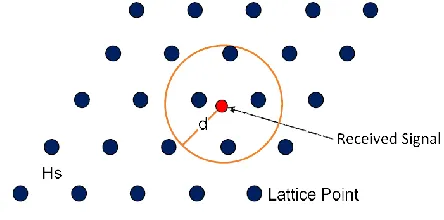
Sphere Decoding (SD) approach was inspired from the mathematical problem of computing the shortest nonzero vector in a lattice. SD algorithm was originally and refined to substantially reduce the computational complexity of signal detection in MIMO communication systems. The principle of SD is to search for the closet constellation point to the received signal within a sphere with
predetermined radius „d‟, where each transmit candidate is
represented by a lattice point in a lattice field {Hs}. Figure 1 depicts a geometrical representation of the idea behind SD algorithm; the search can be restricted to be in a circle around the received signal just small enough to enclose at least one lattice point or ML solution, thus search time can be significantly reduced by eliminating the search of those lattice points lie outside the circle. According to the analysis available, SD can transform the ML detection problem into a tree search and pruning process and achieve
quasi-ML performance with polynomial average
[image:1.612.331.553.488.598.2]computational complexity for large range of signal to noise ratios.
Figure 1: Geometrical representation of the idea behind SD algorithm
B.SD Search Strategies
International Journal of Emerging Technology and Advanced Engineering
Website: www.ijetae.com (ISSN 2250-2459,ISO 9001:2008 Certified Journal, Volume 3, Issue 10, October 2013)
138
The SD algorithm for SM MIMO systems has two types of searching strategies, the Fincke-Pohst (FP) and the Schnorr-Euchner (SE).Fincke-Pohst Strategy
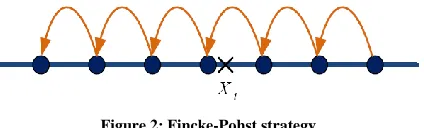
[image:2.612.352.547.148.218.2]The Fincke-Pohst (FP) strategy is considered in literature to be the original sphere decoding algorithm. This strategy was first used in digital communications theory by Viterbo and Biglieri. it was applied to find the closest point for a single antenna fading channels. This method considers all hypotheses in natural order, and the search is starting with the first one as shown in
Figure 2: Fincke-Pohst strategy
Computation time, and thus it is well-known that one of the main drawbacks of the FP strategy is the sensitivity of
its performance to the choice of initial search radius d. A
recommend choice is the distance to the Babai point , which is the first returned point in the search set. Then, it could be assured that at least one lattice point will be found inside the sphere.
Schnorr-Euchner Strategy
Schnorr-Euchner (SE) strategy that was added a small but significant refinement to the FP approach. The FP strategy searches the admissible nodes without any ordering, whereas in SE strategy, the admissible nodes of each level are spanned in a zigzag order starting with the closest middle point as depicted in Figure 3. SE strategy considers symbol close to the ZF solution and if a point is found, then the radius is updated (reduced) and so on. It was also concluded that the SE enumeration is more efficient than FP and has lower computational complexity by reordering the constellation searching at each level.
Figure 3: Schnorr-Euchner strategy
C. QRD-M Detection
The second scheme in the tree search category is the QRD-M, which was proposed to achieve quasi-ML performance while requiring fixed computational effort. QRD-M algorithm was originally discussed in and was first used in signal detection in MIMO system. QRD-M algorithm can reduce the tree search complexity by
selecting only M candidates at each layer instead of testing
all the hypotheses of the transmitted symbol. These M
candidates are the smallest accumulated metric values.
QRD-M Algorithm
QRD-M Algorithm can be considered as a breadth-first search that has only one searching strategy. The concept of
QRD-M is based on the classical M-Algorithm that retains
only a fixed number of symbol candidates, M, at each
detection layer. Basically, the idea of QRD-M.
Algorithm is similar to SQRD approaches for MIMO detection. However, instead of selecting only the closet
constellation point in each layer, a total of M metrics is
considered in evaluation.
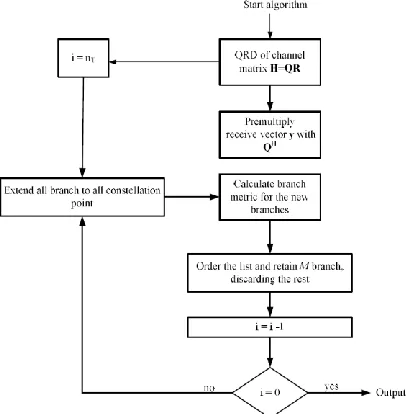
For the ease of understanding, a flowchart for the QRD-M algorithm is drawn,
Figure 4 and the QRD-M algorithm can be summarized in the following six main steps:
Step 1: Perform QRD on H
Step 2: Pre-multiply y with Q H
Step 3: Extend all branches to M nodes
Step 4: Calculate the branch metrics
Step 5: Order the branches according to their metrics,
retaining only M branches and discarding the rest
[image:2.612.64.276.283.347.2]International Journal of Emerging Technology and Advanced Engineering
Website: www.ijetae.com (ISSN 2250-2459,ISO 9001:2008 Certified Journal, Volume 3, Issue 10, October 2013)
[image:3.612.65.268.159.366.2]139
Figure 4: Flowchart of QRD-M detection algorithm
III. COMPLEXITY ANALYSIS OF TREE SEARCH
ALGORITHMS
Linear detectors usually have lower complexity at the cost of performance degradation. Tree search detectors; SD
and QRD-M theoretically can achieve optimal
performance. However, the complexity of these detectors may become prohibitive at low SNR. Most tree-search-based MIMO detection techniques often have limited
performance because of the required hardware
implementations; large memory requirement or high computational complexity of sophisticated algorithms. In this section, the complexity of two tree search based detection algorithms are presented and compared.
A. Complexity of sphere decoding detection
The complexity of ML detection given by solving is exponential or NP-hard. This as discussed earlier is not feasible to implement in a practical system, especially when high rate lattice constellations are used and multiple antennas are utilized. Therefore, it is very important that the SD algorithm provides a low complexity alternative to exhaustive ML detection. It has been shown in fact that the average complexity of sphere decoding is polynomial in the
number of unknowns, roughly O (m3) . However, in worst
case conditions the complexity of sphere decoding is still exponential, making it inefficient in these conditions.
To understand this, it has to be stated that the complexity of SD is highly dependent on many factors, namely the SNR and the choice of initial radius. Therefore in worst case conditions of these parameters, SD will have an exponential complexity. One perception about the SD complexity is that it is a random variable, with an expected complexity proven to be polynomial. There are various ways to analyze and measure the complexity of the SD algorithm. The one most commonly used is to measure the
number of flops (floating point operations). This is the
approach taken in most papers dealing with the complexity of. Other ways also include calculating the expected number of visited nodes in the algorithm. Counting the number of flops may seem to be the most popular way to measure the complexity; however one has to be sure of the accuracy of the count. Most times the assumption is made that the multiplication and addition operations are equivalent in complexity measure. This is inaccurate as one multiplication operation is far more complex than an addition operation. Nevertheless the number of flops is still an acceptable qualitative measure of the complexity. The simple and brief notation used to the state the complexity
of SD without rigorously analyzing it would be the big O
notation, which is used to roughly estimate the complexity.
B.Complexity of QRD-M algorithm detection
QR-decomposition with M-algorithm was introduced to overcome the random Complexity of the SD by retaining a fixed number of candidates per detection level. The original QRD-M has fixed complexity regardless of the channel environment due to the constant selection of survival branches at each stage. The complexity is defined by the total number of branch metric calculations. The parameters which determine the complexity of the QRD-M algorithm;
are the number of transmit antennas Nt, the number of
survival candidates vector at each stage M, and modulation
scheme.
C.Complexity Comparison of QRD-M and SD
International Journal of Emerging Technology and Advanced Engineering
Website: www.ijetae.com (ISSN 2250-2459,ISO 9001:2008 Certified Journal, Volume 3, Issue 10, October 2013)
[image:4.612.55.286.213.323.2]140
It is clear from results attained in Tables 1 and 2 that SD always performs lower average complexity. Its complexity advantage is observed for l6-QAM modulation in particular. The problem of SD lies in that its worst case complexity is significantly higher than the average one.Table 1:
[image:4.612.346.536.269.451.2]Complexity comparison for a QRSK MIMO system with Nt = Nr =4
Table 2:
Complexity comparison for 16 QAM MIMO system with Nt = Nr =4
SD achieves a tremendous reduction in the average complexity; its instantaneous complexity depends on the noise variance and channel conditioning. Thus, for ill- conditioned matrix or high noise power, the complexity of SD can be comparable with that of the ML algorithm. The second scheme in this category is the QRD-M, which was proposed to achieve quasi-ML performance while requiring fixed computational effort. After the QR-decomposition of the channel matrix into unitary and upper triangular matrices, the M-algorithm is applied to retain the best M symbol candidates at each detection stage. At the last detection stage, the branch with the smallest accumulative metric is considered as the estimate of the transmitted vector. Thus, QRD-M algorithm overcomes the extreme case complexity of SD and become more amenable to hardware implementation than SD. While the number of survival candidates at each detection layer increases, the QRD-M performance approaches that of MLD detection. However, it should be noted that this improvement come at the cost of increased computational complexity.
IV. RESULT
SD Performance Comparison and QRD-M
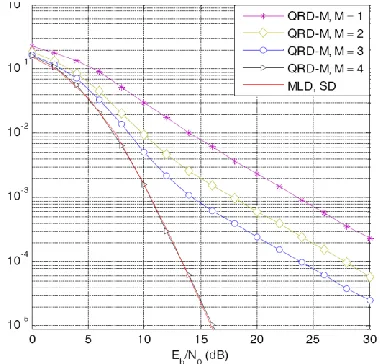
Figure 5 shows the BER performance of SD and QRD-M algorithms in 4 x4 QRD-MIQRD-MO SQRD-M systems. SD algorithm coincides with the optimum performance and the QRD-M algorithm achieves the ML performance for M = |4| which equals 4 in the case of 4-QAM. Although SD achieves aquasi-ML performance, it has the following drawbacks: (i) the complexity of SD is random and depends on the conditionality of the channel matrix and the noise variance.
Figure 5: BER of SD and QRD-M performance for several values of M
The worst-case complexity of SD is therefore exponential which is infeasible in computational power limited communication systems. SD has a sequential nature because it requires the update of the search radius at every time a new lattice point with smaller accumulative metric is found. This limits the possibility of parallel processing and hence reduces the detection throughput, i.e., increases the detection latency. In Barbero et al. have proposed a fixed
complexity sphere decoder to overcome the
aforementioned drawbacks of the SD. The QRD-M algorithm has also two drawbacks: (i) it employs a systematic tree-search without considering the noise power
or the channel conditionality and (ii) for high t N and high
[image:4.612.54.295.348.441.2]International Journal of Emerging Technology and Advanced Engineering
Website: www.ijetae.com (ISSN 2250-2459,ISO 9001:2008 Certified Journal, Volume 3, Issue 10, October 2013)
141
Several algorithms were proposed in the literature to overcome these drawbacks by introducing a method that adaptively selects the number of retained candidates per detection layer .As mentioned above, the tree-search based detection techniques provide quasi- ML performance and the QRD-M algorithm in particular is the most amenable to hardware implementation. It should be noted that the detection complexity of SD and QRD-M was significantly higher than that of linear and SIC detection algorithms.V. CONCLUSION
These techniques are the most appealing ones among tree search based detection schemes. With SD only searching through those candidates falling inside a hyper sphere, thus reduces the high complexity of MLD.
However, the main drawback of SD, a depth-first search
algorithm, is that despite the low average complexity, the
worst case complexity of the SD is identical to that of
MLD. On the other hand, QRD-M, a breadth-first search
algorithm, requires a fixed level of computational
complexity by only keeping those candidates with the best accumulated metric values at each step; therefore, QRD-M
is more amenable tohardware implementation compared to
SD. while the number of survival candidates at each
detection layer increases, the QRD-M performance approaches that of MLD detection, however, this improvement come at the cost of increased computational complexity.
REFERENCES
[1] B. Hassibi and H. Vikalo,“On the expected complexity of sphere decoding,” in Proc. Asilomar Conference on Signals, Systems and Computers, pp. 1051– 1055, November 2001.
[2] H. Vikalo, B. Hassibi, and U. Mitra[39] Z. Lei,Y. Ting-ting, Z. Xin,Y. Da-cheng " Combined simplified maximum likelihood and sphere decoding algorithm for MIMO system" Journal of China Universities of Posts and Telecommunications, Vol. 15,no. 2, June 2008.
[3] E. Viterbo and J. Boutros, “ A universal lattice code decoder for fading channels,” IEEE Transaction on Information Theory, vol. 45, no.5, pp. 1639-1642, July 1999., "Sphere constrained ML detection for frequency-selective channels," IEEE Transactions on Communications, vol. 54, no. 7, pp. 1179 – 1183, July 2006. [4] M. O. Damen, H. El Gamal, and G. Caire. “On maximum–likelihood
detection and the search for the closest lattice point”, IEEE Transactions on Information Theory, vol. 49, no. 10, pp. 2389–2401, October 2003.
[5] B. Hassibi and H. Vikalo, “ On the Sphere Decoding Algorithm: Part I, The Expected Complexity”, IEEE Trans. Sig. Process., vol. 53, no. 8, pp. 2806–2818, August 2005.
[6] H. S. Dhillon, H. Aggarwal and A. Mitra,"A Simple Direction-Based Lattice Decoding Algorithm for Golden Codes", National Conference on Communications (NCC2009), pp. 128-131, January 2009.
[7] A. D. Murugan, H. E. Gamal, M. O. Damen, and G. Caire,”A unified framework for tree search decoding: rediscovering the sequential decoder”, IEEE Transactions on Information Theory, 52(3):933– 953, March 2006.
[8] K. Radhakrishnan"Implementation of a Soft Output Sphere Decoder by Rapid Prototyping Methodology " Technical University of Vienna , November, 2007.