© 2016, IRJET | Impact Factor value: 4.45 | ISO 9001:2008 Certified Journal
| Page 1629
Design and Implementation of AVR Controlled Security System for
Industries
Karan Shah
1, Ranjitsingh Makhija
2, Vinay Mehta
3Shikha Singh
41,2,3
BTech Students , Electrical And Electronics Engineering, Indus University, Gujarat, India
4Assistant Professor, Electrical And Electronics Engineering, Indus University, Gujarat,
IndiaEmail:[email protected]
---***---ABSTRACT -
Nowadays, Security has become analarming issue everywhere. Home and industrial security are becoming necessary nowadays as the possibilities of theft are increasing day by day. For an industry, safety from gas leakage and fire are the mandatory requirements. A traditional security system gives the signals in terms of alarm. For providing security in industries, following security measures are applied in our project. First of all, biometric system and alcohol detection techniques are installed as the first layer of security and on positive results gate control system will be activated. In case biometric system fails to work, we have deployed keypad based numeric password security. Secondly, we have used gas and temperature sensors for detecting any unfavorable condition inside the industry. Finally, for implementation of this project, we have used ATMEGA32A microcontroller.
1. INTRODUCTION
As we all know, security is becoming a major issue now a days for everyone. It is very much important to have a safe environment around us so that we can work with our full efficiency. If every now and then we have to worry about trivial things then our concentration will be diverted to unwanted things and it will greatly affect our work. For totally securing any building, it is very much important to secure the entry as well as the premises. Threat is not only from outsiders who enter the building disguised as someone else, but also from the hazardous situations that arise due to unwanted conditions like high temperature or gas leakage from pipelines etc. Cases of theft are very common and we hear them time and again in news or read it in newspapers. Very famous one is the Bhopal Gas Tragedy in which many people lost their life just due to the leakage of a poisonous gas from the plant. So if we can provide a system which protects the industry from thefts as well as hazardous situations, then we can have a safe environment to work in and can work with our full potential.
2. ARCHITECTURE OF THE SYSTEM
Fig-1:Block Diagram
3. WORKING
© 2016, IRJET | Impact Factor value: 4.45 | ISO 9001:2008 Certified Journal
| Page 1630
4. SENSING DEVICES
4.1 FingerprintSensor
Fig 2:Fingerprint Sensor
There are three functions in the fingerprint sensor. They are explained briefly below:
The three functions are Add, Search and Empty function. Add function is used to add any employee’s fingerprint in the database. So whenever a new fingerprint ID is to be added Add function is used. During the coding process if there is any error, the return code is 0xFF. The next one is the Search function. When the search button is pressed it starts searching the fingerprint ID that was stored in the database using the Add button. So whenever an employee enters the industry and providers his fingerprint it can be searched using the search button. The third function is the Empty function. This function is used to completely erase the entire database from the system. If the data is erased completely the return code is 0xCC and if it fails to erase the data the return code is 0xFF.
4.2 Temperature Sensor
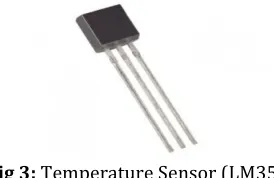
Fig 3: Temperature Sensor (LM35)
The LM35 temperature sensor is used which provides temperature in degree celsius.Lower cost is assured by trimming and calibration. The device is used with single power supplies. The LM35 device draws only 60 μA from the supply. The operating temperature of LM35 device is in the range of −55°C to 150°C.
4.3 Gas Sensor
Fig 4: Gas Sensor(MQ-7)
SnO2, which has lower conductivity in thin air is the most important material in MQ-7 sensor. Gas is detected by method of cycle of high and low temperature, and detect CO (Carbon Monoxide) when low temperature (heated by 1.5V). It cleans the other gases adsorbed under low temperature, when heated by 5.0V .MQ-7 gas sensor is highly sensitive to Carbon Monoxide. In order to detect different gases containing CO2, this sensor could be used . MQ-7 is suitable for different applications as it is cheap in cost.
4.4 Alcohol Sensor
The core system in the sensor is the tube. As shown in above figure, there is an Alumina tube covered by SnO2, which is tin dioxide and between them, there is Aurum (Au) electrode which is of black color.
Fig 5: Alcohol Sensor(MQ-3)
[image:2.612.388.513.124.240.2] [image:2.612.93.232.150.269.2] [image:2.612.94.231.539.628.2]© 2016, IRJET | Impact Factor value: 4.45 | ISO 9001:2008 Certified Journal
| Page 1631
4.5 Keypad
Fig 6: Keypad
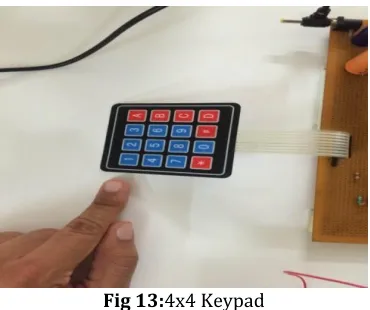
A 4*4 keypad has 4 rows and 4 columns. Initially all switches are open. When any one of the switch is pressed, the rows and columns corresponding to that pressed switch is connected (short circuited). Due to this, that column pin (which was initially high) will become low. Using this logic, the button press can be detected.
5. RESULTS
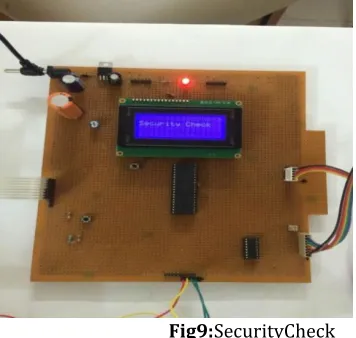
Our project model comprises of 3 PCB’s. Two of them containing different sensors are being interfaced with the main PCB containing the microcontroller which is backbone of our whole project. One PCB has ATMEGA32A microcontroller, LCD, power supply, and IC for gate control. Also the connections to the other two PCBs are taken out from the main PCB. From the remaining two, one PCB has gas and temperature sensor and the other one has alcohol sensor.
Fig 7: Startup Screen
Pseudo code of the first displaycmd(0x01);
display("* * * * * * * * ",0x80); display(" Industrial ",0xc0); display("Security System",0x90); display("* * * * * * * *",0xd0);
Fig 8:Sensors (Temperature and Gas)
Pseudo code for sensors:
sprintf(buffer,"Temperature=%2d%cC",t1,0xdf); display(buffer,0xc0);
sprintf(buffer,"Gas =%3d",gas); display(buffer,0x90);
Fig9:SecurityCheck
[image:3.612.324.502.473.642.2] [image:3.612.88.240.536.689.2]© 2016, IRJET | Impact Factor value: 4.45 | ISO 9001:2008 Certified Journal
| Page 1632
Fig 10: Alcohol testPseudo code result of alcohol test: display("Alcohol Test ",0x80); display(" Completed.",0xc0);
display("No Alcohol ",0x90);
[image:4.612.52.277.96.314.2]display("Detected.",0xd0);_delay_ms(1000); _delay_ms(2000);_delay_ms(3000);
Fig 11: Alcohol Test Result Pseudo code for alcohol detected: cmd(0x01); display("Alcohol Test ",0x80);
sprintf(buffer,"Alcohol=%4d",alcohol); display(buffer,0xc0);
display("Alcohol detected",0x90); _delay_ms(1000);
[image:4.612.51.274.398.585.2]display("Check Again ",0xd0); Buzzer();
Fig 12: Fingerprint Detection
Pseudo code for fingerprint sensor: display("Place Your ",0x80); display(" Finger On ",0xc0); display("FingerPrint ",0x90);
display(" Sensor ",0xd0);
_delay_ms(3000);_delay_ms(2000);
Pseudo code to search the fingerprint: cmd(0x01);
display(" Search.... ",0xc0); Fingerprint_Search(); display(" ok.... ",0xd0);
_delay_ms(2000);_delay_ms(2000);
Fig 13:4x4 Keypad
[image:4.612.358.543.482.637.2]© 2016, IRJET | Impact Factor value: 4.45 | ISO 9001:2008 Certified Journal
| Page 1633
Fig 14: Keypad ResultFig 15:Result showing entry to the premises
Pseudo code: cmd(0x01); display(" WELCOME !! ",0x80); display(" Have A Nice ",0xc0); display("DAY",0x90);
display("* * * * * * * *",0xd0); _delay_ms(5000);
6. FUTURE SCOPE
6.1 RFID Based Entrance System
Fig 16: RFID Tags
During the preliminary testing of our project, this was a major confusion for us. We had to choose between the fingerprint sensor and RFID card to be used in our project. Only one of them could be used as both of them uses the same communication ports available on the microcontroller. Even if we used another microcontroller for the RFID, communication between those two microcontrollers would be very difficult as it requires a large amount of time and skill to accomplish this. So we decided to use fingerprint sensor.One can easily misplace his/her card and in such a case it would cause him a great amount of trouble. Or even if one wants to enter the building with false identity, then he/she can lay his hand on someone else’s card and enter the building. But as fingerprint sensors are installed at the entrance of the building, the case of entering the building with false identity would never take place.
6.2 Laser Sensing
In big industries, there are some restricted areas where entry without precaution is prohibited. If required precautions are not taken then unfortunate incidents can occur. So for avoiding such mishaps proper security arrangement should be provided.
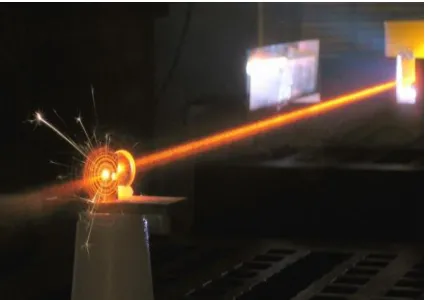
Laser sensing is one such security parameter which can protect the employees of the industry from such incidents.
[image:5.612.345.559.516.666.2]Basically 4 lasers can be installed on the four corners and can be directed towards the hazardous area. If anyone crosses the laser or the laser is obstructed, a siren will start which will intimate the employee that he/she is entering a restricted area. Thus this would help the industry in providing safe environment for its employees.
© 2016, IRJET | Impact Factor value: 4.45 | ISO 9001:2008 Certified Journal
| Page 1634
7. CONCLUSION
Our main aim of making this project was to provide overall security for whole building. Our objective was not only to strengthen the entrance of any industry, but also to provide safety to the employees working inside the building. Talking about the entrance, we made it rock solid by using fingerprint sensor as it is almost impossible to fake someone else’s fingerprint and take entry. Also for ensuring safe and proper working environment, we conducted alcohol test of every employee and only if his alcohol level is below safety level, he/she is allowed to enter the building. In case if fingerprint sensor doesn’t work due to any malfunction, the security guide will enter the password through keypad and do manual entry into his records of the individual whosoever is waiting for entry. Sometimes abnormal situation may occur due to environmental changes or unknown accidents where temperature or gas level inside the industry may increase and may pose dangerous situation where it is advisable to vacate the premises. Keeping this in mind, we have kept two sensors which will detect three abnormal situations inside the premises. First one is temperature sensor which will indicate any rise in temperature and also blow a siren to let everyone know of the problem. Secondly, we have used gas sensor which will detect any rise in gas level. A siren is also attached with this sensor for letting everyone know of the situation. By combining these two sensors, we have developed a fire alarm. Increase in temperature and gas levels simultaneously is only possible when there is a fire. Hence by the combination of these two sensors, fire can also be detected. Thus by designing and implementing this project we tried to provide overall security to the industry.
REFERENCES
[1] M.Sravan Kumar, M.Mounika, L.RamyaPavani, E.Ranadeep, B.Siddhartha SR Engineering College, “GSM Based Industrial Security System” International Journal Of Current Engineering And Scientific Research (IJCESR) ISSN (PRINT): 2393-8374, (ONLINE): 2394-0697, VOLUME-2, ISSUE-5, 2015 [2] Nandeesh G S, B Srinivasalu Reddy, Sunil Kumar K M,
“Intelligent Security System for Industries by using GPS and GSM”, International Journal of Advanced Research in Computer Science & Technology (IJARCST 2014), Vol. 2 Issue 1 Version 2 Jan-March 2014
[3] R.Anandan, “Wireless Home And Industrial Automation Security System Using GSM”, Journal of Global Research in Computer Science, Volume 4, No. 4, April 2013
[4] John H. Bowers, “RFID tags which are virtually activated and/or deactivated and apparatus and methods of using same in an electronic security system”, Feb 15, 2000, US Patent, Patent number US6025780 A
[5] Geoffrey B. Rhoads, “Security System using Photographic Identification”, Nov 24, 1998, US PatentPatent Number US5841886
[6] Peter Tal, “Method and apparatus for uniquely identifying individuals by particular physical characteristics and security system utilizing the same”, Dec 4, 1990, US Patent Patent number US4975969 A [7] KrishnahadiSikunPribadi,