© 2016, IRJET | Impact Factor value: 4.45 | ISO 9001:2008 Certified Journal | Page 742
A Survey of MAC Layer Issues and Application layer Protocols for
Machine-to-Machine Communications
Mrs.Kiran Patil
1, Prof. Dr. S.L. Lahudkar
21
ME Student of Department of Electronics and Telecommunication & Savitribai Phule Pune University, JSPM’s ICOER,
Wagholi, Pune, Maharashtra, India
2 Prof. of Department of Electronics and Telecommunication & Savitribai Phule Pune University, JSPM’s ICOER, Wagholi, Pune,
Maharashtra, India
---***---Abstract -
With the developing enthusiasm for theutilization of independent processing, detecting and activating gadgets for different applications such as smart grids, home networking, smart environments and cities, health care, and machine-to-machine (M2M) communication have become an important networking paradigm. However, in order to fully exploit the applications facilitated by M2M communications adequate support from all layers in the network stack must first be provided in order to meet their service requirements. This paper exhibits a study of the prerequisites, specialized difficulties, and existing work on medium access control (MAC) layer conventions for supporting M2M communications. This paper first describes the issues related to efficient, scalable, and fair channel access for M2M communications. At that point, we present and think about existing application layer conventions and additionally conventions that are used to associate the things additionally end-client applications to the Internet. We highlight IETFs CoAP & HTTP, IBMs MQTT, HTML 5s Web socket among others, and we argue their suitability for the IoT by considering reliability, security, and energy consumption aspects.
Key Words: M2M, MAC, IOT, QoS etc.
1. INTRODUCTION
MACHINE-TO-MACHINE (M2M) communications constitute the fundamental communication worldview in the rising Internet-of-Things (IoT) and include the empowering of consistent trade of data between self-sufficient gadgets with no human intercession. The services facilitated by M2M communications encompass personal, public, and professional spaces and scenarios of interest include smart power grids, intelligent spaces, smart cities, industry automation, and health care just to name a few[1]. The expanding ubiquity of administrations and frameworks in light of the utilization of M2M communications has been powered to some extent by the utility of the applications they encourage, and additionally by the proceeded with fall in the costs of independent gadgets equipped for sensing and actuating. The quantity of gadgets in light of M2M
communication is balanced for broad development soon with anticipated compound yearly development rates of more prominent than 25%. The expanding M2M movement and the related income have made an enthusiasm among telecom administrators and in addition administrative and institutionalization bodies to facilitate M2M communications. The unique characteristics of M2M communications introduce a number of networking challenges. In addition to scalability, the network has also to consider the traffic characteristics and cater to the quality of service (QoS) requirements. For instance, in a home setting, M2M gadgets might haphazardly and rarely send little burst of data or transmit an altered measure of data intermittently. Additionally, the services necessities of application utilizing M2M communications might be not quite the same as existing applications and will likewise differ inside of the M2M-based applications. For example, in specific applications, it might be required to give profoundly solid communication QoS ensures along these lines requiring organized assignments. A significant fraction of the devices involved in M2M communications are expected to be battery operated. Consequently, lowering the communication related power consumption is an important design objective for the network. At last, as M2M communication is essentially “hands off” (i.e., free from human intervention), the M2M communication system must act naturally skilled in different viewpoints such as organization, configuration, and healing. These necessities and attributes influence every one of the layers in the network stack and make network support for M2M communications a testing territory of exploration at various levels.
© 2016, IRJET | Impact Factor value: 4.45 | ISO 9001:2008 Certified Journal | Page 743 such as 2G/3G/Long Term Evolution and beyond (5G) or
they can be connected through a gateway, forming a local area network, to get connection to the Internet. The latter is the case where the end-devices usually form Machine to Machine (M2M) networks using various radio technologies, such as Zigbee (based on the IEEE 802.15.4 Standard), Wi-Fi (based on the IEEE 802.11 Standard), 6LowPAN over Zigbee (IPv6 over Low Power Personal Area Networks), or Bluetooth (based on the IEEE 802.15.1).
Regardless the specific wireless technology used to deploy the M2M network, all the end-devices should make their data available to the Internet [2]. This can be accomplished either by sending the data to a restrictive web server open from the Internet or by utilizing the cloud. Online stages, for example, ThingSpeak.com or Open.Sen.se, among some other choices, are virtual mists ready to get, store, and process information. Besides acting as remote data bases, M2M clouds also offer the following key services: 1. They offer Application Programming Interfaces (API) with inherent capacities for end-clients, in this manner giving the alternative to screen and control end-gadgets remotely from a customer gadget.
[image:2.595.58.262.412.679.2]2. They act as asynchronous intermediate nodes between the end-devices and final applications running on devices such as smart phones, tablets or desktops.
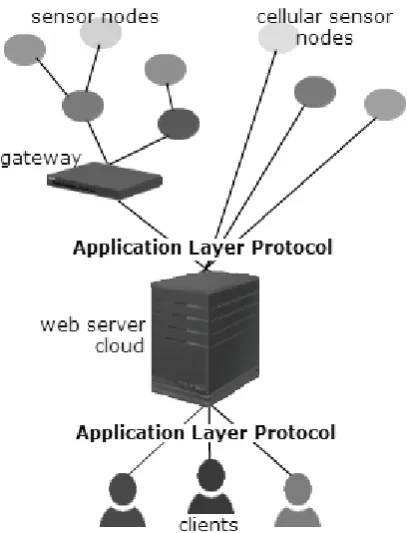
Figure 1.1 M2M Communication Network
Our paper concentrates on the protocols that handle the communication between the gateways, the public Internet, and the final applications (Figure 1.1). They are application layer protocols that are used to update online servers with the latest end-device values but also to carry commands from applications to the end-device actuators.
2. MAC LAYER ISSUE IN M2M COMMUNICATION
To highlight the different issues recorded underneath in a situation with M2M communications, we consider smart homes as an example. Technology for smart homes is evolving rapidly and we consider three of its many services: 1) power management for reducing energy cost; 2) security; and 3) assistive services for the elderly To a vast degree, these administrations depend on the utilization of gadgets, sensors, and actuators that work utilizing M2M data trade. To encourage fine-grained vitality administration of homes, every apparatus and electrical gadget might have a communication interface that sends and gets information and summons to control its operation. What's more, every room might have its own web associated indoor regulators and smoke locators. A home vitality administration framework might likewise incorporate shrewd meters, sun oriented boards, inverters, and capacity gadgets.A home security framework might comprise of numerous cameras, movement sensors in rooms, and reed switches at entryways and windows for edge security. These gadgets produce information at different rates, which might be exchanged to an off-site control station (e.g., claimed by a security administrations organization) for investigation and activity.
At long last, helped living offices rely on upon the information created by various on-body sensors for physiological information, biosensors, sensors to distinguish utilitarian decrease in more established grown-ups (e.g., measuring eagerness in bed), sensors for fall identification, infrared sensors, and camcorders. The quantity of gadgets in a keen home can subsequently effortlessly keep running into numerous tens to many hubs. The assorted scope of gadgets that are required to bolster the administrations anticipated from a brilliant home produce diverse execution necessities from the fundamental MAC convention. For instance, the cameras being used for home security require MAC conventions with high throughput, though sensors being used for helped living and restorative applications have strict postponement prerequisites. Additionally, the expansive number of hubs in close vicinity that share a solitary channel for remote access offers ascend to the prerequisite for adaptability of the MAC convention The way that a significant number of the sensors are battery worked prompts the necessity of vitality effectiveness. At long last, the necessity for a practical answer for the keen home administrations that need an expansive number of sensors requires MAC conventions that can be utilized with minimal effort equipment. Existing answers for remote get to, for example, irregular get to or surveying based MAC conventions don't, at the same time, take into account the different arrangement of prerequisites that emerge in this sample situation. Moreover, as depicted in the resulting segments, they can't scale to handle the substantial number of gadgets that happen in this situation.
© 2016, IRJET | Impact Factor value: 4.45 | ISO 9001:2008 Certified Journal | Page 744 2.1 Data Throughput
The main qualities that MAC conventions for M2M communications need to have are high effectiveness and throughput. Because of the restricted channel/range assets and an extensive number of devices accessing the channel it is alluring that the MAC convention minimizes the time squandered because of impacts or trade of control messages. Proportionately, the throughput must be high keeping in mind the end goal to oblige the vast number of devises. Collisions are the main cause of concern in contention-based systems due to their negative impact on the throughput performance of the system. Moreover, due to the concealed terminal issue, crashes are considerably harder to handle in M2M systems. In dispute free, plan based frameworks, the control overhead, and void openings are critical issues influencing the throughput execution. Note that if the control overhead of a convention is extensive, it influences the successful throughput (i.e., the information bits transmitted per unit time) even despite the fact that the physical information rate may not be influenced. Also, it is required that the successful throughput stay high independent of the traffic levels. The Maximum bandwidth can be calculated as follows:
Throughput ≤ (TCP window size / round-trip time for the path)
The Max TCP Window size without TCP window scale choice is 65,535 bytes. Sample: Max Bandwidth = 65535 bytes/0.220 s = 297886.36 B/s * 8 = 2.383 Mbit/s. Over a solitary TCP association between those endpoints, the tried data transmission will be limited to 2.376 Mbit/s regardless of the possibility that the contracted transfer speed is more noteworthy.
2.2 Scalability
In the context of M2M communications, a key consideration for MAC protocols is scalability [1]. Scenarios with M2M communications are expected to have a large number of nodes. The node density is expected to increase as the deployment of application scenarios with M2M communications becomes more prevalent. Also, the system conditions might be changing, with hubs entering and leaving (or rotating in the middle of dynamic and inert states). In this manner, it is basic that the MAC convention be effectively adaptable and balanced effortlessly to changing node densities with next to zero control data trade, and kept up reasonableness even after the expansion of new devices. While there is no additional control overhead in contention based MAC protocols like CSMA/CA or ALOHA when the number of nodes increases, their performance usually degrades due to factors such as collisions [1]. Then again, contention free conventions like TDMA and even half breed ones normally require reassignment of assets and ought to be composed so that they effectively suit nodes joining or leaving the system without requiring any real system revamping.
2.3 Energy Efficiency
Energy efficiency is one of the most important design considerations for M2M communications because of three
main factors, which are: 1) the fact that many of the devices in M2M networks are expected to be battery operated and thus power constrained; 2) the economic impact (such as operational costs and profit margins) of the power consumed by the communication infrastructure; and 3) the environmental impact of the power consumed. The information and communications industry is currently responsible for 1.3% of total harmful emissions in the world [5]. This number is relied upon to increment with the blast of M2M gadgets in the coming decade. Considering each of the three components, it is hence basic that all operations related with M2M communications be upgraded to devour low power. For the battery operated M2M devices, two major supporters of force utilization are the vitality spent on the radio transmissions and the channel access. Crashes amid channel access are a noteworthy reason for force utilization that ought to be diminished to the best degree conceivable, just like the force devoured because of the transmission of control data. For example, at high loads, the control overhead may consume almost 50% of the total energy in the IEEE 802.11 MAC protocol [1]. Basic strategies to diminish the MAC layer vitality utilization incorporate lessening the impacts, rest planning, power control, and decreasing unmoving tuning in.
2.4 Latency
For a considerable lot of the applications that depend on M2M interchanges, the system idleness is a basic element that decides the viability and utility of the offered services. For example, in scenarios such as intelligent transportation systems with real-time control of vehicles, and e-health applications, it is extremely important to make the communication reliable and fast. Thus, delays during channel access or network congestion are serious issues in M2M networks. Additionally, regardless of the possibility that a MAC convention is throughput proficient, it needs to guarantee both long haul and fleeting reasonableness, so that all gadgets get break even with chance (or a chance proportional to their priority) to send their messages. Also, we note that while it is always desirable to reduce the channel access latency, there are limitations to it, specially when the quantity of nodes increases.
2.5 Coexistence
Due to the spectrum costs associated with operating in licensed bands, a significant fraction of the access networks for M2M communications is relied upon to work in the unlicensed bands. With broad sending of M2M devices, it is likely that different M2M access systems will be sent in close proximity and independently in the same unlicensed based. In addition to coexisting with other M2M networks, they likewise need to coincide with different systems that generally work in the unlicensed (e.g., WiFi and Bluetooth). While issues, for example, impedance produced in these situations and transfer speed sharing might be tended to at both the physical and MAC layers, issues, for example, the impacts because of concealed terminals from neighboring systems need to address at the MAC layer.
© 2016, IRJET | Impact Factor value: 4.45 | ISO 9001:2008 Certified Journal | Page 745 Finally, in order to make M2M communication based
frameworks a reality, the devices must be savvy with the goal that it is reasonable to send them. An MAC protocol that has many desirable properties but relies on the use of costly, complex hardware, is not practical. Despite the fact that advances in assembling of semiconductor devices have prompted a proceeded with fall in the costs of electronic frameworks, with regards to substantial scale arrangements, ease of gadgets is a need from a promoting and financial point of view. Therefore, the MAC protocol should be designed to work effectively on simple hardware. Finally, cost as well as physical form factor requirements may also impact the choice of the hardware and the protocols that may be used on them. For example, small devices such as many sensors may find it difficult to have multiple transmitting and receiving antennas and thus preclude them from using protocols such as IEEE 802.11n. In addition the physical constraints forced by the little shape element, expense might likewise be an issue in deciding the abilities of the physical layer radio framework.
3. APPLICATION LAYER PROTOCOLS USED IN M2M
COMMUNICATION
The messaging protocols discussed in this paper can be used to connect devices and people (e.g., sensors, mobile devices, single board computers, micro controllers, desktop computers, local servers, servers in a Data Center) in a disseminated system (LAN or WAN) through a scope of wired and remote communication advances including: - Ethernet, Wi-Fi, RFID, NFC, Zigbee, Bluetooth, GSM, GPRS, GPS, 3G, 4G).
The problem has a number of variations that can be categorized as follows:
Inter Device communication - message trades between device nodes on a Local Area Network (LAN)
Device to Cloud communication - message exchanges between a device node and an Internet based Data Center or between devices via the Internet
Inter Data Center communication - message exchanges between Internets based Data Centers
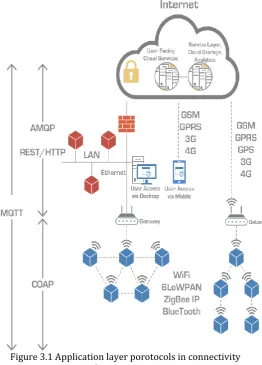
Each messaging technology discussed in this document is suited to addressing one, more or all of the connectivity problems identified above and illustrated in Figure 3.1. AMQP, MQTT and REST/HTTP were all intended to keep running on systems that utilization TCP/IP as the fundamental transport. AMQP, MQTT support brokered publish-and-subscribe message exchanges between device nodes (Inter Device). REST/HTTP encourages a client-server (request/reply) pattern of inter nodal communication using HTTP. CoAP is also based on a RESTful architecture and a client/server interaction pattern. It uses UDP as the underlying transport and can also support IP multicast addressing to enable group communications between devices. CoAP was designed to minimize message overhead and reduce fragmentation when compared to a HTTP message. When used with UDP the entire message must fit within a single datagram or a single IEEE 802.15.4 frame when used with 6LoWPAN.
[image:4.595.308.571.163.529.2]AMQP, MQTT are broker based and can encounter similar issues with respect to reduced performance (lower throughput) and real-time predictability as system scale increases (when the number of publishers, subscribers and nodes grow)
Figure 3.1 Application layer porotocols in connectivity space of M2M communication
3.1 AMQP
AMQP is a message-centric protocol that emerged from the financial area with the point of liberating clients from restrictive and non-interoperable messaging systems. AMQP orders the conduct of the informing supplier and customer to the degree that executions from various merchants are genuinely interoperable. Past endeavors to institutionalize middleware have happened at the API level (e.g. JMS) and in this manner did not guarantee interoperability. Unlike JMS, which merely defines an API, AMQP is a wire-protocol. Consequently any product that can create and interpret messages that conform to this data format can interoperate with any other compliant implementation irrespective of the programming language.
© 2016, IRJET | Impact Factor value: 4.45 | ISO 9001:2008 Certified Journal | Page 746 (where every message is sure to be conveyed, however
might do as such different times) and precisely once (where the message will dependably positively arrive and do as such just once), and verification and/or encryption taking into account SASL and/or TLS. It accept a basic solid transport layer convention, for example, Transmission Control Protocol (TCP).
3.2 MQTT
MQTT is a message-centric wire protocol designed for M2M communications that enables the transfer of telemetry-style data in the form of messages from devices, along high latency or constrained networks, to a server or small message broker. Devices may range from sensors and actuators, to mobile phones, embedded systems on vehicles, or laptops and full scale computers. It supports publish-and-subscribe style communications and is extremely simple.
3.3 REST/ HTTP
REST has emerged as the predominant Web API design model. RESTful style architectures conventionally consist of clients and servers. . Customers start solicitations to servers; servers process demands and return suitable reactions. Solicitations and reactions are worked around the exchange of representations of assets. A resource can be essentially any coherent and meaningful concept that may be addressed. A representation of a resource is typically a document that captures the current or intended state of a resource.
REST was at first portrayed in the setting of HTTP, yet it is not restricted to that protocol. Restful architectures may be based on other Application Layer protocols if they already provide a rich and uniform vocabulary for applications based on the transfer of meaningful representational state. 3.4 CoAP
CoAP is a document transfer protocol that was designed for use with very simple electronic devices, allowing them to communicate over the Internet. The Internet Engineering Task Force (IETF) Constrained Restful Environments (CoRE) Working Group is currently working on standardizing CoAP. CoAP is focused for little low power sensors, switches, valves and asset compelled web gadgets, for example, Wireless Sensor Networks (WSNs) and is intended to effortlessly mean HTPP for streamlined RESTful web reconciliation. CoAP is lightweight, basic and keeps running over UDP (not TCP) with backing for multicast tending to. It is regularly utilized as a part of conjunction with WSNs actualizing the IETF's developing IPv6 over Low Power Wireless Personal Area Networks (6LoWPAN) standard. This new standard enables the use of IPv6 in Low-power and Lossy Networks (LLLNs) such as those based on IEEE 802.15.4. CoAP supports a client/server programming model based on a RESTful architecture in which resources are server controlled abstractions made available by an application process and identified by Universal Resource Identifiers (URIs). Clients can manipulate resource using HTPP: GET, PUT, POST and DELETE methods. It also provides in built support for resource discovery as part of the protocol. A mapping between CoAP and HTTP is also defined, enabling
[image:5.595.303.564.144.715.2]proxies to be built to provide access to COAP resources in a uniform way via HTTP.
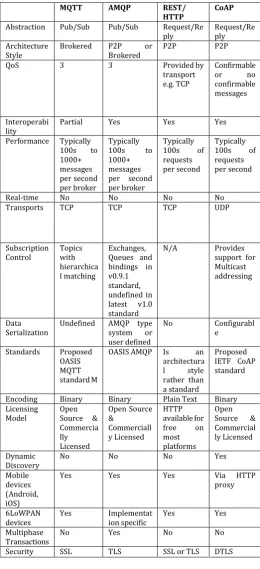
Table -1: Comparison of application layer protocol
MQTT AMQP REST/
HTTP CoAP
Abstraction Pub/Sub Pub/Sub Request/Re
ply Request/Reply
Architecture
Style Brokered P2P Brokered or P2P P2P
QoS 3 3 Provided by
transport e.g. TCP
Confirmable
or no
confirmable messages
Interoperabi
lity Partial Yes Yes Yes
Performance Typically
100s to
1000+ messages per second per broker
Typically
100s to
1000+ messages per second per broker
Typically
100s of
requests per second
Typically
100s of
requests per second
Real-time No No No No
Transports TCP TCP TCP UDP
Subscription
Control Topics with
hierarchica l matching
Exchanges, Queues and bindings in v0.9.1 standard, undefined in latest v1.0 standard
N/A Provides
support for Multicast addressing
Data
Serialization Undefined AMQP type system or user defined
No Configurabl
e
Standards Proposed
OASIS MQTT standard M
OASIS AMQP Is an
architectura
l style
rather than a standard
Proposed IETF CoAP standard
Encoding Binary Binary Plain Text Binary
Licensing
Model Open Source &
Commercia lly Licensed Open Source & Commerciall y Licensed HTTP available for
free on
most platforms
Open Source & Commercial ly Licensed
Dynamic
Discovery No No No Yes
Mobile devices (Android, iOS)
Yes Yes Yes Via HTTP
proxy
6LoWPAN
devices Yes Implementation specific Yes Yes
Multiphase
Transactions No Yes No No
Security SSL TLS SSL or TLS DTLS
4. CONCLUSIONS
© 2016, IRJET | Impact Factor value: 4.45 | ISO 9001:2008 Certified Journal | Page 747 have introduced a typical IoT design by depicting the parts
where application layer conventions are expected to handle communication. We have introduced the most illustrative application layer conventions that have picked up consideration for IoT. The computational and communication capacity of the gadgets included should likewise be mulled over while picking the most fitting convention. On the off chance that obliged communication and battery utilization is not an issue, RESTful administrations can be effortlessly actualized and cooperate with the Internet utilizing the overall HTTP. This can be demonstrated extremely helpful in test beds as it can work as verification of idea for conclusive applications.
REFERENCES
[1] A. Rajandekar and B. Sikdar, “A survey of MAC layer
issues and protocols for machine-to-machine
communications,” IEEE Internet Things J., vol. Early Access, no. 99, pp. 1–1, 2015.
[2] Periklis Chatzimisios, Industry Forum & Exhibition Panel on Internet of Humans and Machines, IEEE Global
Communications Conference (Globecom 2013),
Atlanta,USA, December 2013.
[3] Tasos Kaukalias and Periklis Chatzimisios, Internet of Things (IoT) C Enabling technologies,applications and open issues, Encyclopedia of Information Science and Technology (3rd Ed.), IGI Global Press, 2014.
[4] T. Taleb and A. Kunz, “Machine type communications in
3GPP networks: Potential, challenges, and solutions,” IEEE Commun. Mag., vol. 50, no. 3, pp. 178–184, 2012. [5] J. Malmodin et al., “Greenhouse gas emissions and
operational electricity use in the ICT and entertainment and media sectors,” J. Indus. Ecol., vol. 14, no. 5, pp. 770–790, 2010.
[6] Tasos Kaukalias and Periklis Chatzimisios, Internet of Things (IoT) C Enabling technologies, applications and open issues, Encyclopedia of Information Science and Technology (3rd Ed.), IGI Global Press, 2014.
[7] Zhang, Y.; Yu, R.; Xie, S.; Yao, W.; Xiao, Y.; Guizani, M. Home M2M networks: Architectures,standards, and QoS improvement. IEEE Commun. Mag. 2011, 49, 44–52.
[8] Lien, S.Y.; Chen, K.C.; Lin, Y. Toward ubiquitous massive accesses in 3GPP machine-to-machine communications. IEEE Commun. Mag. 2011, 49, 66–74.
[9] Lu, R.; Li, X.; Liang, X.; Shen, X.; Lin, X. GRS: The green, reliability, and security of emerging machine to machine communications. IEEE Commun. Mag. 2011, 49, 28–35.
[10] Vazquez Gallego, F.; Alonso-Zarate, J.; Alonso, L. Energy and delay analysis of contention resolution mechanisms for machine-to-machine networks based on low-power WiFi. In Proceedings of the 2013 IEEE International Conference on Communications (ICC), Budapest, Hungary, 9–13 June 2013; pp. 2235–2240.
[11] Matamoros, J.; Anton-Haro, C. Data aggregation schemes
for Machine-to-Machine gateways: Interplay with MAC protocols. In Proceedings of the 2012 Future Network Mobile Summit (FutureNetw), Berlin, Germany, 4–6 July 2012; pp. 1–8.
[12] oneM2M. one M2M Prepares for August 2014 Release. Available online: http://www.onem2m.org/press/2014-0411%20TP10_Release_final2.pdf (accessed on 20 July 2014).
[13] MQTT. MQ Telemetry Transport (MQTT) V3.1 Protocol
Specification.Available