© 2016, IRJET | Impact Factor value: 4.45 | ISO 9001:2008 Certified Journal
| Page 148
Numerical and Experimental Study on Dynamic and Static Behavior of
Cantilever Beam using PZT Actuators
Dr. R. B. Barjibhe
1, Mr. P .V. Fegade
21
Professor, Dept. of Mechanical Engineering, S.S.G.B.C.O.E.T., Bhusawal. (INDIA)
2
Assistant Professor, Dept. of Mechanical Engineering, S.S.G.B.C.O.E.T., Bhusawal. (INDIA)
---***---Abstract –
In this present scenario deformation is the major
problem in structural design. In Aerospace and satellite objects, faces a major problem of static deformation due to many parameter uncertainties and environmental disturbances. Piezoelectric materials allow the transformation of electricity constraints into mechanical constraints and vice versa. They are used as controllers or sensors in the industry field. The objectives of this work are the modeling of smart structures and study on dynamic and static behavior of the beam, also the effect of the number and location of the actuators in the control system. In this work we consider a cantilever beam under static loading condition and tried to reduce the deflection of that beam using piezoelectric actuator. The study uses ANSYS software to derive the finite element model of the beam. Experimentation was also conducted to verify numerical results. The effect of the number and locations of the actuators on the control system are also investigated. Results are presented to show the dynamic and static behavior of aluminium beams with piezoelectric (PZT) actuators. The work displayed the role of piezoelectric actuators for the active control of the beam which is utilized to control the different beam like structure like aerospace component, the tail of the aircraft, Arial reflectors etc.Key Words: ANSYS, Cantilever Beam, Mode shape, Natural Frequency, Piezoelectric (PZT) Actuators.
1. INTRODUCTION
Engineers from civil, electrical, aerospace and mechanical engineering fields are all involved in some part of the development of smart materials and structural systems. One reason for this activity is that it may be possible to create structures and systems that are capable of adapting or correcting in response to changing operating conditions without human intervention. The advantage of incorporating these special types of materials into a structure is that the sensing and actuating mechanisms become a part of the structure and can directly sense and actuate strains. Smart materials are defined as materials that are capable of automatically and inherently sensing or detecting changes in their environment and responding to those changes with some kind of actuation or actions. These characteristics provide several possible applications for these materials in aerospace, manufacturing, civil infrastructure systems, and biomechanics. Active vibration and acoustic transmission control, active shape control, and active damage control are
© 2016, IRJET | Impact Factor value: 4.45 | ISO 9001:2008 Certified Journal
| Page 149
beam is investigated.[4] The primary goal of this work is the modelling of smart structures. Static and dynamic analytic models will be derived for segmented piezoelectric actuators that bonded to an aluminium beam. These models lead to the ability to predict:
1. The natural frequencies and mode shapes of this smart beam.
2. The deflection and the response of a beam induced by external forces or both piezoelectric actuators and external forces.
3. The effects of the number and location of the actuators on the control system.
2. MODELING OF CANTILEVER BEAM WITH PZT
ACTUATOR USING ANSYS
2.1 Modal Analysis
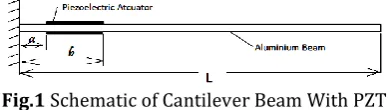
The natural frequency of the aluminium beam is found by the well known Finite Element (FEA) Software ANSYS. Modal analysis is carried out using the Block Lanczos method for finding the natural frequencies. The fixed free boundary condition was applied by constraining the nodal displacement in both x and y direction.
[image:2.595.305.561.71.221.2]Fig.1 Schematic of Cantilever Beam With PZT
Table-1: Material Properties and Dimensions of Aluminium Beam and Piezoelectric Actuator
The first two mode shapes of aluminium beam with and without PZT are shown in following Fig.2 and Fig.3
Fig.2 1st and 2nd Mode Shape of Cantilever Beam without PZT Actuator
[image:2.595.64.260.406.461.2]Fig.3 1st and 2nd Mode Shape of Cantilever Beam with PZT Actuators
Table 2: First Two Natural Frequencies of Beam
Mode fn(Hz)
Without PZT Actuators With PZT Actuators fn (Hz)
1 25.817 27.07
2 161.731 163.87
2.2 Static Analysis
The deflection model is an approximate since the only control action is considered. Several examples of beam had been studied under same external action and various actuation boundary conditions to illustrate how deflection control can be achieved with use of PZT actuators. So the cantilever beam under point load at free end is considered and the response of the beam external action and actuation is superimposed. The results are shown in Fig. 4 to Fig.6.
Deflection of beam at 0 volt
Deflection of beam at 25 volt
Dimensions/Properties Aluminium PZT actuator
Length 0.4 m 0.0762 m
Width 0.03 m 0.0254 m
Thickness 0.005 m 0.5x10⁻³ m
Density 2700 Kg/m3 7600 kg/m3
Young modulus 70 Gpa 76 GPa
Poisson’s ratio 0.3 0.25
[image:2.595.50.277.507.575.2] [image:2.595.318.555.520.720.2] [image:2.595.39.280.617.749.2]© 2016, IRJET | Impact Factor value: 4.45 | ISO 9001:2008 Certified Journal
| Page 150
Deflection of beam at 50 volt
Deflection of beam at 75 volt
Deflection of beam at 100 volt
Deflection of beam at 125 volt
Deflection of beam at 150 volt
Deflection of beam at 175 volt
Fig.4 Deflection Control of Beam When PZT Actuators is
Placed Near Fixed End and Various Voltages Applied to it.
Deflection of beam at 0 volt
Deflection of beam at 25 volt
Deflection of beam at 50 volt
Deflection of beam at 75 volt
Fig.5 Deflection Control of Beam When PZT Actuators is Placed at Middle of the Beam and Various Voltages
Applied to it.
Deflection of beam at 0 volt
© 2016, IRJET | Impact Factor value: 4.45 | ISO 9001:2008 Certified Journal
| Page 151
Deflection of beam at 50 volt
Deflection of beam at 75 volt
Fig.6 Deflection Control of Beam when PZT Actuators is Placed Near Fixed End and at Middle of the Beam and
Various Voltage Applied to it.
3. EXPERIMENTAL SETUP
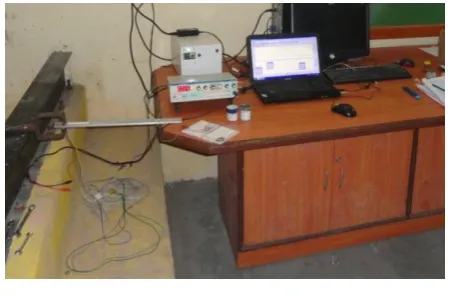
As explained previously, the natural frequencies and mode shapes of a cantilever beam bonded with piezoelectric actuator can be predicted numerically (ANSYS). Experimental analysis has been conducted to verify the numerical approach. Among piezoelectric materials, lead zirconate titanate (PZT) has high coupling coefficients and piezoelectric charge coefficients. PZT-5H of Sparkler Ceramics Company is used for actuators. They are thin, unobtrusive, self-powered, adaptable to complex contours, and available in a variety of configurations.Fig. 7 represents the experimental setup. The experimental setup consists of a cantilever aluminium beam with piezoelectric actuators. A sensor, it was used to measure the displacement at the tip. A control panel instrument and a personal computer, acquired the output data from the sensor at the same time. A function generator was used to provide a harmonic signal to an amplifier which supplied voltage to the piezoelectric actuator.
4. RESULT AND DISCUSSION
Numerical and Experimental results are presented to show the dynamic and static behavior of aluminium beams with PZT actuator. The adhesive layers are neglected. A constant voltage with an opposite sign was applied to the PZT actuator on each side of the beam. Due to the converse piezoelectric effect, the distributed PZT actuator contract or expand depending on negative or positive active voltage. In general, for an upward displacement, the upper actuators need a negative voltage and the lower actuators need a positive one. The control of static deflection and modal analysis of the beam under the distribution of PZT actuator
are analyzed. The natural frequencies for aluminium beam without and with PZT actuator are listed in Table 2.
Fig. 7 Experimental Setup
Fig.8 Comparison of Deflection Control Result When 100 Volt Applied to Actuators Placed Near Fixed End and
Middle of the Beam
[image:4.595.36.286.94.291.2] [image:4.595.321.546.146.294.2]© 2016, IRJET | Impact Factor value: 4.45 | ISO 9001:2008 Certified Journal
| Page 152
5. CONCLUSIONS
A simple but efficient approach was proposed to simulate the action of the PZT actuators placed on cantilever beam. The solutions of the transverse displacement induced by actuation have been written in such form that explicitly accounts for the position of the actuator. Finite element verification of the proposed model is presented. Through the use of those solutions, the deflection control in a beam subjected to static external action can be achieved. Experimentation was also conducted in order to verify the numerical results. Finally, the effect of the number and locations of the actuators on the control system are also investigated. When we placed one pair of PZT near fixed end then the deflection of the beam is controlled as about 28% also it required more voltage. When we placed PZT actuator near fixed end and at middle of the beam then the deflection of the beam controlled as about 82% also it required less voltage and we observed that beam flattened quite smoothly. The investigation shows that designing smart structures with distributed PZT actuators, the number and location of the actuators must be given careful consideration
REFERENCES
1. K.B.Waghulde, Dr. Bimlesh Kumar, Prof. T. D. Garse and Prof. M.M.Patil, “Smart Materials and Structures used for Vibration Control”, Journal of Information Knowledge and Research in Mechanical Engineering, Nov. 10- Oct. 11, Vol.1 pp.26-30.
2. J.J. Liu and B.M. Liaw, “Efficiency of Active Control of Beam Vibration Using PZT Patches” International Congress & Exposition on Experimental and Applied Mechanics Costa Mesa, CA, June 7-10, 2004
3. Waleed Khalid and Al Ashtari, “The Deflection Control of a Thin Cantilever Beam by Using a Piezoelectric Actuator / Sensor” 1st Regional Conference of Eng. Sci. NUCEJ Special Issue Vol.11,No.1, 2008, pp. 43-51
4. K. Venkata Rao, S. Raja and T. Munikenche Gowda, “Bending Behavior and Vibration of Piezoelectric Beam with Debonded Actuators: Coupled Finite Element Analysis”, International Journal of Applied Engineering Research, (2012), ISSN 0973-4562, Vol.7, No.11
5. Yuvaraja .M, Senthilkumar.M and I. Balaguru, “Study on Vibration Characteristics of PZT Actuated Mild steel and Aluminium Cantilever Beams”, Annals of Faculty Engineering Hunedoara, International Journal of Engineering, (2011), pp. 177-182
6. Action Nechibvute, Albert Chawanda, and Pearson Luhanga, “Finite Element Modeling of a Piezoelectric Composite Beam and Comparative Performance Study of Piezoelectric Materials for Voltage Generation”, International Scholarly Research Network,(2012), pp. 1-11
7. Dongchang Sun, Liyong Tong and Satya N. Atluri, “ Effects of Piezoelectric Sensor/Actuator Debonding on Vibration Control of Smart Beam” International journal of Solid and Structures, (2001) pp. 9033-9051