Image Generation in Microprocessor-based
System with Simultaneous Video Memory
Read/Write Access
Piyush Bhatia
1, Rahul Sehrawat
2IT Department, Maharishi Dayanand University
Abstract: In this paper we present a new architecture of video memory data handling in microprocessor-based systems. This architecture is a solution for the real time image processing systems which requires a significant recording time. The solution is based on a simultaneous video memory read/write. This operation is ensured by hardware splits of video memory in separate capacities and by association of a selecting circuit. This later offers a state port and two communication ports. The first communication port is used for reading and the second for writing.
Key words: Video image generation, simultaneous video memory read/write, software/hardware System, microprocessor-based systems.
1 INTRODUCTION
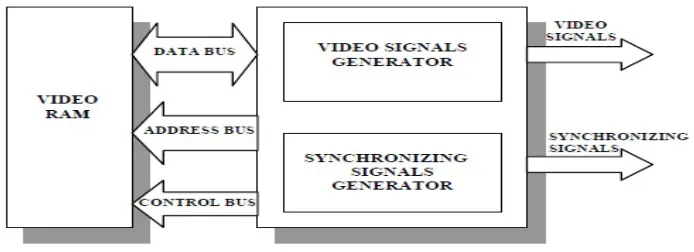
The video image generation in microprocessor-based systems is ensured by the video card or the graphic card. A video card is composed of several function units working in coordination. The starting point of any image is always from the video RAM. This latter is a memory RAM that is on the video card and contains the image information to be displayed. To generate a video image on the basis of a video RAM, the different components of the video card should complete the reading of its entire memory with a frequency being able to reach 75 cycles per second [1] figure 1. During this reading process, no simultaneous access is authorized. This gives the possibility of a writing process only during the time of the return line and frame. Under these operating conditions, the realization of a display device for real time image processing systems, which requires a significant recording time, remains very complicated.
In this paper, we present a hardware/software solution [2] to enlarge the recording access time. This solution consists in designing a display system which allows a simultaneous reading/writing access.
[image:2.612.123.470.522.648.2]The suggested architecture is composed of a hardware part and a software part. The hardware part is based on the memory capacity part of the video RAM with separate buses and on the association of a simultaneous selecting circuit. The software part ensures the data transfer to the display system and the recording synchronization with the video RAM reading cycle
Fig 1: Graphic Card Block Diagram
II. IMAGE GENERATIONS IN THE VIDEO CARD
Tw =T fr +Tlr×Nl
TFr: The time of return frame.
TLr: The time of return line
NL: The number of lines within the frame
III. IMAGE GENERATION WITH SIMULTANEOUS ACCESS BY TWO LEVELS
[image:3.612.75.483.196.344.2]The image generation system with simultaneous access by two levels represents the basic architecture of our system. This architecture of visualization uses a video RAM made up of two RAMs. Both RAMs can be selected separately; one can be selected in reading and the second in writing and vice versa. Figure 2 represents the block diagram of the hardware part of this system.
Fig 2: Two Levels System Block Diagram
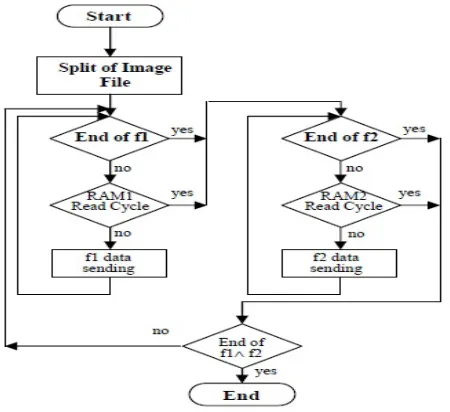
[image:3.612.202.427.414.620.2]The software part is designed to carry out a process of permanent recording on the video RAM of this architecture. In the case of a simultaneous access by two levels, the image file is split up into two parts: f1 and f2. File f1 represents the higher part of the image and file f2 the lower part. The software allows the switching between sending data of file f1 and file f2. The synchronization of sending data is related to the selection state of RAMs in our system. Figure 3 illustrates the main flow chart of the software part.
Fig 3: Two Levels System Flow Chart
IV. IMAGE GENERATION WITH SIMULTANEOUS ACCESS BY SEVERAL LEVELS
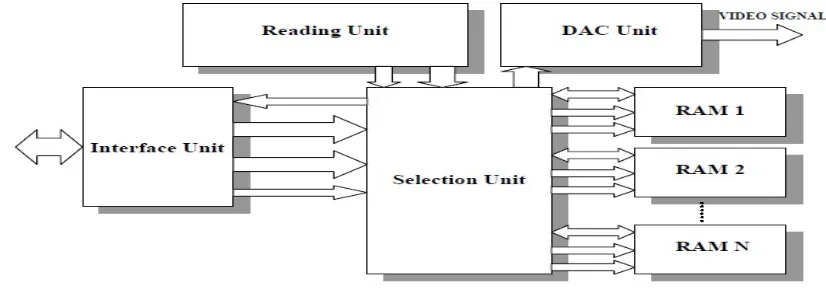
The connection between the units uses the same structure of the two levels system. The size of the state bus depends on the number of the used RAMs. The link between the selection unit and the used RAMs is ensured by several buses: each bus is composed of a data bus, an address bus and a control bus.
Fig 4: N Levels System Block Diagram
This architecture gives a ratio of the writing time over the total time of the video frame varies from 100% to a minimal value WRN.
The ratio WRNis given by the following form:
N: Represent the number of the RAMs used in our system
By using the formula and a value of WRequals to 10%, WRNcan take several values according to N. Table 1 presents the values
WRNfor N varies from 1 to 100.
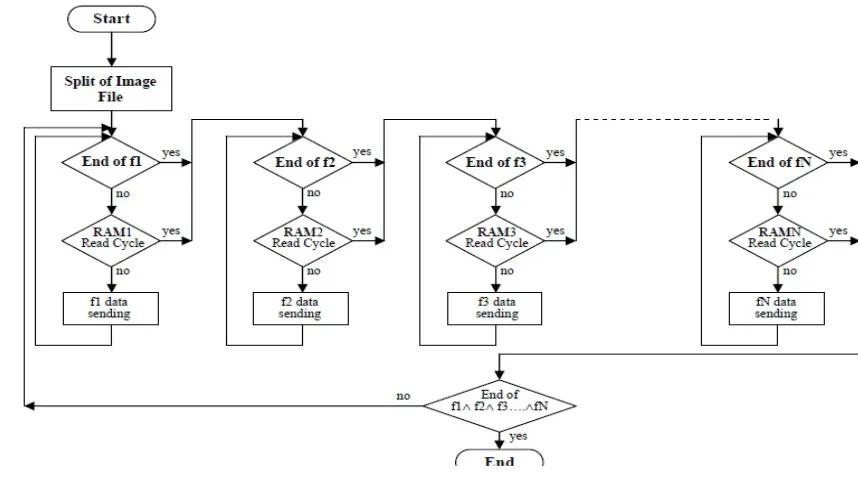
The software part of the simultaneous access by several levels splits up the image file into several parts. The result gives N files (f1, f2, f3 ... , F N). The switching of sending data is done by N files. The synchronization of the sending of data is related to the state of selection of the N RAMs, which compose the video RAM of our system. Figure 5 presents the principal flow chart of the software part of the system at several levels.
N 1 2 3 4 5 6 7 8 9
WRN 10% 55% 70% 77.5% 82% 85% 87.1% 88.78% 90%
N 20 30 40 50 60 70 80 90 100
Fig 5. N levels system flow chart
V. CONCLUSION
The generation of the images in the video cards connected to the microprocessor-based systems uses repeated readings of the video memory contents. In this paper, we have exposed the main principles of the simultaneous access. We have presented the structure at two levels and then the structure at several levels.
The first practical tests have given a recording rate of 95% for the two levels system and a rate of 98% for the three levels system. Structures higher than three levels have given rates lower than that of three and two levels. This characteristic is due to the complexity of the circuitry and the software processing time that is significant for the several levels systems.
REFERENCES
[1] M.Tischer. LA BIBLE PC. EDITIONS MICRO APPLICATION. France. 1997.
[2] G.F.Marchiro. Découpage Transformationnelpour la Conception de Systèmes Mixtes Logiciel/Matériel. Thèse de Doctorat. InstitutNational Polytechnique de Grenoble. France. 1998.
[3] Vijay K. Madisetti and Douglas B. Williams, Digital Signal Processing Handbook, CRC Press, 1999.
[4] M.Maamoun and G.Zerari, Adressage Matériel dans les Systèmes à Microprocesseur avec un Adressage Physique Etendu, 2001 IEEE Canadian Conference on Electrical and Computer Engineering (CCECE01). IEEE Canada. Toronto, Ontario, Canada. 2001.