Effective Alternative for Methane Extraction from
Earth and Solid Waste Management
Hammadhu Rukiya Jalva H1, Sakthi Shree A2
1, 2
M.E in Construction Engineering and Management, Department of Civil Engineering, R V S Technical Campus Coimbatore-641 402, India
Abstract: with increase in population the amount of energy need also increases simultaneously the amount of waste generated also increases enormously. India, the second largest populated country in the world is also the second largest consumer of energy. About 70% of energy production is from fossil fuels. India’s energy consumption is said to grow 4.2% by the year 2035. Due to need for more energy, our country plans to extract methane from ground by a method called hydraulic fracturing which will lead to severe environmental degradation. This paper describes how the method of methane extraction from solid waste acts as an effective alternative against methane production from ground and also explains the environmental benefit associated with it.
Keywords: Green House Gases (GHG), Hydro Carbons (HC), Biodegradation, Landfill, Municipal Solid Waste (MSW)
I. INTRODUCTION
India is rapidly industrialized and its population is also increasing at a fast rate. Urban areas cover nearly 31.2% of population. Many metro cities have population which exceeds ten million. The industrialization and population growth results in production of waste in enormous quantities. Waste generated in urban cities are more complex in its constituents and it is difficult to separate and dispose it effectively. Therefore wastes are collected and dumped in open areas in huge piles in million tones every day. On the other hand earth’s climate is changing abruptly and there are many disasters occurring worldwide. Human activities are one of the causes for the climate change. Greenhouse gases (GHG) are getting trapped in the atmosphere due to human activities and this led to the change in climate system since 1950.Intergovernmental Panel on Climate Change (IPCC) reports that– “Human influence on the climate system is clear, and recent anthropogenic emissions of GHG are the highest in history. Recent climate changes have had wide spread impacts on human and natural systems. The risks of abrupt or irreversible changes increase as the magnitude of the warming increases”. And the world is shifting towards using renewable energy and creating sustainable environment. Hence it is essential to arrest the emission of greenhouse gas from wastes and to find an effective alternative for the energy requirement and fossil fuel extraction from ground as it leads to GHG emission and global warming.
[image:2.612.103.508.517.700.2](Fig. 1) The figure below shows the globally averaged GHG concentrations.
Fig. 1.Globally averaged GHG concentration
II. METHANE
Chemical formula for methane is CH4 .Lifetime of methane in atmosphere is 12 years and has a global warming potential of 28-36. Though methane has a shorter lifetime than carbon -di- oxide (CO2), its global warming potential is much higher than CO2. Human activities contribute to 10% of green house gases. However methane is a valuable fuel gas. It is colourless, odourless clean fuel having energy content of 802.3 KJ/mol or 50 MJ/Kg .combustion of methane produce carbon-di-oxide and water.
CH4+ 2O2 CO2 + 2H2O
[image:3.612.157.456.195.305.2]Methane is one of the major reasons for the rise in global temperature. The figure (Fig. 2) below represents the global atmospheric concentration of methane from 1950 to 2015.
Fig. 2 Global atmospheric concentration of methane over time
Data Source: Compilation of five underlying datasets.www.epa.gov/climate-indicators for specific information.
III.SOURCESOFMETHANE
Majorsource of methane production is from to anaerobic decomposition in
A. Natural wetlands
B. Landfills
C. Paddy field
D. Emission from livestock
E. Biomass burning
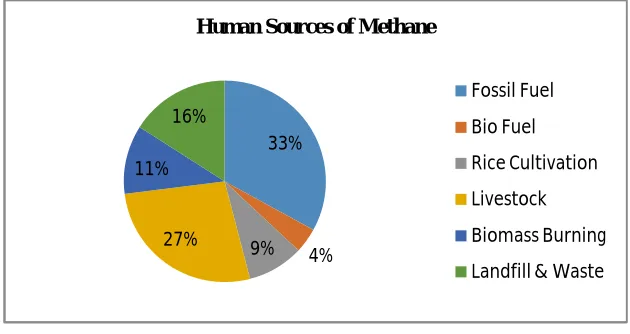
F. Fossil methane emission during exploration & transportation
Fig.3.Human Sources of Methane emission
IV.GHGFROMWASTE
India emitted 1727.71 million tons of GHG in atmosphere in the year 2004. Total emitted methane was 20.56 million tons out of which 4.27 million tons is from energy sector and 2.52 million tons is from waste sector. Methane is release as a by-product during anaerobic decomposition of organic waste present in waste water and solid waste. The organic matter present in them is degraded by methogenic bacteria under suitable conditions. The waste water from domestic, commercial and industrial sources when disposed untreated releases methane under anaerobic condition. 45 million tons of waste water generated releases 1.9 million tons of methane in India. Industries are responsible for about 955 of methane emission from waste water in India. Since effluent from sugar, beer,
33% 4% 9% 27% 11% 16%
Human Sources of Methane
Fossil Fuel
Bio Fuel
Rice Cultivation
Livestock
Biomass Burning
[image:3.612.169.484.451.618.2]meat producing industries are rich in organic constituents. Domestic waste water is a dominant source of methane in India contributing 40% of total CO2 equivalent emission from waste sector. 38% of methane is from disposal and treatment of industrial waste and 22% is from MSW disposal. Figure(Fig. 4)represents GHG emission from waste in million tonnes of carbon-di-oxide equivalent.
Fig.4.GHGemission waste inmillion tonnes of CO2equivalent
Data Source: Report INCCA and Network for preparing the Greenhouse Gas Emissions – 2007.
V. GHGFROMMUNICIPALSOLIDWASTE
The amount of waste generated per capita goes on increasing nowadays. India is producing more than 100000 metric tons of solid waste per day. Mumbai being the top producer with 9000 mt/day, Delhi 8300 mt/day and Chennai alone release 0.12Gg/ year of methane.
In developing countries like India, waste are treated and properly disposed only in few cities but are thrown & disposed improperly or collected as open dumping where methane escapes into atmosphere raising global temperature. Moreover this kind of improper disposal results in odour, anaesthetic places, origin for several germs, hub for mosquito production and other related diseases.
VI.LANDFILLGAS
Landfills are the final way of disposing waste after several processes like segregation, size reduction, etc. The proper management of these waste in the landfill will yield gases called LFG. LFG composed of 45% -60% methane and 40-60% of CO2 and other trace gases. Landfill undergoes four phases of bacterial decomposition. During the final phase it releases LFG with 45-60% methane at a stable rate (Fig. 5). The gas will continue to emit for 50 or more years after waste is placed in landfill depending upon its content. It requires suitable factors like composition of waste, age of refuse, presence of oxygen, moisture, pH and temperature.
Fig. 5.Production Phases of typical of landfill gas
[image:4.612.221.396.519.711.2]VII. BENEFITSOFLFG
A. Reduce GHG emission
B. Reduce air pollution by offsetting use of non-renewable resources
C. Create health and safety benefits
D. Benefits community and economy
E. Reduce environmental compliance cost
VIII. HCISSUE
The need for energy increases with increase in population. India relies on fossil fuels for its energy production and it obtains 60% of energy from coal. Owing to the need for more energy India decides to extract HC from 44 locations across the country through a process called hydraulic fracturing. The process requires about 12.15 gallons of water per minute and tons of sand which will lead to severe environmental degradation such as depletion of groundwater and sand. As agriculture is the backbone of our country the farmers who depend on the land will be affected as this process would make the land uncultivable due to water depletion and if there is accidental spill of oil & chemicals over the land.
IX.HCFROM GROUNDVSHCFROMWASTE
Methane from ground yields 1Billion tons pey year whereas 1.5 billion tons per year from organic decomposition of waste. After methane production the residue can be used as rich manure. Over 90 lakh tons of manure can be used for fertilizing 45 lakh acre of agricultural land.
The anaerobic decomposition of solid waste gives methane. One ton of organic waste yields 40 kg methane depending upon its nutrient content which could fill two LPG cylinders. Cellulose and hemicelluloses are principle biodegradable constituent of refuse accountable for 91% of total methane production.
X. CONCLUSION
We are producing tons and tons of waste everyday and simply throw it as open dumping and letting the methane gas to escape into the atmosphere to increase the temperature of earth. On the other hand we are extracting methane from ground causing heavy impact to people, earth, water resource, environment and climate. Producing methane from waste will prevent global warming, helps in efficient waste management with social, economic and environmental benefits. Thus we could get cleaner, safer, odourless environment by proper waste disposal and management.
REFERENCES
[1] Report of central pollution control board on “status of compliance by CPCB with municipal solid wastes (management and Handling) rules, 2000”
[2] Tchobanoglous G, Theisen H, and Vigil S. 1993. Integrated Solid Waste Management, Engineering Principles and Management Issues. New York: McGraw-Hill, Inc. pp. 381-417.
[3] Nusrat Jahan Imu1, Dido Mann Samuel 2 “Biogas Production Potential from Municipalorganic Wastes In Dhaka City, Bangladesh” International Journal of Research in Engineering and Technology, Volume: 03 Issue: 01 | Jan-2014.
[4] Abhishek Nandan, Bikarama Prasad Yadav, Soumyadeep Baksi, Debajyoti Bose “ Recent Scenario of Solid Waste Management in India” World Scientific News 66 (2017) pp. 56-74
[5] Bhide, A. & Shekdar, A. 1998. Solid waste management in Indian urban centers. International Solid Waste Association Times (ISWA), 1, 26-28.
[6] Gupta, S., Mohan, K., Prasad, R., Gupta, S. & Kansal, A. 1998. Solid waste management in India: options and opportunities. Resources, Conservation and Recycling, 24, 137-154.
[7] Sharholy, M., Ahmad, K., Mahmood, G. & Trivedi, R. C. 2008. Municipal solid waste management in Indian cities – A review. Waste Management, 28, 459-467.
[8] Rajkumar Joshi and Sirajuddin Ahmed “Status and challenges of municipal solid waste management in India: A review” Environmental Chemistry, Pollution & Waste Management -Review Article,Cogent Environmental Science (2016), 2: 1139434 http://dx.doi.org/10.1080/23311843.2016.1139434
[9] Report INCCA Indian Network for Climate Change Assessment Ministry of Environment and ForestsGovernment of India , India: Greenhouse Gas Emissions 2007 ,May 2010
[10] Arvind K. Jha , C. Sharma , Nahar Singh , R. Ramesh , R. Purvaja , Prabhat K. Gupta, Greenhouse gas emissions from municipal solid waste management [11] in Indian mega-cities: A case study of Chennai landfill sites, Chemosphere (2007), doi:10.1016/j.chemosphere.2007.10.024
[12] U.S.EPA’s “Climate Change Indicators in the United States” at www.epa.gov/climate-indicators.
[13] , The Synthesis report of the Fifth Assessment Report. Intergovernmental Panel on Climate Change I(PCC) in October, 2014