Frontiers in Education (FE)
Interactions in Online Forums: A Case Study
Among First-Year Undergraduate Students
Dorothy DeWitt1,Norlidah Alias2, Saedah Siraj3 Abd Razak Zakaria4*
1,2,3,4
Faculty of Education University of Malaya 4*
Abstract- In online communities of learners, interactionsareessentialfor building knowledge. Cognitive interactions assist the learning of concepts and principles, while social interactions engage and motivate learners. Howeverin instructional activities,most of the timethe acquisition of factual knowledge is stressed upon, and not the interactions. In this study, theonline communications of students in their first semester of an undergraduate course, Computers in Counseling, were investigated to determine the types of interactions that took placeduring the online discussions, and whether these discussionscontributed to knowledge-building.The30 undergraduatestudents participated in an online discussion forum, posting their responses to the questions given. Content analysis of the transcripts of their online communications was done to classify the types of interactions. This was followed by a survey of the students’ perceptions of discussion forums for learning. The findings showed that a large proportion of the interactions wascognitiveinteractions (46.0%), followed by attitudes (22.3%),socialinteractions(19.6%) and noise (5.3%). The students perceived that discussion forums were effective for collaborative learning (60.0%) and enabled ICT and communication skills (16.7% each), as well as self-regulated learning skills (13.3%) to be developed. The analysis of the open-ended responses indicated that it was perceived as useful for the construction of knowledge. This study is significant as it shows that interactions on online communication tools should be encouraged for collaboration and sharingof ideas for learning.
Keywords- Online Interactions; Discussion Forums; Community of Inquiry; Collaborative Learning
I. INTRODUCTION
Communication enablesknowledge to be acquired. However, for communication, a language structure making use of vocabulary and rules formeaning-making, is required (Nielsen, 2012). Inthe field of science and technology, scientific verbal knowledge is like the vocabulary of science, and is required for making meaning out of the experiences in learning (Goodney & Long, 2003; Karpov & Haywood, 1998; Nielsen, 2012). To acquire the language of science, learners need to observe patterns, and model the communications duringinteractions and activities in science, to build their knowledge (Hogan & Fishkeller 2005; Karpov & Haywood 1998; Sharma & Anderson 2009).
There are different levels of interactions in learning (Emdin, 2010). Cognitive interactions can range from lower level interactions as one attempts understanding a task to higher level interactions which involve explanation and meaning-making.Low level interactions involve little discussion about the content, but include lots of gestures and
meaningless interactions, ornoise. Emdin’sstudy of interactions in science classrooms in an urban school showed that higher level cognitive interactions improve learning while low level interactions, or noise, do not enhance learning and recall. This is supported by findings from other research which indicatethat discussions and communications in science improve the quality of learning when compared to the memorization of science facts (Kubli 2005; Sharma & Anderson 2009).
The implication for instruction is thatlearners in science and technology related courses must be given activities for discussion and interaction. An online platform for discussions can enable collaborative learning (Hiltz, Turoff, & Harasim, 2007; Weinberger & Fischer, 2006; Schrire, 2006; Spa, 2004; Turcotte, 2012; Zhang, Scardamalia, Lamon, Messina, & Reeve, 2006). A supportive learning community can scaffold learners to a higher level of learning (Ke & Hoadley, 2009). As learning becomes more active and learner-centered, more ideas are shared (Hannafin, Hannafin, & Gabbitas, 2009; Hiltz et. al.,2007). The interactions within the community afford knowledge construction (Noroozi, Weinberger, Biermans, Mulder & Chizari, 2013; Schrire, 2006; Weinberger & Fischer, 2006).
However, there does not seem to be much focus on discussions and interactions in learning science and technology-related subjects as instructors concentrate onthe acquisition of factual knowledge in teaching science (Lee 1999; Sopia 2002; Tan 2002). In addition, instructors perceive that scientific knowledge is dualistic and has a right and wrong answer, when it is actually relative and depends on contexts (Oliveira, Akerson, Colak, Pongsanon, & Genel, 2011; Sharma & Anderson, 2009). Hence, instruction should be designed to take into consideration the interactions during discussions among peers. Learners of science should be aware of the relativist nature of science knowledge and be able to practice presenting and defending their findings as a process of communicating in a culture of science (Oliveira et al. 2011).
A. The Study
Interactions to enable collaboration and encourage learning for building knowledge in technology-related subjects can be done using online tools, such as discussion forums. In reality, these subjects are taught with the focus on acquiring factual knowledge.
Frontiers in Education (FE)
learning to occur. The undergraduates are active users of social media (DeWitt, Naimie & Siraj, 2013), but are new to the use of discussion forums for learning.The results of this study would benefit policy planners and lecturers to determine if online discussion in science and technology-related subjects are beneficial for learning. In addition, it would also assistlecturers and students ofsocial science courses to identify best practices for studying technology-related courses, and whether discussion forums should be used for reflection and support.It will assist in providing the
guidelines for lecturers to consider
whendesigninginstructional activities and materials for technology-relatedsubjects.
B. Research Questions
The research questions are:
• What are the types of interactions(cognitive, social, teaching, attitude and noise) during online
discussionsamong first year undergraduatestudents? • What are the perceptionsof first year undergraduate
students related to learning using online discussion forums?
II. THEORITICAL FRAMEWORK
A. Designing instruction for interactions in collaborative learning
In collaborative learning, learners communicate about the content of instruction and resolve differences of opinions during their discussions to reach a mutual understanding (Jonassen, Lee, Yang & Laffey, 2005; Palloff & Pratt, 1999). Learning is the result of social interactions in a group and not the learning materials (Kaye, 1992). This process of collaboration and resolving differences develops learners’ critical thinking skills (Karpov & Haywood, 1998; Kim & Song, 2005). The learners’ interactions, whether among learners, with the instructor, and with the learning materials enhances the learners’ current understandings of concepts and principles andbuilds new knowledge and understandings based on the discussions through social interactions (Hannafin et. al, 2009; Heo Lim, & Kim, 2010; Kim & Song, 2005).
Higher level cognitive interactionsattempt to interpret and analyze findings of experiments and phenomena, contribute to new scientific facts. There is no specific rule for deriving these scientific facts,andknowledge is constructed during the attempt of making meaning of the information in discussions (Sharma & Anderson 2009). Hence, interactions such as questioning, arguments and debates during discussions, encourage the construction of science knowledge. Interactions also develop critical thinking skills as differences of opinions are resolved in reaching mutual understanding (Kampourakis 2010; Karpov & Haywood 1998; Kim & Song, 2005).
A design for instruction which incorporates collaborative communication should be employed for technology-related subjects. The tasks provided for these discussions should be
ill-structured problem-solving tasks for authentic and complex problems (Jonassen et al., 2005). Meaningful and authentic tasks ensure that enriching and creative ideas can be shared in the group (Jonassen et al., 2005; Kaye, 1992; Palloff & Pratt, 1999; Puntambekar, 2006; Siraj & Norman, 2012; Vaughan, 2010; Woo & Reeves, 2007). Reflection is important for successful collaborative learning. Learning supports for the problem-solving tasks could enhance the quality of interaction by providing opportunities for reflection during the interaction on the collaborative tasks (Heo et al., 2010;Puntambekar, 2006). In addition, learners should be supported with sufficient resources and tools which can be used, as well as teaching strategies employed by instructors (Heo et al., 2010; Vaughan & Garrison, 2005).
Self-directed constructivist learning environments encourage learners to form and test their own hypothesis. However, the learners may not have adequate prior knowledge and require support to detect inaccurate information and misconceptions (Hannafin et al., 2009). Hence, the importance of scaffolding through peer interaction, with an instructor or through system prompts, supports the learner in solving problems (Chiu, Huang & Chang, 2000; Hannafin et al., 2009; Vaughan & Garrison, 2005; Zhang et al., 2007). Scaffolding will assist learners to construct accurate representations of the solution to the problems.
Online discussion forums have been shown to be effective for collaborative learning. They are asynchronous platforms for sharing text-based information, enabling flexible and independent learning (Lee, 2012). Learners post information in a forum, and share and reflect upon what they have learnt (Hannafin, et. al., 2009; Hiltz et. al., 2007; Lee, 2012). By viewing their peers’ postings, they gather different opinions which may require them to adapt to their existing knowledge structures or to respond to it by questioning and developing arguments. This process and their interactions enable knowledge construction (Noroozi et. al., 2013; Schrire, 2006; Weinberger and Fischer, 2006). Learners develop critical thinking skills as they interpret and reorganize the information gathered to be presented in a different way, and collaborate with others (Hiltz, et. al., 2007; Lee, 2012; Zhang et al. 2007). At the same time they are scaffold by their peers (Ke and Hoadley, 2009; Lee, 2102).
On the other hand, some students may not be involved in discussions but were concerned with posting their answers and relying on the instructors’ feedback (Lee, 2012). Another reason forlack of interaction between learners was that they did not read and respond to their peers’ posts (Lee, 2012). The potential of discussion forums for encouraging the cognitive processes in learning needs to be investigated. Although there have been many advantages of its use, the use for students in the context of the study, needs to be investigated.
B. Community of InquiryFramework
Frontiers in Education (FE)
Woo and Reeves, 2007). In a face-to-face environment, interactions can be controlled by the teacher. However, in an online learning environment, interactions need to be designed into the instruction. The theory of transactional distance rationalizes the need for interactions. A shorter transactional distance (TD) means better communication between learner and instructor. In online communication, the gap can be reduced through dialogues between the learner and instructor in the form of interaction (D), structure of the course content and delivery (S), and the instructor enabling and learner exercising autonomy (A) (Moore 1993).
Moore and Kearsley(2005) classified three types of online interactions: learner-content, learner-learner, and learner-instructor. Other researchers have included another category of interaction to cover the learners’ satisfaction and willingness to use technology: the learner–interphase interaction(Hillman, Willis, & Gunawardena, 1994; Thurmond & Wambach, 2004). Some researchers believethat students’ online interactions show little evidence of cognitive processes like critical thinking (Garrison, Anderson, & Archer, 2010). However, others have found evidence of more critical thinking when there are moe interactions in the online communications, as compared to face-to-face communications (Heckman & Annabi, 2005; Shedletsky, 2010).
The Community of Inquiry(COI) Framework uses social, cognitive and teaching presence as categories of interactions to investigate online interactions(Garrison et al., 2010; Vaughan, 2010). An additional category, discourse, was added later the original three presences (Shedletsky, 2010). Pinzon-Salcedo, Barros, Zarama, de Meza, Carulla, & Bejarano (2008) used the COI Framework in their analysis of a mathematical problem-solving environment. Their analysis of online interactions included an additional two categories: the attitudes interaction for the affective aspect; and noise, for any communications which could not be identified. These categories of attitude and noise could be used to further analyze the discourse process in Shedletsky’s (2010) study.
In this study, the interactions in the online environment were analysed to determine the types of interactions according to the COI framework. In addition to the social, cognitive and teaching presences for categories of interactions(Garrison et al., 2010; Vaughan, 2010),attitudes and noise will be included (Pinzon-Salcedo et al., 2008; Shedletsky, 2010).
C. Objectives
1. To study the types of online interactions, viz., cognitive, social, teaching, attitude and noise existing among first year undergraduate students. 2. To understand the perceptions of first year
undergraduate students related to learning using online forums.
III.METHODOLOGY
A. Sample
The sample of this study consisted of undergraduate students in their first semester, enrolled in a counseling course, Computers in Counseling, at a local university. There were 30 students enrolled in the course, 20 females (66.7%) and 10 males (33.3%), all aged 19 years.
B. Design of the Study
The undergraduate students were required to access materials on the Moodle Learning Management System, and were required to make weekly posts on a forum for the group as part of the requirements of the course. The data was collected on the second and third week of semester.
The students had been introduced to an overview of the history of interactions in computer systems, answers questions for their student profiles and learning styles on
Google Forms, introduced themselves online on Wallwisher, had an orientation session to Paint during the class, and had to access several journal articles online.
The task was to answer the following questions, which were posted on an online discussion forum:
Question 1: Explain what you think is the purpose of
doing your Profile.
Question 2:Please share what you have learnt this week.
On completion of the discussion questions, the students completed an online survey on their perception of learning and other skills improvement when using discussion forums. There was an 80% response rate to the online survey.
C. Instrument
The code for the analysis of transcript of online communication on the forum was based on COI Framework: cognitive, social, teaching processes, attitude and noise. Cognitive processes are further divided to different levels: triggering, exploration, integration and resolution(Garrison et al., 2010, Shedletsky, 2010).An online survey on the perception of first year undergraduate students related to the use of discussion forums for learning was done on Google Forms. In the first section, two main areas, the perception of knowledge and skills acquired was determined using a checklist. The next section consisted of open-ended questions for the students to describe the strengths and weakness of using discussion forums from their experiences, and challenges when using discussion forms for learning.
D. Data collection and analysis
Frontiers in Education (FE)
2013).
IV.RESULTS
A. Results for objective 1
To study the types of online interactions, viz., cognitive, social, teaching, attitude and noise existingamong first year undergraduate students.
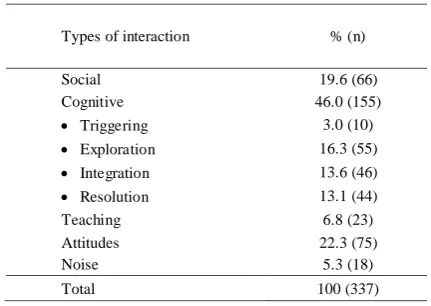
In answering the first research question, thetypes of interactions in the online discussions were analysed. Most of the interactions were cognitive processes (46.0%) but there were some interactions involving attitude (22.3%), social processes (19.6%), teaching (6.8%)and noise (5.3%) on the discussion forum (Table 1).
TABLE 1: TYPES OF INTERACTIONS IN THE POSTS ON THE DISCUSSION FORUMS
Types of interaction % (n)
Social 19.6 (66)
Cognitive 46.0 (155)
• Triggering 3.0 (10)
• Exploration 16.3 (55)
• Integration 13.6 (46)
• Resolution 13.1 (44)
Teaching 6.8 (23)
Attitudes 22.3 (75)
Noise 5.3 (18)
Total 100 (337)
Cognitive processes recorded the most interactions (Table 1). There were responses at higher levels of cognitive processes: to explore the solution to the questions (16.3%); suggest their solutions and build on previous messages (13.6%); assess the solutions and suggest applications in the resolution of the solution (13.1%). This indicated that cognitive processes occuredduring the interactions.
It was noted that there was fewer teaching processes (6.8%). This may be because instruction was done mainly offline. In addition, learners cooperated and helped each other offline as wasevidenced in theonline communicationsby the learners offering theirassistance:
Student A: Sincerely..I really don’t understand..google doc?? I really need help from my friends...hehehehe
Student B: no problem mate! anytime..;)
Students also indicated that they had received offlinehelp from their peers:
I learnt how to use the wiki. At first I was confused but my friends helped me and I managed to create a “new” page with “links” and a “main page”
There were also offers of assistance, to facilitate the learning: “Hello, did you manage to get the journal article? I’ve got it but there’s only one copy, and I managed to borrow it from the l;ibrary. If you like to get it, you will need to wait till I return it, yes?”
A large proportion of the interactions (22.3%) was based on attitudes. Learners expressed themselves in words. In some cases, there was extensive use of emoticons:“After I took this class, I realised the importance of ICT in our daily lives
. ; and “I really dont understand Google docs. I need my friends help... hehehehe
.”Expressions that indicated their emotions such as
“huwaaaaaaaaaaaaaaaaaaa ” was prominent in their forums.
In some posts, it was accompanied by the use of graphics to reinforce the written text: “The importance of ICT in our daily lives, As a future counsellor, I believe ICT will be the sole medium for exploriong the clients feelings and thinking.”
“In this time and place, clients are constantly busy at work, and with ICT the problem of space and shyness can be overcome as ICT can be used 24 hours 7 days a week”
Student even shared their thoughts and feelings, such as in this case when she overcame the difficulties of using forums:
This is the very first time I am posting on forum and seriously gave me a headache. This is because I didn't realized that we can only edit our post within 30minutes after we have posted it on the forum.
There were only some social processesoccuring(19.6%). The students were just getting to know each other and this influenced the way they interacted socially. It would also be interesting to see how the interactions in a group which were more familiar with each other. “The activity using the 'paint' application was fun as I produced a homemade vase. Hahahaha. Also, I went to some friends of mine and I am very impressed with their paintings. Mustaqimhas the characteristics of a painter, Penina had very colourful vases full of flowers, also Wahida and others. This is the best activity in which everyone looked at the work of art and other latent talents of their friends.”
[image:4.595.56.272.271.424.2]Frontiers in Education (FE)
To understand the perceptions of first year undergraduate students related to learning using online forums.
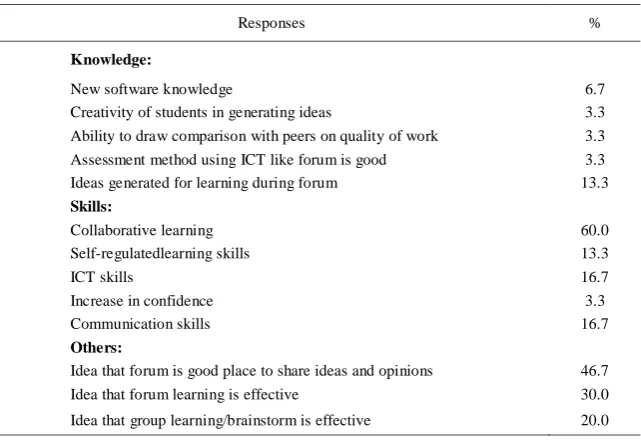
Most of the learners agreed that they were learning collaboratively (60.0%), but only a fewbelieved new ideas were generated in the forum (13.33%)(see Table 2). few
Although they perceived that they learnt a few skills: self-regulated learning skills (13.3%), ICT skills and communications skills (16.67% each), almost half (46.7%) agreed that the forum was a good place for sharing. Generally, only a few (30.0 %) perceived that learning was effective.
TABLE 2: PERCEPTIONS OF LEARNING USING THE DISCUSSION FORUMS
Responses %
Knowledge:
New software knowledge 6.7
Creativity of students in generating ideas 3.3 Ability to draw comparison with peers on quality of work 3.3 Assessment method using ICT like forum is good 3.3 Ideas generated for learning during forum 13.3
Skills:
Collaborative learning 60.0
Self-regulatedlearning skills 13.3
ICT skills 16.7
Increase in confidence 3.3
Communication skills 16.7
Others:
Idea that forum is good place to share ideas and opinions 46.7
Idea that forum learning is effective 30.0
Idea that group learning/brainstorm is effective 20.0
The open-ended responses gave richer data. The responses given by the students were categorized into the usefulness of the discussion forum for the sharing of knowledge and ideas, construction of knowledge, expressing themselves, peer respect, motivation to complete, interesting,
self assessment and encouraging creativity (see Table 3). Only two responses indicated that the use of forums was challenging as there was too much information online. Table 3 shows some of the more interesting responses in the categories.
TABLE 3. ANALYSIS OF OPEN-ENDED QUESTION ON PERCEPTIONS OF DISCUSSION FORUMS
Categories Comments
Sharing of knowledge
The forum provides an opportunity for me and my friends to share our thoughts and get new ideas
I have learnt to have discussions with my peers in a different way. Previously, whenever there is a discussion to be done, we will gather together and conduct the discussion. With the use of forums, I can easily share my ideas and thoughts with my peers.
Knowledge construction
My knowledge has improved with the latest input. I have also been able to improve my skills in answering questions and asking relevant questions.
I can also correct my wrong ideas through comments and suggestions provided by others. I also learn new ideas, concepts, new applications from others especially in doing the assignments. I have discovered many new ICT software which can be used in the field of counselling.
A combination of ideas to create a perfect answer.
Self-expression
I have learnt that sharing is good because in the old times, I did not like to share my knowledge because I’m too shy to speak. But now, since I've been using news forum, I can share my ideas and knowledge :)
-Speaking ideas without fear of backlash and able to answer peer's queries by brainstorming
Peer Respect This application educates us to respect the opinions of others besides presenting views in a respectful manner.
Motivation to complete tasks
Use of the forums can also boost my self-motivation to complete the tasks that should be performed, especially when an increasing number of my classmates who have posted their work on the forum.
[image:5.595.139.460.165.386.2] [image:5.595.89.503.482.759.2]Frontiers in Education (FE)
Categories Comments
Self assessment I can evaluate my work compared to my peers
Creativity I am able to be creative in developing ideas.
V. DISCUSSION
Discussion forums can be used for acquiring knowledge through sharing of ideas (Hannafin et al., 2009; Hiltz et. al., 2007). The students in this context did not have much difficulty in writing and many were verbose in writing, and hence the large amount of information.However, some students seem to be posting their ideas, and did not build on the ideas of their peers. This is similar to Lee’s (2012) findings as learners did not seem to respond to their peers’ answers. However, it might also be because a lot of other interactions took place offline so there was no need to support and build on the answers the peers gave. There was indication that learning occurred. The responses in their posts showed high levels of cognitive processes (46.0%). Ideas were supported and built upon as the postings progressively improved in the quality of the answers. The students admitted they learnt from their friends posts’ and improved their answers from the posts: I gained new knowledge through reading entries displayed in our forum. Besides, I learn to comment and criticize academically my friends’ writings.
The findings of this study expand on the findings of other studies to show that cognitive processes occur during online communications (Shedletsky 2010). The online interactions enable collaborative learning andinvolve the cognitive processes: forming concepts, resolving differences and developing critical thinking (Karpov & Haywood 1998; Kim & Song 2005). The findings showed interactions occurred at different cognitive levels. Triggering, which are communications that encourage thinking about issues, followed by exploration to connect and search for information; integration to build a possible solution on previous messages; and resolution to test and defend hypotheses (Shedletsky 2010).
However, further studies may be required to determine if this measure of interactions is suitable for this context and for other online communications. This is because although the use of discussion forums have been shown to promote active learning for building knowledge (Noroozi et. al., 2013; Schrire, 2006; Weinberger & Fischer, 2006) the students’ perception did not indicate that. Hence, the quantitative measure of effectiveness of learning should be designed in future studies.
The large number of attitude processes might be attributed to students being polite online and using a lot of feelings and expressions in their posts. This also shows that they were motivated to participate. However, the polite behavior might also be because they are just beginning to foster friendships among new friends. Further investigations will be required to determine whether they are other contributing factors such as apprehension on hurting others’ feelings, or sensitivity to others. The transactional distance between learners is reduced when there are interactions
(Moore 1993). The learners did interact with the content in this study when they answered the questions. However, there was not much interaction with the instructor and among themselves. The reduced transactional distance between instructors and learner might have contributed to the perception that there was not much knowledge constructed.
In the process of collaboration and problem solving, social interactions contributed to developing cognitive processes for learners to acquire new knowledge and skills(Jonassen et al., 2005; Kaye, 1992). However, in this study, there were very little social interactions. Future designs of the online environment should promote social interaction, which might contribute to cognitive interactions. This might also increase the perception that online discussions can be used for learning. The limitation of the study is that much of the interactions between learners was conducted offline and could not be captured. Future studies should control the environment and capture other interactions in the different environments. Records such as journal records may be of benefit.
VI.CONCLUSIONS AND IMPLICATIONS
The students in this study were novice users of the discussion forum, and were also unfamiliar with online discussion and collaborative process of learning. They were accustomed to a traditional teacher-centered instruction. However, they did not seem to face much difficulty inpresentingan online presence. The lack of interaction and building of previous knowledge may be improved as they become experienced users.
Discussion forums can be used for learning as cognitive processes are developed during the online communications. The different types of interactions not only promote generation of new knowledge but can encourage self-expression among learners who are shy, and motivate others to complete tasks. Hence, the use of discussion forums is useful for learning, especially in technology-related subjects.
Frontiers in Education (FE)
including activities, materials and interactions, should be designed for this environment to optimize the processes for learning.
REFRENCES
[1] Chiu, C.-H., Huang, C.-H., & Chang, W.-T. (2000). The
evaluation and influence of interaction in network supported
collaborative concept-mapping. Computers and education, 34,
17-25.
[2] DeWitt, D., Naimie, Z. & Siraj, S. (2013). Technology
Applications Used by First year Undergraduates in a Malaysian Public University. Paper presented at the International Educational Technology Conference. The University of Malaya& Sarkarya University: Kuala Lumpur
[3] DeWitt, D., Saedah, S. (2008, May 6-8). Designing a
collaborative mLearning environment for form two science. Proceeding, Working Paper, and Power Point delivered at International Conference on Educational Innovation (ICEI '08). The University of Malaya, Malaysian National Commission for UNESCO, and UNESCO Regional Office Jakarta. Legend Hotel, Kuala Lumpur
[4] DeWitt, D., Alias, N., Chin, H.L. & Naimie, Z. (2013).
Content Analysis. In S. Siraj, N. Alias, D. DeWitt & Z. Husin
(Eds.), Design & developmental Research: Emergent Trends
in Educational Research (pp. 38-49). Kuala Lumpur: Pearson Malaysia Sdn. Bhd.
[5] Emdin, C. (2011). Dimensions of communication in urban
Science education: Interactions and transactions. Science
Education. doi: 10.1002/sce.20411
[6] Garrison, D. R., Anderson, T., & Archer, W. (2010). The first
decade of the community of inquiry framework: A
retrospective. The Internet and Higher Education, 13, 5-9. doi:
10.1016/j.iheduc.2009.10.003
[7] Garrison, D. R., & Arbaugh, J. B. (2007). Researching the
community of inquiry framework: review, issues, and future
duirections. The Internet and Higher Education, 10, 157-172.
[8] Goodney, D.E & Long. C.S. (2003). The collective classic: A
case for the reading of Science. Science & Education, 12,
167–184, 2003.
[9] Hannafin, M., Hannafin, K., & Gabbitas, B. (2009).
Re-examining cognition during student-centered, Web-based
learning. Educational Technology Research and Development,
57, 767–785. doi: DOI 10.1007/s11423-009-9117-x
[10]Heckman, R., & Annabi, H. (2005). A content analytic
comparison of learning processes in online and face-to-face
case study discussions. [Online]. Journal of
Computer-Mediated Communication, 10(2).
[11]Heo, H., Lim, K. Y., & Kim, Y. (2010). Exploratory study on
the patterns of online interaction and knowledge
co-construction in project-based learning. Computers and
Education, 55, 1383–1392. doi: 10.1016/j.compedu.2010.06.012
[12]Hillman, D. C. A., Willis, D. J., & Gunawardena, C. N. (1994).
Learner interphase interaction in distance education. An extension of contemporary models and strategies for
practioners.The American Journal of Distance Education, 8(8),
30-42.
[13]Hiltz, S., Turoff, M., & Harasim, L. (2007). Development and
philosophy of the field of asynchronous learning networks. In
R. Andrews, & C. Haythornthwaite (Eds.), The sage handbook
of e-learning research. (pp. 55-73). London: SAGE Publications Ltd. doi: 10.4135/9781848607859.n2
[14]Hogan, K., Fisherkeller, J. (2005). Dialogue as data:
Assessing students’ scientific reasoning with interactive protocols. In J. J. Mintzes, J. H. Wandersee, & J. D. Novak
(Eds.), Assessing science understanding: A human
constructivist view. London: Elsevier. 2005:95-127.
[15]Johnson, D. W., & Johnson, R. T. (2004). Cooperation and the
use of technology. . In D. H. Jonassen (Ed.), Handbook of
research on educational communications and technology (2nd ed., pp. 785-812). Mawah, NJ: Lawrence Erlbaum Associates Publishers.
[16]Jonassen, D. H., Lee, C. B., Yang, C. C., & Laffey, J. (2005).
The collaborative principle in multimedia learning. In R. E.
Mayer (Ed.), The Cambridge handbook of multimedia
learning (pp. 247-270). New York, NY: Cambridge University Press.
[17]Kampourakis, K. (2010). Mendel and the Path to Genetics:
Portraying Science as a Social Process. Science & Education.
DOI 10.1007/s11191-010-9323-2
[18]Karpov, Y. V., Haywood, H.C. (1998). Two ways to elaborate
Vygotsky’s concept of mediation: Implications for instruction.
American Psychologist, 53(1), 27-36.
[19]Kaye, A. R. (1992). Learning together apart. . Paper
presented at the Proceedings of the NATO Advanced Research Workshop on Collaborative Learning and Computer Conferencing, Copenhagen, Denmark
[20]Ke, F. & Hoadley, C. (2009). Evaluating online learning
communities. Educational Technology Research and
Development, 57, 487-510. doi: 10.1007/s11423-009-9120-2
[21]Kim, H., & Song, J. (2005). The features of peer
argumentation in middle school students’ scientific inquiry.
Research In Science Education, 36 (3), 211-233
[22]Kubli, F. (2005).Science Teaching as a Dialogue –
Bakhtin,Vygotsky and some Applications in the Classroom.
Science & Education,14: 501–534 DOI 10.1007/s11191-004-8046-7
[23]Lee, L. L. (1999). Acquisition of science process skills and its
relationship to cognitive development. (Masters in Education), University of Malaya.
[24]Mayer, R. E. (2011). Towards a science of motivated learning
in technology-supported environments. Educational
Technology Research and Development, 59, 301–308. doi: DOI 10.1007/s11423-011-9188-3
[25]Moore, M., & Kearsley, G. (2005). Distance education: A
systems view (2nd ed.). Ontario, Canada: Thomson Wadsworth.
[26]Nielsen, K.H. (2012). Scientific Communication and the
Nature of Science, Science & Education, DOI
10.1007/s11191-012-9475-3
[27]Noroozi, O., Weinberger, A., Biermans, H. J. A., Mulder, M.,
& Chizari, M. (2013). Facilitating argumentative knowledge construction through a transactive discussion script in CSCL.
Computers & Education, 61, 59-76.
[28]Oliveira, A. W., Akerson, V. L., Colak, H., Pongsanon, K.,
&Genel, A.(2011).The Implicit Communication of Nature of
Science and Epistemology During Inquiry Discussion. Science
Education. DOI 10.1002/sce.21005
[29]Palloff, R. M., & Pratt, K. (1999). Building learning
communities in cyberspace: Effective strategies for the online classroom. San Franscisco, CA: Jossey-Bass Inc.
[30]Pinzon-Salcedo, L., Barros, R., Zarama, R., de Meza, M.,
Carulla, C., & Bejarano, A. (2008, July 13th - 18th 2008).
Using systems thinking and social network theory to improve children’s mathematical problem solving skills. Paper presented at the 52nd Annual Meeting of the International Society for the Systems Sciences (ISSS), University of Wisconsin, Madison, Wisconsin, USA.
[31]Puntambekar, S. (2006). Analyzing collaborative interactions:
divergence, shared understanding and construction of
knowledge. Computers and Education 47 332–351. doi:
Frontiers in Education (FE)
[32]Schrire, S. (2006). Knowledge building in asynchronous
discussion groups: Going beyond quantitative analysis.
Computers & Education, 46, 49-70.
[33]Sharma, A., &Anderson, C. W. (2009). Recontextualization of
Science from Lab to School: Implications for Science Literacy.
Science & Education,18:1253–1275, DOI 10.1007/s11191-007-9112-8
[34]Shedletsky, L. (2010). Critical Thinking in Discussions:
Online verses face to face. D. Russel (Ed.) Cases on
Collaboration in Virtual Learning Environments: Processes & Interactions (pp. 23). Retrieved from EBSCOhost database
[35]Siraj, S., & Norman, M. H. (2012). Curriculum
Transformation within mLearning Envitonments. In S. Siraj, F.
Siraj & M. H. Norman (Eds.), mLearning: A new dimension of
curriculum advancement (pp. 17-38). Kuala Lumpur: University Malaya Press.
[36]Sopia, M. Y. (2002). Teachers’ perceptions of technology and
its relationship with science in Malaysian schools. .
University of Queensland, Australia, Ministry of Education Malaysia.
[37]Spa, M. V. D. (2004). Cyber-communities: Idle talk or
inspirational interaction? Educational Technology Research
and Development, 52(2), 97-105
[38]Tan, J. N. (2002). The development and implementation if the
primary school science curriculum in Malaysia. (Ph. D), University of East Anglia, U.K, Ministry of Education Malaysia. Doctoral dissertation abstracts on education in Malaysia. Educational Planning and Research Division, Ministry of Education database.
[39]Thurmond, V., & Wambach, K. (2004). Towards an
Understanding of Interactions in Distance Education. [Online].
Online Journal of Nursing Informatics (OJNI), 8(2).
[40]Turcotte, S. (2012). Computer-Supported Collaborative
Inquiry on Buoyancy: A Discourse Analysis Supporting the
“Pieces” Position on Conceptual Change. Journal of Science
Education and Technology. doi: 10.1007/s10956-012-9368-x
[41]Vaughan, N. D. (2010). A blended community of inquiry
approach: linking student engagenment and course redesign.
The Internet and Higher Education, 13, 60-65. doi: 10.1016/j.heduc2009.10.007
[42]Vaughan, N., & Garrison, D. R. (2005). Creating cognitive
presence in a blended faculty development community. The
Internet and Higher Education, 8, 1-12. doi: 10.1016/jheduc.2004.11.001
[43]Vygotsky, L. (1962). Thought and language. (E. Hanfamann
& G. Vakar, Trans.). Cambridge, MA: The NIT Press.
[44]Vygotsky, L. (1988). The genesis of higher mental functions.
In J. V. Wertsch (Ed.), The concept of activity in Soviet
psychology (pp. 144-188). UK: Lawrence Erlbaum Associates in association with The Open University (Reprinted from: 1981)
[45]Weinberger, A. & Fischer, F. (2006). A framework to analyze
argumentative knowledge construction in computer-supported
collaborative learning. Computers & Education, 46, 71-95
[46]Woo, Y., & Reeves, T. C. (2007). Meaningful interaction in
web-based learning: A social constructivist interpretation. The
Internet and Higher Education, 10(1), 15-25. doi: 10.1016/j.iheduc.2006.10.005
[47]Zhang, J., Scardamalia, M., Lamon, M., Messina, R., & Reeve,
R. (2007). Socio-cognitive dynamics of knowledge-building
in the work of 9- and 10-year-olds. Educational Technology