FAUZIAH Shahul Hamid
,
and NURUL Atikah Afifah Ibrahim
Institute of Biological Sciences, Faculty of Science, University of Malaya, 50603 Kuala Lumpur, Malaysia
[email protected](corresponding author)
Keywords: Coastal pollution, marine debris, tourisms, recycling
Abstract. The significance of marine debris presence particularly plastic in marine ecosystem calls for proper monitoring strategies to establish a solid foundation for mitigation measures. The objectives of this paper are to study plastic debris distribution while correlating it to the level of awareness on marine pollution among beach users. It is aimed to investigate the impacts of tourism activities and the abundance of plastic debris on the beach. To quantify plastic debris on the beach, five points with duplicates were taken for three consecutive months. These sand samples were sieved through 1.00mm, 2.80mm and 4.7mm apertures. On the other hand, questionnaires were distributed to 625 beach users to study the awareness on issues related to marine pollution. Results indicated that the most crowded site accumulated the highest number of plastic debris (59 items), ranging between 1.00mm to 2.8mm (48% of the total weight of plastic). Debris sizing 4.75mm and more only contributed 41% of the total weight. Questionnaires data revealed that 2.4% of the respondents admitted to leave waste on the beach particularly if no garbage bins are provided, while the majority (92%) collect and throw the waste elsewhere. As for the cause of polluted beaches, 56% believed it is due to the indifferent attitude of the beach users that 20% of the respondents felt that stricter law should be enforced. It can be concluded that the number of plastic debris is highly influenced by the number of beach users. On the other hand, though it is lower in weight, smaller debris makes the largest number of items on the beach. While public believe that more stringent enforcement should be in place, an efficient waste management is also vital to prevent further detrimental impacts of plastic debris to the marine ecosystem.
Introduction
1046
and seabirds. Plastic is the most dominating waste types found in the marine environment [3].
Plastic which emerged centuries ago gained popularity among consumers very rapidly. Due to its characteristics of light-weight and high durability, it become the main components in countless products from simple consumers merchandise like drinking straw and disposable cutlery to complicated computer parts. In fact, the dependency of manufacturing sector on plastic is undeniable that plastic production and demand also dictate the price of its originating resources namely petroleum [4]. Thus, it is essential that appropriate management of plastic is in placed to ensure the efficient utilization of its raw materials. Retrieval of plastic from the waste stream can further strengthen the reutilization of plastics polymers via recycling of plastics wastes. Yet, this is not happening in many parts of the world where plastic generally are discarded indiscriminately. This resulted with plastics materials being found to contaminate land and sea.
Plastics are inert materials which last for a very long time on land. It degrades the aesthetic value of the area where it was discarded and accumulated. Yet, certain environmental conditions namely weathering and fractionation may cause the materials to undergo physical degradation process producing smaller and minute plastic forms. This is a concern if it is taken up by animals at the lower trophic level. It may result with bioaccumulation and biomagnifications of plastic elements up through the trophic levels. Though the possibility for it to make its way into the human food-chain is lower, it is not the case in the marine environment. Similarly to that of plastic on land, plastics in marine environment will undergo the physical degradation of which the minute forms of plastic will accumulate [5]. It will be taken up by the plankton and will be biomagnify within the food chain [6]. This is a huge concern in the scientific world ever since many plastic elements had already contaminated the sea food which has been the main protein source for human [5,6,7].
With the current situation of plastic elements contaminating the human food chain, it is crucial that the marine debris is managed appropriately. The significance of marine debris presence particularly plastic in marine ecosystem calls for proper monitoring strategies to establish a solid foundation for mitigation measures. The objectives of this paper are to study plastic debris distribution in selected beaches in Malaysia while correlating it to the level of awareness on marine pollution among beach users. It is aimed to investigate the impacts of tourism activities and the abundance of plastic debris on the beach.
Methodology
Marine debris sampling
The study area is located in Port Dickson, a popular tourist beach on the west coast of Peninsular Malaysia. It is approximately 1.5km in length. For the purpose of the study, the study area was divided into five strata to represent the whole length of the beach. From each strata, two points were selected namely the high tide region and the beam region, giving a total sampling point of 10. The locations of the sampling points are given in Table 1.
Table 1 Location of the sampling points on Port Dickson beach.
Strata High tide points Beam points
B N 02’45968 E 101’85333 N 02’45965 E 101’853298
C N 02’45659 E 101’85460 N 02’45657 E 101’85451
D N 02’453337 E 101’85446 N 02’45224 E 101’855445
E N 02’44998 E 101’85602 N 02’44997 E 101’85592
Soil samples were collected four times on alternate months from October 2013to April 2014, using a 50cm X 50 cm quadrat with a depth of 5cm. Samples were then sieved through nested sieved with aperture size of 4.75mm, 2.80mm and 1.0mm, accordingly. Items collected through the sieves were sorted according to types namely shells, plants, animals, plastics and glass. The sorted materials were weighed and counted.
Public survey
A total of 625 randomly selected respondents were given a set of questionnaires consisting of three main sections. The sections include general information of the respondents, level of awareness of beach users and knowledge on marine pollution. The answered questionnaires were analyzed accordingly.
Results and Discussions
Abundance of plastic debris
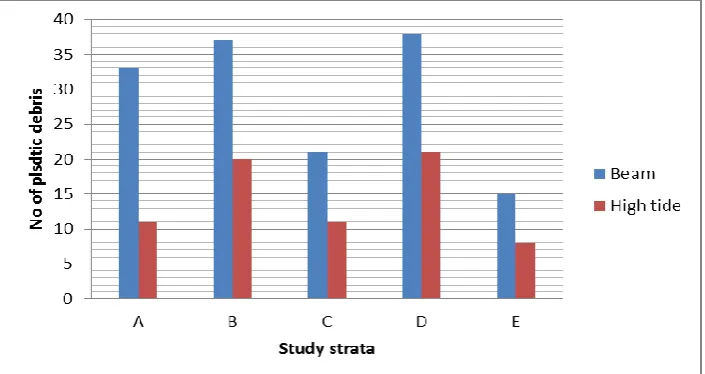
[image:3.595.93.446.343.530.2]A total of 215 plastic debris weighing 0.217g were collected at the five sampling strata during this study. Figure 1 illustrates the distribution of plastic debris at the study area.
Fig. 1 Distribution of plastic debris at the study area.
Results indicated that larger number of plastic debris was found in the beam regions as compared to that of the high tide lines. This probably is contributed to the fact that more plastic debris accumulated at the points sourced from the land while waves action during high tides add to its number further. Since beam region received less wind and only the high tides, debris accumulated there is static and accumulated longer than the debris at the high debris and at the water column. This is agreeable to the findings by Morris [7] and Moore [8].
Strata D which received the largest number of beach users recorded the highest number of plastic debris (59 items). It consisted mostly of small size debris originated from discarded wastes by beachgoers which had undergone physical degradation.
Weight of plastic debris
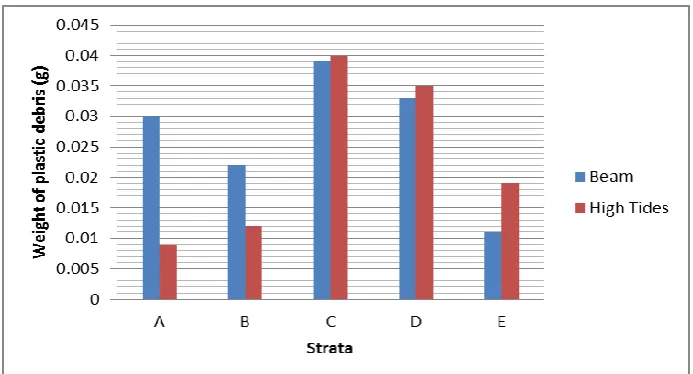
1048
[image:4.595.91.438.165.352.2]debris found in this area was hard plastics which are heavier and larger in size. However, the high tide of Strata C has the lowest weight of plastic debris, 0.004g. This probably is contributed to the presence of waves which will transport out most of large plastic debris in the area. As a result, only the finer debris which was trapped within the sand layers was left while the free debris will be removed by the wave actions. The weight of plastic debris collected from the sampling points are shown in Figure 2.
Fig. 2 Weight of plastic debris collected from Port Dickson beach.
Size of plastic debris.
Approximately 88% of plastic debris found on the beach ranged between 2.80mm to 1.00mm, followed by 7% 4.75mm. Most of the debris was collected from Strata D which recorded the highest number of beach users. Figure 3 illustrates the distribution of size of plastic debris collected from the study beach.
Fig. 3 Distribution of plastic debris according to size.
findings by Moore et al [9] where major contributor of plastic debris on beaches are littering by beach goers. It implies the significant impacts of beach users on the distribution of plastic debris.
Public Survey
The result indicated that 76% of the respondents admitted that they generate plastic waste when they visit the beach. This result is correspond to the main types of waste found on the beach in this study. It is also agreable to the fact that the main group of waste found in the marine environment consist 60-80% of plastic [9,10]. In addition, these probably is due to the characteristics which are light-weight, cheap and durable [Thompson]. Thus, it is favourably used as food packaging. Most of the food selling stalls use plastic to wrap their products which later will be discarded by the customers. Consequently, plastic become the most types of waste generated by the beach goers.
[image:5.595.92.423.304.460.2]When asked on the satisfactory level of beach cleanliness, majority of the respondents (84%) opted that the beach is clean. Figure 5 indicates the opinion of beach users on the level of cleanliness of Port Dickson beach.
Fig. 5 Respondents opinion on the level of cleanliness of Port Dickson beach.
Results indicated that the beach is considered clean where less than 3% felt that it was dirty. This is highly contributed to the fact that the beach cleaning was conducted every morning by the municipality. The daily cleaning is necessary since the beach receives high number of beach users everyday. It is also agreeable to the findings by other researchers which reported that beaches that received high number of tourist would be cleaned more often by the local authorities for tourism purpose [10]. The scheduled cleaning is necessary to maintain the cleanliness of the beaches.
The presence of plastic debris is highly dependent on the attitude of the beach users. Question was also asked on the typical habit among respondent in dealing with the waste generated produced while on the beach. Approximately 92% of the beach users threw the waste into the provided bins while 5.6% brought their waste home. 2.4% of the respondents admitted that they left the waste they generated on the beach, mainly at their picnic spot. This is observed mainly at Strata B, C and Strata E where no waste bins were provided. In addition these sites are a distance away from parking lots, public toilets and food-selling stalls.
1050
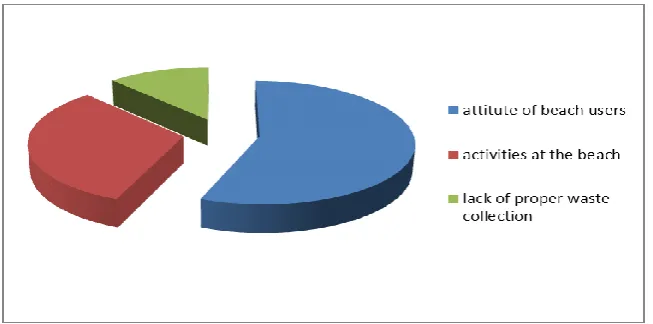
[image:6.595.91.418.110.272.2]causing the beach pollution. Figure 6 illustrates the respondents’ opinion on the causes that lead to beach pollution.
Fig. 6 Respondents’ opinion on causes of the beach pollution
Most of the respondents believed that beaches which receive large number of users will have an effective waste management system with scheduled waste collection and beach cleaning. Thus, lack of effective waste management not a significant factor of that cause beach pollution since the municipality will ensure the cleanliness of beach to attract tourist to visit the area. Yet, the indifferent attitude of the beach user cause more waste on the beach regardless of the scheduled waste collection conducted.
Conclusions
The study indicated that plastic debris are more abundantly found accumulated at the berm of a beach. The abundance is highly dependent on the level of awareness among beach users where their habit of littering can influence the presence of plastic debris on the beach. As for impacts of tourism activities, it play a double edge role where a tourism beach normally would be maintained properly by the municipalities to ensure that the beach can serve it tourism purposes. On the other hand, the high number of tourist visiting a beach can also lead to higher volume of waste being generated in the beaches. In conclusion, the behavior and attitude of beach users play a very crucial role in maintaining the cleanliness of a beach.
References
[1] S.H. Fauziah, P. Agamuthu. Trends in Sustainable Landfilling in Developing Countries, Waste Management and Research, 30(2012):656-663
[2] P. Agamuthu, S.H. Fauziah, S. Sakai. Disaster Waste Management Challenges.
Waste Management and Research 30(2012):113-114.
[3] A. K. Khairunnisa, S.H. Fauziah, P. Agamuthu. Marine debris composition and abundance:a case study of selected beaches in Port Dickson, Malaysia. Aquatic
Ecosystem Health and Management Society 15(2012):279-286.
[5] M. Gregory, P. Ryan. Pelagic Plastics and other seaborne persistent synthetic debris: A review of Southern Hemisphere perspectives. In J.M. Coe, D.B. Rogers. Marine debris: Sources, impacts and solutions. 1997, pp 46-66. New York, Springer-Verlag.
[6] B.M. Jenssen. Endocrine-disrupting chemicals and climate change: A worst-case combination for arctic marine mammals and seabirds? Environmental Health Perspectives, 114(2006): 76-80.
[7] R.J. Morris. Plastic Debris in the Surface Waters of South Atlantic. Marine Pollution Bulletin, 11(1980):164-166
[8] C. Moore. Synthetic polymers in the marine environment: A rapidly increasing long term threat.
Environmental Research, 102 (2008): 131-139.
[9] S.L. Moore, D. Gregorio, M. Carreons, S.B. Weisberg, M.K. Leecaster. Composition and Distribution of Beach Debris in Orange County, California. Marine Pollution Bulletin, 42 (2001): 241-245.