Compact Energy and Delay-Aware Authentication
∗Muslum Ozgur Ozmen†‡ Rouzbeh Behnia†‡ Attila A. Yavuz†
Abstract
Authentication and integrity are fundamental security services that are critical for any viable system. However, some of the emerging systems (e.g., smart grids, aerial drones) are delay-sensitive, and therefore their safe and reliable operation requires delay-aware authentication mechanisms. Unfortunately, the current state-of-the-art authentication mechanisms either incur heavy compu-tations or lack scalability for such large and distributed systems. Hence, there is a crucial need for digital signature schemes that can satisfy the requirements of delay-aware applications.
In this paper, we propose a new digital signature scheme that we refer to asCompact Energy and Delay-aware Authentication(CEDA). InCEDA, signature generation and verification only require a small-constant number of multiplications and Pseudo Random Function (PRF) calls. Therefore, it achieves the lowest end-to-end delay among its counterparts. Our implementation results on an ARM processor and commodity hardware show thatCEDAhas the most efficient signature generation on both platforms, while offering a fast signature verification. Among its delay-aware counterparts,CEDAhas a smaller private key with a constant-size signature. All these advantages are achieved with the cost of a larger public key. This is a highly favorable trade-off for applications wherein the verifier is not memory-limited. We open-sourced our implementation ofCEDAto enable its broad testing and adaptation.
Keywords: Applied cryptography, delay-aware authentication, real-time networks, digital signa-tures.
1
Introduction
Broadcast authentication is an essential security service for various important systems, where the au-thenticity of messages should be verified by multiple receivers. However, broadcast authentication is a challenging problem for large and distributed systems (e.g. smart grids, vehicular networks, IoT systems), especially if the system has real-time authentication requirements [21]. For instance, as men-tioned in relevant vehicular network standards (e.g., [2, 18]), a single car might broadcast a very large number of messages (e.g., up to 500-1000 messages) per second, where all these messages should be verified by other vehicles/devices in the vicinity. Such messages may include directives for sudden brakes/turns, which require the timely reaction of the receiving parties. This also brings scalability problems since a vehicular network might be composed of a large number of components (e.g., vehi-cles, infrastructure, devices). Similarly, in power grid/smart grid systems, some critical command and control messages must be verified by a large number of peripheral devices [38, 33] in real-time. Besides such real-time applications, an efficient authentication mechanism is also greatly needed by recently emerging IoT applications that involve resource-limited devices (e.g., small aerial drones).
∗
This work is supported by the NSF CAREER Award CNS-1652389. †
Oregon State University, Corvallis, Oregon, USA, {ozmenmu,behniar,Attila.Yavuz}@oregonstate.edu ‡
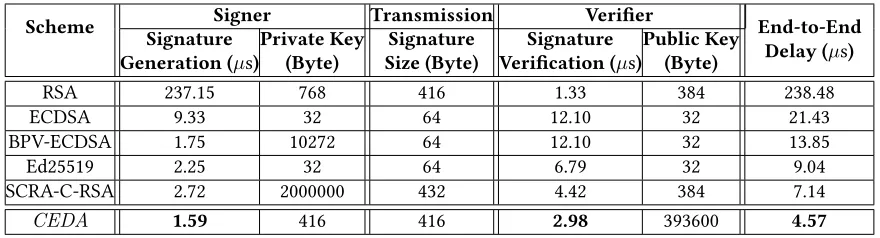
Table 1: Experimental Performance Comparison ofCEDAand its Counterparts on ARM Cortex A53
Scheme Signer Transmission Verifier End-to-End
Signature Generation (µs)
Private Key (Byte)
Signature Size (Byte)
Signature Verification (µs)
Public Key
(Byte) Delay (µs)
RSA 237.15 768 416 1.33 384 238.48
ECDSA 9.33 32 64 12.10 32 21.43
BPV-ECDSA 1.75 10272 64 12.10 32 13.85
Ed25519 2.25 32 64 6.79 32 9.04
SCRA-C-RSA 2.72 2000000 432 4.42 384 7.14
CEDA 1.59 416 416 2.98 393600 4.57
1.1 Problem Statement
The current state-of-the-art authentication mechanisms might not be able to fully meet the demands of large and distributed time-critical applications (e.g., smart-grid, vehicular/drone networks). That is, Message Authentication Codes (MACs) are highly efficient but they lack the necessary scalability for large and distributed systems as well as public verifiability and non-repudiation properties. Digital sig-nature schemes rely on public key infrastructures, and therefore can enable scalable authentication for large-distributed systems. However, unlike MACs, they generally require highly expensive operations at the signer’s and/or verifier’s side. For instance, standard signatures (e.g., RSA [30], ECDSA [4]) re-quire expensive operations such as exponentiation or elliptic curve scalar multiplications, which have been shown to be highly costly for some delay-aware applications (e.g., smart-grid [1, 35, 36], vehicular networks [23, 39, 18, 2]).
Delay-aware signatures such as SCRA [37] and RA [36] were proposed, however both of these schemes incur very large private keys due to the pre-computation tables at the signer’s side. More-over, RA requires messages to have specific pre-defined structures, which might not be the case for various real-life applications. One-time signatures [29] and some of their variants (e.g., [35, 20]) offer very fast signature generation and verification, however they have large signature sizes. Moreover, the private-public key pair must be continuously renewed, whose overhead may not be practical for certain applications. Signature schemes that incur linear token/key storage (e.g. online/offline signatures [16]) are also not suitable for applications with memory-limited devices. Efficient signature generation and verification can be achieved by delayed key disclosure methods [26] and amortized signatures [22]. However, these methods rely on packet buffering, and therefore, highly intolerant to packet losses. Moreover, they lack the immediate verification critically required by delay-aware applications. In Sec-tion 2, we provide a detailed overview of the related works that are most relevant to ours.
There is a significant need for a compact and light-weight digital signature scheme that can achieve high-speed signature generation and verification for time-critical systems.
1.2 Our Contributions
In this paper, we developed a new real-time digital signature scheme that we refer to asCompact En-ergy and Delay-aware Authentication(CEDA). We summarize the desirable properties of CEDAas follows (Table 1 demonstrates the experimental comparison betweenCEDAand its counterparts on ARM Cortex A53).
as exponentiation over large integers or elliptic curve scalar multiplication. More specifically, the signing algorithm inCEDAonly requires an exponentiation over a small modulus and cryp-tographic hash function calls that makes it the fastest among its counterparts. For instance, as shown in Tables 1 and 4,CEDAcan generate up to 18,070 and 628 signatures per second on a commodity hardware and IoT device, respectively.
• Low End-to-end Delay:CEDAenjoys from the fastest signing algorithm and the second fastest verification algorithm among its counterparts. That is, the verification only requires an exponen-tiation over a small modulus and a few multiplications. More specifically, as shown in Table 1,
CEDAis 1.56×faster than its most efficient counterpart (SCRA in [37]) and 4.69×faster than ECDSA, in terms of end-to-end delay.
• Eliminate the Pre-computation Components from Signer:Some applications (e.g. IoT, smart-grids) may require memory-limited devices to issue signatures. Unlike some existing alternatives (e.g., [11, 37, 36, 13, 31, 16]),CEDAdoes not require any pre-computation table or tokens to be stored at signer’s side. For instance, SCRA-C-RSA [37] and ECDSA with pre-computation [11] require storing a private key of size 2 MB and 10 KB on the signer’s side, respectively. CEDA has a constant private key of size 416 Byte that is smaller than traditional RSA signature [30] and a signature size identical to the traditional RSA (see Table 1).
• Immediate Verification:Unlike some broadcast authentication mechanisms (e.g. [26]),CEDAcan achieve immediate verification without the need of packet buffering or time synchronization.
•Limitation: The main limitation ofCEDAis its large public key size (e.g., 393 KB forκ = 128-bit security) compared to its alternatives. However, in many delay-aware applications (e.g., aerial drones, vehicular networks, smart-grid), the verifying devices (e.g., cars, UAVs, command centers) are poten-tially more than capable of storing such public keys. Therefore, by providing the lowest end-to-end cryptographic delay with small private key sizes,CEDAis expected to offer an ideal choice for time-critical networks, in which a very high-speed authentication is a crucial requirement to ensure a safe and reliable operation.
2
Related Work
In this section, we provide an overview of efficient digital signature schemes and authentication mech-anisms that are most relevant to our work.
resource-limited signers.
One-time Signatures (OTS) and Their Extensions: Hash-based signatures achieve post-quantum security [9]. Earlier one-time hash-based signatures (e.g., HORS [29]) offer fast signing and verification but have very large signature sizes (e.g., 2-5 KB). Moreover, a private/public key pair can only be used once and therefore, must be renewed frequently. This continuous renewal requires the distribution of new public keys and may be impractical for real-life applications where each new public key should be signed by a certificate authority and verified by the verifier. Different performance and security trade-offs, such as low storage with very high computational cost [20] and time valid OTS such as TV-HORS [35], have been offered based on TV-HORS. Despite their benefits, time-valid approaches suffer from performance and security penalties due to time-synchronization requirements and low tolerance for packet loss. Moreover, the use of low-security parameters might not be ideal for some security-critical delay-aware applications even with potential time constraints. Multiple-time hash-based signatures (e.g., [8]) rely on Merkle-trees [24] with a signer state [12] to be able to sign several messages. Recently, stateless signatures (e.g., SPHINCS [9]) have been proposed. However, these schemes have extremely large signatures (up to 41 KB) and expensive signing algorithms for low-end devices [19].
Online/Offline Signatures: Online/offline signatures (e.g. [31, 16, 25]) pre-compute a token for each message to be signed at the offline phase, and then use it to compute a signature on a message efficiently at the online phase. However, these schemes can use a private/public key pair only once, and therefore introduce a linear public key size. Hence, all such online/offline signatures incur linear storage with respect to the number of messages to be signed, which might not be practical for resource-limited devices. Moreover, the tokens must be renewed continuously as depleted, which introduces further computational overhead. Therefore, they may not be practical for real-time networks or IoT devices as considered in this work.
Delayed Key Disclosure and Amortized Signatures: Delayed key disclosure methods [26] introduce an asymmetry between the signer and the verifier via a time factor, and therefore can achieve highly efficient signing and verification via only Message Authentication Codes. However, they require time synchronization among entities, packet buffering, and introduce potential packet loss risks. Therefore, such schemes cannot provide immediate verification, which is a critical requirement for real-time net-works. Similarly, achieving time synchronization for a large distributed system might be difficult. In signature amortization techniques (e.g., [22]), the signer generates a signature over a set of messages to reduce the cost. However, this also requires packet buffering and introduces potential packet loss risks. Moreover, amortized signatures require all related messages in a single set to be received until a message could be verified, and therefore they lack immediate verification.
3
Preliminaries
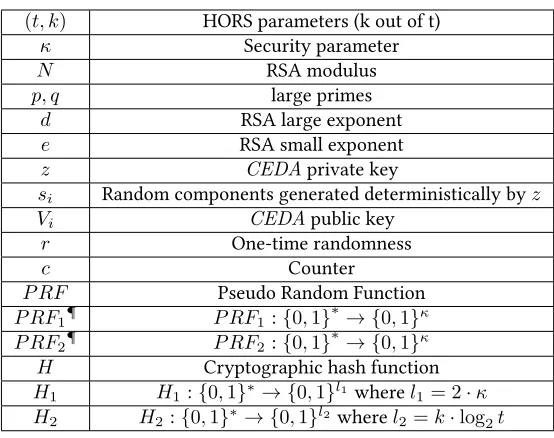
We first outline the notation in Table 2 and then describe our building blocks.
Definition 1. A digital signature scheme is a tuple of three algorithms SGN = (Kg,Sig,Ver) defined as follows.
Table 2: Notation followed to describe schemes.
(t, k) HORS parameters (k out of t)
κ Security parameter
N RSA modulus
p, q large primes
d RSA large exponent
e RSA small exponent
z CEDAprivate key
si Random components generated deterministically byz
Vi CEDApublic key
r One-time randomness
c Counter
P RF Pseudo Random Function
P RF1¶ P RF1:{0,1}∗→ {0,1}κ
P RF2¶ P RF2:{0,1}∗→ {0,1}κ
H Cryptographic hash function
H1 H1:{0,1}∗→ {0,1}l1 wherel1= 2·κ
H2 H2:{0,1}∗→ {0,1}l2 wherel2=k·log2t
¶P RF1 and P RF2 are two different PRF instantiations with the
same domain.
– σ ←SGN.Sig(m,sk): Given a message to be signedmand the private key of the signer (sk), this algorithm outputs the signatureσ.
– {0,1} ←SGN.Ver(m, σ,PK): Given a message-signature pair to be verified (m, σ), and the public key of the signer (PK), this algorithm outputs a bit that indicates if the signature is verified (1) or not (0).
Definition 2. Existential Unforgeability under Chosen Message Attack (EU-CMA) experimentExptEUSGN−CMA
is defined as follows.
– (sk,PK)←SGN.Kg(1κ)
– (m∗, σ∗)← ASGN.Sig(·)(PK)
– If1 ←SGN.Ver(m∗, σ∗,PK)andm∗was not queried toSGN.Sig(·), return 1, else, return 0.
The EMU-CMA advantage ofAis defined asAdvEU-CMASGN = Pr[ExptEUSGN−CMA = 1].
Given a one-way functionf, HORS signature scheme is defined in the following definition. Definition 3. HORS signature scheme consists of three algorithmsHORS= (Kg,Sig,Ver)defined as follow.
– (sk,PK)←HORS.Kg(l, k, t): Given parametersl, kandt, this algorithm generatestrandom
l-bit strings(s1, s2. . . , st), computesvi =f(si)for1≤i≤tand outputssk = (s1, s2. . . , st)
– σ←HORS.Sig(m,sk): Given a messagemto be signed, this algorithm computesh=H(m) and splitsh intoksubstrings(h1, h2, . . . , hk), each of lengthlog2t. The substrings are
inter-preted as integersij for1≤j≤kand used to generate a signature asσ= (si1, si2, . . . , sik).
– {0,1} ←HORS.Ver(m, σ,PK): Given a message-signature pair (m, σ = (si0 1, s
0
i2, . . . , s 0
ik)),
this algorithm computes h = H(m) and splitsh intok substrings(h1, h2, . . . , hk). The
sub-strings are interpreted as integersij for 1 ≤ j ≤ k. Returns 1 if for each j,f(s
0
j) = vij and
returns 0 otherwise.
Definition 4. A trapdoor permutation function family is a tuple of algorithmsπ= (Gen,Eval,Invert) as follows.
– (i, td) ← π.Gen(1κ): Given the security parameterκ, this algorithm outputs a pair (i, td), whereiis the index of a particular permutationπidefined over some domainDi, andtdis the trapdoor that allows for the inversion ofπi.
– y ← π.Eval(i, x): Given an indexiandx ∈ Di, this algorithm outputs an elementy ∈ Di. More specifically, for allioutput byGen, the functionEval(i,·) :Di →Di is a permutation. – x←π.Invert(td, y): Given a trapdoortdandy, this algorithm outputs the elementx∈Di. The correctness of a trapdoor permutation family requires that for allκ,all(i, td)output byGen, and allx∈Di, we havex←Invert(td, y).
Definition 5. An RSA permutation function is defined as a tupleRSA= (GenRSA,EvalRSA,InvertRSA)
as below.
– h(N, e),(N, d)i ←GenRSA(1κ): Given the security parameterκ, it chooses two large primesp
andqand forms their productN ←p·q. It then computesφ(N)←(p−1)·(q−1), choosese
that is relatively prime toφ(N)and computesdwheree·d≡1 mod φ(N). It outputs(N, e) as the indexi, and(N, d)as the trapdoortd. The domainDN,eisZ∗N.
– y←EvalRSA((N, e), x): Given the index(N, e)and a random elementx∈Z∗N, this algorithm computes and outputsy←xe mod N.
– x←InvertRSA((N, d), y): Given(N, d)and an elementy, it computes the inversion asx←
yd mod N.
Definition 6. Inverting the RSA permutation function defined in Definition 5 without having the knowledge of the trapdoor informationtdis known to be a hard problem [3]. Given, a public key(N, e) andx∈Zqthe advantage of the adversaryAis defined asAdvRSA= Pr[y←EvalRSA((N, e), x);x←
A(κ,N,e)(y)]< .
•Security and System Model: The standard security notion that captures our threat model is EU-CMA as in Definition 2
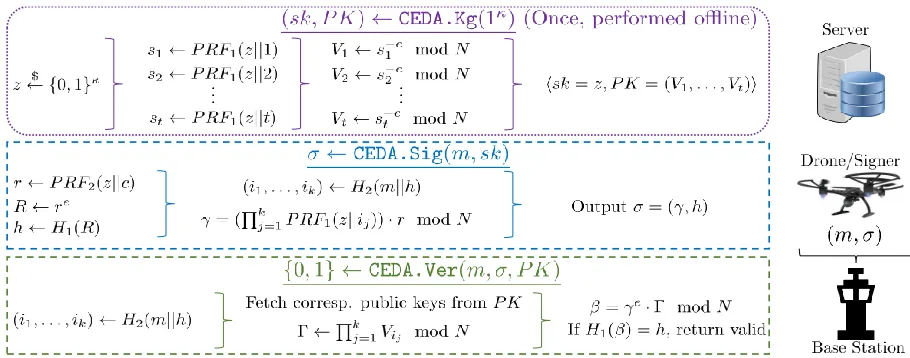
Figure 1: High-level description ofCEDAalgorithms
4
Proposed Scheme
The idea behind the proposed scheme is to leverage the multiplicative property of RSA trapdoor per-mutation function (Definition 5) to transform one-time HORS [29] signatures into an (practically) unbounded time signature. Specifically, our private key consists of trandomly generated values si (that can be deterministically generated with a seed) and the corresponding public key consists of all
Vi ← (EvalRSA((N, e), si))−1 modN wherei ∈ {1, . . . , t}. To sign a message, we computeγ by
combining a subset ofkselected one-time signature components (i.e.,si’s whose indexes(i1, . . . , ik) are obtained from the message hash output, as in HORS) along with a one-time randomnessrto prevent their disclosure. Recall that the release of the private key components with each signature is the main reason that HORS is a one-time signature. We then computeR ← EvalRSA((N, e), r) and set the
CEDAsignature asσ= (R, γ). Upon receiving the signature, the verifier first multiplies the subset of corresponding public keys fromP Kand calculatesΓ. The verifier checksR=EvalRSA((N, e), γ)·Γ,
and returns valid (1) if it holds; otherwise returns invalid (0). Our scheme consists of the following algorithms.
(sk,PK)←CEDA.Kg(1κ): Given the security parameterκ, this algorithm works as follows:
1. SelectHORS parameters(t, k)as in Definition 3 and runh(N, e),(N, d)i ←GenRSA(1κ)to set
sk0 = (N, d)andPK0 = (N, e)as in Definition 5. 2. Pickz← {$ 0,1}κ and computes
i ←P RF1(z||i)fori= 1, . . . , t.
3. Generate the public keysVi ←EvalRSA(PK0, si)fori= 1, . . . , tand set a counterc←0.
4. Compute the modular inverse of the public keysVi =Vi−1 mod N fori= 1, . . . , t.
5. Output the public and private key pairhPK = (V1, . . . , Vt), sk =ziand the public parameters
params= (PK0, t, k).
σ←CEDA.Sig(m,sk): Given a messagem∈ {0,1}∗to be signed, this algorithm works as follows.
2. Computeh←H1(R)and(i1, . . . , ik)←H2(m||h)where{ij}kj=1 ∈[1, t]and|ij|= log2t.
3. Generatesij ←P RF1(z||ij)forj= 1, . . . , kand computeγ = ( Qk
j=1sij)·r mod Nto output
the signature asσ= (γ, h).
{0,1} ←CEDA.Ver(m, σ,PK): Given a message-signature pairhm, σ= (γ, h)iandPK = (V1, . . . , Vt), this algorithm works as follows.
1. Compute(i1, . . . , ik)←H2(m||h)where{ij}kj=1∈[1, k]and|ij|= log2t.
2. ComputeΓ← Qk
j=1Vij mod N andβ=EvalRSA(PK
0, γ)·Γ mod N.
3. IfH1(β) =hholds, output1and0otherwise.
5
Security Analysis
In the random oracle model [6], we prove thatCEDAisEU-CMAin Theorem 1. In our proof, we ignore terms that are negligible in terms of our security parameters.
Theorem 1. If an adversaryAcan break the EU-CMA security of our scheme in timetAafter making qH hash queries andqSsignature queries, we can build another algorithmBthat runsAas a subroutine and upon outputting a successful forgery byA,Bcan invert the RSA trapdoor one-way permutation function as in Definition 6 in timetB.
AdvEUEDA-CMA(tA, qH, qS)≤AdvRSA(tB, qH, qS)
Proof:Let(N, e)be the output ofGenRSA(1κ)as defined in Definition 5 andY =EvalRSA((N, e), x)
be the target challenge value for the algorithmBon a random inputx ∈ZN∗.BtakesY as input and runs as follows.
AlgorithmB(Y):
•Setup:Bmaintains a listLM, and two tablesHL1andHL2 that are all initially empty.LMstores
messages M that are queried to CEDA.Sigoracle byA.HL1 andHL2 store the queries (and re-sponses) to hash functionsH1andH2, respectively.Bsets upRO(.)and the simulated public keys to
initializeCEDA.Sigoracle as follows.
- SetupRO(.)Oracle:Bimplements a functionH-Simto handleRO(.)queries to random oraclesH1
andH2. That is, the cryptographic hash functions H1 andH2 are modeled as random oracles via H-Simas follows.
1) h1←H-Sim(R,HL1): IfR∈ HL1thenH-Simreturns the corresponding valueh1← HL1(R).
Otherwise, it returnsh1 $
← {0,1}l1 as the answer, and inserts(R, h
1)intoHL1.
2) h2 ← H-Sim(Mkh1,HL2): If (Mkh1) ∈ HL2 thenH-Sim returns the corresponding value h2 ← HL2(Mkh1). Otherwise, it returnsh2 ← {$ 0,1}l2 as the answer, inserts(Mkh1, h2)into
HL2.
1) Bgenerates indexj0 ←$ [1, t]and sets the challenge public key asVj0 ←Y.
2) Bgenerates{si← {$ 0,1}µN}ti=1,i6=j0 and{Vi←EvalRSA((N, e), si)}ti=1,i6=j0.
3) Bsetsz← {$ 0,1}κand counterc←0.
4) Setsk← {si}ti=1,i6=j0,PK ←(V1, . . . , Vt)and public parametersparams ←(t, k, N, e, c).
•Execute(M∗, σ∗)← ARO(.),CEDA.Sigsk(·)(PK):BhandlesA’s queries as follows:
- Queries ofA:Acan queryRO(.)andCEDA.Sig(·)oracles on any message of its choice up toqH andqStimes, respectively.
1) Handle RO(.)queries: A’s queries onH1 andH2 are handled byH-Sim function as described
above.
2) HandleCEDA.Sigqueries: To answerA’s signature queriesCEDA.Sig(·)on any message of its choiceM,BinsertsM intoLMand continues as follows.
i) Pick r ∈ Z∗
N and compute R0 ← EvalRSA((N, e),
r). ii) ij
$
←[1, . . . , t], j= 1, . . . , k. iii) R ←R0·Qk
j=1V −1
ij mod N.
iv) h← {$ 0,1}l1 and insert(R, h)inHL 1.
v) If(H(M||h))∈ HL2,Baborts. We call this eventBAD1. Else, it inserts(H(Mkh),hi1. . . , iki) inHL2.
vi) Setσ= (γ, h)whereγ =r, and returnσtoA.
- Forgery ofA: Finally,Aoutputs a forgery forPK as(M∗, σ∗), whereσ∗ = (γ∗, h∗). By Definition 2,Awins theEU-CMAexperiment forCEDAif the below conditions hold.
i) CEDA.Ver(M∗, σ∗,PK) = 1 ii) M∗ ∈ LM/
• B’s Attempt to Invert RSA Trapdoor Permutation: IfAfails in theEU-CMAexperiment forCEDA, B also fails in inverting the RSA trapdoor permutation function as in Definition 5, and therefore, Babortsand returns0.
Otherwise, if A outputs a successful forgery (M∗, σ∗), by behaving similar toFA(x), as in [7, Lemma 1],Bcan rewindAto get a second forgery(M∗,σ˜ =h˜γ,˜hi)whereγ∗ 6= ˜γ andh∗ = ˜hwith an overwhelming probability. GivenCEDAforgeries(M∗, σ∗ = hγ∗, h∗i)and(M∗,σ˜ = h˜γ,˜hi)on
PK where(M∗||h∗) = (M∗||˜h), based on [7, Lemma 1], we know that H(M∗kh∗) 6= H(M∗k˜h). ThenBcan attempt to break RSA trapdoor permutation function if either of the following conditions holds.
- If(M∗kh∗ ∈ HL2)and (j0∈(i∗1. . . , i∗k))then (j
0∈/ (˜i
1. . . ,˜ik)), where(i∗1. . . , i∗k)← HL2(M
∗kh∗)
and(˜i1. . . ,˜ik)← HL2(M∗k˜h). We recall this event asGOOD1.
- If(M∗kh∗ ∈ HL2)and (j0∈/ (i∗1. . . , i∗k))then (j0∈(˜i1. . . ,˜ik)), where(i∗1. . . , i∗k)← HL2(M∗kh∗)
In a case that none of the above conditions holds, Baborts and fails to break RSA, otherwise, it works as follows.
- Case 1: Ifj0 ∈(i∗1. . . , i∗k)andj0 ∈/ (˜i1. . . ,˜ik), setex ←γ ∗Qk
j=1s˜ij/˜γQkj=1,j6=j0si∗
j modN.
- Case 2: Ifj0 ∈/ (i∗1. . . , i∗k)andj0 ∈( ˜i1. . . ,˜ik), setex ←γ˜ Qk
j=1si∗j/γ∗Qkj=1,j6=j0s˜ij modN.
Then, ifxe = ximplies thatBhas inverted RSA permutation function without any knowledge of the trapdoor.
- Success Probability Analysis: We analyze the events that are needed forBto successfully invert RSA as follows.
- BAD1:Bmay abort in the simulation phase when the adversary queries theCEDA.Sigoracle. This event happens when the randomly drawn(i1, . . . , ik)already exists inHL2. This can happen with
the probability(qH−1)qS/2l.
- ACC: The success probability ofAto win the game in Definition 2 is as in [7, Lemma 1]. - FRK:Breceives two valid forgeries fromAfor the target message.
- BAD2: IfAsuccessfully outputs a forgery in each of the runs, thenBwill break RSA if (GOOD1∨GOOD2)
happens for the forged signatures. (GOOD1 ∨GOOD2) can happen with a non-negligible probability
of2k(t−k)/t2. Note that given the random behavior of our hash function, we consider the probability
((M∗||h∗∈ HL/ 2)∨(M∗k˜h /∈ HL2))to be negligible in the case of the above event.
We bound the success probability ofAas defined in [7, Lemma 1] asACC≥A−Pr[BAD1]. The proba-bility thatBAD1occurs can be upper-bounded by(qH−1)qS/2l2, and therefore,ACC≥A−(qH−1)qS/2l2.
The probability ofBin breaking RSA is given by:
B ≥FRK·BAD2
≥
ACC2 qH +qS
− 1
2l2
·BAD2
≥
2A
(qH +qS)
−2((qH −1)qS)
2l2(qH+qS) −
1 2l2
·2k(t−k)
t2
Target Collision of Hash Function (H2):Following the work of [28], the security of our scheme
relies on the subset resiliency of the underlying hash function. We “salt” the hash of each signature with a one-time randomness so thatAdoes not know the internal state of the hash function when they want to compute a collision. Therefore, we reduce the hardness of our signature scheme from collision resistance to target-collision resistance. Therefore, consideringksubsets in the hash output, and the number ofA’s signature queriesqS, the target collision resiliency of our hash function isqS·k!/2l2. The k!factor comes in place since we should consider different permutations of the indexes in the hash output which would potentially result in a collision and forgery.
6
Performance Analysis and Comparison
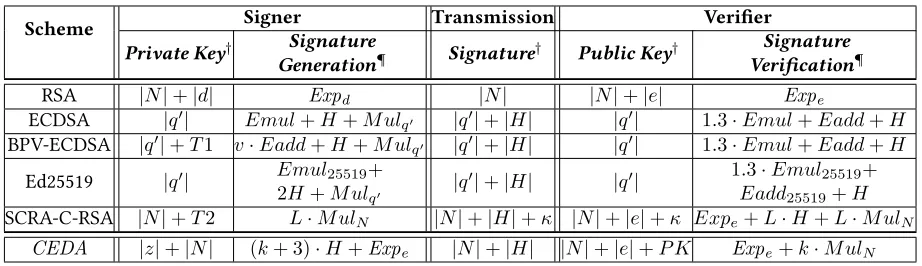
Table 3: Analytical Performance Comparison ofCEDAand its Counterparts
Scheme Signer Transmission Verifier
Private Key† Signature
Generation¶ Signature† Public Key†
Signature Verification¶
RSA |N|+|d| Expd |N| |N|+|e| Expe
ECDSA |q0| Emul+H+M ulq0 |q0|+|H| |q0| 1.3·Emul+Eadd+H
BPV-ECDSA |q0|+T1 v·Eadd+H+M ulq0 |q0|+|H| |q0| 1.3·Emul+Eadd+H
Ed25519 |q0| Emul25519+
2H+M ulq0 |q
0|+|H| |q0| 1.3·Emul25519+
Eadd25519+H
SCRA-C-RSA |N|+T2 L·M ulN |N|+|H|+κ |N|+|e|+κ Expe+L·H+L·M ulN CEDA |z|+|N| (k+ 3)·H+Expe |N|+|H| |N|+|e|+P K Expe+k·M ulN
¶ExpeandExpddenote exponentiation over the small exponenteand large exponentd, respectively.EmulandEadddenote the costs
of EC scalar multiplication over modulusp0, and EC addition over modulusp, respectively.EmulandEaddare performed in secp256r1,
whereEmul25519andEadd25519are performed on twisted Edwards’ curve.HandM ulq0denote a cryptographic hash and a modular multiplication over modulusq0, respectively. We omit the constant number of negligible operations if there is an expensive operation (e.g., integer additions are omitted if there is anEmulorExpe). We use double-point scalar multiplication for verifications of ECC based schemes
(1.3·Emulinstead of2·Emul[17]).
Suggested parameters forv,L,kare 32 [11], 32 [37], and 26, respectively.
†Forκ= 128, the parameter sizes are:|N|= 3072bit,|e|= 17bit,|d| ≈3072bit, and|z|= 128bit. The size of the pre-computation tables with the suggested parameters for BPV-ECDSA [11], SCRA-C-RSA [37] andCEDAare 384 KB, 10KB [11] and 2MB [37] forP K,T1
andT2, respectively. For ECC-based schemes,(p0, q0)are ECC parameters where|p0|=|q0|= 256bit.
optimization techniques such as constant storage pre-computation [11] and efficient curves [10]. Fur-ther note that in [37], authors proposed three instantiations of SCRA: (i) SCRA-C-RSA (ii) SCRA-BGLS (iii) SCRA-NTRU. We compare the cost ofCEDAwith SCRA-C-RSA since it achieves the lowest end-to-end delay among these three schemes with a mid-size table stored at the signer’s side [37].
6.1 Analytical Performance Comparison
Table 3 shows the analytical comparison ofCEDAwith its state-of-the-art counterparts.
Signer Computation and Storage: InCEDA, signature generation only requires an exponentiation over the small exponenteand a small-constant number of hash calls, which have an (almost) negligible overhead (implemented with highly optimized Blake2 [5]). The small exponent is selected ase= 65537 to ensure the security, while enabling the computational efficiency as such an exponentiation can only be done with 16 squarings and a single multiplication via square-and-multiply algorithm. Moreover,
CEDAhas a much smaller private key size than that of its delay-aware variants as well as the RSA signature, since the signer does not store a pre-computed table or the RSA private keyd.
RSA and ECDSA require an exponentiation over large exponent and elliptic curve scalar multiplica-tion(s), respectively, both of which are considered as expensive computations. BPV-ECDSA eliminates the scalar multiplication in ECDSA [4] in exchange of some elliptic curve additions [11]. However, it re-quires storing a pre-computation table at the signer’s side. Ed25519 scheme [10] uses efficient twisted Edwards’ curve to perform scalar multiplications. It also has a very compact private key. SCRA-C-RSA [37] only requires L multiplications to compute the signature, where L is suggested to be32. However, this scheme requires a very large private key of 2MB, which may not be feasible for some resource-constrained devices.
specif-ically, signature length in RSA-based schemes, includingCEDA, require at least|N|+|H|bits where |N| = 3072bits forκ = 128bit security. On the other hand elliptic curve based schemes require a signature size of|q0|+|H|where|q0|= 256bits.
Verifier Computation and Storage:CEDAhas an ultra efficient verification algorithm since it only requires an exponentiation over e and k multiplications, where k is suggested to be 26. However,
CEDAhas a relatively large public key size, that requires storing a table. This table has a size oft· |N|, wheret = 1024and|N| = 3072bits. On the other hand, all elliptic curve based counterparts have a very small public key of size 32 bytes, but they require a double scalar multiplication for verifica-tion. Double scalar multiplication can be accelerated with Shamir’s trick [17], however, this is still a very expensive operation, and to the best of our knowledge, there are no pre-computation methods to speed-up this operation. RSA verification is the fastest among all schemes, since it only requires an exponentiation over e. It also has a compact public key size of|N|+|e|. SCRA-C-RSA requires exponentiation overealong withLhash and multiplication calls, whereLis suggested to be 32 [37]. As for the public key size, it only requires and additionalκbits to be stored, in addition to traditional RSA [30].
Our analytical analysis shows that CEDAonly requires a small-constant number of inexpensive operations at the signer’s and verifier’s sides, which makes it a suitable alternative for delay-aware applications. It has a compact private key and signature size as compared to that of its delay-aware signature alternatives. However, it can be seen that elliptic curve-based counterparts offer more com-pact private key and signatures thanCEDA, but with the cost of a large end-to-end delay. The main limitation ofCEDAis its relatively large public key size, which can be readily stored by verifiers for many real-life applications.
6.2 Experimental Evaluation
Evaluation Metrics:We implementedCEDAboth on an IoT device (ARM Cortex A53) and commodity hardware. We also ran our counterparts on both devices to compare the signature generation and verification times. Moreover, we discuss the signer’s and verifier’s storage, along with the transmission requirement of each signature scheme.
Software Libraries and Implementation: We developed two implementations ofCEDAin C, one with MIRACL [32] and the other with GMP [15]. We observed that GMP implementation is significantly faster, and therefore we present our results in GMP. We use Blake2 as our cryptographic hash function and PRF due to its high efficiency [5]. We use portable implementation of Blake2 hash, b2 library. We have open-sourced our implementation ofCEDAfor wide adaptation and comparison.
https://github.com/ozgurozmen/CEDA
Aside from the hash functions and RSA parameters, the security of our scheme relies on the selec-tion of parameters (t, k). The security of these parameters depend on the number of k-out-of-t different combinations and also the target collision (k!/2l2) as described in Section 5. We selectedt = 1024and k = 26which guarantees2172different combinations and a target collision probability of1/2171.
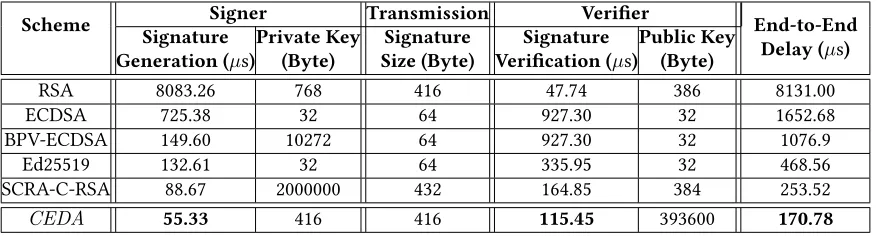
Table 4: Experimental Performance Comparison ofCEDAand its Counterparts on an Intel Processor
Scheme Signer Transmission Verifier End-to-End
Signature Generation (µs)
Private Key (Byte)
Signature Size (Byte)
Signature Verification (µs)
Public Key
(Byte) Delay (µs)
RSA 8083.26 768 416 47.74 386 8131.00
ECDSA 725.38 32 64 927.30 32 1652.68
BPV-ECDSA 149.60 10272 64 927.30 32 1076.9
Ed25519 132.61 32 64 335.95 32 468.56
SCRA-C-RSA 88.67 2000000 432 164.85 384 253.52
CEDA 55.33 416 416 115.45 393600 170.78
We benchmarked the ECDSA implementation in MIRACL library [32]. We applied BPV pre-computation technique [11] to ECDSA implementation of MIRACL. For Ed25519, we used the Supercop implemen-tation [10]. Note that BPV pre-compuimplemen-tation technique cannot be directly incorporated into Ed25519 scheme, since the randomness is generated deterministically with the message that is being signed. We also benchmarked RSA [30] with GMP library in C [15]. SCRA-C-RSA was implemented in MIRACL library in [37], however, our experiments showed us that MIRACL is significantly slower than GMP for modular exponentiations and multiplications. Therefore, for the purpose of fairness, we measured SCRA-C-RSA costs with GMP library. Moreover, we observed that authors selected the small exponent in RSA as e = 3, that is not recommended [14]. Therefore, we calculated SCRA-C-RSA costs with
e= 65537(as inCEDAimplementation).
Hardware Configurations: We benchmarked our scheme and its counterparts on an ARM Cortex A53 processor as the IoT device. ARM Cortex A53 is a low-cost and low energy consuming (can work with small batteries) device with a powerful processor [34]. Therefore, it is highly preferred in IoT applications [27]. We used a laptop equipped with Intel Core i7 6700HQ 2.6 GHz processor and 12GB RAM as the commodity hardware.
6.3 Performance Evaluation
Tables 1 and 4 depict the experimental results ofCEDAand its counterparts on ARM Cortex A53 and commodity hardware, respectively.
IoT Device: Our experiments on ARM Cortex A53 show thatCEDAis the fastest signature scheme among its counterparts. CEDAoutperforms all its counterparts in terms of signature generation and verification speeds (the only exception is RSA verification, however the signature generation of RSA is very expensive). More specifically,CEDAhas 1.56×, 1.98×, and 3.03×lower end-to-end delay as compared to SCRA-C-RSA, Ed25519, and BPV-ECDSA (as its most efficient counterparts), respectively. AlthoughCEDArequires a larger storage requirement at the verifier’s side, due to the larger public key (≈ 393KB), it is still highly achiveable with the storage capabilities of IoT devices such as ARM Cortex A53.
CEDAdrastically reduces the energy consumption and we believe that it is the most suitable signature scheme to be deployed in energy-critical applications.
Commodity Hardware: The signature generation of CEDAis 1.60× faster than that of SCRA-C-RSA (the fastest counterpart), which has a very large private key (2MB). We note that CEDA can generate18,070 signatures per second, which can meet the high throughput signing requirements of various real-life applications. For instance, as discussed in Section 1.2, vehicular networks may require a significantly large throughput for signature generation [2]. With the hardware configuration described,
CEDAoffers a signing speed way above this requirement, which can be suitable for infrastructure-to-vehicle communication. Therefore, we believeCEDAcan potentially meet the needs of even the most stringent requirements of high signing throughput applications.
CEDAsignature verification is also 1.43×and 2.91×faster than that of SCRA-C-RSA and Ed25519 (the fastest counterpart with reasonable end-to-end delay), respectively. Note that standard RSA has 2×faster verification thanCEDA. However, its signature generation is 146.17×slower thanCEDA, which is not suitable for delay-aware applications. The signature verification time is highly critical for applications that require a fast response to the commands/messages. We believe thatCEDAis highly suitable for such applications with a very fast verification and end-to-end delay. Specifically,verification throughput ofCEDAis 8,660 signatures per second. However, as depicted in Table 4,CEDArequires storing a public key of size almost 393 KB at the verifier’s side, whent= 1024. Therefore, if the verifier is storage-limited, different parameters (e.g.t= 256,k= 32) can be used to instantiateCEDAwith a storage-computation trade-off.
7
Conclusion
In this paper, towards addressing the authentication requirements of time-critical applications, we created a novel delay-aware digital signature scheme that we refer to asCompact Energy and Delay-aware Authentication(CEDA). CEDAachieves the lowest end-to-end cryptographic delay among all of its counterparts by offering the fastest signature generation along with a highly efficient verifica-tion. MoreoverCEDArequires only a small-constant size private key and signature, which are smaller than its most efficient delay-aware counterparts. Our experiments on ARM and Intel processors fur-ther confirmed the significant speed advantages ofCEDAover its counterparts with compact signer storage overhead. On the other hand,CEDAhas a larger public key size than that of its counterparts. Overall, by offering the lowest end-to-end delay with small private key and signature sizes,CEDAis an ideal authentication tool for delay-aware critical systems such as energy delivery (e.g., smart-grids) and mobile cyber-physical systems (e.g., vehicular and aerial drone networks). We open-sourced our implementation ofCEDAfor public testing and adaptation purposes.
References
[1] Ieee standard communication delivery time performance requirements for electric power substa-tion automasubsta-tion. IEEE Std 1646-2004, pages 1–24, 2005.
[2] Ieee guide for wireless access in vehicular environments (wave) - architecture. IEEE Std 1609.0-2013, pages 1–78, March 2014.
[4] American Bankers Association. ANSI X9.62-1998: Public Key Cryptography for the Financial Ser-vices Industry: The Elliptic Curve Digital Signature Algorithm (ECDSA), 1999.
[5] Jean-Philippe Aumasson, Luca Henzen, Willi Meier, and Raphael C.-W. Phan. Sha-3 proposal blake. Submission to NIST (Round 3), 2010.
[6] M. Bellare and P. Rogaway. Random oracles are practical: A paradigm for designing efficient protocols. InProceedings of the 1st ACM conference on Computer and Communications Security (CCS ’93), pages 62–73, NY, USA, 1993. ACM.
[7] Mihir Bellare and Gregory Neven. Multi-signatures in the plain public-key model and a general forking lemma. In Proceedings of the 13th ACM Conference on Computer and Communications Security, CCS ’06, pages 390–399, New York, NY, USA, 2006. ACM.
[8] Piotr Berman, Marek Karpinski, and Yakov Nekrich. Optimal trade-off for merkle tree traversal.
Theor. Comput. Sci., 372(1):26–36, March 2007.
[9] Daniel J. Bernstein, Daira Hopwood, Andreas Hülsing, Tanja Lange, Ruben Niederhagen, Louiza Papachristodoulou, Michael Schneider, Peter Schwabe, and Zooko Wilcox-O’Hearn. SPHINCS: Practical stateless hash-based signatures. In Advances in Cryptology – EUROCRYPT 2015: 34th Annual International Conference on the Theory and Applications of Cryptographic Techniques, pages 368–397. Springer Berlin Heidelberg, April 2015.
[10] DanielJ. Bernstein, Niels Duif, Tanja Lange, Peter Schwabe, and Bo-Yin Yang. High-speed high-security signatures. Journal of Cryptographic Engineering, 2(2):77–89, 2012.
[11] Victor Boyko, Marcus Peinado, and Ramarathnam Venkatesan. Speeding up discrete log and fac-toring based schemes via precomputations. InAdvances in Cryptology — EUROCRYPT’98: Interna-tional Conference on the Theory and Application of Cryptographic Techniques Espoo, Finland, May 31 – June 4, 1998 Proceedings, pages 221–235, Berlin, Heidelberg, 1998. Springer Berlin Heidelberg. [12] Johannes Buchmann, Erik Dahmen, and Andreas Hülsing. Xmss - a practical forward secure signature scheme based on minimal security assumptions. InProceedings of the 4th International Conference on Post-Quantum Cryptography, PQCrypto’11, pages 117–129, Berlin, Heidelberg, 2011. Springer-Verlag.
[13] D. Catalano, M. D. Raimondo, D. Fiore, and R. Gennaro. Off-line/on-line signatures: Theoretical as-pects and experimental results. Public Key Cryptography (PKC), pages 101–120. Springer-Verlag, 2008.
[14] Don Coppersmith. Small solutions to polynomial equations, and low exponent rsa vulnerabilities.
Journal of Cryptology, 10(4):233–260, Sep 1997.
[15] Torbjörn Granlund et al. GNU multiple precision arithmetic library 6.1.2.https://gmplib. org/.
[16] S. Even, O. Goldreich, and S. Micali. Online/offline digital signatures. InProceedings on Advances in Cryptology (CRYPTO ’89), pages 263–275. Springer-Verlag, 1989.
[18] John Harding, Gregory Powell, Rebecca Yoon, Joshua Fikentscher, Charlene Doyle, Dana Sade, Mike Lukuc, Jim Simons, and Jing Wang. Vehicle-to-Vehicle Communications: Readiness of V2V Technology for Application. U.S. Department of Transportation National Highway Traffic Safety Administration (NHTSA), August 2014.
[19] Andreas Hülsing, Joost Rijneveld, and Peter Schwabe. Armed SPHINCS - computing a 41 KB signature in 16 KB of RAM. In Public-Key Cryptography - PKC 2016 - 19th IACR International Conference on Practice and Theory in Public-Key Cryptography, pages 446–470, March 2016. [20] Q. Li and G. Cao. Multicast authentication in the smart grid with one-time signature.IEEE
Trans-actions on Smart Grid, 2(4):686 –696, December 2011.
[21] M. Luk, A. Perrig, and B. Whillock. Seven cardinal properties of sensor network broadcast au-thentication. InProceedings of 4th ACM workshop on security of ad hoc and sensor networks, SASN ’06, pages 147–156, New York, NY, USA, 2006. ACM.
[22] A. Lysyanskaya, R. Tamassia, and N. Triandopoulos. Multicast authentication in fully adversarial networks. InIEEE Symposium on Security and Privacy, pages 241 –253, May 2004.
[23] S. S. Manvi, M. S. Kakkasageri, and D. G. Adiga. Message authentication in vehicular ad hoc networks: Ecdsa based approach. InProceedings of the 2009 International Conference on Future Computer and Communication, ICFCC ’09, pages 16–20, Washington, DC, USA, 2009. IEEE Com-puter Society.
[24] Ralph C. Merkle. A certified digital signature. InProceedings on Advances in cryptology, CRYPTO ’89, pages 218–238, New York, NY, USA, 1989. Springer-Verlag.
[25] D. Naccache, D. M’Raïhi, S. Vaudenay, and D. Raphaeli. Can D.S.A. be improved? Complexity trade-offs with the digital signature standard. InProceedings of the 13th International Conference on the Theory and Application of Cryptographic Techniques (EUROCRYPT ’94), pages 77–85, 1994. [26] A. Perrig, R. Canetti, D. Song, and D. Tygar. Efficient and secure source authentication for
multi-cast. InProceedings of Network and Distributed System Security Symposium, February 2001. [27] A. Raza, A. A. Ikram, A. Amin, and A. J. Ikram. A review of low cost and power efficient
devel-opment boards for iot applications. In2016 Future Technologies Conference (FTC), pages 786–790, Dec 2016.
[28] L. Reyzin and N. Reyzin. Better than BiBa: Short one-time signatures with fast signing and veri-fying. InProceedings of the 7th Australian Conference on Information Security and Privacy (ACIPS ’02), pages 144–153. Springer-Verlag, 2002.
[29] Leonid Reyzin and Natan Reyzin. Better than biba: Short one-time signatures with fast signing and verifying. In Lynn Batten and Jennifer Seberry, editors, Information Security and Privacy: 7th Australasian Conference, ACISP 2002 Melbourne, Australia, July 3–5, 2002 Proceedings, pages 144–153, Berlin, Heidelberg, 2002. Springer Berlin Heidelberg.
[31] A. Shamir and Y. Tauman. Improved online/offline signature schemes. InProceedings of the 21st Annual International Cryptology Conference on Advances in Cryptology, CRYPTO ’01, pages 355– 367, London, UK, 2001. Springer-Verlag.
[32] Shamus. Multiprecision integer and rational arithmetic c/c++ library (MIRACL).http://www. certivox.com/miracl/miracl-download/. Last Accessed on 09/02/2014.
[33] T. Tesfay and J. Y. Le Boudec. Experimental comparison of multicast authentication for wide area monitoring systems. IEEE Transactions on Smart Grid, PP(99), 2017.
[34] Vladimir Vujović and Mirjana Maksimović. Raspberry pi as a sensor web node for home automa-tion. Comput. Electr. Eng., 44(C):153–171, May 2015.
[35] Q. Wang, H. Khurana, Y. Huang, and K. Nahrstedt. Time valid one-time signature for time-critical multicast data authentication. InINFOCOM 2009, IEEE, April 2009.
[36] A. A. Yavuz. An efficient real-time broadcast authentication scheme for command and control messages. IEEE Transactions on Information Forensics and Security, 9(10):1733–1742, Oct 2014. [37] A. A. Yavuz, A. Mudgerikar, A. Singla, I. Papapanagiotou, and E. Bertino. Real-time digital
signatures for time-critical networks. IEEE Transactions on Information Forensics and Security, 12(11):2627–2639, Nov 2017.
[38] A. Zanella, N. Bui, A. Castellani, L. Vangelista, and M. Zorzi. Internet of things for smart cities.
IEEE Internet of Things Journal, 1(1):22–32, Feb 2014.