5
XI
November 2017
Embedding Intelligence through Cognitive Services
Dr. Latika Kharb 1, Sarabjit Kaur2
Associate Professor1, Student2, Jagan Institute of Management Studies (JIMS), Delhi, India.
Abstract: Cognitive Services include various APIs, SDKs and services for the software developers to develop applications to display not only intelligence but also discoverable. Cognitive Services permit developers to embed intelligent features of emotions, recognition of voice/face/video and also embed understanding of it within their applications. They aim to enhance the computing speed and provide productivity through systems that can generate results for what we see, hear and speak i.e. they can now understand and reason. In this paper, we have taken the case of available API launched by Microsoft Project Oxford recently along with a quick look at its competitors in market.
Keywords: Cognitive Services, API, SDK, productivity, vision recognition, Microsoft Project Oxford.
I. INTRODUCTION
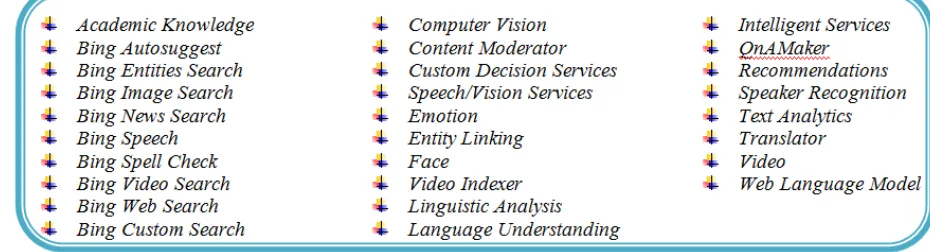
[image:2.612.70.535.357.483.2]Cognitive Services include various APIs, SDKs and services for the software developers to develop applications to display not only intelligence but also discoverable. Cognitive Services permit developers to embed intelligent features of emotions, recognition of voice/face/video and also embed understanding of it within their applications. They aim to enhance the computing speed and provide productivity through systems that can generate results for what we see, hear and speak i.e. they can now understand and reason. Microsoft Project Oxford is the case taken in this paper. It includes API and SDK for services like:
Figure 1: Various API by Microsoft
Now, we will discuss some most popular API in the later part of our paper.
A. Academic Knowledge API
With this service, developer interprets user queries to retrieve information from the Microsoft ‘stool set MAG. As a result of on-going Bing indexing, this API will contain fresh information from the Web following discovery and indexing by Bing [1].
B. Bing Autosuggest API
The Autosuggest API returns a list of suggested queries based on the partial query string the user enters in the search box. Display the suggestions in the search box's drop-down list. The suggested terms are based on suggested queries that other users have searched on and user intent.
Typically, you'd call this API each time the user types a new character in the search box. The completeness of the query string impacts the relevance of the suggested query terms that the API returns.
C. Bing Entities Search API
states, countries, etc. If you provide a search box where the user enters their search term, use the Bing Autosuggest API to improve the experience. The API returns suggested query strings based on partial search terms as the user types.
D. Bing Image Search API
The Images Search API provides a similar experience to Bing.com/Images. The API sends a search query to Bing and a list of relevant images is displayed. If you're building an images-only search results page to find images that are relevant to the user's search query, call this API instead of calling the more general Web Search API. If you want images and other types of content such as webpages, news, and videos, then call the Web Search API.
E. Bing News Search API
The News API [2] provides a similar (but not exact) experience to Bing.com/News. The News API lets you send a search query to Bing and get back a list of relevant news articles. If you're building a news-only search results page to find news that's relevant to the user's search query, call this API instead of calling the more general Web Search API. If you want news and other types of content such as WebPages, images, and videos, then call the Web Search API.
F. Bing Speech API
It helps to use speech API in your application that can interpret the speech into text and generate speech from text.
1) Speech to Text: It converts human speech to text to be used as input or commands to control your application. 2) Text to Speech: It converts text to audio data so that can be used as input also.
G. Bing Spell Check API
The Spell Check API lets you perform contextual grammar and spell checking [3]. It verifies the spelling and grammar from available dictionary databases that may or may not be updated frequently. While Bing has a web-based spell-checker that uses machine learning algorithms for web searches and documents.
H. Bing Video Search API
The Videos Search API provides a similar experience to Bing.com/Videos. The API sends a search query to Bing and search displays a list of relevant videos. If you're building a videos-only search results page to find videos that are relevant to the user's search query, call this API instead of calling the more general Web Search API [4]. If you want videos and other types of content such as WebPages, news, and images, then calls the Web Search API.
I. Bing Web Search API
The Web Search API provides web search by returning search results that are relevant to the specified user's query. The results include web pages and may include images, videos, and more.
J. Bing Custom Search API
Bing Custom Search empowers businesses of any size, hobbyists, developers, and entrepreneurs to create tailored search experiences for intents and topics that they really care about. To create a custom search service, follow these three steps:
1) Sign-up to the Custom Search Portal to build your custom search service
2) Publish your custom search service
3) Integrate your search service into an application endpoint
K. Computer Vision API
The cloud-based Computer Vision API [5] provides developers with access to advanced algorithms for processing images and returning information. When we upload an image or its URL, the algorithms analyze its content in different ways.
L. Content Moderator API
assess, and filter out offensive and unwanted content that creates risks for businesses. The content can include text, images, and videos.
M. Custom Decision Service API
Azure Custom Decision Service helps you to create intelligent systems that sharpen with experience over time. Custom Decision Service harnesses the power of reinforcement learning and adapts the content in your application to maximize the overall engagement of users. The system incorporates user feedback into its decisions in real time and responds to emergent trends and breaking stories in minutes.
Custom Decision Service is easy to use. The easiest integration mode requires only an RSS feed for your content and a few lines of JavaScript to be added into your application.Custom Decision Service converts your content into features for machine learning. The system uses these features to understand your content in terms of its text, images, videos, and overall sentiment.
N. Custom Speech Service API
The Custom Speech Service [6] enables you to create customized language models and acoustic models tailored to your application and your users. By uploading your specific speech and/or text data to the Custom Speech Service, you can create custom models that can be used in conjunction with Microsoft’s existing state-of-the-art speech models.For example, if you’re adding voice interaction to a mobile phone, tablet or PC app, you can create a custom language model that can be combined with Microsoft’s acoustic model to create a speech-to-text endpoint designed especially for your app. If your application is designed for use in a particular environment or by a particular user population, you can also create and deploy a custom acoustic model with this service.
O. Custom Vision Service API
Custom Vision Service is a tool used for building custom image classification blocks called classifiers. For example, if we need to identify images of one kind of flower with other types.
P. Emotion API
Microsoft Emotion API [7] allows you to build more personalized apps with Microsoft’s cutting edge cloud-based emotion recognition algorithm.It takes image as input and returns all the hidden emotions like happy, sad, angry, fearful etc. for each face.
Q. Entity Linking API
Microsoft Entity Linking Intelligence Service, a web service created to help developers with tasks relating to entity linking: word is named as entity. For example, in the case where “delhi” is a named entity, it still may refer to two separately distinguishable entities, such as “New Delhi” or “Delhi”.
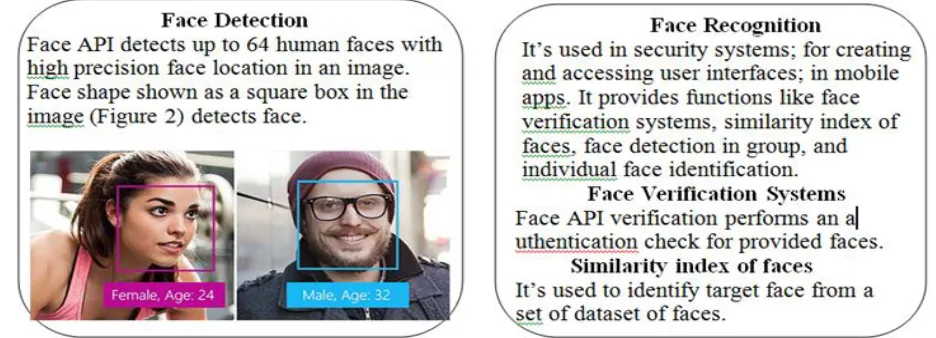
R. Face API
[image:4.612.70.538.550.719.2]Figure 3: Similarity index of faces: Depicting from (a),(b),(c),(d),(e).
S. Face detection in group
Face grouping API automatically depicts the right face from a given set of unknown faces based on similarity.
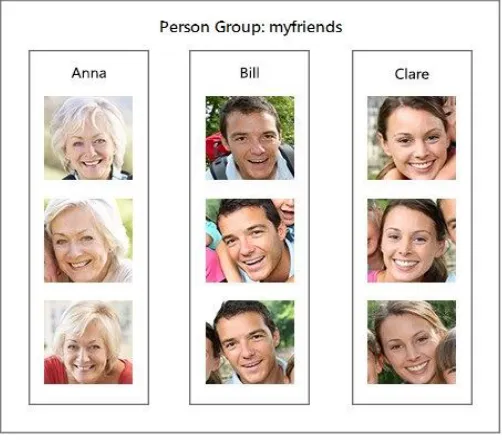
T. Individual Face identification
[image:5.612.182.433.329.549.2]It’s used to identify people on basis of a detected face and individual’s datasets that are created in advance and updated periodically.
Figure 4: Face Identification API
U. Microsoft Project Oxford and its Competitors in Market
Microsoft Project Oxford has many competitors in market [9]. Some of them can be named as under:
COMPANY NAME PROJECT NAME
IBM Watson
Google DeepMind
Baidu Minwa
TCS Ignio
Wipro Holmes
Infosys Mana
TechMahindra AQT
[image:5.612.147.462.611.716.2]II. CONCLUSION
Microsoft is working on great ideas and innovations that can help us to make research and development faster. However, Microsoft Project Oxford has many competitors in market like IBM, Google, TCS, Wipro, and Infosys and so on. Cognitive Services include various APIs, SDKs and services for the software developers to develop applications to display not only intelligence but also discoverable.This paper will help out the young developers to gain knowledge and create applications using these APIs.
REFERENCES
[1] https://github.com/MicrosoftDocs/azure-docs/blob/master/articles/cognitive-services/Academic-Knowledge/Home.md [2] https://www.microsoft.com/en-us/research/project/microsoft-academic-g
[3] https://docs.microsoft.com/en-us/azure/cognitive-services/bing-spell-check/proof-text [4] https://docs.microsoft.com/en-in/azure/cognitive-services/bing-web-search/search-the-web [5] https://azure.microsoft.com/en-in/services/cognitive-services/computer-vision/
[6] https://azure.microsoft.com/en-in/blog/new-custom-speech-service-available-in-public-preview/ [7] https://docs.microsoft.com/en-us/azure/cognitive-services/emotion/home
[8] https://azure.microsoft.com/en-in/services/cognitive-services/face/