Simultaneous Scheduling of Machines and AGVS
in FMS by Using Symbiotic Organisms Search
(SOS) Algorithm
Kommuri S Reddy1, N. Sivarami Reddy2,
1
PG Student, 2Professor, Dept of Mechanical, AITS, Rajampet, Kadapa, AP, India.
Abstract: Scheduling of flexible manufacturing systems is a NP–hard problem which is very complex. Improvement in the performance of a FMS can be expected by efficient utilization of its resources, by proper integration and synchronization of their scheduling. Symbiotic Organisms Search (SOS) algorithm is a potent tool which is a better alternative for solving optimization problems like scheduling and proven itself.
In this paper, authors addressed the problem of simultaneous scheduling of machines and automated guided vehicles in flexible manufacturing system (FMS) so as to minimize the make span. The organisms in ‘SOS’ represent both operation sequencing and AGVs assigned. The proposed SOS is tested on various problems with make span as an objective and the results are compared with the results of earlier methods.
I. INTRODUCTION
They provided a MIP model to formulate the problem. The MIP heuristic was tested on 82 test problems. Ulusoy et al [8] proposed a genetic algorithm for this problem. Suitable coding scheme was provided, in which chromosome represents both the operation number and AGV assignment. Special genetic operators were developed for this purpose. The authors implemented their GA program with this coding and tested it on the 82 test problems that were solved earlier by the STW heuristic. Abdelmaguidet [9] proposed a hybrid genetic algorithm for the problem. The hybrid GA consists of GA and heuristic. The GA addresses the scheduling of jobs and the heuristic called vehicle assignment algorithm handles the vehicle assignment. The hybrid GA is applied on a set of 82 test problems. Murayama and Kawata [10] also addressed simultaneous scheduling of machines and AGVs. However it is assumed that AGVs can carry multiple loads instead of single load at a time. The genetic algorithm was applied to the problem. MURAYAMA and KAWATA [11] proposed a local search method for simultaneous scheduling of machines and multiple-load automated guided vehicles. They introduced a representation of solutions and a neighborhood operation considering operation sequence and AGV assignment. JERALD et al [12] proposed an adaptive GA (AGA) and ants colony optimization (ACO) for a 16-machine and 43-part problem. Their objective function is a combined objective of minimizing penalty cost and minimizing 16-machine idle time. They also examined the speed of the AGV and found that AGA is superior to the ACO algorithm. JERALD et al [13] compared a GA and an adaptive GA (AGA). They showed that AGA performs better than the GA. JERALD et al [14] considered the scheduling of parts and AS/RS in an FMS using genetic algorithm. They used GA to find out the minimum movement of shuttle for the optimum storage allocation of materials in AS/RS. MURAYAMA and KAWATA [15] proposed a simulated annealing method for the simultaneous scheduling problems of machines and multiple-load AGVs to obtain relatively good solutions for a short time. The proposed method is based on a local search method for job shop scheduling problems. They provided a new representation of solutions and neighborhood operation in order to consider the transportation by multiple-load automated guided vehicles . Reddy and Rao[16] addressed simultaneous scheduling of machines and vehicles for multi objective. Hybrid multi objective GA was used to solve the problem and the combined minimization of makespan, mean flow time and mean tardiness considered as an objective. DEROUSSI et al [17] also addressed the problem of simultaneous scheduling of machines and vehicles in FMS. They proposed a new solution representation based on vehicles rather than machines, whereby each solution can thus be evaluated using a discrete event approach. An efficient neighboring system is then implemented into three different meta-heuristics, namely iterated local search, simulated annealing and their hybridization. Their results were compared with previous studies and show the effectiveness of the presented approach. Philippe Lacomma et al [18] propose a new effective framework based on a disjunctive graph to modelize the joint scheduling problem and on a memetic algorithm for jobs sequence generation on machines, AGVs sequence generation and vehicles assignments to transport operations.
II. FMS ENVIRONMENT
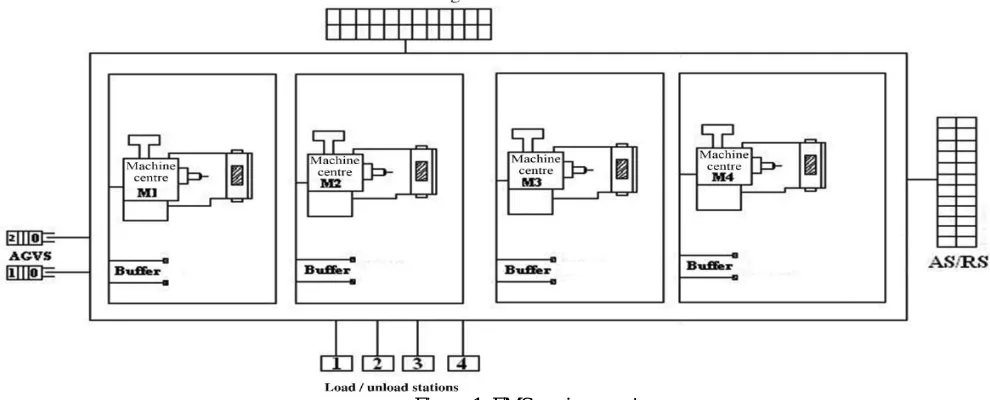
[image:3.612.61.556.519.719.2]The FMS environment considered here consists of four machines, and CTM consisting of four tools, one Automatic tool changer (ATC),the AGVs and tool transporter(TT). On one end there is loading and unloading station. Buffer storage at each machine center is provided to store the jobs before and after processing. There is an automated storage and retrieval system (AS/RS) for storage of raw material and retrieval. The system is shown in figure1 with the elements.
III. PROBLEM AND ASSUMPTIONS
Simultaneous scheduling of the machines and the material handling system in an FMS can be defined as follows: Given the FMS described later, determine the starting and completion times of operations for each job and the trips between workstations together with the vehicle assignment according to the objective of minimising the make span.
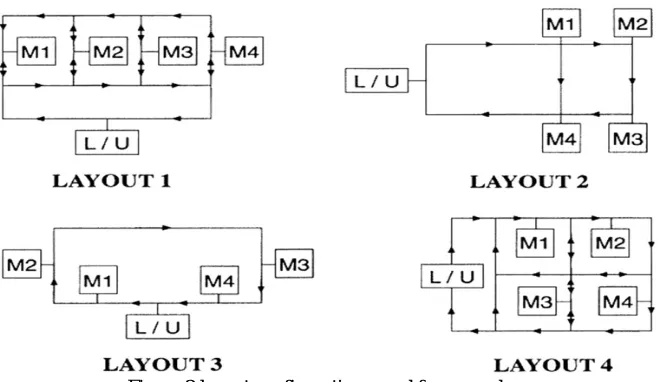
[image:4.612.144.473.340.531.2]It is assumed that all the design and set-up issues for the FMS as suggested by STECKE [19] have already been resolved. Four layout configurations as shown in Fig.2 and ten job sets are used. The number of automated guided vehicles (AGVs) in the system is two. The types and number of machines are known. There is a sufficient input/output buffer space at each machine. Machine loading has been done i.e., allocation of tools to machines and the assignment of operations to machines.Operations are not pre-emptive. Ready times of all jobs are known. The load/unload (L/U) station serves as a distribution centre for parts not yet processed and as a collection centre for parts finished. All vehicles start from the L/U station initially. There is a sufficient input/output buffer space at the L/U station. Trips follow the shortest path between two points and occur either between two machines or between a machine and the L/U station. Pre-emption of the trips is not allowed. The trips are called loaded or deadheading (empty) trips depending on whether or not a part is carried during that trip, respectively. The duration of deadheading trips is sequence-dependent and is not known until the vehicle route is specified. Processing, set-up, loading, unloading and travel times are available and deterministic. Vehicles move along predetermined shortest paths, with the assumption of no delay due to the congestion. As a result of this assumption, it would follow that the guide paths on segments can be uni-directional or bi-directional. However, on busy segments, two uni-directional paths should be used instead of abi-directional guide path so that traffic congestion does not reach a critical level leading to the violation of this assumption. Furthermore, such issues as traffic control, machine failure or downtime, scraps, rework and vehicle dispatches for battery changes are ignored here and leftas issues to be considered during real time control.
Figure 2.layout configurations used for examples
The following constraints are to be satisfied by the AGV travel when scheduling these FMSs:
A. For each operation j, there is a corresponding loaded trip whose destination is the machine where operation j is to be performed and its origin is either the machine where the operation preceding j is assigned or the L/U station;
B. Operation j of job I can start only after the trip to load has been completed
C. An AGV trip cannot start before the maximum of the completion time of the previous operation of a job and the deadheading trip of the AGV to the job is obtained. The AGV travel times and the machine allocation and operation times for the jobs are given in Appendix A.
IV. METHODOLOGY
A. Symbiotic Organisms Search Algorithm
only one of them (without the affecting other) is called commensalism. Finally, a relationship between two distinct species that offers benefits to one and cause harm to the other is called parasitism. The pseudo code of the above explanation is shown in figure 3.
Figure 3. Pseudo code for the SOS algorithm:
no
yes
Figure3: Flow chart for the SOS Algorithm Initialize all algorithm parameters and generate initial organisms in the eco system.
Evaluate the objective function value for each organism
Update organism by mutualism phase
Update organism by commensalism phase
Update organism by parasitism phase
Check for termination??
Return the best objective function value
B. Simultaneous scheduling methodology
1) Procedural steps in simultaneous scheduling methodology
a) Step 1: Enter the input data: Job set details, solution vector, AGV travelling time matrix.
b) Step 2: Read parameter of solution vector one after another.
c) Step 3:Get job no, operation no, machine no, AGV no.
d) Step 4:Check whether it is the first operation of a Job or not. If yes find which AGV will reach the L/U station early. If not find which AGV will reach the machine when Preceding operation is carried out early Move the AGV from the current position to the request point for its next assignment
e) : Check whether the Job is ready or not. If yes AGV moves the Job to the next machine at which next operation is scheduled. If not AGV waits till the Job is ready and then AGV moves the Job.
f) Check whether machine is free or not. If it is free load the Job, else the Job waits in the buffer till the machine becomes free
g) Step8: Check whether all the parameters completed. If not read the next parameter of the solution vector and repeat from step 3.
h) Step9: If all parameters are completed out put the make span and stop.
no
no
yes
Start
Read the first parameter of solution vector
Set job no, Operation no, Machine no, AGV no.
It is the first operation of Job?
move AGV from the current position to the request point for its next assignment
Find which AGVwill reach the m/c where preceding operation is carried out early
Input data-Job set details, solution vector Travelling times of AGV
Find which AGV will reach the L/U station early
no
yes
no non
yes
no
[image:7.612.82.503.67.454.2]yes
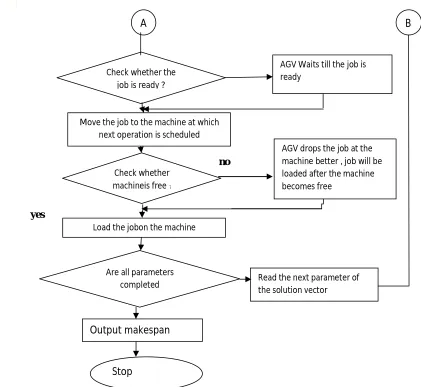
Fig 4: Simultaneous scheduling methodology flow chart
C. Limits Function And Bounds Function
Limits function is used to make sure that the operations in the vector so generated using random numbers follows precedence requirement constraints of the operations. If the precedence is not followed, the limits function correct the vector so that the operations of the vector follows precedence requirement constraints. Bounds function is used to make sure that the AGVs in the vector so generated using random numbers are within bounds. If the AGVs are not within the bounds which will be corrected by bounds function so that the AGVs of the vector are within the bounds.
IV. RESULTS AND DISCUSSION
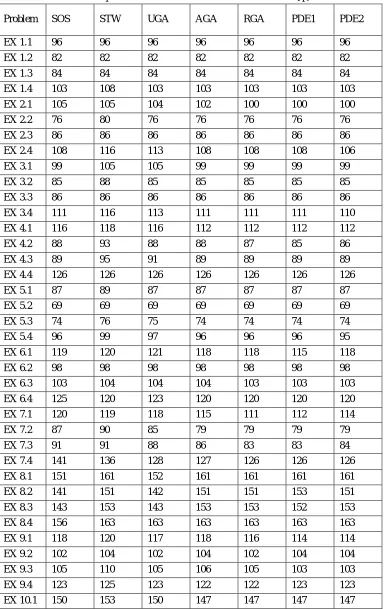
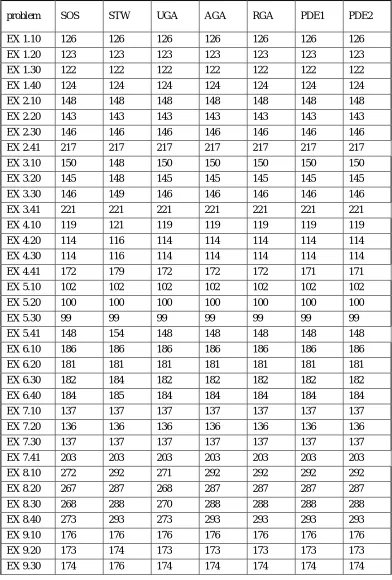
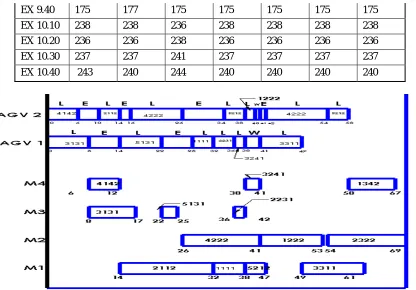
Make span of simulation in FMS for simultaneous scheduling of Jobs and Machines has been executed by the proposed algorithm on 10 different job sets with different processing sequences and process times are generated and presented in Appendix A. Different combinations of each 10 job sets and 4 layouts are used to generate 82 example problems. In all these problems there are 4 machines and 2 AGVs, Table 1 consist of make span of problems whose ti/pi ratios greater than 0.25 while Table 2 consist of make span of problems whose ti/pi ratios are less than 0.25. A code is used to designate the problems which are given in the first column. The digits that follow EX indicates the job set in the layout. In table 2, another digits is appended to the code. Here having zero or one as the last digit implies that the process times are doubled or triple respectively, where as travel times are halved in both cases. The minimum make span is represented in bold letters. The results show that solutions obtained by proposed algorithm are better. The Gantt chart for the sequence generated for job set 5layout 2 by SOS is shown fig 5.The operations that are assigned to each machine
Check whether the job is ready ?
Move the job to the machine at which next operation is scheduled
Check whether machineis free Ị
Load the jobon the machine
Are all parameters completed
Stop
Read the next parameter of the solution vector
AGV drops the job at the machine better , job will be loaded after the machine becomes free
AGV Waits till the job is ready
Output makespan
as well as start and finish times of each operation shown in the Gantt chart. The loaded trip times and empty trip times of AGVs for all the jobs are shown in the Gantt chart. The Gantt chart shows the correctness of solution provided by the proposed SOS method.
Table 1. Comparision of SOS results with other methods for ti/pi>0.25
Problem SOS STW UGA AGA RGA PDE1 PDE2
EX 1.1 96 96 96 96 96 96 96
EX 1.2 82 82 82 82 82 82 82
EX 1.3 84 84 84 84 84 84 84
EX 1.4 103 108 103 103 103 103 103
EX 2.1 105 105 104 102 100 100 100
EX 2.2 76 80 76 76 76 76 76
EX 2.3 86 86 86 86 86 86 86
EX 2.4 108 116 113 108 108 108 106
EX 3.1 99 105 105 99 99 99 99
EX 3.2 85 88 85 85 85 85 85
EX 3.3 86 86 86 86 86 86 86
EX 3.4 111 116 113 111 111 111 110
EX 4.1 116 118 116 112 112 112 112
EX 4.2 88 93 88 88 87 85 86
EX 4.3 89 95 91 89 89 89 89
EX 4.4 126 126 126 126 126 126 126
EX 5.1 87 89 87 87 87 87 87
EX 5.2 69 69 69 69 69 69 69
EX 5.3 74 76 75 74 74 74 74
EX 5.4 96 99 97 96 96 96 95
EX 6.1 119 120 121 118 118 115 118
EX 6.2 98 98 98 98 98 98 98
EX 6.3 103 104 104 104 103 103 103
EX 6.4 125 120 123 120 120 120 120
EX 7.1 120 119 118 115 111 112 114
EX 7.2 87 90 85 79 79 79 79
EX 7.3 91 91 88 86 83 83 84
EX 7.4 141 136 128 127 126 126 126
EX 8.1 151 161 152 161 161 161 161
EX 8.2 141 151 142 151 151 153 151
EX 8.3 143 153 143 153 153 152 153
EX 8.4 156 163 163 163 163 163 163
EX 9.1 118 120 117 118 116 114 114
EX 9.2 102 104 102 104 102 104 104
EX 9.3 105 110 105 106 105 103 103
EX 9.4 123 125 123 122 122 123 123
EX 10.2 141 139 137 136 135 135 135
EX 10.3 148 143 143 141 139 139 139
[image:9.612.110.502.160.740.2]EX 10.4 165 171 164 159 158 158 158
Table 2. Comparision of SOS results with other methods for ti/pi<0.25
problem SOS STW UGA AGA RGA PDE1 PDE2
EX 1.10 126 126 126 126 126 126 126
EX 1.20 123 123 123 123 123 123 123
EX 1.30 122 122 122 122 122 122 122
EX 1.40 124 124 124 124 124 124 124
EX 2.10 148 148 148 148 148 148 148
EX 2.20 143 143 143 143 143 143 143
EX 2.30 146 146 146 146 146 146 146
EX 2.41 217 217 217 217 217 217 217
EX 3.10 150 148 150 150 150 150 150
EX 3.20 145 148 145 145 145 145 145
EX 3.30 146 149 146 146 146 146 146
EX 3.41 221 221 221 221 221 221 221
EX 4.10 119 121 119 119 119 119 119
EX 4.20 114 116 114 114 114 114 114
EX 4.30 114 116 114 114 114 114 114
EX 4.41 172 179 172 172 172 171 171
EX 5.10 102 102 102 102 102 102 102
EX 5.20 100 100 100 100 100 100 100
EX 5.30 99 99 99 99 99 99 99
EX 5.41 148 154 148 148 148 148 148
EX 6.10 186 186 186 186 186 186 186
EX 6.20 181 181 181 181 181 181 181
EX 6.30 182 184 182 182 182 182 182
EX 6.40 184 185 184 184 184 184 184
EX 7.10 137 137 137 137 137 137 137
EX 7.20 136 136 136 136 136 136 136
EX 7.30 137 137 137 137 137 137 137
EX 7.41 203 203 203 203 203 203 203
EX 8.10 272 292 271 292 292 292 292
EX 8.20 267 287 268 287 287 287 287
EX 8.30 268 288 270 288 288 288 288
EX 8.40 273 293 273 293 293 293 293
EX 9.10 176 176 176 176 176 176 176
EX 9.20 173 174 173 173 173 173 173
EX 9.40 175 177 175 175 175 175 175
EX 10.10 238 238 236 238 238 238 238
EX 10.20 236 236 238 236 236 236 236
EX 10.30 237 237 241 237 237 237 237
[image:10.612.96.512.74.364.2]EX 10.40 243 240 244 240 240 240 240
Figure 5.Gantt chart for job set 5 layout 2
V. CONCLUSION
Scheduling of Jobs and machines is performed by the proposed SOS algorithm. It is noticed that results obtained by SOS algorithm is better. The work can be extended by considering down time and AGVs dispatch time for battery change.
BIBLIOGRAPHY
[1] BAKER,K.R Introduction to Sequencing and Scheduling. New York, Wiley (1974).
[2] LEE,D., ANDF.DICESARE. Integrated Scheduling of FMSs Employing Automated Guided Vehicles ”IEEE Transactions on Industrial Electronics,41(6),
pp.602–610 ,( 1994).
[3] AGNETIS,A.A.ALFIERI,P.BRANDIMARTE,ANDP.PRINSECCHI.JointJob/ToolSchedulinginaFlexibleManufacturingCell with No On-Board Tool
Magazine” Computer Integrated Manufacturing System10(1),pp.61–68(1997).
[4] JERALD,J., And P.ASOKAN. Simultaneous Scheduling of Parts and Automated Guided Vehicles in an FMS Environment using Adaptive Genetic Algorithm.
International Journal of Advanced Manufacturing Technology, 29(5),pp.584–589 (2006).
[5] RAMAN N, TALBOT F B, RACHAMADGU R V. Simultaneous scheduling of machines and material handling devices in automated manufacturing [C]// STECKE K E, SURI R. Proceedings of the Second ORSA/TIMS Conference on Flexible Manufacturing Systems. University of Michigan, Ann Arbor, MI,USA, 1986: 455−466.
[6] ULUSOY G, BILGE U. Simultaneous scheduling of machines and automated guided vehicles [J]. International Journal of Production Research, 1993, 31(12): 2857−2873.
[7] BILGE U, ULUSOY G. A time window approach to simultaneous scheduling of machines and material handling system in FMS [J]. Operations Research, 1995, 43: 1058−1070.
[8] ULUSOY G, SIVRIKAYA-SERIFOGLU F, BILGE U. A genetic algorithm approach to the simultaneous scheduling of machines and automated guided vehicles [J]. Computers & Industrial Engineering, 1997, 24(4): 335−351.
[9] ABDELMAGUID T F, NASSEF O N, KAMAL B A, HASSAN M F. A hybrid GA/heuristic approach to the simultaneous scheduling of machines and automated guided vehicles [J]. International Journal of Production Research, 2004, 42: 267−281.
[10] MURAYAMA N, KAWATA S. A genetic algorithm approach to simultaneous scheduling of processing machines and multiple-load automated guided vehicles [J]. Transactions of the Japan Society of Mechanical Engineers C, 2005, 71(712): 3638−3643. (in Japanese)
[11] MURAYAMA N, KAWATA S. Job-shop scheduling considering material handling by multiple-load AGVs [R]. The Institute of Electronics, Information and Communication Engineers, IEICE Tech. Report, 2005,105(159): 17−21. (in Japanese)
[13] JERALD J, ASOKAN P, SARAVANAN R, RANI A D C. Simultaneous scheduling of parts and automated guided vehicles in an FMS environment using adaptive genetic algorithms [J]. International Journal of Advanced Manufacturing Technology, 2006, 59: 584−589.
[14] JERALD J, ASOKAN P, PRABHAHARAN G, SARAVANAN R. Scheduling of parts and AS/RS in FMS using genetic algorithm [J]. International Journal of Applied Management and Technology, 2006, 4(1): 25−34.
[15] MURAYAMA N, KAWATA S. Simulated annealing method for simultaneous scheduling of machines and multiple-load AGVs [C]// IJCC Workshop on Digital Engineering. Pyeongchang-gun, Gangwon-do, SouthKorea, 2006: 55−62. (in Japanese)
[16] REDDY B S P, RAO C S P. A hybrid multi-objective GA for simultaneous scheduling of machines and AGVs in FMS [J]. International Journal of Advanced Manufacturing Technology, 2006, 31(5/6): 602−613.
[17] DEROUSSI L, GOURGAND M, TCHERNEV N. A simple met heuristic approach to the simultaneous scheduling of machines and automated guided vehicles [J]. International Journal of Production Research, 2008, 46(8): 2143−2164.
[18] PHILIPPE LACOMME ,MOHAND LARABI , NIKOLAY TCHERNEV Job-shop based framework for simultaneous scheduling of machines and automated guided vehicles Int. J. Production Economics 143 (2013) 24–34
[19] STECKE K E. Design, planning, scheduling, and control problems of flexible manufacturing systems [J]. Annals of Operations Research, 1985, 3(1): 3−12.
[20] MIN-YUAN CHENG, DODDY PRAYOGO. Symbiotic organisms search: a new metaheurstic optimization algorithm. Computers& structures, 2014, Vol 139, 98-112.
APENDIX A
A. Travel time matrix for the example problem
L/U M1 M2 M3 M4
L/U 0 4 6 8 6
M1 6 0 2 4 2
M2 8 12 0 2 4
M3 6 10 1 0 2
M4 4 8 10 12 0
B. Data for the job sets used:
Job Set 1 Job Set 2 Job Set 3
Job1 M1- (8); M2- (16); M4-(12)
Job1 M1-(10); M4-(18)
Job1 M1-(16); M3-(15)
Job2 M1- (20); M3-(10); M2- (18)
Job2 M2-(10); M4- (18)
Job2 M2- (18); M4- (15)
Job3 M3-(12); M4-(8); M1- (15)
Job3 M1- (10); M3- (20)
Job3 M1- (10); M2- (10)
Job4 M4- (14); M2-(18)
Job4 M2- (10); M3-(15); M4-(12)
Job4 M3- (15); M4- (10) Job5 M3-(10);
M1-(15)
Job5 M1- (10); M2- (15); M4- (12)
Job5 M1-(8); M2- (10); M3-(15); M4- (17)
Job Set 4
Job6 M1-(10); M2-(15); M3- (12)
Job6 M2-(10); M3- (15); M4- (8); M1- (15)
Job1 M4- (11); M1-(10); M2- (7)
Job Set 5 Job Set 6
Job2 M3- (12); M2-(10); M4-(8)
Job1 M1-(6); M2-(12); M4- (9)
Job1 M1- (9); M2-(11); M4-(7) Job3 M2- (7);
M3-(10); M1- (9); M3- (8)
Job2 M1- (18); M3-(6); M2-(15)
Job2 M1-(19); M2-(20); M4-(13)
Job4 M2-(7); M4- (8); M1- (12);
Job3 M3- (9); M4-(3); M1- (12)
M2- (6) Job5 M1- (9); M2-(7); M4- (8); M2- (10); M3- (8)
Job4 M4-(6); M2-(15)
Job4 M2-(14); M3- (20); M4-(9)
Job Set 7
Job5 M3-(3); M1- (9)
Job5 M1-(11); M3- (16); M4-(8) Job1 M1-(6);
M4- (6) Job Set 8
Job6 M1-(10); M3-(12); M4-(10) Job2 M2-(11);
M4-(9)
Job1 M2-(12); M3- (21); M4- (11)
Job Set 9
Job3 M2-(9); M4-(7)
Job2 M2-(12); M3-(21); M4-(11)
Job1 M3- (9); M1-(12); M2-(9); M4-(6) Job4 M3- (16);
M4-(7)
Job3 M2-(12); M3-(21); M4-(11)
Job2 M3-(16); M2- (11); M4-(9) Job5 M1-(9);
M3-(18)
Job4 M2-(12); M3-(21); M4-(11)
Job3 M1-(21); M2-(18); M4-(7) Job6 M2-(13);
M3-(19); M4-(6)
Job5 M1-(10); M2-(14); M3-(18); M4-(9)
Job4 M2- (20); M3- (10); M4-(11)
Job7 M1-(10); M2-(9); M3-(13)
Job6 M1-(10); M2-(14); M3-(18); M4-(9)
Job5 M3-(14); M1- (16); M2-(13); M4-(9) Job8 M1-(11);
M2-(9); M4-(8) Job Set 10 Job1 M1-(11);
M3-(19); M2-(16); M4-(13)
Job3 M3-(8); M2-(10); M1-(14); M4-(9)
Job5 M1-(9); M3-(16); M4-(18)
Job2 M2-(21); M3-(16); M4-(14)
Job4 M2-(13); M3-(20); M4-(10)