"'
"'
World Academy of Science, Engineering and Technology International Journal of Aerospace and Mechanical Engineering
Vol:l2, No:6,2018
Time Effective Structural Frequency Response
Testing with Oblique Impact
Khoo Shin Yee, Lian Yee Cheng, Ong Zhi Chao, Zubaidah Ismail, Siamak Noroozi
Abstract-Structural
frequency response testing is accurate in identifying the dynamic characteristic of a machinery structure. In practical perspective, conventional structural frequency response testing such as experimental modal analysis with impulse technique(also known as "impulse testing") has limitation especially on its long
acquisition time. The high acquisition time is mainly due to the redundancy procedure where the engineer has to repeatedly perform the test in 3 directions, namely the axial-, horizontal- and
vertical-axis, in order to comprehensively define the dynamic behavior of a 3D structure. This is unfavorable to numerous industries where the downtime cost is high. This study proposes to reduce the testing time by using oblique impact. Theoretically, a single oblique impact can induce significant vibration responses and vibration modes in all the 3 directions. Hence, the acquisition time with the implementation of the oblique impulse technique can be reduced by a factor of three (i.e.
for a 3D dynamic system). This study initiates an experimental investigation of impulse testing with oblique excitation. A motor-driven test rig has been used for the testing purpose. Its dynamic characteristic has been identified using the impulse testing with the conventional normal impact and the proposed oblique impact respectively. The results show that the proposed oblique impulse testing is able to obtain all the desired natural frequencies in all 3
directions and thus providing a feasible solution for a fast and time effective way of conducting the impulse testing.
Keywords-Frequ
ency
response function, impact testing, modal analysis, oblique angle, oblique impact.I. INTRODUCTION
S
TRUCTURAL frequency response testing with impact testing is commonly used to identify the dynamic characteristics of a machinery structure. This testing is also known as "experimental modal analysis (EMA)" [!]. It has been implemented in a wide range of field for the purpose of testing, design, and development of a new product/system. Dynamic information such as the natural frequency, modal damping and mode shape are used in solving the vibration problem, fatigue & damage problem and inverse identification problem. However, conventionalEMA
has a limitation in theKhoo Shin Yee is with the Department of Mechanical Engineering, Engineering Faculty, University of Malaya, 50603 Kuala Lumpur, Malaysia (phone: +60379675270; fax: +60379675317; e-mail: [email protected]; [email protected]).
Lian Yee Cheng and Ong Zhi Chao are with the Department of Mechanical
Engineering, Engineering Faculty, University of Malaya, 50603 Kuala Lumpur, Malaysia (e-mail: [email protected],
Zubaidah Ismail is with the Department of Civil Engineering, Engineering Faculty, University of Malaya, 50603 Kuala Lumpur, Malaysia (e-mail:
Siamak Noroozi is with the Department of Design and Engineering, Faculty of Science and Technology, Bournemouth University, Talbot
Campus, Fern Barrow, Poole, Dorset (e-mail: [email protected]).
International Scholarly and Scientific Research & Innovation 12(6) 2018
data acquisition process where it requires the machine to be shut down completely [2]. Moreover, to comprehensively understand the dynamic behavior of a 30 structure, there is a need to conduct multi-reference. EMA that repeatedly perform the impact testing in 3 principal directions, namely the axial-, horizontal- and vertical-axis [3]. Therefore, the high testing time of multi-reference EMA is not favorable in many industries. For example, the cost of downtime and unscheduled shutdown can be as high as USD I 00,000 per day in the petrochemical industry [4]. Therefore, there is a need to reduce the testing time to save the maintenance cost.
This study initiates an experimental investigation of impulse testing with oblique impact, i.e. the impact is excited to the structure at oblique or non-normal angle. The intention of imposing an oblique impact instead of normal impact is to induce a significant vibration response in all the 3 directions simultaneously. With that, the vibration modes at 3 directions can be obtained by using signal processing technique. Hence, it is expected that the acquisition time can be reduced by a factor of three by using the proposed method.
ll.THEORY
A.
Structural Frequency Response Testing with
Norma
l
Impact
Structural frequency response testing with impulse technique is frequently used to measure the dynamic characteristic of a system such as natural frequency, damping and mode shape [1]. This technique requires a complete 'shut down' situation of the system with no unaccounted excitation force. Theoretically, if the impact force and the corresponding vibration can be measured, the structural frequency response function (FRF) can be obtained, as in {I):
H . . = Xn;
m:n) Fnj {I)
where Hni:nj is the FRF or the transfer function due to force, F
acting at location
n
and direction j and its corresponding acceleration response,X
measured at locationn
and direction i.To perform the impulse testing, the reference DOF of the force must be normal to the surface of a 3D structure, denoted as x-, y-, & z-axis respectively. A complete FRF matrix can be obtained, as in (2):
N N
"'
§
~
0
:
~
:0
~
C>I
International Journal of Aerospace and Mechanical Engineering Yol:12, No:6,2018
Hlx:lx Hlx:ly Hlx:lz HlX:nj xlX F1X -1 Hly:lx Hly:ly Hly:lz Hly:nj kly Fly
Hlz:lx Hlz:ly Hlz:lz HlZ:nj Xlz F1Z (2)
Hnl:lx Hnl:ly Hni:lz Hnl:nj Xni Fnj
Instead of measuring a complete FRF matrix, a single column or single row of FRF matrix is able to obtain the modal parameters of dynamic characteristics at particular direction [5]. Thus, a minimum 3 sets of single column/row
FRF are needed to acquire vibration modes at all the three
translational directions. However, the redundancy procedure is
time consuming, especially conducting testing for a large
structure where a large number of measurement points are
needed. Therefore, structural frequency response testing with oblique impact is proposed in this study to reduce the time
consuming testing process.
B. Structural Frequency Response Testing with Oblique Impact
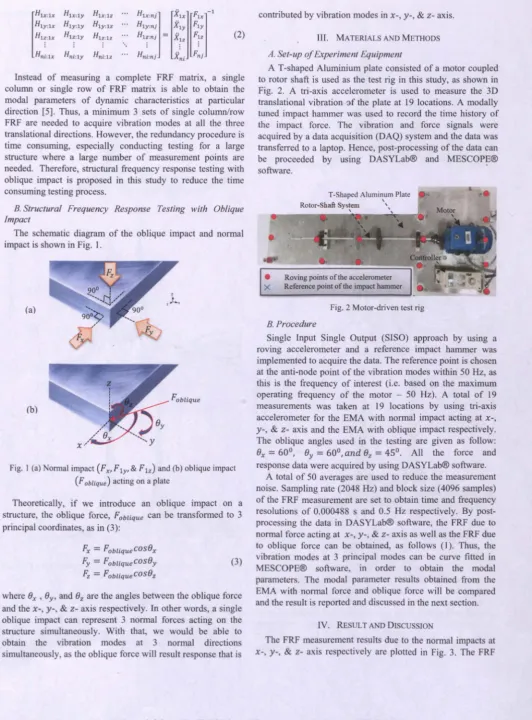
The schematic diagram of the oblique impact and normal
impact is shown in Fig. I.
(a)
(b)
Fig. I (a) Normal impact ( F
x.F
ly• & F lz) and (b) oblique impact (F oblique) acting on a plateTheoretically, if we introduce an oblique impact on a
structure, the oblique force, Foblique can be transformed to 3
principal coordinates, as in (3):
Fx
=
Fobliquecos(JxFy
=
Fobltquecos(JyFz
=
FobltqueCOSOz(3)
where (Jx , Oy, and (Jz are the angles between the oblique force
and the
x-,
y-, &z-
axis respectively. In other words, a singleoblique impact can represent 3 normal forces acting on the
structure simultaneously. With that, we would be able to
obtain the vibration modes at 3 normal directions
simultaneously, as the oblique force will re ult response that is
International Scholarly and Scientific Research & Innovation 12(6) 2018
contributed by vibration modes in
x-,
y-, &z-
axis.Ill. MATERIALS AND METHODS
A. Set-up of Experiment Equipment
AT-shaped Aluminium plate consisted of a motor coupled
to rotor shaft is used as the test rig in this study, as shown in
Fig. 2. A tri-axis accelerometer is used to measure the 3D
translational vibration :>f the plate at 19 locations. A modally tuned impact hammer was used to record the time history of the impact force. The vibration and force signals were acquired by a data acquisition (DAQ) system and the data was transferred to a laptop. Hence, post-processing of the data can
be proceeded by using DASYLab® and MESCOP~®
software.
T-Sbaped Aluminum Plate
\
Roving points of the accelerometer Reference point of the impact hammer
Fig. 2 Motor-driven test rig
B. Procedure
Single Input Single Output (SISO) approach by using a roving accelerometer and a reference impact hammer was implemented to acquire the data. The reference point is chosen at the anti-node point of the vibration modes within 50 Hz, as
this is the frequency of interest (i.e. based on the maximum
operating frequency of the motor - 50 Hz). A total of 19
measurements was taken at 19 locations by using tri-axis
accelerometer for the EMA with normal impact acting at x-,
y-, &
z-
axis and the EMA with oblique impact respectively. The oblique angles used in the testing are given as follow:(Jx = 60°, (JY = 60°, and (Jz = 45°. All the force and
response data were acquired by using DASYLab® software. A total of 50 averages are used to reduce the measurement
noise. Sampling rate (2048Hz) and block size (4096 samples)
of the FRF measurement are set to obtain time and frequency
resolutions of 0.000488 s and 0.5 Hz respectively. By post-processing the data in DASYLab® software, the FRF due to
normal force acting at
x-,
y-, &z-
axis as well as the FRF dueto oblique force can be obtained, as follows (!). Thus, the
vibration modes at 3 principal modes can be curve fitted in
MESCOPE® oftware, in order to obtain the modal
parameters. The modal parameter results obtained from the EMA with normal force and oblique force will be compared and the result is reported and discussed in the next section.
IV. RESULT AND DISCUSSION
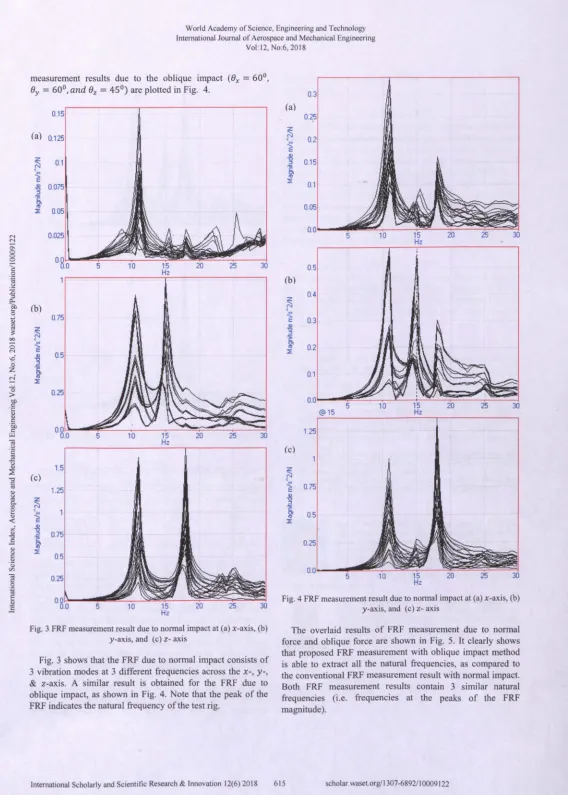
The FRF measurement results due to the normal impacts at
x-, y-, & z- axis respectively are plotted in Fig. 3. The FRF
[image:2.588.34.566.83.803.2]"'
"'
"'
08
~ .9 ;;; .'=! ::0 ::l~
Cl"
"'
~ 00 0"'
-.6 0z
,....
·
0>
co c: ·c:
:::
c: 'Oil c: UJ ~..,
·;:"'
..c:
..,
"
::E
-o c:
"'
"
..,
"'
Q."'
e
"
<(,.
·
"
-o..=
8
c:"
·;:; </} ~ c: 0 -~ E B..=
World Academy of Science, Engineering and Technology International Journal of Aerospace and Mechanical Engineering
Voi:I2,No:6,2018
measurement results due to the oblique impact (8x
=
60°,8y
= 60°,and 8
2 = 45°) are plotted in Fig. 4.0.
(a) 0.125
~ 0.1
~
'
E.,
0.075
"0 ::l 'E Cl
.,
:l: (b)0.75
~
N
<
"
'
E.,
-o·
~
"'
"'
:l: (c) :z'
N <"
'
E.,
]
·c:
"'
.,
:l:Fig. 3 FRF measurement result due to normal impact at (a) x-axis, (b)
y-axis, and (c) z-axis
Fig. 3 shows that the FRF due to normal impact consists of
3 vibration modes at 3 different frequencies across the x-, y-,
& z-axis. A similar result is obtained for the FRF due to
oblique impact, as shown in Fig. 4. Note that the peak of the
FRF indicates the natural frequency of the test rig.
International Scholarly and Scientific Research & Innovation 12(6) 2018
0.3
(a) 0.25 :z
'
N 02 < "'
E.,
"0 ::l
·~
"'
:::;:0.5
(b) 04 z
'
N < "'
.,
E 0.3-o
.2
·c:
"'
0.2"'
:l:
0.1
0.0
5 10
@15 (c) ~ N <
"
'
E.,
"0
·~
"'
"'
:l:
Fig. 4 FRF measurement result due to normal impact at (a) x-axis, (b) y-axis, and (c) z-axis
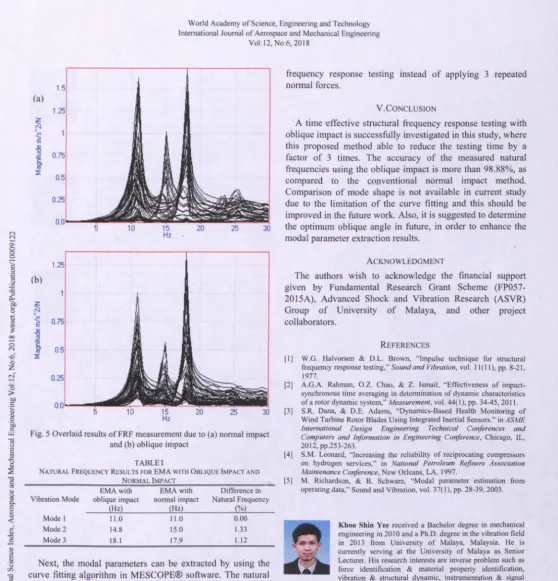
The overlaid results of FRF measurement due to normal
force and oblique force are shown in Fig. 5. It clearly shows
that proposed FRF measurement with oblique impact method is able to extract all the natural frequencies, as compared to the conventional FRF measurement result with normal impact.
Both FRF measurement results contain 3 similar natural
frequencies (i.e. frequencies at the peaks of the FRF magnitude).
[image:3.588.8.576.16.811.2]International Journal of Aerospace and Mechanical Engineering
Vol: 12, No:6, 2018
1.5 (a)
1.25 z
'
N ("
'
E.,
"t>
-~
Ol
"'
:l:
1 25
(b)
Fig. 5 Overlaid results of FRF measurement due to (a) normal impact
and (b) oblique impact
TABLE!
NATURAL FREQUENCY RESULTS FOR EMA WITH OBLIQUE IMPACT A D
NORMAL IMPACT
EMA with EMA with Difference in Vibration Mode oblique impact normal impact Natural Frequency
{Hz} {Hz} {%)
Mode I I 1.0 I 1.0 0.00
Mode2 14.8 15.0 1.33
Mode3 18.1 17.9 1.12
Next, the modal parameters can be extracted by using the
curve fitting algorithm in MESCOPE® software. The natural
frequencies for the EMA with normal forces and oblique force
are given in Table I. Table I shows that the accuracy of the
EMA with the proposed oblique impact method achieves
I 00%, 98.67%, and 98.88% for mode I, 2, and 3 respectively.
However, the comparison between the mode shape is not
available in this study. This is because multi-reference curve
fitting of the FRFs with 3 reference normal impacts will generate 3 sets mode shapes while single-reference curve
fitting of the FRFs with I reference oblique impact will
generate I set mode shape only. Despite that, the results show
the great potential of the proposed oblique impact in
enhancing and promoting the time effective structural
International Scholarly and cientitic Research & Innovatton I 2(6) 2018
frequency response testing instead of applying 3 repeated
normal forces.
V.CONCLUSION
A time -effective structural frequency response testing with
oblique impact is successfully investigated in this study, where
this proposed method able to reduce the testing time by a
factor of 3 times. The accuracy of the measured natural
frequencies using the oblique impact is more than 98.88%, as
compared to the conventional normal impact method.
Comparison of mode shape is not available in current study
due to the limitation of the curve fitting and this should be
improved in the future work. Also, it is suggested to determine
the optimum oblique angle in future, in order to enhance the
modal parameter extraction results.
ACKNOWLEDGMENT
The authors wish to acknowledge the financial support
given by Fundamental Research Grant Scheme
(FP057-20 IS A), Advanced Shock and Vibration Research (ASVR)
Group of University of Malaya, and other project
collaborators.
REFERE CES
[I] W.G. Halvorsen & D.L. Brown, "Impulse technique for structural frequency response testing," Sound and Vibration, vol. II (I I), pp. 8-2 I, 1977.
[2] A.G.A. Rahman, O.Z. Chao, & Z. Ismail, "Effectiveness of
impact-synchronous time averaging in determination of dynamic characteristics of a rotor dynamic system," Measurement, vol. 44(1), pp. 34-45,201 I. [3] S.R. Dana, & D.E. Adams, "Dynamics-Based Health Monitoring of
Wind Turbine Rotor Blades Using Integrated Inertial Sensors." in ASME
International Design Engineering Technical Conferences and
Computers and Information in Engineering Conference, Chicago, IL,
2012, pp.253-263.
[ 4] S.M. Leonard, "Increasing the reliability of reciprocating compressors on hydrogen services," in National Petroleum Refiners Association
Maintenance Conference, New Orleans, LA, I 997.
[5] M. Richardson, & B. Schwarz, "Modal parameter estimation from
operating data," Sound and Vibration, vol. 37(1), pp. 28-39,2003.
Khoo Shin Vee received a Bachelor degree in mechanical
engineering in 2010 and a Ph.D. degree in the vibration field
in 2013 from University of Malaya, Malaysia. He is
currently serving at the University of Malaya as Senior Lecturer. His research interests are inverse problem such as force identification & material property identification,
vibration & structural dynamic, instrumentation & signal processing and neural network.
616
Lian Vee Cheng received a Bachelor degree in Mechanical
Engineering in 20 I 0 and Master of Engineering Science in
2015 from University of Malaya, Malaysia. He is currently a research assistant.
[image:4.591.8.566.16.596.2]World Academy of Science, Engineering and Technology
International Journal of Aerospace and Mechanical Engineering
Vol: 12, No:6, 2018
Ong Zhi Chao, received his Bachelor degree in Mechanical
Engineering (2007), Master of Engineering Science in
vibration and rotor dynamics (20 I 0) and Ph.D (20 13) from
University of Malaya, Malaysia. His research interests
include vibration, modal analysis, impact-synchronous
modal analysis (!SMA), structural and rotor dynamics,
virtual instrumentation, signal processing, fault diagnostic.
For the past 5 years, he has collaborated with a local vibration consultancy
company in Malaysia and he is actively involved in industrial projects on
machinery vibration related issues at both on-shore and off-shore
petrochemical and oil and gas processing plants in Malaysia.
Zubaidah Binti Ismail received her BA ( 1985) from State
University of N. York, New Paltz and MA (1987) from
Temple University, Philadelphia, Pennsylvania. Later, she
obtained her PhD (2006) from University of Malaya,
Malaysia. Presently, she is serving as an Associate
Professor in Department of Civil Engineering and as the Director of Advanced Shock and Vibration Research Group
at University of Malaya. Her areas of expertise include structural health
monitoring, modal testing, structural dynamics, engineering maths, statistics,
computer programming.
Professor Siamak Noroozi is the Director of Design
simulation Research Centre at Bournemouth University. He
moved to Bournemouth University in 2008 after 9 years at
the University of the West of England, Bristol where he was
Director of the Computational Mechanics Research Centre
and lectured in areas such as mechanical engineering,
structures and design. He has a long and well established link with Airbus UK, where for the past 13 years, he has been providing
training and CPO in the area of advanced mechanics of materials and
lightweight structure design and analysis.