5
III
March 2017
Technology (IJRASET)
©IJRASET: All Rights are Reserved
606
Decision Making to Evaluate Interpersonal Skills
Based on Similarity Checking using Artificial
Intelligence
K. Abinaya1, R. Kaviya2, R. Janani3, N. Rajganesh4
1,2,3
UG Students, 4Assistant Professor , Department of Information Technology A.V.C College of Engineering, Tamil Nadu, India
Abstract- In this paper, we proposed a method to solve the problem related to the team formation and influence of the team performance among the students. Group formation could be a key aspect in computer-supported cooperative learning, not only do several factors such as team performance, team dynamics. However, the solution becomes increased exponentially, if the teams get to be optimized. Despite its crucial importance within the classroom, there is a lack of support for the team formation process. We tend to test the performance of the students in team activities. The experiments suggest that the proposed system is in a position to improve completely different teamwork aspects like team dynamics and student satisfaction. To provide the efficient cooperation supported constraints. Conduct the test supported their interested area then evaluates the result according to their performance. Form the team using the evaluated result. Using the dataset of illustrious personality compare the students record with them. Then find out similarities among them.
Keywords- Team Formation, Team Members, Performance, Teamwork, Constraints, Result.
I. INTRODUCTION
Nowadays, teams are at the heart of a vast majority of modern companies. The reasons for this inclusion are well-grounded in its pedagogic effectiveness and our current industrial paradigm. Firstly, the realm of collaborative learning, supported by computers, promotes collaboration and makes learning more effective [5]. Secondly, the industry has shifted from an individually oriented work environment towards a team-oriented geographic point. Despite the often difficult decision-making tasks involving teams of people, teams have proven to have an inherent ability to solve the complicated issues that are confronted in the current work environment [1]. To place a special emphasis on teamwork skills as a section of program’s learning outcomes.
Unfortunately, not every single team is prospering in their goals, and lots of groups fail attributable to incorrect team dynamics, lack
of communication, and interpersonal conflict among team members [7]. Even though some of the aforementioned problems can be
alleviated with teamwork experience, these negative factors should be avoided whenever attainable as they will generate resentment towards teamwork. Hence, distinguishing the patterns that drive successful teams and forming work teams according to these patterns become crucial tasks for every organization.
Classrooms aren't resistant to this issue (especially if students are to find out teamwork skills), and unnecessary issues might hinder this learning process. These behavioural patterns (or roles) should be contended by the various team members to help made teamwork [8]. One of the explanations for this successful application in education is the identification of behavioural patterns that are present in several group dynamics. Therefore, we tend to believe that a simpler role assignment might be achieved by considering each the data collected before acting on a team and the feedback provided from peers after performing on a team. The second is that individuals aren't strictly represented by simply a static and strict role. Despite the real fact that, as a result of the individual’s personality, one might have a most main role, individuals show an expensive kind of behavioural patterns depending on circumstances [9]. Firstly, this makes the foremost distinguished role of the individual unsure; because the individual might show vary behaviours for different situations.
Technology (IJRASET)
©IJRASET: All Rights are Reserved
607
II. RELATED WORK
A. Team Formation Instruments to Enhance Learner Interactions in Massive Open Online Courses
Spoelstra et al [2] proposed that instruments exist of team formation principles and algorithms for the formation of productive, creative, and learning teams. The algorithms use data on learner knowledge, personality and preferences to form teams. In this there is no implementation of the project-based learning and team formation instruments.
B. Team Role Experience and Orientation a Measure and Tests of Construct Validity, Group & Organization Management
Mathieu et al [3] proposed that to fulfil the different critical needs such as organizing work, maintaining group harmony, and aligning their efforts with those of others in an organization. The team configuration management is the major drawback in this paper.
C. Using Constraint Satisfaction to Aid Group Formation in CSCL., Revista Iberoamericana de Inteligencia Artificial
Balmaceda et al [4] proposed that assistant is to aid teachers to form learning groups considering factors such as team role balance and distribution of psychological styles. They combine constraints and preferences both for individuals and groups. But they does not analysed the performance of teams formed as suggested by our assistant.
D. Using clickers in Class. The Role of Interactivity, Active Collaborative Learning and Engagement in Learnin Performance, Computers & Education
Blasco-Arcas et al [6] suggested that to find a positive impact on student learning. The Students engagement and achievement compared to traditional lecture format instruction were increased. There is no feedback system measure from the student.
III. SYSTEM ANALYSIS
System Analysis is the process of analysing the system and its component. Proposed systems are detailed below.
A. Existing System
In the existing system, team formation in the classroom. The tool forms teams based on Belbin’s role theory, which identifies eight different behavioural patterns (i.e., roles) found in successful teams. As proposed by the theory, teams are formed with a heterogeneous configuration of roles. These roles are inferred from feedback that is received from students about their teammates after each team activity. Artificial intelligence allows us to handle two important issues for the tool: it can handle uncertainty with respect to individuals’ roles and students’ feedback by means of Bayesian techniques; (ii) it allows us to calculate the ideal team configuration for the classroom in an enormous search space by using coalitional structure generation approaches that are supported by linear programming.
1) Disadvantage: There is no feedback from the student
B. Proposed System
In this paper, we have greatly worked our process to make the system according to the team formation. Here the system is implemented as dynamic i.e., to give the efficient teamwork based on constraints. Conduct the test based on their interested area. Outcomes of the test will be recorded. The Heterogeneous team will be formed using the algorithm Particle Swarm Optimization (PSO) shown in the Algorithm 1. This algorithm is a swarm intelligence based about non-deterministic optimization technique. Then dataset for the illustrious personalities are extracted from the knowledge base. Using Linear Discriminant Analysis (LDA) compare them with the students. Then find the students who come under the group of illustrious personalities. Hence motivate them for achieving greater extent.
1) Advantages: It provides feedback. It checks similarity among students and illustrious personalities
C. System Description
Technology (IJRASET)
©IJRASET: All Rights are Reserved
608
D. Module Description
1) Here Every Stage in the System is Described Below:
a) Module 1: Administrative Respective: In this module, the admin has given their username and password, and then enter into the system. Admin register the student’s details and test their date, time, and subject for particular students. Then admin add course for the test. Next add the questions and options for the questions are entered into the system. Admin can insert and delete the courses and can insert and delete the questions in the system. Username and password are generated for the student automatically.
b) Module 2: User Respective: In this module, the admin gives the username and password to the student. Students are login into the system using the username and password. Then they attend the test and answer the questions. Hence, the results are recorded in the database and the results are generated for the student. Finally the students are logout from the system. Feedback for the test will be entered by the student.
c) Module 3: Heterogeneous Team Formation: In this module, using the recorded result Particle Swarm Optimization algorithm is aplied to form the heterogeneous team. Hence, Heterogeneous team will be formed.
d) Module 4: Similarity Checking: In this module, dataset for the illustrious personalities were taken from the knowledge base. Then compare the student’s record with the illustrious personalities and find the similarity among them. Next, find out who are all comes under the group of illustrious personalities. Hence, motivate the students to meet great things.
E. System Architecture Design
A system architecture or systems architecture is the conceptual design that defines the structure and/or behaviour of a system. An architecture description is a formal description of a system, organized in a way that supports reasoning about the structural properties of the system. It defines the system components or building blocks and provides a plan from which products can be procured, and systems developed, that will work together to implement the overall system.
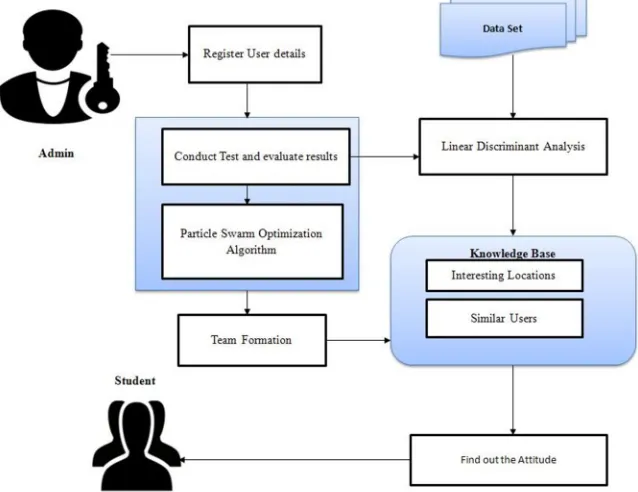
[image:4.612.136.455.441.687.2]In the Fig. 1 shows that admin login using username and password, then register the student details. Admin give username and password to the students for attend the test. Then test are conduct and judge the results. Using particle swarm optimisation algorithm form the team then team can be formed. Next collects the dataset of illustrious personality and check the similarity between students and illustrious personality using linear discriminant analysis algorithm. Then finding the students who comes under the category of illustrious personality, finally motivate the students.
Technology (IJRASET)
©IJRASET: All Rights are Reserved
609
F. Team Formation Mechanism
The team formation will be formed using the following Particle Swarm Optimization Algorithm.
1) Algorithm 1: Team Formation Algorithm Input: Results of the test
Output: Team formation
[x*] = PSO()
P = Particle_Initialization(); For i=1 to it_max
For each particle p in P do fp = f(p);
If fp is better than f(pBest) pBest = p;
end end
gBest = best p in P;
For each particle p in P do
v = v + c1*rand*(pBest – p) + c2*rand*(gBest – p); p=p+v;
end end
IV. CONCLUSION
In this paper, a team formation, similarity among the students and illustrious personalities are found. We have the tendency to test the performance of the proposed system in an experiment involving students that took part in several team activities. The paper suggests that the proposed system is able to improve different teamwork aspects like team dynamics and student satisfaction. Teams are formed with a heterogeneous configuration of roles. This is about to implement in organisations, schools. To spot the talents of students then giving work supported their skills to become associate illustrious personality.
REFERENCES
[1] Juan M. Alberola, Elena del Val, Victor Sanchez-Anguix, Alberto Palomares, Maria Dolores Teruel, An artificial intelligence tool for heterogeneous team formation in the Classroom, 2016.
[2] H. Spoelstra, P. van Rosmalen, T. Houtmans, P. Sloep, Team formation instruments to enhance learner interactions in open learning environments, Computers in Human Behavior 45 (2015) 11 – 20.
[3] J. E. Mathieu, S. I. Tannenbaum, M. R. Kukenberger, J. S. Donsbach, G. M. Alliger, Team role experience and orientation a measure and tests of construct validity, Group & Organization Management 40 (1) (2015) 6–3.
[4] J. M. Balmaceda, S. N. Schiaffno, J. A. D. Pace, Using constraint satisfaction to aid group formation in cscl., Revista Iberoamericana de Inteligencia Artificial 17 (53) (2014) 35–45.
[5] J. Bais, J. Giletto, J. Balmaceda, S. Schiaffno, J. A. Diaz, An assistant for group formation in cscl based on constraint satisfaction, Proceedings of ASAI (2013) [6] L. Blasco-Arcas, I. Buil, B. Hernandez-Ortega, F. J. Sese, Using clickers in class. The role of interactivity, active collaborative learning and engagement in
learning performance, Computers & Education 62 (2013) 102–110.
[7] P. Bergey, M. King, Team machine: A decision support system for team formation, Decision Sciences Journal of Innovative Education 12 (2) (2014).
[8] J. M. Alberola, E. del Val, V. Sanchez-Anguix, V. Julian, Simulating a collective intelligence approach to student team formation, in: Hybrid Artificial Intelligent Systems, Springer, 2013, pp. 161–170