A Novel LTE Scheduling Algorithm for Green
Technology in Smart Grid
Mohammad Nour Hindia, Ahmed Wasif Reza*, Kamarul Ariffin Noordin, Muhammad Hasibur Rashid Chayon
Department of Electrical Engineering, Faculty of Engineering, University of Malaya, Kuala Lumpur, Malaysia
Abstract
Smart grid (SG) application is being used nowadays to meet the demand of increasing power consumption. SG application is considered as a perfect solution for combining re-newable energy resources and electrical grid by means of creating a bidirectional communi-cation channel between the two systems. In this paper, three SG applicommuni-cations applicable to renewable energy system, namely, distribution automation (DA), distributed energy system-storage (DER) and electrical vehicle (EV), are investigated in order to study their suitability in Long Term Evolution (LTE) network. To compensate the weakness in the existing sched-uling algorithms, a novel bandwidth estimation and allocation technique and a new schedul-ing algorithm are proposed. The technique allocates available network resources based on application’s priority, whereas the algorithm makes scheduling decision based on dynamic weighting factors of multi-criteria to satisfy the demands (delay, past average throughput and instantaneous transmission rate) of quality of service. Finally, the simulation results demonstrate that the proposed mechanism achieves higher throughput, lower delay and lower packet loss rate for DA and DER as well as provide a degree of service for EV. In terms of fairness, the proposed algorithm shows 3%, 7 % and 9% better performance com-pared to exponential rule (EXP-Rule), modified-largest weighted delay first (M-LWDF) and exponential/PF (EXP/PF), respectively.
Introduction
Nowadays, the existing power grid systems are facing difficulties to cope up with increasing de-mand for energy, leading to a lack of reliability, instability and poorquality of service(QoS) [1]. Therefore, recent researches focused on upgrading the traditional grid towards smart grid (SG) system [2–4]. The enhancement and modernization of the present grid to an SG structure can be accomplished by providing two-way communication between the control unit and the dis-tributed components all over the network. SG can guarantee a better efficiency in terms of cus-tomer services, power management, flexibility and failure prediction, and it can offer less expensive services than the traditional system. Moreover, SG offers a large amount of support for the environment by integrating the renewable energy into the grid [5,6]. By using certain
a11111
OPEN ACCESS
Citation:Hindia MN, Reza AW, Noordin KA, Chayon MHR (2015) A Novel LTE Scheduling Algorithm for Green Technology in Smart Grid. PLoS ONE 10(4): e0121901. doi:10.1371/journal.pone.0121901
Academic Editor:Cheng-Yi Xia, Tianjin University of Technology, CHINA
Received:December 3, 2014
Accepted:February 8, 2015
Published:April 1, 2015
Copyright:© 2015 Hindia et al. This is an open access article distributed under the terms of the Creative Commons Attribution License, which permits unrestricted use, distribution, and reproduction in any medium, provided the original author and source are credited.
Data Availability Statement:All relevant data are within the paper.
Funding:This research work is supported by the University of Malaya Research Grant (UMRG) scheme (RG286-14AFR). The funders had no role in study design, data collection and analysis, decision to publish, or preparation of the manuscript.
management algorithms, it can help the existing system to store the surplus electricity during the off peak period in the Vehicle-to-Grid (V2G) nodes, then reuse it when necessary. Hun-dreds of thousands of nodes, such as V2G can be used as storage devices for power generation from solar or wind by using V2G batteries. This integration offers consistent, controllable, sta-ble and reliasta-ble power supply. In addition, it helps minimizing the damages caused by the pres-ent grid system on the environmpres-ent by decreasing the CO2emission and fuel consumption [7– 10]. However, renewable energy has its own drawbacks, such as huge dependency of solar cell and wind energy generator on the weather condition, thus the instable power generation dis-rupts the grid system. As proposed in [11], V2G or electrical vehicle node can add on average 560–910 Watt to the grid based on the battery size. Large number of vehicles contributes to a significant amount of energy which helps in stabilizing the power grid. The V2G system pro-vides dual benefits for both the electricity provider and the consumer. Electrical vehicle (EV) owners can sell their excessive stored energy to the grid as a distributed generator so that the grid can purchase when it needs. Thus, the dependency on regular generators, such as nuclear and fuel power generators decreases significantly.
To provide smooth running of EV over the grid, an aggregator and two SG applications are required, which are distribution automation (DA) and distributed energy system-storage (DER). The aggregator is defined as a bridge between the vehicles and the control unit that contains the information about the number of EVs and their coordination on the map. It also provides the status of charging and discharging, amount of power consumption and generation to the grid and billing information service to the users. Whereas, the DA application acts as a connection be-tween the end user and the transmission system. Moreover, it remotely controls, monitors and repairs the electrical distributed components on the grid. In addition, it has a major role in terms of minimizing the power shortage, provides high reliability of electrical power consumption, and high ability to control and balance the load on the grid. DA application can be considered as a real time application since the feedbacks have strict requirements in terms of delay [12]. Finally, DER supplies the required energy during the peak loads and stores the surplus power when the demand is low. This can be a consistent, controllable, and reliable energy source [13].
In order to allow the integration between the green technology and SG system, so that the whole system can benefit from the above mentioned advantages, three different groups are re-quired to work in harmony as one group to complete this mission successfully. These groups and their roles can be described as follows: firstly, the power engineers play major role in the energy conversion process. Secondly, the electrical engineering group proposes a technique to guarantee the exact voltage and current flowing from the V2G to grid, and via versa. Finally, the communication engineering group adds the communication layer that secures the energy flow and data exchange between the vehicle and the public grid as well as guarantees the QoS’ demands of end-to-end users and applications.
As using of game theory (cooperative and non-cooperative techniques) increases dramati-cally nowadays, integration with SG applications can enhance the system performance, such as fairness index as well as the throughput since it has the ability of dynamic resource allocation among application users [14]. Some researchers [15] introduced a weighting structure into the spatial prisoner’s dilemma game to analyze the cooperative behaviors. Three types of weight distributions were considered, namely exponential, power-law and uniform distributions. This mechanism showed an enhancement in terms of the cooperators frequency because of the high heterogeneity of link strength.
demonstrated that the cooperation was remarkably enhanced by increasing the size of tion neighborhood. It has been reported that the cooperation is faded when the size of interac-tion neighborhood becomes too large.
Besides, a spatial prisoner’s dilemma game model is studied in [17] to analyze the impact of separation between the interaction and learning neighborhood. The authors considered two dif-ferent cases where the size of one neighborhood was fixed and the other one was varied and vice versa. The results showed that this separation strongly influenced the cooperative behaviors among players. According to their findings, medium-sized neighborhood can manage and assist the cooperation among individuals on the square lattice when compared to the standard case.
From the communication engineering aspect, distributed components, such as generators, power transfers and distribution feeders should be supported by a bidirectional communica-tion network that is fast, reliable and secure communicacommunica-tion technology. Several wireless tech-nologies can be employed in SG applications, such as 3G cellular network, Worldwide Interoperability for Microwave Access (WiMAX) and Long Term Evolution (LTE). However, according to laboratory and field tests [18], LTE network meets all the technical requirements for SG communications because it offers reliability, very low latency, high data rate and spectral efficiency, as well as commercial advantages, but it is not specifically designed for SG applica-tions. As the scheduling mechanism has an essential impact on the performance of LTE net-work, a new scheduling algorithm must be proposed or the existing algorithms need to be optimized to satisfy the demands of SG application.
Uplink and downlink scheduling are separated in LTE and the scheduling decisions can be taken independently of each other. Orthogonal frequency division multiple access (OFDMA) technique is deployed in LTE for downlink stream. Its robustness and reliability against multi fad-ing, interference and higher spectral efficiency are proved [19,20]. Whereas, single carrier FDMA (SC-FDMA) is utilized for uplink stream because of its power conservation at the user equipment (UE). The scheduler takes into account the channel quality inductor (CQI), which is updated reg-ularly at each transmission time interval (TTI). Resource Blocks (RBs) are assigned by the sched-uler to users at each 1 ms of scheduling interval [21]. For further scheduling improvements of real time applications, several algorithms, such as exponential/PF (EXP/PF), modified-largest weighted delay first (M-LWDF) and exponential rule (EXP-Rule) schemes have been proposed. These schemes improve the scheduling performance in terms of throughput, latency and fairness. It is worth to mention that, these approaches are recognized as channel and QoS aware strategies.
In this paper, three SG applications for renewable energy are investigated in order to study their applicability in LTE network. LTE network is not specially designed to accommodate these applications. Therefore, we propose a novel bandwidth estimation and allocation technique and a new scheduling algorithm to make the LTE network fully compatible with these applications. The bandwidth estimation and allocation technique is used for resource allocation based on the priority of each application. By using this method, it is possible to guarantee that each application will be served by the optimized amount of RBs. As a result, the network resources will be used ef-ficiently. Furthermore, suggested scheduling algorithm provides a dynamic scheduling solution for different types of applications. This algorithm is able to serve the users’applications according to the preference of each application. Moreover, it prioritizes users for service based on three cri-teria, namely, packet waiting delay, past average throughput and instantaneous transmission rate. Based on the authors’knowledge, this is the first time, these applications have been studied from the telecommunication side and being optimized for integration with an LTE network.
Related Work
V2G
The issues related to implementing the V2G, i.e., electronic vehicles (EV) with ability to con-nect with and imply the request from the central control, smart aggregator with bidirectional communication system, intelligent metering with fast and reliable communication technique between the central control module and the end user need to be solved. From the telecommu-nication side, these difficulties are summarized as enhancing the efficiency of data exchange be-tween the nodes and the applications in terms of throughput, packet loss ratio and delay. Wencong Su and Wente Zeng [22] describe three possible communication protocols for V2G, such as HomePlug, ZigBee and cellular network. HomePlug uses broadband communications over low-voltage power line which can transfer data at a maximum rate of 14 Mbps, higher than other two technologies. This protocol does not need additional battery and free from all issues regarding wireless data transmission. On the other hand, ZigBee is for small and self-programming mesh network devices (i.e., smart meter, electric vehicle charging station or per-sonal electric vehicle) based on IEEE 802.15.4 wireless standard. Its maximum data rate is 250 kbps at 2.4 GHz, which satisfies the EV application’s requirements. The authors [22] mention that, Bluetooth and Z-wave technologies can be used in future for further improved result. Ac-cording to the authors [22], cellular network can be used for highly mobile devices in case of long-range wireless communication. Cellular network requires more power consumption to enable long-range transmission and the data rate is above 100 kbps, which satisfies the require-ments of EV applications. Commercial cellular services offer sufficient capabilities to commu-nicate billing information and it may be a feasible option at public charging facilities.
Active Network Management (ANM) is used in [23,24] based on IEEE supervisory control and data acquisition standard (IEEE SCADA), which is designed to run over a serial line-either in point-to-point or in the multi-drop system. In [25], the authors propose wireless sensor net-work by using IEEE 802.15.4 (CC2420 radio Chips) in an SG environment to communicate be-tween the smart meter and the control room. Sensors remotely read the meter and send the data to the control panel. They also include substations, power control room, and underground network transformer vault.
Wireless mesh [13] is another viable option to use in advanced metering infrastructure (AMI) and home energy management. This technology is cost effective with dynamic self-orga-nization, self-configuration, self-healing, and high scalability services, which provides im-proved network performance, load balancing of the network and extended network coverage. However, mesh network needs a third party company to manage the network and it is less se-cured and it causes additional overheads in the communication channel that would result in a reduced available bandwidth.
Power line communication (PLC) [26] can be well suited to home area network (HAN) ap-plications and urban areas for SG apap-plications, such as smart metering, monitoring and control applications because of its cost effectiveness, ubiquitous nature and wide availability of PLC frastructures. The low-bandwidth characteristics (20 kbps for neighborhood area network), in-ability to handle different types and a large number of devices, poor performance in long distance communication and hugely affected by PLC environment are the major drawbacks of the packet loss rate system, which can be overcome by combining with other technologies, i.e., general packet radio service and global positioning system.
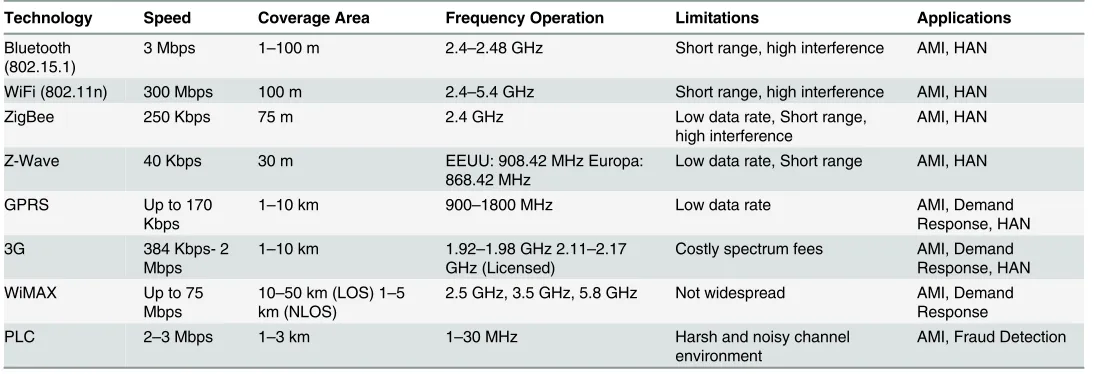
cause more problems.Table 1illustrates the characteristics, limitations, and possible applica-tions of different communication technologies [27,28].
LTE scheduling algorithm
Each scheduling algorithm has different methods to determine the users’scheduling priority, such as buffer status, delay, expected throughput, channel status and past average throughput. The principal aims of the schedulers should be maximizing the throughput, providing good QoS to the user and providing good fairness to the non-real time (N-RT) user. This paper fo-cuses on the most popular algorithms, namely proportional fairness (PF), M-LWDF, EXP/PF and EXP-Rule to analyze the performance with the proposed algorithm.
In [29], PF is proposed to provide service for N-RT. The scheduling metric is based on pri-oritizing the user with maximum relative channel quality indicator (RCQI) which is defined as the ratio between the instantaneous data rate supported by the user on the CQI value and the average data rate of previous transmission till the present TTI. However, PF does not consider the delay metric, that is why it cannot serve the real time (RT) application.
Many algorithms have been proposed as an extension to the PF algorithm, such as EXP/PF [30]. It distinguishes the user depends on their packet type. For RT users, it is emerging, based on the benefits of the exponential function which guarantees the delay boundaries of RT appli-cation and at the same time, maximizes the system throughput. The robustness of this algo-rithm are based on taking the exponential of the end-to-end delay of user’s packets, thus scheduling metric exponentially grows along with delay metric. Whereas, the N-RT users are served as PF with a specific degree of service. This degree is controlled by the proportion of waiting packets of RT applications at BS. The main drawback of this algorithm is the positive probability of drop of the services from N-RT applications as shifting it to RT one.
[image:5.612.34.581.88.275.2]In [31], the M-LWDF is used in so many fields, for instance, streaming video application; it mixes between the user channel status quality and the time delay of the packets. It proves to be a suitable solution for scheduling flows of the high speed downlink packet access. It is based on the head of line packet delay along with the PF metric to ensure the QoS provision fairness and spectral efficiency among the users. It takes into consideration the channel condition, head of line delay and the packet loss ratio.
Table 1. Comparison of different communication technologies.
Technology Speed Coverage Area Frequency Operation Limitations Applications Bluetooth
(802.15.1)
3 Mbps 1–100 m 2.4–2.48 GHz Short range, high interference AMI, HAN
WiFi (802.11n) 300 Mbps 100 m 2.4–5.4 GHz Short range, high interference AMI, HAN
ZigBee 250 Kbps 75 m 2.4 GHz Low data rate, Short range,
high interference
AMI, HAN
Z-Wave 40 Kbps 30 m EEUU: 908.42 MHz Europa:
868.42 MHz
Low data rate, Short range AMI, HAN
GPRS Up to 170
Kbps
1–10 km 900–1800 MHz Low data rate AMI, Demand
Response, HAN
3G 384 Kbps- 2
Mbps
1–10 km 1.92–1.98 GHz 2.11–2.17 GHz (Licensed)
Costly spectrum fees AMI, Demand Response, HAN
WiMAX Up to 75
Mbps
10–50 km (LOS) 1–5 km (NLOS)
2.5 GHz, 3.5 GHz, 5.8 GHz Not widespread AMI, Demand Response
PLC 2–3 Mbps 1–3 km 1–30 MHz Harsh and noisy channel
environment
AMI, Fraud Detection
EXP-Rule algorithm [32] is considered as a further modification of the EXP/PF algorithm. The main purpose of this algorithm is to distribute radio resources among users in a fair and ef-ficient manner so that the system throughput can be maximized. The EXP-Rule algorithm gives higher priority to the user with more transmission delay besides the channel condition.
Materials and Methods
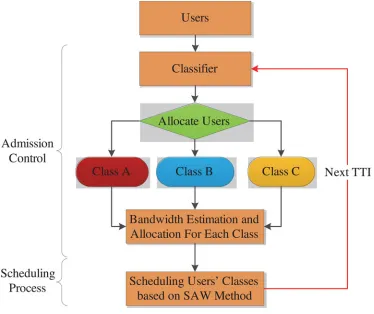
As it is illustrated inFig. 1, the system model is divided into two main levels, namely admission control and scheduling process.
2 Admission control
Due to random variation of radio condition in LTE network, the obtainable bit rate for the ac-tive user is supposed to vary based on the signal to interference noise ratio (SINR) which is re-ceived at the mobile station (MS) from the base station (BS). Allowing or denying the service for the new user of specific class is based on the admission control procedure. Admission con-trol has two steps, which are classifier and bandwidth estimation and allocation. The first step authenticates whether or not the new user belongs to the classes (applications) (Table 2) and the second step decides the acceptance or rejection of new user based on the availability of bandwidth of each class.
[image:6.612.200.574.374.688.2]Each user will be allocated to related class based on its demands (Table 2) by the classifier as follows:
Class 1: Urgent to be served which has so strict delay tolerance, such as DA application (pri-ority 1).
Class 2: Requires an RT service which has a tolerance in terms of delay, such as DER appli-cation (priority 2).
Class 3: Requires N-RT service which has a high tolerance in terms of delay, such as EV ap-plication (priority 3).
The classifier determines the user number of each class. Then this information will pass to the bandwidth estimation and allocation level to allocate efficient RBs based on its required data rate.
Bandwidth estimation and allocation. Several issues control the data transmission ability
of RB, such as distance from the BS, power allocation for each RB and the external and internal noise. In our model, it is assumed that, all users have fixed coordination at the map and the same transmission power is allocated for all sub-carriers. Moreover, two types of noises are de-fined which are internal and external noise. Thermal noise at the receiver end is internal noise, whereas the interference from neighboring BSs is defined as external noise. The SINR is calcu-lated by multiplying the channel gain of useriRBj(Cgain i,j) (1) with assigned power for the subcarriers (Psubcarrier) over the noise (2) [33].
Cgain i;j¼10 pathloss
10 þ
multifading
10 þ
fading
10 ð1Þ
SINR¼Cgaini;jPsubcarrier
N0þI ð2Þ
wherepathloss,multi-fadingandfadingare measured in scale of dB,N0is the thermal noise andIis the interference from surrounding BSs.
At each TTI, MS reports their instantaneous downlink SINR to BS that is used to determine the ability of data transmission for allocatable RBjof useriat timet(RjiðtÞ) as follows:
RjiðtÞ ¼nbits symbol
nsymbols
slot
nslots subcarrier
nsubcarrier
RB ð3Þ
wheren—bits,n—symbols,n—slotsandn—subcarrierare the number of bits, number of sym-bols, number of slots and number of subcarriers, respectively [34].
From (3), it can be said that the number of bits per symbol (n-bits) has a strong impact on RB’s obtainable data rate. Based on the bit per symbol, the data rate will be changed at each TTI along with SINR value. Total number of RBs (nc
i) required to satisfy the useriof classccan
[image:7.612.198.579.90.146.2]be obtained by the ratio of the demand data rate (rc) and obtainable data rate for RB (RjiðtÞ) with specific modulation and coding scheme (MCS) (4). Then the number of required RBs at timetfor useriis calculated by (5). All sets of RBs, which are assigned to useriat timetmust
Table 2. Demands of smart grid applications.
SG Application Bandwidth Requirement [kpbs] Delay Budget [ms]
Distribution automation (DA) 100 100
Distributed energy system-storage (DER) 500 300
Electrical vehicle (EV) 64 2000
have the same MCS and one RB cannot be assigned to more than one user at timet.
nc
i ¼
rc
RjiðtÞ ð4Þ
NRBc iðtÞ ¼
nc i
ti
ð5Þ
whereNRBc
iðtÞis the number of RBs required for useriof classcat timetandτiis the maxi-mum delay budget.
For providing services to the user, scheduler requires to know the exact number of RBs re-quired per user for each class which is calculated by (5). After that, in terms of measuring the required bandwidth for classcat timet, (6) is proposed.
RcðtÞ ¼NcðtÞ bc ð6Þ
whereRc(t)is the required bandwidth for classcat timet,Nc(tc) is the number of users allocat-ed to classcat timetandbcis the required data rate.
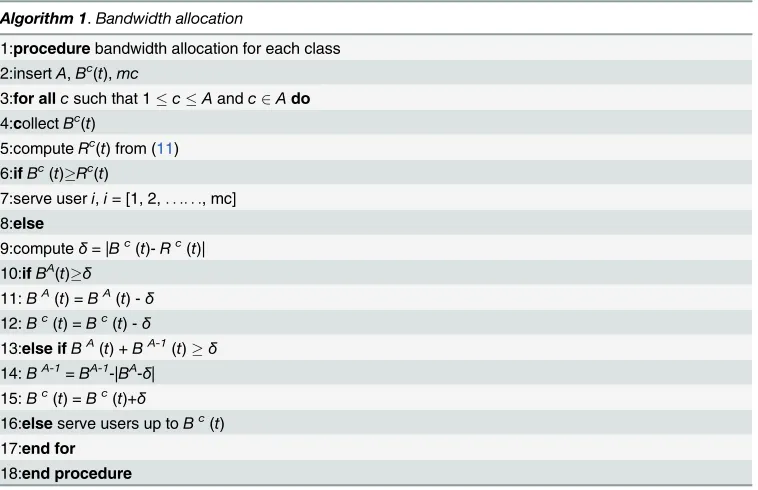
[image:8.612.200.579.419.664.2]The bandwidth estimation is followed by the bandwidth allocation procedure. The main purpose of bandwidth allocation is to determine whether or not there are enough resources to cover the demand of a particular class. Otherwise, the resources will be shifted from the lower priority class to the higher priority class to cover the shortage and it will be repeated until all network resources have been utilized. For instance, if a new user comes to class 1 and the re-sources of class 1 are not enough to satisfy that user, then rere-sources from class 3 will be shifted to class 1. High priority class users will be served until all the resources are assigned. This algo-rithm (Table 3) will be updated and calculated at each TTI.
Table 3. Proposed algorithm of bandwidth estimation and allocation.
Algorithm 1.Bandwidth allocation
1:procedurebandwidth allocation for each class 2:insertA,Bc(t),mc
3:for allcsuch that 1cAandc2Ado 4:collectBc(t)
5:computeRc(t) from (11)
6:ifBc(t)Rc(t)
7:serve useri,i =[1, 2,. . .. . ., mc] 8:else
9:computeδ= |Bc(t)-Rc(t)|
10:ifBA(t)δ
11:BA(t) =BA(t) -δ 12:Bc(t) =Bc(t) -δ
13:else ifBA(t) +BA-1(t)δ
14:BA-1=BA-1-|BA-δ|
15:Bc(t) =Bc(t)+δ
16:elseserve users up toBc(t)
17:end for 18:end procedure
3 Proposed scheduling scheme
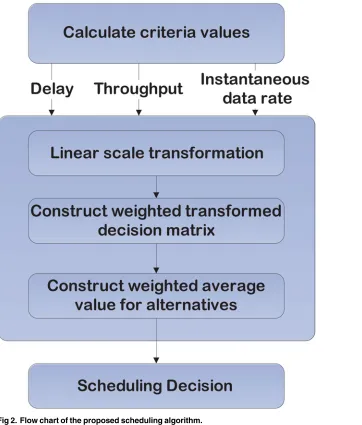
[image:9.612.203.565.266.691.2]The proposed scheduling algorithm is based on simple additive weighting (SAW) technique, which is a multi-attribute decision making method to find out the best option from all feasible alternatives. Our proposed scheduling scheme relies on proportional linear transformation of the raw data (criteria values), thus the relative order of magnitude of the standardized scores re-mains equal. Moreover, it ensures low complexity, dynamic adjusting and good controlling to the scheduling algorithm behavior as well as it satisfies the demand of SG application. The dy-namic weighting factors, namely delay, past average throughput and instantaneous transmis-sion rate are used to adjust the scheduling decitransmis-sion for each application (class). For instance, some applications require high emphasis on the delay, such as DA, thus the higher weight will be given to delay than others. Whereas, the EV requires more emphasis on throughput than delay, thus the higher weight will be given to past average throughput rather than delay or channel status. The proposed scheduling algorithm is described inFig. 2.
Calculation of the criteria values. Three criteria values for each user are calculated and in-serted as input to the proposed scheduling algorithm as follows:
a) Delay metric of useriis calculated as the ratio of the difference between current time and stamped time of packet at the buffer queue to the delay budget of its related class. And, if the delay factor is bigger than one, useri’s packets will be dropped from further evaluation (7).
Dc iðtÞ ¼
tTstamp;i
tc ð7Þ
whereDciðtÞis the delay factor of userifor classcat timet,Tstamp,iis the entrance time of useri’s packets in the buffer queue andτcis the delay budget of classc.
b) The instantaneous data rate is the expected data rate, which could be achieved by usersi from classcat time slott.
c) The past average throughput metric is used as pointer to determine the data rate of useri in previous TTI. It calculates as a moving average throughput as follows:
THicðtÞ ¼cTHicðt1Þ þ ð1cÞ rc iðtÞ
where0c1 ð8Þ
whereTH ciðtÞis the past average throughput of useriof classcat timet,Cis constant re-lated to the window size andricðtÞis the acquired data rate of user i from class c at time t.
Step 1.Linear scale transformation. Data collection is normalized by the maximum value of
the criterion for all users as a process to unify all values up to one measurement scale for the specific class. Then, it inserts into the normalized decision matrix at timet(R(t)) as follows:
Dc i1ðtÞ ¼
Dc iðtÞ
D
mcðtÞ
;for i¼1;2;. . .;mc
rc i2ðtÞ ¼
rc iðtÞ
rmcð tÞ;for i¼1;2;. . .;mc
THic3ðtÞ ¼
THicðtÞ
TH
mcðtÞ
;for i¼1;2;. . .;mc
ð9Þ
RðtÞ ¼
D11ðtÞ r12ðtÞ TH13cðtÞ
D21ðtÞ r22ðtÞ TH
c
23ðtÞ
... ... ...
Dmc1ðtÞ rmc2ðtÞ TH
c mc3ðtÞ 2 6 6 6 6 6 6 4 3 7 7 7 7 7 7 5
ð10Þ
whereDmcðtÞ,rmcðtÞandTHmcðtÞare the maximum value of delay, instantaneous data rate and
past average throughput, respectively.
Step 2.Construction of the weighted transformed decision matrix. In this step, a set of weight coefficientswc
weighted transformed decision matrixv(t) as follows:
vðtÞ ¼ wc
DD11ðtÞ wcrr12ðtÞ wcTH TH13ðtÞ
wc
DD21ðtÞ
...
wc
rr22ðtÞ
...
wc
TH TH23ðtÞ
...
wc
DDmc1ðtÞ wcrrmc2ðtÞ wcTHTHmc3ðtÞ 2 6 6 6 6 6 6 6 4 3 7 7 7 7 7 7 7 5
ð11Þ
Step 3.Construction of the weighted average value for users. In this process, after summing up the criteria values (AiðtÞ) belong to useriin (12), the scheduler will serve the user according to the obtained values in descending order.
AiðtÞ ¼X
A
g¼1
vigðtÞ ð12Þ
whereAiðtÞis the descending order of the users at timetandvig(t) is the metricvindex.
Results and Discussion
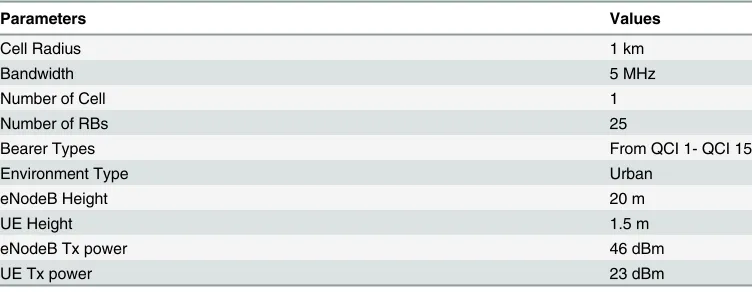
The LTE-Sim is used as a simulation tool, which is based on C++. The testing scenario is a sin-gle cell with interference and the simulation inputs are illustrated inTable 4. All the users have fixed location in the cell and their coordination is well known by the scheduler. As a fairness index, the Jain fairness index method is adopted [35]. Two types of loss models are utilized in this scenario, which are path loss (it has a direct relation to the distance from the BS) and shadow fading.
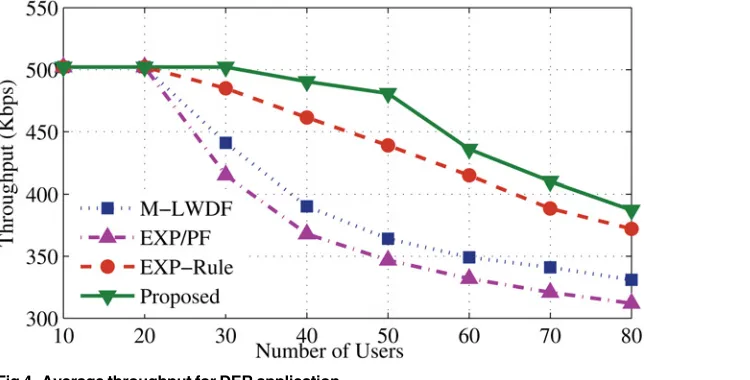
[image:11.612.200.576.554.700.2]Scheduling algorithms, such as EXP-Rule, M-LWDF and EXP/PF have been chosen to com-pare with the proposed algorithm. The new algorithm focuses on giving high priority to the RT applications and above existing algorithms are popular and well accepted. The throughput per-formance of the proposed algorithm is illustrated in Figs.3and4. It shows a high ability to serve up to 30 users and then start degrading slowly comparing with other algorithms. Two reasons behind the robustness of the proposed algorithm are the bandwidth estimation and al-location and dynamic scheduling approach. For the bandwidth estimation and alal-location, when the number of users increases (after 20 users), some resources shift from EV application as a process to keep serving the users of DA and DER. Another issue is the way of making the
Table 4. Simulation parameters.
Parameters Values
Cell Radius 1 km
Bandwidth 5 MHz
Number of Cell 1
Number of RBs 25
Bearer Types From QCI 1- QCI 15
Environment Type Urban
eNodeB Height 20 m
UE Height 1.5 m
eNodeB Tx power 46 dBm
UE Tx power 23 dBm
scheduling decision for DA and DER guarantees to provide the service based on urgency to serve. At the same time, it needs to satisfy the application’s demands (high weight coefficients for delay and instantaneous data rate) that maintains good QoS for DA and DER users along with increasing the user number.
[image:12.612.202.577.78.267.2]Meanwhile, the EXP-Rule algorithm shows better performance than the M-LWDF and EXP/PF. The EXP-Rule takes the delay metric of the considered user ratio to the sum of the ex-perienced delays of all real time users. That means it exponentially prioritizes the user which has the highest waiting head of line delay along with the higher channel condition of this user. As a result, it offers more resources to the DA and DER users than EV users. After 20 users, M-LWDF and EXP/PF sharply degrade even though M-LWDF considers the delay boundaries and channel status of the DA and DER applications. For that reason, it fails to prioritize their users when packet delay is approaching (clearly after 20 users). From Figs.3and4, it can be said that the proposed algorithm shows noticeable enhancement by 1%, 10% and 15% com-pared to EXP-Rule, M-LWDF and EXP/PF, respectively.
Fig 3. Average throughput for DA application. doi:10.1371/journal.pone.0121901.g003
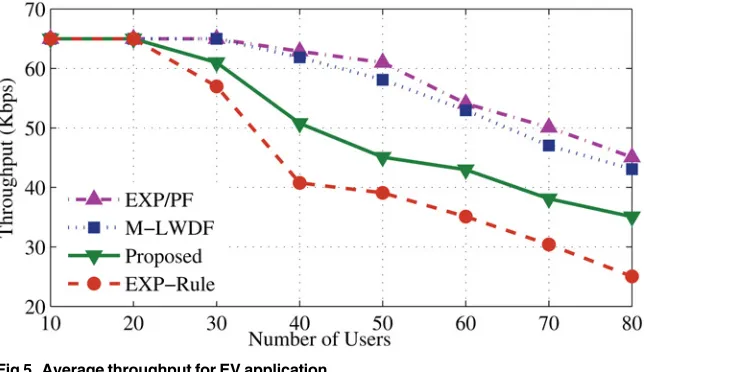
[image:12.612.202.577.503.693.2]For the EV application (Fig. 5), the proposed algorithm shows slightly better performance than EXP-Rule algorithm. The throughput is stable like other algorithms up to 20 users, but starts decreasing when the amount of the user increases. EXP-Rule shows the lowest perfor-mance since the delay boundary of the EV application is 2000 ms. The EXP/PF and M-LWDF show better performance than other algorithms since both of them have the PF metric, which has a direct effect on the scheduling decision. And, even though they are organized to serve the real time applications, they still need to provide the degree of service up to a certain number of users for the EV application.
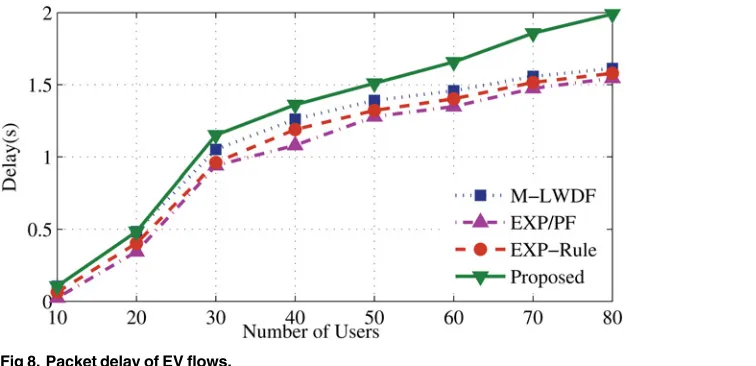
[image:13.612.202.576.78.264.2]Figs.6and7illustrate that the new algorithm has the lowest serving delay compared to other scheduling algorithms. It gives higher concern to the delay metric than the other metrics. Once the number of RT users increases (after 20 users), the EV application experiences degra-dation of the servicing level. That leads to add more delay until the higher priority users have been served (as described inFig. 8). The EXP-Rule shows an average level of delay since it con-cerns about maintaining the delay of DA and DER users within the acceptable range even if EV’s users do not receive enough services. The M-LWDF and EXP/PF show the higher delay
[image:13.612.200.575.509.695.2]Fig 5. Average throughput for EV application. doi:10.1371/journal.pone.0121901.g005
level for DA and DER users as the PF metric at both approaches forces to provide the services for the N-RT user. As a result, more waiting time for the RT packets will be added as some re-sources are shifted to serve the EV users.
InFig. 9, the proposed algorithm shows the lowest packet loss rate (PLR), which proves that new algorithm has the ability to maintain good quality of service for DA user. And, this ratio shows relatively low growth for the proposed algorithm compared to other algorithms. At 80th user, the PLR of the proposed algorithm shows improved performance up to 5%, 10% and 15% compared to EXP-Rule, M-LEDF and EXP/PF, respectively.
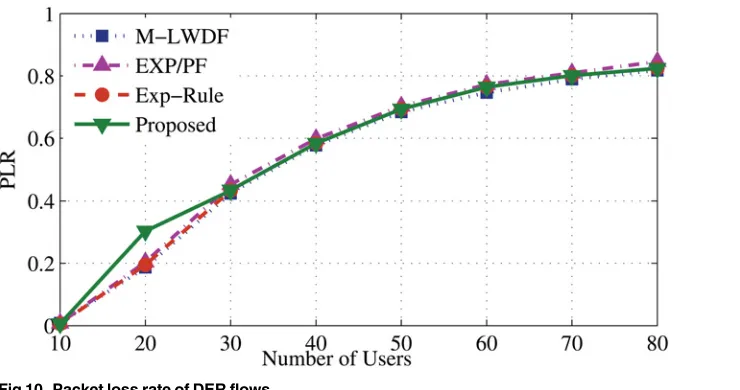
For DER flows inFig. 10, all scheduling algorithms show almost same level of PLR.Fig. 11 shows that the proposed algorithm has the highest PLR due to positive probability. EV applica-tion drops the packets as a scarifying process to serve the real time user.
[image:14.612.202.577.77.264.2]Average Packet Fairness Index among all users is illustrated inFig. 12. As the scheduling metric is following the same method for serving the users, the proposed algorithm shows higher performance compared to other algorithms. It reaches to 0.93 even in overloaded situa-tions (up to 80 users), followed by EXP-Rule which is 0.9. Whereas, the M-LWDF and EXP/PF show less contrast by 0.86 and 0.84 fairness index, respectively at the same number of users.
Fig 7. Packet delay of DER flows. doi:10.1371/journal.pone.0121901.g007
[image:14.612.200.578.513.696.2]Limitations and Future Work
The main objective of the proposed algorithm is to distribute the RBs in an efficient way based on the urgency of the specific applications. In some cases, scheduler takes all or most of the RBs from lower priority application to serve the higher priority application. This causes a lon-ger wait or denial of services for the lower priority application.
[image:15.612.202.574.76.271.2]As a future work, the scheduling approach can be extended by introducing more criteria, such as queue length in terms of the scheduling decision. It can also be adjusted to ensure the minimum level of service for lower priority application. Our next goal is to modify the pro-posed method to make it useful to serve a variety of applications with different goals, such as elastic resources and shared services scenario. It will be based on migrating the cloud comput-ing system with SG applications, which will guarantee high robustness in terms of resistance and privacy protection and hardware failure issues. We will test it in different networks, such as LTE-Advanced.
Fig 9. Packet loss rate of DA flows. doi:10.1371/journal.pone.0121901.g009
[image:15.612.201.571.499.694.2]Conclusion
[image:16.612.203.576.77.261.2]This paper has focused on three smart grid applications, namely DA, DER and EV. These ap-plications can be useful for supporting the grid with renewable energy, such as wind and solar over LTE networks. The novel bandwidth estimation and allocation technique and the new scheduling algorithm for each class are proposed as a guarantee for the efficient utilization of available network resources that satisfied the application’s demand. The bandwidth estimation is based on giving the satisfied amount of resources for each application if there is sufficient bandwidth; otherwise, the resources will be distributed according to the priority of each class. Whereas, the scheduling algorithm uses dynamic scheduling technique for three criteria, namely delay, past average throughput and instantaneous transmission rate. It demonstrates its ability to provide a robust solution for solving the users’scheduling issues with respect to SG application QoS’s demands. Simulation results prove that, the proposed technique achieves higher throughput, lower delay and lower packet loss rate for DA, DER applications as well as
Fig 11. Packet loss rate of EV flows. doi:10.1371/journal.pone.0121901.g011
[image:16.612.202.574.495.693.2]provides a degree of service for EV application. The proposed algorithm shows noticeable im-provement for DA and DER applications by 1%, 10% and 15% compared to EXP-Rule, M-LWDF and EXP/PF, respectively.
Author Contributions
Conceived and designed the experiments: MNH AWR. Performed the experiments: MNH. An-alyzed the data: MNH MHRC. Contributed reagents/materials/analysis tools: KAN. Wrote the paper: MNH AWR MHRC.
References
1. Guttinger M, Ahcin P. The potential of Demand Side Management and Vehicle-to-Grid for the city of Bern, Switzerland. In: IEEE International Conference on Environment and Electrical Engineering (EEEIC); 2011. pp. 1–5.
2. Fang X, Misra S, Xue G, Yang D. Smart grid-The new and improved power grid: A survey. IEEE Com-munications Surveys & Tutorials 2012; 14: 944–980.
3. Issac B, Israr N, Case Studies in Intelligent Computing: Achievements and Trends. CRC Press; 2014. 4. Biswas SS, Shariatzadeh F, Beckstrom R, Srivastava AK. Real time testing and validation of Smart Grid
devices and algorithms. In: IEEE Power and Energy Society General Meeting (PES); 2013. pp. 1–5. 5. De Capua C, Lipari G, Lugara M, Morello R. A smart energy meter for power grids. In: IEEE
Internation-al Instrumentation and Measurement Technology Conference (MTC); (2014). pp. 878–883. 6. Andria G, Attivissimo F, Cavone G, Di Nisio A. Spadavecchia M. Toward a new smart metering
para-digm for microgrid. In: IEEE International Workshop on Measurements and Networking (M&N); 2013. pp. 79–82.
7. Gao S, Chau KT, Liu C, Wu D, Chan CC. Integrated Energy Management of Plug-in Electric Vehicles in Power Grid with Renewables. IEEE Transactions on Vehicular Technology 2013; 63: 3019–3027. 8. Marsden J. Distributed generation systems: a new paradigm for sustainable energy. In: IEEE
Confer-ence on Green Technologies (IEEE-Green); 2011. pp. 1–4.
9. Hosseini SS, Badri A, Parvania M. The plug-in electric vehicles for power system applications: The ve-hicle to grid (V2G) concept. In: IEEE International Energy Conference and Exhibition (ENERGYCON); 2012. pp. 1101–1106.
10. Casalegno S, Bennie JJ, Inger R, Gaston KJ. Regional Scale Prioritisation for Key Ecosystem Ser-vices, Renewable Energy Production and Urban Development. PLoS ONE 2014; 9: e107822. doi:10. 1371/journal.pone.0107822PMID:25250775
11. Yilmaz M, Krein PT. Review of the impact of vehicle-to-grid technologies on distribution systems and utility interfaces. IEEE Transactions on Power Electronics 2013; 28: 5673–5689.
12. Zavoda F. Advanced distribution automation (ADA) applications and power quality in Smart Grids. In: IEEE China International Conference on Electricity Distribution (CICED); 2010. pp. 1–7.
13. Gungor VC, Sahin D, Kocak T, Ergut S, Buccella C, Cecati C, et al. A survey on smart grid potential appli-cations and communication requirements. IEEE Transactions on Industrial Informatics 2013; 9: 28–42. 14. Hindia MN, Reza AW, Noordin KA. A Novel Scheduling Algorithm Based on Game Theory and
Multi-Criteria Decision Making in LTE network. International Journal of Distributed Sensor Networks 2014; Article ID 604752.
15. Ma Z-Q, Xia C-Y, Sun S-W, Wang L, Wang H-B, Wang J. Heterogeneous link weight promotes the co-operation in spatial prisoner’s dilemma. International Journal of Modern Physics C 2011; 22: 1257– 1268.
16. Wang J, Xia C, Wang Y, Ding S, Sun J. Spatial prisoner’s dilemma games with increasing size of the in-teraction neighborhood on regular lattices. Chinese Science Bulletin 2012; 57: 724–728.
17. Xia C, Miao Q, Zhang J. Impact of neighborhood separation on the spatial reciprocity in the prisoner’s dilemma game. Chaos, Solitons & Fractals 2013; 51: 22–30.
18. Ericsson White paper. LTE for utilities—supporting smart grids. Uen 284 23–3208; 2013.
19. Capozzi F, Piro G, Grieco LA, Boggia G, Camarda P. Downlink packet scheduling in LTE cellular net-works: Key design issues and a survey. IEEE Communications Surveys & Tutorials 2013; 15: 678–700. 20. Al-Gumaei YA, Noordin KA, Reza AW, Dimyati K. A New SIR-Based Sigmoid Power Control Game in
21. Iturralde M, Wei A, Ali-Yahiya T, Beylot A-L. Resource Allocation for Real Time Services in LTE Net-works: Resource Allocation Using Cooperative Game Theory and Virtual Token Mechanism. Wireless Personal Communications 2013; 72: 1415–1435.
22. Su W, Eichi H, Zeng W, Chow M-Y. A survey on the electrification of transportation in a smart grid envi-ronment. IEEE Transactions on Industrial Informatics 2012; 8: 1–10.
23. Yang Q, Barria JA, Green TC. Communication infrastructures for distributed control of power distribu-tion networks. IEEE Transacdistribu-tions on Industrial Informatics 2011; 7: 316–327.
24. Sauter T, Lobashov M. End-to-end communication architecture for smart grids. IEEE Transactions on Industrial Electronics 2011; 58: 1218–1228.
25. Gungor VC, Lu B, Hancke GP. Opportunities and challenges of wireless sensor networks in smart grid. IEEE Transactions on Industrial Electronics 2010; 57: 3557–3564.
26. Wang W, Xu Y, Khanna M. A survey on the communication architectures in smart grid. Computer Net-works 2011; 55: 3604–3629.
27. Berrio L, Zuluaga C. Concepts, standards and communication technologies in smart grid. In: IEEE Co-lombian Workshop on Circuits and Systems (CWCAS); 2012. pp. 1–6.
28. Gungor VC, Sahin D, Kocak T, Ergut S, Buccella C, Cecati C, et al. Smart grid technologies: communi-cation technologies and standards. IEEE Transactions on Industrial Informatics 2011; 7: 529–539. 29. Lee S-B, Pefkianakis I, Meyerson A, Xu S, Lu S. Proportional fair frequency-domain packet scheduling
for 3GPP LTE uplink. In: IEEE INFOCOM; 2009. pp. 2611–2615.
30. Basukala R, Mohd Ramli H, Sandrasegaran K. Performance analysis of EXP/PF and M-LWDF in down-link 3GPP LTE system. In: IEEE International Conference on Internet Asian Himalayas; 2009. pp. 1–5. 31. Kim K, Koo I, Sung S, Kim K. Multiple QoS support using M-LWDF in OFDMA adaptive resource
alloca-tion. In: IEEE Workshop on Local and Metropolitan Area Networks; 2004. pp. 217–222.
32. Ang EM, Wee KK, Pang YH, Lau SH. Two-Level Scheduling Framework with Frame Level Scheduling and Exponential Rule in Wireless Network. In: IEEE International Conference on Information Science and Applications (ICISA); 2014. pp. 1–4.
33. ØsterbøO. Scheduling and capacity estimation in LTE. In: Proceedings of the 23rd International Tele-traffic Congress. International TeleTele-traffic Congress; 2011. pp. 63–70.
34. Ali S, Zeeshan M, Naveed A. A capacity and minimum guarantee-based service class-oriented sched-uler for LTE networks. EURASIP Journal on Wireless Communications and Networking 2013; 67: 1– 15.