Technology (IJRASET)
Causal Productions
899
Performance Evaluation of MPEG-4 and
H.264/SVC Video Codec Over WLAN
Mayank Patel1, Naveen Choudhary2
1,2 Department of CSE, CTAE, Udaipur
Abstract: In recent years, the usefulness of video compression technologies has increased greatly. Video content sharing over Ethernet and WLAN has being increasing day by day. The easiness availability of network resources has further boosted the video sharing among each other. Increasing video-based applications in day-to-day life has attracted various researchers’ attention in the enhancements and evaluation of the different video codec’s. Since 1994, MPEG family’s video codec are in use. Various MPEG versions have been introduced with aim to reduce the storage capacity and to increase the video quality. All the MPEG video codec are having constant frame rate and resolutions. In today's network scenarios, where there is an anomaly in network traffic, the codec’s with constant frame rates and resolutions do not give equal performance. Thus, H.264/SVC video codec has been introduces with the main aim to support temporal and spatial scalability. In this paper, we evaluate the MPEG-4 and H.264/SVC video codec in terms of QoS parameters. Our experimental result shows that H.264/SVC video codec performs better than MPEG-4 in all type of network traffic loads.
Keywords: MPEG-4, H.264/SVC, WLAN, NS2, QoS
I. INTRODUCTION
Main goal of video compression is to reduce and remove excess video information so that a video can be effectively sent and stored in digital format[1]. It is done by employing an algorithm to the video source. By employing algorithm, it creates a compressed digital file that is ready for transmission. To use the compressed file at destination side, an inverse algorithm is employed on the compressed file to regenerate video from it. The video decoded shows approximately the same content as of original video. The response time here is the total time taken to compress, transmit, decompress and display a video file [2]. As we use more complex algorithms, the response time will increase which in turn increase latency. Thus, latency is the parameter that should be considered while selecting the video compression techniques for video transmission.
Video codec is a pair of algorithms that work together (encoder/decoder) and follows different standards that are commonly not compatible with each other. This means that, if a video file is compressed by utilizing one standard, then it cannot be decompressed with a different standard’s algorithm. For example, a MPEG-4 Part-2 cannot be used as a decoder for the video file compressed by H.264 encoder because one de-compression algorithm cannot correctly decode the output file that is compressed by another algorithm.
For wireless devices, standardized encoder and decoder has to be used to deliver better-compressed video to support real time video transmission such as video conferencing and video calling. In wireless transmission, video codec whose working can be adapted according to traffic is more desirable. Thus, the selection of video compression technique plays an important role for video transmission over wireless medium. Table 1 list the different types of video compression techniques.
Technology (IJRASET)
[image:3.612.193.420.116.459.2]Causal Productions
900
Table 1 Comparisons of different video compression techniques.
Standard Year Bit Rate Applications
H.261
1988 N * 64
Kbps
Video transmission over
ISDN and Video telephony
MPEG-1 1992 1.5 Mbps
Video storage on digital media
(CD-ROM)
MPEG-2 1994 > 2.0
Mbps
Digital Video Broadcasting and
storage on DVD
MPEG-4 1998
64 Kbps to 4.0 Mbps
Object Based coding, Video on
internet H.264 /AVC 2004 64 Kbps to 20.0 Mbps Video conferencing, Digital Video Broadcasting H.264/ SVC
2008 Variable
Multimedia application , Video conferencing in wireless environment
II. EPITOME OF MPEG-4
In 1998, with the aim to provide better video quality MPEG-4 was introduced [3]. MPEG-4 provides good quality with a bit rates from 10 Kbps to 1 Mbps. Due to the variable bit rate it is suitable for the application such as video telephony and multimedia applications. It heightens the MPEG standards with ability to lower down the video bit-rate as per applications required. MPEG-4 was designed to address the following issues:
A. Interoperability
The standard is designed for all platforms and not for any one specific platform.
B. Transport Independence
In MPEG-4, service provider selects transport mechanism. This makes MPEG-4 to work in vast range of network environments.
C. Compression and Transmission of Rich Media
MPEG-4 is designed with the feature of low and mid rate compression and transmission to support from average to good video quality.
D. Scalability
Technology (IJRASET)
Causal Productions
901
E. Profiles
The service providers provide various set of profiles. These profile in turn have has sub set of profiles. Thus, service provider can use only those sub sets that are needful for their applications. In MPEG-4 standard, there are three types of video frames in the compressed encoded video sequences [4]. These frames are as below:
F. I (Intra-coded) frame
G. P (Predictive-coded) frame
H. B (Bidirectional predictive-coded) frame.
I- frame of MPEG-4 is independently encoded and decoded. Thus I frame is not related to the predecessor and successor frames. It is similar like a still image is encoded. The P-frame of MPEG-4 is encoded using prediction from the predecessor I-frame or P- frame resides in that video sequence. Thus, P- Frames needs the information of nearer I-Frame or P – frame for encoding and decoding process. The B-frame of MPEG-4 encoded using prediction predecessor from I-frame or P- frame. Thus, the B-frame needs the information of two closest I-frame and P-frame. According to the coding set tool of MPEG-4, in video coded stream, the most significant video frame is the I-frame, while the P frame is being second important and then B frame is the least important frame.[5]
III. EPITOME OF H.264/SVC CODEC
For an efficient transmission and storage of video, H.264/MPEG10 or Advance Video Coding (AVC) converts digital video into some other formats by which storage capacity of video is decreased. The ability of H.264/AVC is limited due to different requirements of different networks with different video quality desires[6]. Some of the H.264/AVC examples such as video conferencing, video playback, video surveillance, and video recording are affected due to saturated traffic. Therefore Joint video team of ITU-T VCEG and the ISO/IEC MPEG -2007 proposed H.264 scalable video coding (SVC) standards[7].
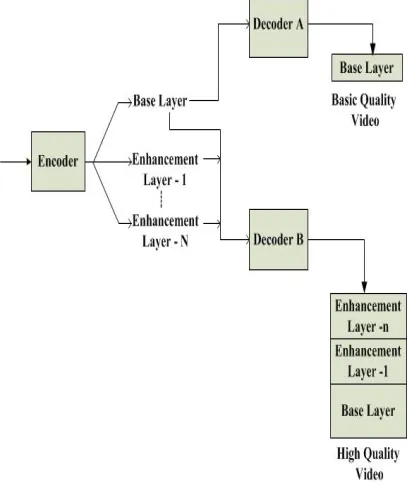
[image:4.612.204.408.401.644.2]In scalable video coding (SVC), the word scalable means to get rid of parts of video bit stream in order to meet the various requirement of wireless network and varying network connection scenarios. According to dynamic bandwidth adaption, this scalable video coding allows the decoder to decode selective part of the encoded bit stream. The resultant or encoded bit streams are arranged in single base layer and multiple enhancement layers is shown below in figure 1.
Figure 1: Scalable Video Coding basic principle
Technology (IJRASET)
Causal Productions
902
information) may be transmit over the variable network. The temporal, spatial, and quality scalability are the new features of H.264/SVC [8]. The subset of the bit stream represents the source content with decreased frame rate in temporal scalability. The subset of the bit stream represents the source content with reduced picture size in spatial scalability. The sub-stream provides the same spatial-temporal resolution as the complete bit stream, but with a lower signal-to-noise ratio in quality scalability.
The structure of H.264/SVC is layered architecture that consist of one base layer and one or more multiple number of enhancement layers[9]. The basic video quality is provided in the base layer. For reverse compatibility, all H.264 decoder with its compatible legacy standards must be familiar with the base layer. By adding enhancement layer with base layer, the video quality can be increased. On the contrary, if the bandwidth availability is less due to traffic congestion or noisy environment, discarding of one or more enhancement layers is performed. It is done so to avoid run-time blocking off. Instead of blocking whole video, the video is delivered with some degraded quality.
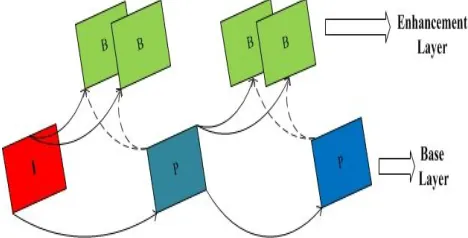
[image:5.612.155.389.288.407.2]In SVC video coding standard, the video is been encoded in a hierarchical manner. It means that video is encoded into a base layer and multiple number of enhancement layers whereas the decoding of the base layer gives the standard video quality. For enhanced smoothness of the video quality, decoding the base layer is been done with number of enhancement layers. To achieve SVC scalability, encoding and decoding is done with any one of temporal or spatial scalability [10]. Temporal scalable encoding with one base layer and one enhancement layer is shown in figure 2.
Figure 2: Example showing temporal scalability of H.264/SVC video coding.
The base layer is formed with I-frame and optionally with P-frames. The enhanced layer is comprised of P-frame and B-frame. The basic video quality is provided in base layer with a lower frame rate. For the smoothness or better video quality, the enhancement layer is added to the base layer [11].
IV. EXPERIMENTAL RESULT
The performance evaluation of MPEG-4 and H.264/SVC is evaluated over the NS2 simulator using myevalvid[12] and myevalSVC [13] along with framework designed by [14]. The experimental setup shown in figure 3 is designed to evaluate the performance.
Technology (IJRASET)
Causal Productions
903
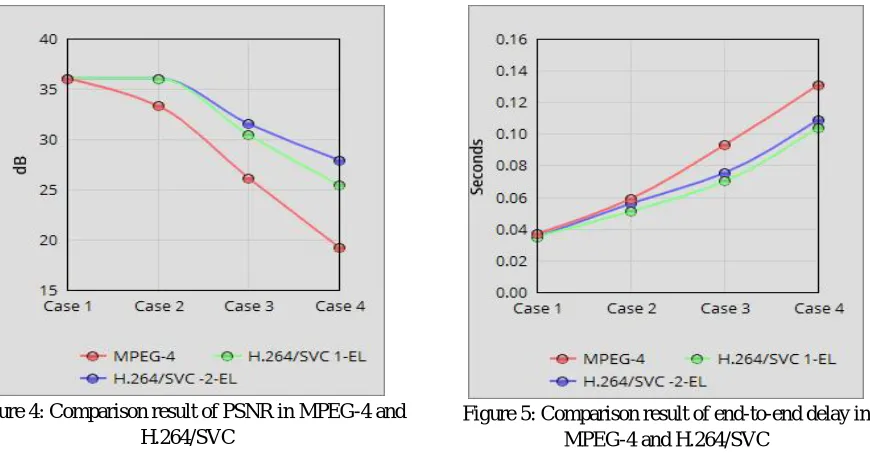
[image:6.612.61.496.150.377.2]The video codecs are evaluated over the QoS parameters such as PSNR, end-to-end delay, jitter and packet deliver ration. For analysis we differentiate the network traffic into four cases; case1 has no traffic load, case 2 has light traffic load, case 3 has intermediate traffic load , case 4 has heavy traffic load. In the H.264/SVC, we choose two different video stream, one having only one enhancement layer along with base layer(H.264/SVC-1-EL) and other having two enhancement layer along with base layer(H.264/SVC-2-EL).
[image:6.612.54.260.153.346.2]Figure 4: Comparison result of PSNR in MPEG-4 and H.264/SVC
[image:6.612.84.528.475.706.2]Figure 5: Comparison result of end-to-end delay in MPEG-4 and H.264/SVC
Figure 4 shows the PSNR result comparisons. From the figure 4 it is observed that H.264/SVC video codec with two enhancement layer and base layer performs better in all the cases whereas MPEG-4 codec poorly degrades in the heavy saturated traffic.Figure 5 shows the end-to-end delay results. From the obtained results it is seen that H.264/SVC video codec with two enhancement layer and base layer performs equally with the video stream having one base layer and one enhancement layer. H.264/SVC performs better than MPEG-4 in every cases.
[image:6.612.280.519.492.695.2]Jitter comparison among video codecs is shown in figure 6. H.264/SVC video streams yields less jitter than MPEG-4 video codec. Figure 7 shows the packet delivery ration comparisons. The result shows that packet drops in H.264/SVC video codec is lesser than MPEG-4 video codec.
[image:6.612.90.285.492.697.2]Figure 6: Comparison result of jitter in MPEG-4 and H.264/SVC
Technology (IJRASET)
[image:7.612.106.512.122.430.2]Causal Productions
904
Figure 8 shows the snapshots of decoded video frame of “crew.cif” of MPEG and H.264/SVC video codec at the reciver station in heavily loaded traffic scenario. The snapshots exemplifies that H.264/SVC video codec (Figure 8.c & 8.d) provides better video display than the MPEG video codec (figure b.b).
a) Original Video Frame b) Decoded Frame of MPEG-4
c) Decoded Video frame of H.264/SVC -1-E d) Decoded Video frame of H.264/SVC -2-EL
Figure 8: Comparison of decoded video frame in MPEG-4, H.264/SVC video codec with one Enhancement Layer and H.264/SVC video codec with two Enhancement Layer in heavily loaded traffic scenario.
V. CONCLUSION
The newly introduced H.264/SVC video codec supports the temporal and spatial scalability features that make it more beneficial in terms of gaining better QoS. Dynamically supporting different frames rates according to the network scenarios make H.264/SVC more robust. In comparison with MPEG-4, video codec H.264/SVC codec can support different users with different needs. Experimental results show that PSNR and packet deliver ratio has been gained where as delay and jitter has been reduced in comparison with MPEG-4 video codec. Looking at the results, we conclude that H.264/SVC is a profitable video codec for use over all type of network traffic load.
REFERENCES
[1] Haskell, B. and Puri, A. 2010. MPEG Video Compression Basis. Chapter two of the MPEG Representation of Digital Media, Springer Science Publisher. pp. 7-38.
[2] Dembla, B., Patel, B., Kumar, A. and Bhomia, Y. 2013. Comparison of H.264 and MPEG-4 Codec Based on PSNR-Peak Signal to Noise Ratio Algorithm. International Journal of Advanced Research in Computer Science and Software Engineering 3 : 365-370.
[3] Bulycz, G., Aghdasi, F. and Bourges, M. 2005. Understanging MPEG-4 : Technologies, Advantages and Markets. An MPEGIF White Paper. pp. 1-44. [4] Lin, C.H., Shieh, C.K., Ke, C.H. and Chilamkurti, N.K. 2009. An adaptive cross-layer mapping algorithm for MPEG-4 video transmission over IEEE 802.11e
WLAN. Journal of Springer Science: Telecommunication Systems 42 : 223-234.
[5] Yao, X.W., Wang, W.L., Yang, S.H. and Cen, Y.F. 2014. IPB-frame Adaptive Mapping Mechanism for Video Transmission over IEEE 802.11e WLANs. ACM SIGCOMM Computer Communication Review 44 : 6-12.
[6] Schwarz, H., Marpe, D. and Wiegand, T. 2007. Overview of the Scalable Video Coding Extension of the H.264/AVC Standard. IEEE Transactions On Circuits And Systems For Video Technology 17 : 1103-1120.
Technology (IJRASET)
Causal Productions
905
Video Technology 15 : 1332-1340.
[8] Unanue, I., Urteaga, I., Husemann, R. and Ser, J.D. 2011. A Tutorial on H.264/SVC Scalable Video Coding and its Tradeoff between Quality, Coding Efficiency and Performance. In Recent Advances on Video Coding. Dr. Javier Del Ser Lorente (Ed.), InTech publisher. pp. 4-26.
[9] Huang, C.L. and Liao, W. 2007. Throughput and Delay Performance of IEEE 802.11e Enhanced Distributed Channel Access (EDCA) Under Saturation Condition. IEEE Transactions On Wireless Communications 6 : 136-145.
[10] Mathew, M. 2010. Overview of Temporal Scalability with Scalable Video coding (SVC). Texas Instrumentation: Technical Document. 2010. pp. 41-46. [11] Rhaiem, O.B. and Fourati, L.C. 2013. H.264/SVC scalability performance analysis. In proceedings of IEEE International Conference on Signal and Image
Processing Applications. 2013. pp. 203-208.
[12] C. H. Ke, C. K. Shieh, W. S. Hwang, A. Ziviani, 2008 “An Evaluation Framework for More Realistic Simulations of MPEG Video Transmission”, Journal of Information Science and Engineering 24 : 425-440.
[13] Ke, C.H. myEvalSVC: an Integrated Simulation Framework for Evaluation of H.264/SVC Transmission. KSII Transactions on Internet and Information Systems 6 : 379-394.