© 2017, IRJET | Impact Factor value: 5.181 | ISO 9001:2008 Certified Journal | Page 1882
HUMAN POWERED DC MICRO GRID ELECTRIFICATION
Soham Roy
1, Abhra Dass
2, Elangovan D.
312
Student, School of Electrical and Electronics Engineering, VIT University, India
3Professor,
School of Electrical and Electronics Engineering, VIT University, India
---***---Abstract -
Finding new energy sources is an importantchallenge in the current generation. Presently research is being done to optimize the already existing sources of renewable energy, which are time consuming and requires a lot of investment. The other option available to us to find new and innovative techniques to find a new source of renewable energy. In this project we wish to utilize the motion of a bicycle to generate electricity and eventually simulate design where we can power a dc micro-grid. The idea came to being when we noticed that a major portion of the population of our country use bicycle as a means of transport, so we look forward in designing a system where the motion of the bicycle coupled with a generator can charge a battery pack. This accumulated charge can then be discharged into a micro grid. Currently energy generated by a person while cycling is utilized for the motion of the cycle and the rest is lost as heat and other mechanical losses. In this project we want to design a low cost and effective system where we can scavenge and utilize the energy.
Key Words: Renewable Energy, Automotive, Power
Electronics, Speed multiplication system, Li-ion Battery
1. INTRODUCTION
In order to meet our energy demands we have increased our consumption of conventional energy resources that leads to release of harmful and toxic gases in atmosphere, thus completely disturbing our eco-system. This imbalance in the ecosystem we are living in has led to complete environmental degradation and leaves a disastrous effect on human health. The power demand across the world is increasing day by day which redirects us to new power generation and conservation techniques that can bridge the energy gap between power demand and generation. We particularly need to adopt power generation approaches that have less environmental impacts. In the field of power research, scientists are looking for alternate sources of energy. The human population is an ever increasing entity and if we are able to use this entity as an asset we can bridge the energy gap to some extent and make progress.
The current trend in the generation of new renewable energy has been a hurdle in our country. In this project we wish to develop a new system where we can generate clean energy from human exercise. In India a vast number of student and middle income people use a bicycle for their daily commute, we propose a system where through this bicycle motion we can generate electricity and utilize them
to power up low powered dc loads. Using human energy as a source of power generation motivated us to design a system that traps the mechanical energy of pedaling cycle and convert it into electrical energy. Bicycle, is the main mode of transport and easily available in villages in developing country like India. This paper focuses on generation of electrical power using different types of generators, storage and its application.
This idea although prevalent for some time now has not been developed much further, the concept of generating energy using a bicycle which existed in our country was powered by the friction of the rear wheel with that of the shaft of a small dynamo which in turn powered a small bulb. This idea was developed further in other countries by making a static system; where the rear wheel is connected to a flywheel which is there by connected to a generator.
The main hurdle with such system is the speed multiplication i.e. increasing the speed such that optimum generator output can be achieved, this was previously achieved by attaching a fly wheel making it a static system. We decided to come up with a solution through our project such that the speed can be multiplied and the system can be dynamic i.e. the system can be mobile and the cycle can be used for daily chores of a person and this will be a simple add on which can generate and save the energy generated.
In the models which were prevalent in the market all either had no place to save the energy generated or used (in case of a static system) a lead acid battery bank. This being our second objective of distributing the energy requirement such that per bicycle the energy generated can be optimum and the we can select a cell chemistry which will have suitable energy density as well as small in size.
2. ANALYSIS OF THE PROPOSED DESIGN
© 2017, IRJET | Impact Factor value: 5.181 | ISO 9001:2008 Certified Journal | Page 1883
take advantage of the economies of scale. The electric powerwhich is generated is stepped up to a higher voltage at which it connects to the electric power transmission network.
The bulk power transmission network will move the power long distances, sometimes across international boundaries, until it reaches its wholesale customer (usually the company that owns the local electric power distribution network). On arrival at a substation, the power will be stepped down from a transmission level voltage to a distribution level voltage. As it exits the substation, it enters the distribution wiring. Finally, upon arrival at the service location, the power is stepped down again from the distribution voltage to the required service voltage(s).
[image:2.595.311.578.196.377.2]The system we propose is a distributed system where every location has its own local grid and each grid is isolated from other grids, here the cycle is a key component. This system is applicable where people live in a cluster and they travel within that specified location. The user uses the cycle to commute from one point to another in the meantime generating energy and storing in the battery pack. On reaching the destination, the user plugs into the destination grid and discharging the generated energy. Another user can take that same cycle or a different one that is parked in the stand can travel to another destination where enroute can generate energy and on reaching the destination can plug into the destination grid through the stand which is the terminal and discharge the energy.
Fig.1 System Overview
The cycle we propose to build through this project is very much different from an average cycle or that of a conventional e-bike. There are a lot if changes both from the mechanical stand point as well as an electrical stand point that needs to be made in order for the cycle to generate appropriate energy. Also we cannot load the cycle with an arbitrary value of the battery pack. The battery pack needs to be designed such that the cycle can charge a significant portion of the battery pack when reaching the destination. After the battery pack power rating has been calculated we need to design the optimum configuration to charge the battery pack in order for the battery pack to be charged
[image:2.595.43.283.442.622.2]properly. In the mechanical section we need to design the right gear ration in order to increase the speed of the generator to get the right output voltage to charge the battery pack. The output current will depend on the load i.e. the battery pack so the output power of the generator will depend on the load it is providing. Below is the systematic diagram of the cycle electrical section where it is given in detail as to how it is functioning.
Fig. 2 Electrical Layout
3. SIMULATIONS
The system we propose to make has two significant parts:
Electrical Section
Mechanical Section
Here we will show the simulation and results for each section which will give a brief understanding of each section and how they are functioning.
Electrical Section
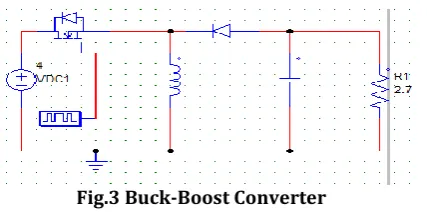
In the electrical section, we have performed two simulations mainly one is the converter simulation and the other is the battery charging simulation. In the previous section we have shown the electrical layout of the system, where we have shown the use of a buck-boost converter which receives the output from the generator, the purpose of this is to provide a constant 5 Volts output to the battery pack, the reason we used this is because the generator output will range from as low as 2 Volts to a maximum of 12 Volts, so there will be instances where we may need to step up or step down the voltage. We have performed the simulation in PISIM.
[image:2.595.333.547.665.771.2]© 2017, IRJET | Impact Factor value: 5.181 | ISO 9001:2008 Certified Journal | Page 1884
In the above Fig.3 we have shown the schematic of thebuck-boost converter we have designed, it is calibrated to give a constant output of 5 Volts for an input ranging from 3 Volts to 12 Volts.
Fig.4 Converter Output
The figure above is the converter output we have received. We received a steady band in the output which shows the triggering of the switch or MOSFET for the operation.
The next section of the electrical segment is the battery charging simulation. In our project we are using li-ion 18650 cells for the purpose of retaining charge. But lithium chemistry cells are to be handled with a lot of care and their charging must follow a certain pattern in order for the cells to remain healthy. The advised charge rate of an Energy Cell is between 0.5C and 1C; the complete charge time is about 2– 3 hours. Manufacturers of these cells recommend charging at 0.8C or less to prolong battery life; however, most Power Cells can take a higher charge C-rate with little stress. Charge efficiency is about 99 percent and the cell remains cool during charge.
Full charge occurs when the battery reaches the voltage threshold and the current drops to 3 percent of the rated current. A battery is also considered fully charged if the current levels off and cannot go down further. Elevated self-discharge might be the cause of this condition.
Fig.5 Li-ion Charging stages
Increasing the charge current does not hasten the full-charge state by much. Although the battery reaches the voltage peak quicker, the saturation charge will take longer accordingly. With higher current, Stage 1 is shorter but the saturation during Stage 2 will take longer. A high current charge will, however, quickly fill the battery to about 70 percent.
We have performed the battery charging in MATLAB where we have obtained the results as per the stages of the battery charging.
Fig.6 MATLAB Model LI-ion Charging
Fig.7 MATLAB Output
Mechanical Section
The most important aspect of this section is the speed multiplication system, where e have used a gear and sprocket system to increase the speed at the generator shaft to give a desirable output.
© 2017, IRJET | Impact Factor value: 5.181 | ISO 9001:2008 Certified Journal | Page 1885
drives a larger output sprocket, then for one rotation of theinput the output will complete less than one revolution resulting in a speed decrease from the input. The ratio of the sizes of the two sprockets is proportional to the speed and torque changes between them.
The ratio in size from the input (driving) sprocket to the output (driven) sprocket determines if the output is faster (less torque) or has more torque (slower). To calculate exactly how the sprocket size ratio effects the relationship from input to output we can use the ratio of the number of teeth between the two sprockets. Sprocket and chain is a very efficient way to transmit torque over long distances. Modest reductions can be accomplished using sprockets and chain, but gears typically provide a more space efficient solution for higher ratio reductions.
The ratio of the number of teeth from the input sprocket to the output sprocket = 300T / 9T. Which means the output would turn 33.33 rotations for the input to complete one rotation
Speed Multiplier Ratio (M) = 300 / 9 = 33.33 Wheel Diameter of Cycle (D) = 620 mm
Average Speed of Cyclist (S) = 15.5 km/hr = 258.33 m /min Perimeter of Wheel (P) = Distance covered in one rotation = 2*π*(D/2)
Average RPM of Wheel at S speed (R) = S / P = 132.2 Rpm RPM at Generator Shaft end = R * M = 132.2 * 33.3 = 4,402.26 Rpm
The CAD model we designed on the basis of the above mentioned calculations is given below.
Fig.8 CAD model
4. HARDWARE SETUP
Similar to the simulations we have done the hardware setup is also divided into the (i) electrical section and the (ii) mechanical section.
Energy Section
The energy generation unit mainly comprises of the DC Generator and the voltage regulator which in our case we
used a buck boost DC-DC converter. The dc generator serves the purpose of the energy generation, we are currently using a MY6812 DC motor which has 100Watts of power at full load and operates at 12 Volts and can take up to 24 Volts. The generator has the following specifications:
Voltage- 12 Volts
Current- 1 Amp/ 11.9 Amp with load
Max speed- 3200 rpm
Torque-0.35Nm
Fig.8 MY6812 DC motor
© 2017, IRJET | Impact Factor value: 5.181 | ISO 9001:2008 Certified Journal | Page 1886
Fig.9 LTC3780 BoardThe charging of the battery pack is monitored by TP4056 li-ion charging board. The charging board is specially designed for the 18650 cells. The TP4056 is a complete constant-current/constant-voltage linear charger for single cell lithium-ion batteries. Its SOP package and low external component count make the TP4056 ideally suited for portable applications. No blocking diode is required due to the internal PMOSFET architecture and have prevent to negative Charge Current Circuit. Thermal feedback regulates the charge current to limit the die temperature during high power operation or high ambient temperature. The charge voltage is fixed at 4.2V, and the charge current can be programmed externally with a single resistor. The TP4056 automatically terminates the charge cycle when the charge current drops to 1/10th the programmed value after the final float voltage is reached. TP4056. Other features include current monitor, under voltage lockout, automatic recharge and two status pin to indicate charge termination and the presence of an input voltage.
The main features of the TP4056 cell boards are as follows:
Programmable Charge Current Up to 1000mA
No MOSFET, Sense Resistor or Blocking Diode required.
Preset 4.2V Charge Voltage with 1.5% Accuracy
Automatic Recharge ·two Charge Status Output Pins
C/10 Charge Termination ·2.9V Trickle Charge threshold (TP4056).
Fig.10 TP4056 Charging Board
We are charging the battery pack in a parallel configuration, as it allows to separately charge each cell without the consequence of a cell failing in the process. In case of series charging, if a particular cell fails, then the entire charging can
be hampered which is avoided in case of parallel charging when if a cell fails to charge, the charging process can continue for the remaining healthy cells.
Mechanical Section
In the mechanical section, the most important part of the project is the timing chain and the speed multiplier sprocket. The gear enables us to generate 1500 to 4000 Rpm at Generator end. As per the MY6812 Performance Curve it would be generating 5v to 18v. The gear setup has gear ratio of 33.33 which means an input speed of X Rpm would be 33.33*X Rpm at Generator shaft end. We laser cut the sprocket The Sprocket has been cut out of CR (cold rolled) Mild Steel of 3mm thickness.
Fig.11 Sprocket after Laser Cutting
We have used timing chain or #25 Roller Chain of 8mm pitch for the transmission system. This was the type of chain that was recommended for the sprocket at the generator shaft. While testing of our system we noticed that the transmission system was prone to vibrations in the arising due to slight increase in speed. Even after tweaking the system multiple times the results were unsatisfactory due to the vibrations which caused the chain to fall off.
We were advised to try out a thicker chain in-order to tackle the vibrations. So we went with the standard Cycle chain and implemented a new setup which had a speed multiplier ratio of 4, for which we used a new Sprocket.
5. CONCLUSIONS
© 2017, IRJET | Impact Factor value: 5.181 | ISO 9001:2008 Certified Journal | Page 1887
DC power from a bicycle, but we believe modifying aconverter is the most cost effective way to reach that goal. Unfortunately, the major problem we faced was with the speed multiplication for reaching optimum speed for the generator give the output. The bike stand and coupling between bike and motor have room for improvement as well like to reduce torque and tension to the stand and reduce slippage between the belt couplings. Further stress tests over a longer period of time would also be beneficial in order to determine the actual average lifetime of our product, and if the cost of production is worth the provided power within that lifetime. Our greatest difficulty came with the charging time of the battery pack. More testing can be done to find the right cell chemistry or to find a new way to reduce the charging time for the battery pack
REFERENCES
[1] Generation of Electrical Power using Bicycle Pedal Rajneesh Suhalka1, Mahesh Chand Khandelwal2, Krishna Kant Sharma3,Abhishek Sanghi4 1,2M.Tech Scholar, Jagan Nath University, Jaipur 3Assistant Professor, YIT, Jaipur 4Assistant Professor, Jagan Nath University, Jaipur. International Journal of Recent Research and Review, Vol.VII, Issue 2, June 2014 [2] Generation of Power from Bicycle Pedal B.Sneha1,
Dr.M.Damodar Reddy2 1PG student [PSOC], Dept. of EEE, SV University, Tirupati, A.P, India 2Professor, Dept. of EEE, SV University, Tirupati, A.P, India. International Journal of Advanced Research in Electrical, Electronics and Instrumentation Engineering (An ISO 3297: 2007 Certified Organization) Vol. 4, Issue 10, October 2015. [3] Bike-Powered Electricity Generator. ŞTEFAN MOCANU1,
ADRIAN UNGUREANU2, RADU VARBANESCU 1Faculty of Automatic Control and Computer Science, Department of Automatic Control and Industrial Informatics, University „Politehnica” of Bucharest, Romania. Asia Pacific Journal of Multidisciplinary Research, Vol. 3, No. 1, February 2015
[4] Bicycle Powered Generator for the University Farm, Bradley Pelz and Jeffrey Feiereisen. Submitted in Partial Fulfillment of the Requirement for the BSEE Degree. Washington University in St. Louis School of Engineering & Applied Science Electrical & Systems Engineering Department.