© 2017, IRJET | Impact Factor value: 5.181 | ISO 9001:2008 Certified Journal | Page 711
A Review: The Internet of Things Using Fog Computing
Miss. Yugandhara A. Thakare
1, Miss. Pranita P. Deshmukh
2, Miss. Rupali A. Meshram
3,
Miss. Komal R. Hole
4, Miss. Rutuja A. Gulhane
5, Miss. Nilaja A. Deshmukh
61,2,3,4,5,6
Assistant Professor, PRMIT&R, Badnera, Maharashtra
---***---Abstract: Fog computing is a research area that targets on
providing services and specifying customers needs in the space between “Ground” and “Cloud”. In the current cloud-based Internet-of-Things (IoT) model, smart devices (such as sensors, smart phones) exchange information through the Internet (routers and/or servers on cloud) to cooperate and provide services to users, which could be citizens, smart home systems, and industrial applications. Even though the cloud based IoT model describes a uniform, concise, and scalable solution for supporting IoT applications, the deployments of IoT applications on cloud and are facing the challenges originated from economic considerations, social concerns, technical limitations, and administrative issues.
The Internet of Things expands its reach into virtually every domain, high-speed data processing, analytics and shorter response times are becoming more necessary than ever. Meeting these requirements is somewhat difficult through the current centralized, cloud-based model powering IoT systems, but can be made possible through fog computing brings computing resources and application services closer to the edge, the most rational and efficient spot in the range between the data source and the cloud.
Keywords:- IoT, Fog Computing, Cloud
1. INTRODUCTION
The Internet of Things (IoT) promises to make many items with consumer electronic devices, home appliances, medical devices, cameras, and all types of sensors part of the Internet environment [1].This opens the access to innovations that make possible new interactions among things and humans, and enables the realization of smart cities, infrastructures, and services that enhance the quality of life. The researchers approximation that the IoT could have an economic impact—including, for example, revenue generated and operational savings—of $11 trillion per year, which would represent about 11 percent of the world economy;[2] and that users will deploy 1 trillion IoT devices.
The Internet of Things, can be a person with a heart monitor implant, a farm animal with a biochip transponder, an automobile that has fixed sensors to aware the driver when tire pressure is low or any other natural or man-made object that can be assigned an IP address and provided with the ability to transfer data over a network. IoT has evolved
from the convergence of wireless technologies, micro-electromechanical systems (MEMS), micro services and the internet. The meeting has helped split down the silo walls between operational technologies (OT) and information technology, allowing unstructured machine-generated data to be analyzed for insights that will drive improvements. Fog computing extends the Cloud Computing model to the perimeter of the network, thus enabling a new type of applications and services.
The characteristics of the Fog are: a) Low latency and location awareness b) Wide-spread geographical distribution c) Mobility
d) Very huge number of nodes e) Prime role of wireless access,
f) Strong presence of streaming and real time applications g) Heterogeneity.
In this paper we argue that the above characteristics make the Fog the appropriate platform for a number of critical Internet of Things (IoT) services and applications, namely, Connected Vehicle, Smart Grid , Smart Cities, and, in general, Wireless Sensors and Actuators Networks (WSANs).
2. WHY IoT NEEDS FOG COMPUTING
The Internet of Things (IoT) is one of the hottest mega-trends in technology and for good reason , IoT deals with all the components including Big Data Analytics, Cloud Computing and Mobile Computing .
2.1 The Challenge
© 2017, IRJET | Impact Factor value: 5.181 | ISO 9001:2008 Certified Journal | Page 712
Figure 2.1 Gardner
The popular current approach is to centralize cloud data processing in a single site, resulting in minor costs and burly application security. But with the sheer amount of input data that will be received from globally distributed sources, this central processing structure will require backup. Also most endeavor data is short of to the cloud, stored and analyzed, after which a decision is made and action taken. But this system isn’t efficient, to make it efficient, there is a require to process some data or some big data in IoT case in a smart way, especially if it’s sensitive data and need quick action.
To illustrate the need for smart dispensation of some kind of data, IDC estimates that the amount of data analyzed on devices that are physically close to the Internet of Things is approaching 40 percent, which supports the urgent need for a different approach to this need.
Figure 2.2Cisco
2.2 The Solution
To deal with this challenge, Fog Computing is the champion. Fog computing allows computing, decision-making and action-taking to occur via IoT devices and only pushes related data to the cloud, Cisco coined the term “Fog computing “and gave a brilliant definition for Fog Computing: “The fog extends the cloud to be earlier to the things that produce and act on IoT data. These devices, called
[image:2.612.326.551.209.343.2]fog nodes, can be deployed anywhere with a network connection: on a factory floor, on top of a power pole, alongside a railway track, in a vehicle, or on an oil rig. Any device with computing, storage, and network connectivity can be a fog node. Examples include industrial controllers, switches, routers, embedded servers, and video surveillance cameras.”
Figure 2.3 Cisco
2.3 To understand Fog computing concept, the
following actions define fog computing
Analyzes the mainly time-sensitive data at the network edge, close to where it is generated as a substitute of sending vast amounts of IoT data to the cloud.
Acts on IoT data in milliseconds, based on strategy.
Sends preferred data to the cloud for chronological analysis and longer-term storage.
2.4 Benefits of using Fog Computing
Minimize latency
Conserve network bandwidth
deal with security concerns at all stage of the network
Operate reliably with quick decisions
Collect and secure wide range of data
Move data to the best place for processing
Lower operating cost of using high computing power only when needed and less bandwidth
Better analysis and insights of local data
[image:2.612.35.211.491.589.2]© 2017, IRJET | Impact Factor value: 5.181 | ISO 9001:2008 Certified Journal | Page 713
address two challenges, real-time process and action of incoming data, and limitation of resources like bandwidth and computing power, another factor helping fog computing is the fact that it takes advantage of the distributed nature of today’s virtualized IT assets. This improvement to the data-path hierarchy is enabled by the increased compute functionality that manufacturers are building into their edge routers and switches.
3. THE FOG COMPUTING PLATFORM
3.1 Characterization of Fog Computing
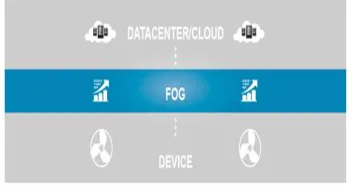
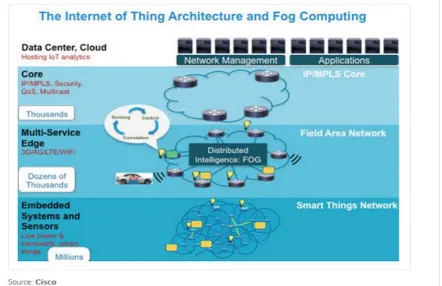
Fog Computing is a highly virtualized platform that provides compute, storage, and networking services between end devices and conventional Cloud Computing Data Centers, normally, but not entirely located at the edge of network. Figure 3.1 presents the idealized information and computing architecture sustaining the upcoming IoT applications, and illustrates the role of Fog Computing. Figure out, storage, and networking resources are the building blocks of both the Cloud and the Fog. Edge of the Network", however, implies a amount of individuality that create the Fog a non-trivial extension of the Cloud.
Let us list them with pointers to motivating examples.
[image:3.612.45.266.481.624.2] Edge location, alertness, and low latency. The origins of the Fog can be traced to early proposals to support endpoints with rich services at the edge of the network, including applications with low latency requirements (e.g. gaming, video streaming, and augmented reality)[10].
Figure 3.1 The Internet of Things and Fog Computing
Geographical Distribution: In sharp contrast to the more centralized Cloud, the services and applications embattled by the Fog demand broadly scattered deployments. The Fog, for instance, will play an active role
in delivering high feature streaming to moving vehicles, through proxies and contact points positioned along highways and tracks [6].
Large-scale sensor networks to monitor the setting and the Smart Grid are other examples of essentially distributed systems, requiring distributed computing and storage assets.
Very large number of nodes, as a consequence of the wide geo-distribution, as evidenced in sensor networks in common and the Smart Grid in exacting. Support for mobility. It is essential for many Fog applications to communicate directly with mobile devices, and therefore
Support mobility techniques, such as the LISP protocol1, that decouple host identity from location identity, and require a distributed directory system.
Real-time Interactions: Important Fog applications engage real-time interactions rather than batch processing prevalence of wireless right to use
Heterogeneity: Fog nodes come in different form factors, and will be deployed in a wide variety of environments.
Interoperability and federation
Seamless support of certain services (streaming is a good example) requires the cooperation of different providers. Hence, Fog mechanism must be able to interoperate, and services must be federated diagonally domains.
Support for on-line analytic and interplay with the Cloud. The Fog is positioned to play a significant role in the intake and processing of the data close to the cause. We detailed in section 4 on the interplay between Fog and Cloud regarding Big Data.
4. COPING WITH INTERNET OF THINGS
DATA
IoT environments generate unprecedented amounts of data that can be useful in many ways, particularly if analyzed for insights. However, the data volume can overwhelm today’s storage systems and analytics applications. Cloud computing could help by offering on-demand and scalable storage, as well as processing services that can scale to IoT requirements. However, for health monitoring, crisis response, and other latency receptive applications, the delay caused by transferring data to the cloud and back to the application is unacceptable[11].
© 2017, IRJET | Impact Factor value: 5.181 | ISO 9001:2008 Certified Journal | Page 714 Many more data sources could easily reach millions of tuples
per second. To address these issues, edge computing [4] was proposed to use computing resources near IoT sensors for local storage and preliminary data processing. This would decrease network congestion, as well as accelerate analysis and the ensuing assessment production. However, edge devices can’t handle multiple IoT applications competing for their limited resources, which results in resource contention and increases processing latency[12].
Fog computing—which seamlessly integrates edge devices and cloud resources—helps overcome these limitations. It avoids resource contention at the edge by leveraging cloud resources and coordinating the use of geographically distributed edge devices.
4.1 How fog computing pushes IoT intelligence
to the edge
As the Internet of Things evolves into the Internet of Everything and expands its get to into nearly every area, high-speed data processing, analytics and shorter response times are fetching more essentially than ever [5]. Meeting these requirements is somewhat difficult through the existing centralized, cloud-based representation powering IoT systems, but can be made probable through fog computing, a decentralized architectural blueprint that brings computing resources and application services closer to the edge, the most rational and well-organized spot in the continuum between the data source and the cloud.
The phrase fog computing, coined by Cisco, refers to require for bringing the compensation and power of cloud computing closer to where the data is being generated and acted upon. Fog computing reduces the quantity of data that is transferred to the cloud for giving out and analysis, while also improving security, a major concern in the IoT industry. Here is how transitioning from the cloud to the fog can help contract with the current and future challenges of the IoT industry.
4.2 The Problem with the Cloud
The IoT owes its explosive growth to the association of objective things and function technologies (OT) to analytics and machine learning applications, which can help glean insights from device-generated data and enable devices to create “smart” decisions lacking human involvement. Currently, such resources are mostly being provided by cloud service providers, where the computation and storage capacity exists [4].
However, in spite of its power, the cloud model is not applicable to environments where operations are time-critical or internet connectivity is deprived. This is especially true in scenarios such as telemedicine and patient concern, where milliseconds can have serious consequences. The same can be said about vehicle to vehicle communications, where the prevention of collisions and accidents can’t pay for the latency caused by the roundtrip to the cloud server. The cloud paradigm is like having your brain command your limbs from miles away — it won’t help you where you require sudden reflexes. besides, having every device associated to the cloud and sending unprocessed data over the internet can have privacy, security and legal implications, especially when dealing with sensitive data that is subject to separate regulations in different countries.
4.3 Does the fog eliminate the cloud
Fog computing improves efficiency and reduces the amount of data that wants to be sent to the cloud for giving out. But it’s here to complement the cloud, not replace it. The cloud will continue to have a pertinent role in the IoT cycle. In fact, with fog computing shouldering the load of short-range analytics at the perimeter, cloud resources will be freed to take on the heavier tasks, especially where the analysis of historical data and huge datasets is apprehensive. Insights obtained by the cloud can help update and tweak policies and functionality at the fog layer [7, 8].
And there are still many cases where the centralized, highly proficient computing infrastructure of the cloud will outperform decentralized systems in concert scalability and expenses. This includes environments where data needs to be analyzed from largely dispersed sources. It is the combination of fog and cloud computing that will accelerate the adoption of IoT, especially for the enterprise.
5. CONCLUSION
© 2017, IRJET | Impact Factor value: 5.181 | ISO 9001:2008 Certified Journal | Page 715 volumes generated by IoT sensors deployed for smooth
combination of objective and cyber environments.
This could produce many settlement to society by, for example, enabling smart healthcare applications. The further development of fog computing could thus help the IoT reach its vast potential.
REFERENCES:
[1]R. Buyya and A. Dastjerdi, Internet of Things: Principles and Paradigms,Morgan Kaufmann, 2016
[2]. J. Manyika et al.Unlocking the Potential of the Internet of Things, McKinsey & Company, 2015.
[3] G. Gan, Z. Lu, and J. Jiang, “Internet of Things Security Analysis”, 2011 International Conference on Internet Technology and Applications (iTAP), August 16-18, 2011 [4]J. Chong, C. Joe-Wong, S. Ha and M. Chiang, “CYRUS: Toward client-defined Cloud storage,” Proceedings of EuroSys 2015.
[5] F. Bonomi, R. Milito, P. Natarajan and J. Zhu, “Fog computing: A Platform for Internet of Things and Analytics,” in Big Data and Internet of Things: A Roadmap for Smart Environments, Springer, March 2014, pp 169-186.
[6] S. Agarwal, J. Dunagan, N. Jain, S. Saroiu, A. Wolman,and H. Bhogan. Volley: Automated data placement for geo-distributed cloud services. In NSDI, 2010.
[7] I. Stojmenovic and S. Wen. The fog computing paradigm:Scenarios and security issues. In Computer Science and Information Systems (FedCSIS), 2014 Federated Conference on, 2014.
[8] Bonomi, Flavio, et al. "Fog computing and its role in the internet of things." Proceedings of the first edition of the MCC workshop on Mobile cloud computing. ACM, 2012, pp. 13-16).
[9] F. Bonomi, ―Connected vehicles, the internet of things, and fog computing,‖ in The Eighth ACM International Workshop on Vehicular Internet Networking (VANET), Las Vegas, USA, 2011.
[10] Zhu, Jiang, ―Improving Web Sites Performance Using Edge Servers in Fog Computing Architecture‖, Service Oriented System Engineering (SOSE), IEEE. 2013.
[11] Amir Vahid Dastjerdi, Rajkumar Buyya – “Fog Computing: Helping the Internet of Things Realize its Potential.” IEEE, University of Melbourne , 2016.