DECISION MAKING PROCESS MODEL FOR HOUSING DEVELOPERS IN MALAYSIA
ROZLIN BINTI ZAINAL
A thesis submitted in fulfilment of the requirements for the award of the degree of Doctor of Philosophy (Quantity Surveying)
Faculty of Built Environment Universiti Teknologi Malaysia
ABSTRACT
vii
ABSTRAK
TABLE OF CONTENTS
CHAPTER TITLE PAGE
DECLARATION DEDICATION
ACKNOWLEDGEMENTS ABSTRACT
ABSTRAK
TABLE OF CONTENTS LIST OF TABLES LIST OF FIGURES
LIST OF ABBREVIATIONS LIST OF APPENDICES
ii iv v vi vii viii xvi xx xxvii xxix
1 INTRODUCTION 1
1.1 Background of the Study 1
1.2 Problem Statement 3
1.3 Summary of Previous Studies 7
1.4 Research Questions 10
1.5 Aim and Objective of Research 10 1.6 Scope and Limitation of Research 11
1.7 Significant of Research 12
ix
1.9 Organisation of Thesis 14
1.10 Conclusion 16
2 THEORY OF DECISION MAKING 17
2.1 Introduction 17
2.2 Terms and definition 18
2.3 Model and its attributes 19
2.4 Decision making process 21
2.5 Decision making method 26
2.5.1 Decision making tool 34
2.5.1.1 Financial 35
2.5.1.2 Market 39
2.6 Decision criteria 42
2.7 Conclusion 49
3 DECISION MAKING PROCESS MODEL FOR
HOUSING DEVELOPMENT AT INITIATION PHASE
50
3.1 Introduction 50
3.2 What is Housing? 51
3.3 Housing Industry in Malaysia (1971–2010) 53
3.4 Housing Development Players 55
3.4.1 The owner 55
3.4.2 Developer 56
3.4.3 Public Sector and Government Agencies
57 3.4.4 Design Professional 58
3.4.5 Contractors 58
3.5 The Objective of Housing Development 60
3.5.1 To Developer 60
3.6 Housing development process 61 3.7 Initiation phase in Housing Development 76 3.8 The Information of Decision Making at
Initiation Phase
85
3.9 Conclusion 95
4 RESEARCH METHODOLOGY 98
4.1 Introduction 98
4.2 Research Flow 99
4.3 Research Design 102
5.3.1 Delphi Method 106
4.4 Literature Review 108
4.5 Delphi Pilot Study 109
4.6 First Round Survey (R1) 110
4.6.1 Questionnaire Survey 110
4.6.2 Selection Sample 111
4.7 Second Round Survey (R2) 113
4.7.1 Questionnaire Survey 113 4.7.2 Verification Process 114
4.7.3 Selection Sample 115
4.8 Statistical Analysis 115
4.8.1 Frequency 116
4.8.2 Mean 116
4.9 Theory Triangulation (Cross Validation) 118
4.10 Conclusion 120
5 RESEARCH ANALYSIS AND RESULT 121
5.1 Introduction 121
5.2 Data Analyses-Pilot Study 121
xi 5.2.2 The Way of Decision Making 122
5.2.3 Decision Making Criteria 123 5.2.4 Decision Making Method 123 5.2.5 Problems in Decision Making 123 5.2.6 Decision Making Process 124 5.3 Data Analyses - First Round Survey (R1) 133
5.3.1 Frequency 133
5.3.1.1 Social Characteristics 133 5.3.1.2 Current Decision
Making Process in Housing Project
134
5.3.1.3 Information Required for Decision Making Process
152
5.3.2 Mean 159
5.3.2.1 Current Decision Making Process in Housing Project
160
5.3.2.2 Information Required for Decision Making Process
161
5.4 Data Analyses - Second Round Survey (R2) 169
5.4.1 Mean 169
5.4.1.1 Current Decision Making Process in Housing Project
169
5.4.1.2 Information Required for Decision Making Process
174
6 PRACTICE OF DECISION MAKING PROCESS PROCESS
180
6.1 Introduction 180
6.2 Decision Making Stage 180
6.3 Decision Making Activity 182
6.3.1 Explore and Asses Development 182 6.3.2 Evaluate Development 183 6.3.3 Pre-Feasibility Study 183 6.3.4 Preliminary Investigation 184 6.3.5 Development Schedule 185
6.3.6 Feasibility Study 186
6.4 Decision Making Point 186
6.5 Decision Maker 187
6.6 Critical Level of Decision Making 188 6.6.1 Explore and Asses Development 189 6.6.2 Evaluate Development 190 6.6.3 Pre Feasibility Study 190 6.6.4 Preliminary Investigation 191 6.6.5 Development Schedule 191
6.6.6 Feasibility Study 192
6.7 Decision Making Method 192
6.7.1 Discussion 193
6.7.2 Experience Judgement 193
6.7.3 Intuition 194
6.7.4 Comparison with Historical Data 194 6.7.5 Multi-Attribute Utility Theory
(MAUT)
194
6.7.6 Market/Economic Report 195
6.7.7 Decision Tree 195
xiii
6.7.9 SWOT Analysis 196
6.7.10 Pros and Cons Analysis 197
6.7.11 Voting/Consensus 197
6.7.12 Operation Management (Location)
197
6.7.13 Computer Simulation 198 6.7.14 Financial Analysis 198
6.8 Decision Making Tool 199
6.8.1 Financial 199
6.8.2 Market 201
6.9 Decision Criteria 202
6.9.1 Explore and Asses Development 202 6.9.2 Evaluate Development 203 6.9.3 Pre Feasibility Study 203 6.9.4 Preliminary Investigation 204 6.9.5 Development Schedule 204
6.9.6 Feasibility Study 204
6.10 Conclusion 205
7 INFORMATION REQUIRED FOR DECISION
MAKING PROCESS
206
7.1 Introduction 206
7.2 Economic Information 206
7.2.1 Authorities Policies 207
7.2.2 Potential Demand 207
7.2.3 Existing Supplying 208
7.2.4 Competition 208
7.2.5 Housing Market 209
7.2.6 Timing (Life Cycle Project) 209
7.2.7 Target Customer 210
7.2.9 Projected Market 210 7.2.10 Current Trade Area 211 7.2.11 Size of Housing Product 211
7.2.12 Past Issues 212
7.3 Technical Information 212
7.3.1 Location 212
7.3.2 Authorities Policies 213
7.3.3 Infrastructure 213
7.3.4 Facilities 214
7.3.5 Flexibility of Productive Capacity 214 7.3.6 Preliminary Research and Testing 214
7.3.7 Size of Project 215
7.3.8 Building 215
7.3.9 Environmental 216
7.3.10 Plant Layout 216
7.3.11 Work Schedule 216
7.4 Financial Information 217
7.4.1 Loan 217
7.4.2 Capital 218
7.4.3 Revenue of Project 218
7.4.4 Term of Project 218
7.4.5 Development Cost 219
7.4.6 Construction Cost 219
7.4.7 Operating Cost 220
7.4.8 Pre Operating Expenses 220
7.4.9 Working Capital 220
7.4.10 Sunk Cost 221
7.5 Conclusion 222
xv
8.1 Introduction 223
8.2 Initiation Phase Process 224
8.3 Stages Process at Initiation Phase 224
8.4 Decision Making Point 233
8.5 Decision Maker 233
8.6 Decision Making Method 236
8.7 Decision Making Tool 239
8.7.1 Financial 239
8.7.2 Market 241
8.8 Decision Criteria 243
8.9 Economic Information 246
8.10 Technical Information 249
8.11 Financial Information 252
8.12 Conclusion 261
9 CONCLUSION 262
9.1 Introduction 262
9.2 Summary of Research Work 263
9.3
9.4
9.5
Decision Making Process Practiced Among Malaysian Housing Developers Methods and Tools Used to Make Decision
Types of Information Required for Making Decision
265
266
268
9.6 Significant Contributions 269
9.7 9.8
Recommendations for Future Research Closure
269 270
REFERENCES 271
LIST OF TABLES
TABLE NO. TITLE PAGE
1.1 List of summary of previous studies in housing decision
making 8
2.1 Literature review of decision making process elements 22 2.2 The example of format of pros and cons analysis 31
2.3 The example of format of SWOT analysis 31
2.4 Summary of decision method theory 34
2.5 NPV analysis 37
2.6 Conclusion of NPV result 38
2.7 Summary of decision tool 41
2.8 A summary of CSR elements 45
2.9 Project definition checklist 47
2.10 Literature review of housing development decision criteria 48 3.1 Housing progress by private sector of the Malaysia’s Plans 53
3.2 Contractor (building) category 59
3.3 Characteristics of housing demand at various human motivation levels
xvii 3.4 Summary of selected literature review of decision
elements, development process and initiation phase activity 82
3.5 Summaries of Theoretical of Information Required in Decision Making at Initiation Phase
92
4.1 The summary of integration research objectives with elements of data
105
4.2 Interview schedule framework 109
4.3 The summary of questionnaire (R1) form element 110 4.4 The summary of questionnaire (R2) form element 114
4.5 The description function of frequency 117
4.6 The description function of mean 117
4.7 Theories selected of decision making at initiation phase 119 4.8 Theories selected of information in decision making at
initiation phase 119
4.9 Theories selected of decision criteria at initiation phase 119
5.1 Decision making concept by developer 124
5.2 The proportion of position in company 133
5.3 The proportion of experience in job 134
5.4 The proportion of number of years of the company in business
134
5.5 Value of critical level 159
5.6 Critical level of initiation phase stage 160
5.10 Critical level of preliminary investigation activities 161 5.11 Critical level of development schedule activities 161 5.12 Critical level of feasibility study activities 161 5.13 Critical level of decision making process in initiation phase
stage 161
5.14 Economic information of explore and assess development
stage 162
5.15 Economic information of evaluate development stage 162 5.16 Economic information of pre feasibility study stage 162 5.17 Economic information of preliminary investigation stage 163 5.18 Economic information of development schedule stage 163 5.19 Economic information of feasibility study stage 164 5.20 Technical information of explore and assess development
stage 164
5.21 Technical information of evaluate development stage 164 5.22 Technical information of pre feasibility study stage 165 5.23 Technical information of preliminary investigation stage 165 5.24 Technical information of development schedule stage 166 5.25 Technical information of feasibility study stage 166 5.26 Financial information of explore and asses development
stage 166
xix 5.31 Financial information of feasibility study stage 168
5.32 Value of agreement level 169
5.33 Value of acceptance level 169
5.34 Acceptance level of initiation phase activities 170 5.35 Acceptation level of critical level of initiation phase
activity 171
5.36 Acceptation level of decision maker of initiation phase
stage 171
5.37 Acceptation level of decision making method 172 5.38 Acceptation level of decision financial tool 173
5.39 Acceptation level of decision market tool 173
5.40 Acceptation level of decision criteria 174
5.41 Acceptance level of economic information 175
LIST OF FIGURES
FIGURE NO. TITLE PAGE
1.1 Statistic of housing project failure in Malaysia from 2007
until 2011 2
1.2 Contradictory objectives 5
1.3 Complaints in housing sector for year 2008 in Malaysia 6
1.4 Scope of research 12
2.1 The modelling process 20
2.2 Idea assessment and business development process 23
2.3 Conceptual design process 24
2.4 Generic diagram of the decision-making information flows in information intensive agriculture
25
2.5 Decision methods 27
2.6 Example decision tree 28
2.7 An outline Delphi process 29
2.8 ROI graphic approach 35
2.9 Future Value (FV) Formula 37
2.8 The connections of various factors in Hong Kong urban housing development process
xxi
3.1 Contractor hierarchy 59
3.2 Stages of the development process and their
interrelationship 62
3.3 Outline plan of work 64
3.4 Project development process 65
3.5 Actors in the Development Process 66
3.6 Housing development process in Republic South Africa 67 3.7 The residential land development in Indonesia 69
3.8 Development approval 70
3.9 Planning approvals process 71
3.10 Development process 72
3.11 The development process at feasibility stage 73 3.12 Flowchart of property development in Malaysia 75
3.13 Elements of strategy stage 78
3.14 Feedback, Changes and Corrective Action 80
3.15 Project Management Process 81
3.16 The fundamental model of decision making process for housing development
84
3.17 The information required at initiation phase 94 3.18 Conceptual of decision making process model at initiation
phase for housing development
96
4.1 Research flow 101
4.2 Research methodology process – Delphi method 104
5.1 Decision making process by D1 127
5.2 Decision making process by D2 128
5.3 Decision making process by D3 129
5.4 Decision making process by D4 130
5.5 Decision making process by D5 131
5.6 Summary of decision making process by private developer 132
5.7 The proportion of position in company 133
5.8 The proportion of experience in job 134
5.9 The proportion of number of years of the company in business
135
5.10 The frequencies of stages normally carried out during the initiation phase
136
5.11 The frequencies of explore and asses development stage activities
136
5.12 The frequencies of evaluate development stage activities 136 5.13 The frequencies of pre feasibility study stage activities 137 5.14 The frequencies of preliminary investigation stage activities 137 5.15 The frequencies of development schedule stage activities 137 5.16 The frequencies of feasibility study stage activities 138 5.17 The frequencies of decision making point at initiation phase 138 5.18 The frequencies of critical level of each stage during
initiation phase
139
5.19 The frequencies of explore and assess development stage activities
139
xxiii 5.21 The frequencies of pre feasibility study stage activities 140 5.22 The frequencies of preliminary investigation stage activities 141 5.23 The frequencies of development schedule stage activities 141 5.24 The frequencies of feasibility study stage activities 142
5.25 The frequencies of decision maker 143
5.26 The frequencies of decision making method at explore and assess development stage
144
5.27 The frequencies of decision making method at evaluate development stage
144
5.28 The frequencies of decision making method at pre feasibility stage
144
5.29 The frequencies of decision making method at preliminary investigation stage
145
5.30 The frequencies of decision making method at development schedule stage
145
5.31 The frequencies of decision making method at feasibility study stage
145
5.32 The frequencies of financial decision making tools at explore and assess development stage
146
5.33 The frequencies of financial decision making tools at evaluate development stage
146
5.34 The frequencies of financial decision making tools at pre feasibility stage
147
5.35 The frequencies of financial decision making tools at preliminary investigation stage
147
5.36 The frequencies of financial decision making tools at development schedule stage
147
5.37 The frequencies of financial decision making tools at feasibility study stage
5.38 The frequencies of market decision making tools at explore and assess development stage
148
5.39 The frequencies of market decision making tools at evaluate
development stage 148
5.40 The frequencies of market decision making tools at pre
feasibility study stage 149
5.41 The frequencies of market decision making tools at
preliminary investigation stage 149
5.42 The frequencies of market decision making tools at
development schedule stage 149
5.43 The frequencies of market decision making tools at
feasibility study stage 149
5.44 The frequencies of decision criteria at explore and asses
development stage 150
5.45 The frequencies of decision criteria at evaluate development
stage 150
5.46 The frequencies of decision criteria at pre feasibility study
stage 151
5.47 The frequencies of decision criteria at preliminary
investigation stage 151
5.48 The frequencies of decision criteria at development
schedule stage 151
5.49 The frequencies of decision criteria at feasibility study stage 151 5.50 The frequencies of economic information at explore and
assess development stage 153
5.51 The frequencies of economic information at evaluate
development stage 153
5.52 The frequencies of economic information at pre feasibility
study stage 154
xxv
investigation stage 154
5.54 The frequencies of economic information at development
schedule stage 154
5.55 The frequencies of economic information at feasibility
study stage 154
5.56 The frequencies of technical information at explore and
assess development stage 155
5.57 The frequencies of technical information at evaluate
development stage 155
5.58 The frequencies of technical information at pre feasibility
study stage 156
5.59 The frequencies of technical information at preliminary
investigation stage 156
5.60 The frequencies of technical information at development
schedule stage 156
5.61 The frequencies of technical information at feasibility study
stage 156
5.62 The frequencies of financial information at explore and
assess development stage 157
5.63 The frequencies of financial information at evaluate
development stage 157
5.64 The frequencies of financial information at pre feasibility
study stage 158
5.65 The frequencies of financial information at preliminary
investigation stage 158
5.66 The frequencies of financial information at development
schedule stage 158
5.67 The frequencies of financial information at feasibility study
stage 158
8.1 Initiation phase process for housing development 226 8.2 Explore and asses development stage process 227
8.3 Evaluate development stage process 228
8.4 Pre-feasibility study stage process 229
8.5 Preliminary investigation stage process 230
8.6 Schedule development stage process 231
8.7 Feasibility study stage process 232
8.8 Decision making point process at initiation phase for
housing development 234
8.9 Decision maker involved at the initiation phase process for
housing development 235
8.10 Decision method used at initiation phase process for
housing development 238
8.11 Financial tools used at initiation phase process for housing
development 240
8.12 Market tools used at initiation phase process for housing
development 242
8.13 Decision criteria required at initiation phase process for
housing development 245
8.14 Economic information required at initiation phase process
for housing development 248
8.15 Technical information required at initiation phase process
for housing development 251
8.16 Financial information required at initiation phase process
for housing development 251
8.17 Decision making process model for housing development
xxvii
LIST OF ABREVIATIONS/SYMBOLS
4P’s - Product, price, place (distribution) and promotion AHP - Analytic Hierarchy Process
APH - Affordable Public Housing BERNAMA - Malaysian National News Agency BOD - Board of Directors
BTS - Build-Then-Sell
CCC - Completion and Compliance CEO - Chief Executive Officer
CHM - Chairman
CIDB - Construction Industry Development Board CIOB - Charted Institute of Building
CVI - Cumulative Volume Index
CSR - Corporate Social Responsibility
DSS - Decision Support System
DCF - Discounted Cash Flow
FV - Future Value
GDP - Gross Domestic Product
GM - General Manager
HDA - Housing Development (Control and Licensing) Act 1966
HOD - Head of Department
IBS - Industrialised Building System IRR - Internal Rate of Return
MEC - Member of Executive Committee MOT - Memorandum of Transfer
NDP - National Development Policy
NEP - New Economic Policy
NHP - National Housing Policy
NPV - Net Present Value
NPW - Net Present Worth
OLAP - Online Analytical Processing
OSC - One Stop Centre
PHP - People’s Housing Programme
PI - Profitability index
PV - Present Value
R1 - First Round Delphi
R2 - Second Round Delphi
REHDA - Real Estate and Housing Developers' Association Malaysia
ROC - Rate of Cost
ROI - Return on Investment SOP - Standard Operating Practice
SPSS - Statistical Package for the Social Sciences
SWOT - Strengths, Weaknesses, Opportunities and Threats TVD - Transportation rate, Volume and Distance
I - Interest discount rate
N - Number of periods/numbers
T - Time of the cash flow
R
t - Net cash flow (the amount of cash, inflow minus outflow) attime t
µ
- Mean∞ - Infinity
xxix
LIST OF APPENDICES
APPENDIX TITLE PAGE
A Sample of questionnaire form for first round survey (R1) 282 B Sample of questionnaire form for second round survey (R2) 294
C List of respondents 307
CHAPTER 1
INTRODUCTION
1.1 Background of the Study
Housing is one of the important elements for the Malaysian growth and development. In 2010, housing made up of 30% of the total output of the Malaysian construction industry which is 5.8% of the country’s Gross Development Product (GDP) (CIDB, 2010). Malaysian has emphasised on home ownership as part of its economic policy since the 2nd Malaysia Plan (1971-1975). This has led to a series of implementation of housing development programmes that saw thousands of housing facilities being built annually by both the government and private sectors.
The aim of the housing policy in Malaysia is to give all Malaysian adequate, decent, affordable and accessible housing that is completely facilitated with
2
group are able to own a house in such criteria (Ting, 2001). In this regards, the private sectors (key players in housing development) are optimistic to build more profitable houses in developers’ development area.
Despite the pleasant track record of the housing development, thousands of complaints received by National Housing Department in the year 2000 about the unethical practices of some developers or criminal house developers such as late delivery, compensation, cheating, non conforming to plan, low customer high-interest, high interest loan, late produce certificate of fitness, payment, contravene act or regulation and deposit ownership. The impact will face is on the house buyers where they have to pay high-interest loan payment for a long time without owning any house. The issue becomes more critical while the demand of housing is increasing and imbalance with the total of land in the country is worsened. This situation is worsen due to land decreasing and limited (Salleh & Chai, 1997).
[image:27.595.125.514.595.699.2]Figure 1.1 shows the statistic of housing project failure (late delivery project, sick project and abandoned project) in Malaysia from 2007 until 2011. According to National Housing Department (2008), late project delivery means that the project is experiencing delays of 10% to 30% compared to the proper development. Sick project refers to the project which experiences a delay of more than 30% stack up of the progress that should be or has expired Sale and Purchase Agreement. Abandoned project is a project which was not complete and no major activity at the construction site for six months and after.
Figure 1.1 Statistic of Housing Failure in Malaysia from 2007 until 2011 (National Housing Department, 2008-2012)
74
216
63 43 50
120
208
281
228 235
0 0
148 161
0 0
100 200 300
2007 2008 2009 2010 2011
There are no abandoned projects in the year 2007, 2008 and 2011 but there are still problems in the housing project such as late delivery project and sick project. As suggested by Holian (2002), much of these problems were attributed to poor decision making. Accordingly, poor decision making also exist in the case of housing development in Malaysia (Khalid, 2005).
1.2 Problem Statement
The foregoing discussion highlighted the problems associated with decision making in housing development. According to Sharipah (2011) the main issues in the Malaysian housing industry are on the unsold, overhang and oversupply of housing development throughout the country. Sharipah (2011) also find that the exceeding target of the residential sector, industrial sector and unsold shop lots with a total of RM 9.84 billion as at end of 2000, increased by 11.62% over the previous half year. The National Economic Action Council (NEAC) (1999) recognised that the cause of economy suffered poorly in the 1997 economic recession was due to property market overhang and oversupply.
4
Basi (1998) highlighted that all decision made by intuitive without scientific approach. Important decisions are probably made intuitive at the executive level, cooperation at the managerial level, and computational at the administrative level. This classification will create dissimilarity in decision making group and it causes misunderstanding between each other. When this situation occurs among them, the accurate result cannot be achieved. Again regarding to Basi (1998), integration of all levels in organisation especially those who are involved in decision making must work together and have mutual understanding; so that the issue may be disappearing in conflict group.
(Suffolk Planning Office
There are many complaints received by National Housing Department on the lack of housing quality
statistics in the Figure 1.3 delivery and the lowest
(problems/issues) according to ranking; (8%), contravene act/regulations (6%) deposit ownership (3%)
infrastructure (1%).
may be attributed mainly to poor or wrong decision making. Poor decision making can be due to many reasons. The failures included the procedure or poor quality information or wrong the using decision techniques (Harris, 2009).
Figure 1.2 Contradictory Objectives (Suffolk Planning Officer’s, 1993 in Carmona, 2001
here are many complaints received by National Housing Department on the lack of housing quality in Malaysia due to sequence in decision making issue
Figure 1.3 shows that the highest percentage of complaint is late delivery and the lowest percentage is complaint in infrastructure.
(problems/issues) according to ranking; Late delivery (42%), defective workmanship ontravene act/regulations (6%), interest (5%), services (4%)
eposit ownership (3%), certificate of fitness (2%), Compensation (2%) . Based on Basi (1998), Ziara (1999) and Holian (200
may be attributed mainly to poor or wrong decision making. Poor decision making can be due to many reasons. The failures included the procedure or poor quality information or wrong the using decision techniques (Harris, 2009).
r’s, 1993 in Carmona, 2001)
here are many complaints received by National Housing Department on the nce in decision making issue. The
of complaint is late is complaint in infrastructure. The complaints
efective workmanship ervices (4%), payment (4%), Compensation (2%) and
Figure 1.3
According to
decision maker, proposer and secretariat happen distance separately in
Consequently convenience
amount of data supplied by propos decision maker may
expertise with a simplest approach by just applying the rules.
Whole Building Design Guides (WBDG) initiation phase is critical to a project’s su
qualities of the project that are necessary to satisfy client and end user needs and expectations, once it is delivered and in use.
thinking and some tough decisions and application know-how (Carroll, 2004)
this phase because i
or that an existing project should continue into the next phas
Initial survey suggested
implement housing project during decision making in a mo
8% 2% 4% 2% 5% 1% 4% 3% 6% 0% 10%
Complaints in Housing Sector for Year 2008 in Malaysia. (National Housing Department, 2008)
According to Mat and Md. (2004), incomplete communication between decision maker, proposer and secretariat happened due to restraint of time and
tance separately in decision making process for construction development convenience to information becomes limited due to the amount of data supplied by proposer. Again Mat & Md. (2004) pointed
decision maker may create their own approach based on their experiences and a simplest approach by just applying the obtainable
Whole Building Design Guides (WBDG) (2012) pointed out that initiation phase is critical to a project’s success. It is regarding to establish the qualities of the project that are necessary to satisfy client and end user needs and expectations, once it is delivered and in use. Initiation phase needs some hard thinking and some tough decisions and application of systematic knowledge and
(Carroll, 2004). Decision maker in housing maker must particular with this phase because it is the process of formally recognising that a new project exists or that an existing project should continue into the next phase (REHDA, 2010).
survey suggested that developers in Malaysia should
implement housing project during decision making in a more systematic and
42%
22%
20% 30% 40% 50%
Others Contravene act/regulations Deposit ownership Services Infrastructure Interest Late delivery Certificate of fitness Payment
Compensation Defective workmanship
6
Complaints in Housing Sector for Year 2008 in Malaysia.
, incomplete communication between due to restraint of time and for construction development project.
due to the restricted pointed that the their experiences and obtainable standards and
pointed out that the to establish the qualities of the project that are necessary to satisfy client and end user needs and
needs some hard of systematic knowledge and . Decision maker in housing maker must particular with t is the process of formally recognising that a new project exists
(REHDA, 2010).
that developers in Malaysia should manage and re systematic and
Others Contravene act/regulations Deposit ownership Services Infrastructure Interest Late delivery Certificate of fitness Payment
[image:31.595.119.521.120.278.2]measurable way at initiation phase. They also need to apply the appropriate
approach. The issue is majority of them prefer making decision using trial and error and experience method. They also use a simple feasibility study with simple
mathemathical calculation and ordinary personnel to support the decision. They must make decisions methodically or scientifically by applying the science
management (Wheelen & Hunger, 1991). The aim of their housing project is more to get high profit and fulfills the high demand.
As a conclusion, based on Ziara (1999), Mat & Md. (2004), Harris (2009) and Whole Building Design Guides (WBDG) (2012), all the problems of housing development attributed mainly to poor or wrong decision making, procedure or poor quality information or wrong the using decision techniques at initiation phase. Beside that, regarding to initial survey finds that the decision making process in developer’s management is straightforward. Thus, this research emphasises on the developing of decision making process model for housing projects at initiation phase.
1.3 Summary of Previous Studies
8
First, Ahmad et al (2004) came out with decision for site selection. The research raises out those decision makers usually uses own biased decision and gut feelings based on their experience in selecting the most suitable sites for
development. Then, online analytical processing (OLAP) concept is employed to analyse data using just for site selection decision stage not for all stages in initiation phase.
The second is research on decision making in house marketing area. Livette (2006) highlightedissue that pleasure with the result of the decision making process is more important than the nature of the process itself, but, unsuitable that process seems to be in terms of the theory of buyer actions. The research is focusing more to house purchaser which demonstrates that most of the buyers undertake imperfect decision making not to developer effort.
The third previous study is government decision making model in housing scope. Mahdi et al (2006) emphasised on point of government’s and recipients’ perspective only. He found that the system of housing construction is proved to be efficient in making a trade off between the government purposes and recipients desires not to developer and technical player advantages in housing development.
Table 1.1: List of Summary of Previous Studies in Housing Decision Making
Title Author Year Issue Methodology Finding Scope
1.Development of a Decision Support System Using Data Warehousing to Assist Builders/Develo pers in Site Selection.
Ahmad, I., Azharb, S. & Lukauskis, P.
2004 • Site selection process is a complex decision making task.
• Decision makers to use their subjective judgment and gut feelings based on their experience in selecting the most appropriate site for
development.
• Use a decision support system (DSS).
• Respondent:
builders/developers of housing development.
• Enhanced approach for integrating data from multiple, often very large, distributed, heterogeneous databases and other information sources.
• Introduce online analytical processing (OLAP) concept which analyzes data using for any combination of variables.
• Users can generate data trends over a period of time to make any forecasts.
Decision tool for site selection
2.A Marketing Perspective of Private Sector Retirement Housing and the Effectiveness of the Buyer Behaviour of Its Purchasers
Livette, M. 2006 • Inappropriate t decision making process of the theory of buyer behaviour.
• Examines the decision making process of retirement housing purchasers.
• Determine its efficiency by comparing and contrasting data.
• 200 respondents with semi-structured interviews.
• Majority of retirement housing purchasers undertake limited decision making: they consider only the scheme in which a property is eventually bought, and they are very satisfied with their purchase.
Make decision in house marketing
3.Optimum House Delivery Decision Model from the Government’s And Recipients’ Point-Of-View.
Mahdi, I. M., Al-Reshaid, K. & Fereig, S. M.
2006 • Decision maker have their own perspective and imagination of their needs, objectives, constraints and requirements.
• Decision making process very difficult to produce satisfactory typical housing units.
• Appear into the mass production of house units and the conflict.
• Proposes a decision model for deciding the optimum house delivery alternatives for both the recipients and the Government.
• Use analytical hierarchy process.
• Partially constructed houses enable the possibility of many alternatives by the recipients, which in turn avoids the drawbacks of rebuilding and at the same time, maintains work quality. Model of housing decision making for Government
4.An Assessment of Sustainable Housing Affordability Using a Multiple Criteria Decision Making Method
Mulliner, E., Smallbone, K., Maliene, V.
2013 • Quality of life and community sustainability the environmental and social sustainability of housing not taken into consideration.
• Application of a methodology that can be applied to assess the affordability of different housing locations in a sustainable manner, taking into account a range of economic, environmental and social criteria
• A range of social and environmental criteria can greatly affect the calculation of an areas affordability, in comparison to focusing solely on financial attributes.
10
1.4 Research Questions
Regarding to problem statement, the issues need to be the reply and fully investigate as found out in the preliminary enquiry. Therefore the research requirements are stated in the questions below;
1. How do developers make decision? 2. When do they make decision? 3. Who make the decision?
4. What are the inputs (data/information)? 5. What are the criteria taken into account?
1.5 Aim and Objectives of the Research
This research aims to develop a process model for decision making in housing development at the strategic phase in Malaysia.
The objectives of this research are;
1. to identify the decision making process practiced by the Malaysian housing developers
2. to identify the methods and tools used to make decisions and
1.6 Scope and Limitation of Research
This research is limited to a study of decision making process among large housing developers in Malaysia particularly in Peninsula. The research is also limited to the decision making process during the strategic phase which include initiation phase. It does not consider decision making in other phases.
The research focuses on strategic phase which include initiation phase
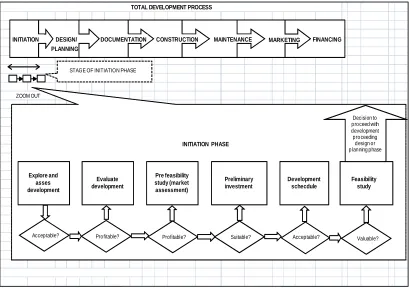
(before planning phase) because it is considered to be the first step and focal point in construction process (Tan, 1996) (see Figure 1.4). Initiation phase includes explore and assess development, evaluate development, pre feasibility study (market
assessment), preliminary investment, development schedule and feasibility study stage. This research also includes all types of housing development whether low cost, medium cost, high cost, terrace house, apartment, bungalow, semi detached or mix development. Researcher uses a natural view in housing development project so that it can be used by developers in whatever circumstances.
12
1.7 Significance of Research
The main contribution of this study to the body of knowledge falls on the following aspects: First, improving the current process and technique in decision making model of initiation phase in housing project. This study has contributed to the standards definition of housing approval and the decision makers especially developers to realize the component in stage of initiation phase in housing
development. In addition, this study will provide cost and time saving at the stage of preliminary development housing process and finally producing quality housing as ZOOM OUT
TOTAL DEVELOPMENT PROCESS
MARKETING MAINTENANCE
CONSTRUCTION DOCUMENTATION
DESIGN/ FINANCING
Explore and asses development
Evaluate development
Pre feasibility study (market assessment)
Preliminary investment
Development schecdule
Feasibility study INITIATION PHASE
Decision to proceed with development proceeding
design or planning phase
PLANNING INITIATION
STAGE OF INITIATION PHASE
[image:37.595.98.507.118.406.2]Acceptable? Profitable? Profitable? Suitable? Acceptable? Valuable?
the final product. Finally, this research overall want to help developers make quality in their decision at each stage of initial phase of housing development.
Beside that, this study can provide an overview or idea and knowledge to academia on the developing of decision making process model for housing projects especially at initiation phase. Based on previous studies (as mentioned in sub chapter 1.2) most of them did not emphasised on this area especially at primary phase in housing development. Therefore this research will contribute to the future development of an academia.
1.8 Research Approach
A research approach is basically a research model. It has a correlation with the data collection method because it is specified by research strategy. Generally, this research has five main activities which are theoretical study, pilot study, data collection, data analysis and finally findings. The main purpose of these activities is to ensure that this research is carried systematically so that the aim and objectives of the research can be achieved.
14
The third phase is data collection. In this phase, data and information are collected with three rounds survey (Delphi Pilot, Delphi 1st Round, and Delphi 2nd Round) and analysed systematically by way of scientific methods like qualitative and quantitative method. The sample of respondents is identified scientifically in order for the researcher to find a representation of the total population which is the total number housing developers in Malaysia.
Data analysed is formulated as solutions targeted to answer the objectives of the research. Generally, the decision making practice for housing development situation is discussed in detail including current decision making process in housing projects which is the normal process of decision making, critical level at each of the process, party(ies) or person making the decision, decision making methods and tools and decision criteria. Another aspect which will be discussed is the
information required for the decision making process. The answers of questionnaires and opinions from selected developers will be analysed with SPSS (Statistical Package for the Social Sciences) software.
The last part of this research is a summary of findings explain the problem statement and aim and objectives achievement. Another part is the elaboration of the theoretical study and practice implication based on the findings’ result. This part will be accompanied by suggestions based on further research conducted by other
researchers.
1.9 Organisation of Thesis
Chapter 2 explain the theory of decision making the associated decision making process, the various tools and techniques used and the criteria of decision making functions are discussed.
Chapter 3 provides the overview of Malaysian housing industry and its performance for the last 15 years. It also discusses some of the issues and problems facing the housing development as well as the developer. This chapter also highlights into the theoretical aspects of housing project development with particular attention given to the decision making element of the processes and information required.
Chapter 4 discusses in detail the methodology of the research. The research was discussed in accordance stages of the research. The stages includes identification of survey elements, questionnaire development, data collection process and method of analysis are the main topics described in the chapter.
Chapter 5 describes the analyses that were performed on the data collected from different stages of the research. The results are displayed, analysed and discussed in order to obtain significant findings and fulfill the research objectives.
Chapter 6 discusses the synthesis of interesting findings leading to the identification of the determinants that current practice of decision making process in housing development project. An equal emphasis on the aspects or variables and practices for each aspect that promote the practice of decision making process are highlighted in each subsequent section of the discussions.
16
Chapter 8 discusses the aim of research. The contant covers the illustration of decision making process model for housing development project during initiation phase by flow chart. Illustration of model looks into the process of housing development, the associated decision making process, the various tools and techniques used and the inputs and outputs of decision making functions.
Chapter 9 summarises the research work, provides the conclusions of this research and recommendations for future research.
1.10 Conclusion
This chapter outlined the thesis. It indicated the research background,
CHAPTER 2
THEORY OF DECISION MAKING
2.1 Introduction
Decision making is a process that tangled with the other planning,
18
2.2 Terms and Definition
Before further discuss the subject of the research, it must has a clear understanding of the terms used in this study. Based on Keast et al. (2009) many types of decision can be defined by situation, alternatives and outcome. Furthermore taking adecision is a process which includes a recognition process; an argumentation process and a selection from alternatives process.
According to Reason (1990) decision making is also as cognitive process. It is produced in the selection of alternative scenarios. Each of decision making process presents the last alternative. The result can be an exploit option.
For the purpose of this research, the following terms present different meaning.
1. Decision:
“Decision means that each of the potential solutions is evaluated and compared to the alternatives until the best solution is obtained”.
(Hendrickson, 1998)
2. Decision making:
“The analysis of a finite set of alternatives described in terms of some evaluative criteria.”
(Triantaphyllou, 2000) 3. Decision making process:
“Taking a judgement procedure or selecting alternatives which comprise a process of define and clarify the issue, gather all the facts and understand their causes, think about or brainstorm possible options and solutions, consider and compare the pros and cons of each option and select the best option.”
4. Decision points:
“Latest moment at which a predetermined course of action is (or must be) initiated.”
(Businessdictionary.com, 2009)
As the result, decision making defined as the process of choosing and analysing alternatives, ideas and judgements with evaluate action until the best solution decided. The integration from terms and definition listed guide this research to achieve the aim. Futuremore, it fulfils all the research questions onbehalf to research objectives.
2.3 Model and Its Attributes
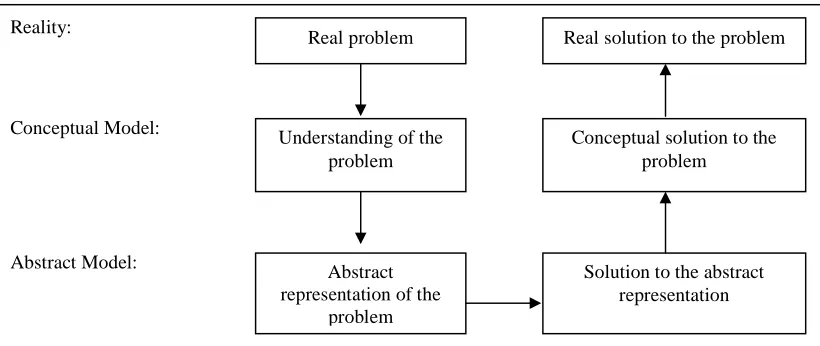
This section describes the component of model and select which it used in this research as final finding. A model is a simplified representation of the key elements of reality and their interaction (Golub, 1997). A model expresses what we mean when we say that we know how something works (Oxenfeldt, 2001). The characteristics of models are;
− They simplify complex reality by stripping away the non-essentials. − They include the essential elements.
− They indicate the relationships among the component parts.
(Oxenfeldt, 2001)
20
Reality:
Conceptual Model:
[image:45.595.114.524.125.298.2]Abstract Model:
Figure 2.1 The Modelling Process (Brewer and DeLeon, 1995 in Golub, 1997).
Abstract Models is the first type of model. The models are the variety of mathematical models which are covered in courses on forecasting, management science and operations research. According to Golub (1997) there are three types in this brief typology of models such as deterministic models, probability models and simulation models.
Secondly is a Conceptual Models. This model is frequently criticised as subjective because the decision made by decision maker can be biased. Beside that, the models are less explicit and consequently, can be more difficult to modify. Conceptual forecasts are typically based on analogies (Golub, 1997). For the purpose of this research, the focus on the conceptual model as a method of presenting the integrated decision making process model for housing development process. It is because the method of research uses an elaboration of the theoretical study and practice implication based on the findings’ result.
Real problem Real solution to the problem
Understanding of the problem
Conceptual solution to the problem
Abstract representation of the
problem
2.4 Decision Making Process
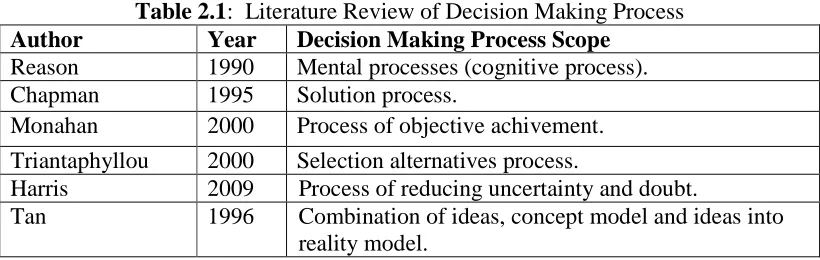
Chapman (1995) pointed out that decision making process includes activity that define and clarified the issue. Then, collect all the information. After that, come up with potential choices and clarifications. The following process considers and compares the advantages and disadvantages of options. Next process is selecting the best opinion and lastly explains the decision to those concerned and affected.
Monahan (2000) presented the decision making as an objective achievement process. To him the process started with the establishment, classify and place the objectives with according to importance level. Second is the development of alternative. Third is the evaluation of alternative against all the objectives and tentative decisions. Followed by evaluate tentative decision. Lastly it is the implementation of the decisive actions. Triantaphyllou (2000) described decision making involved the analysis of alternatives in evaluative criteria which have benefit and nature value
22
Table 2.1: Literature Review of Decision Making Process Author Year Decision Making Process Scope
Reason 1990 Mental processes (cognitive process). Chapman 1995 Solution process.
Monahan 2000 Process of objective achivement. Triantaphyllou 2000 Selection alternatives process.
Harris 2009 Process of reducing uncertainty and doubt.
Tan 1996 Combination of ideas, concept model and ideas into reality model.
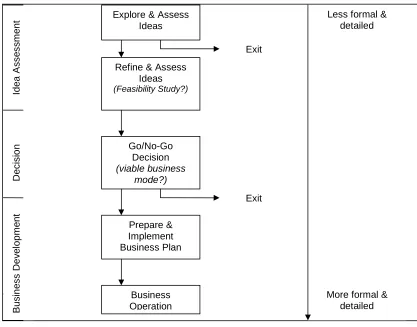
Further discussion focused on selected area used decision making process basically. Hofstrand (2006) discussed decision making on business area. Based on Hofstrand (2006), whether to move forward or not, a successful business
Figure 2.2 Idea Assessments and Business Development Process (Hosftrand, 2006)
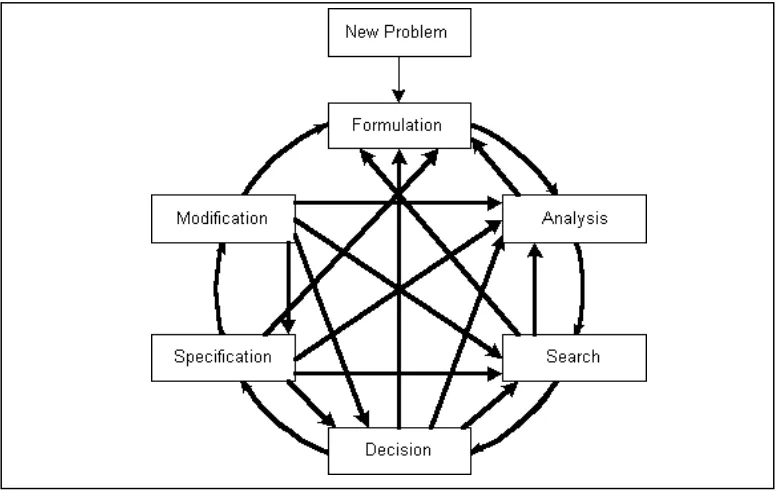
However, Hendrickson (1998) reviewed the conceptual design process in information technology (IT) area characterised by a systematic syries which started with formulation, analysis, search, decision, specification, and modification (see Figure 2.3). Though, these actions are highly interactive at the early stage in the development of a new project. The process and relationship of action and decision making has shown. Nevertheless, it is too many and crowded with relationship arrows and the decision point in each of action is not given.
Explore & Assess Ideas
Refine & Assess Ideas (Feasibility Study?) Go/No-Go Decision (viable business mode?) Prepare & Implement Business Plan Business Operation Id e a A s s e s s m e n t D e c is io n B u s in e s s D e v e lo p m e n t Exit Exit
Less formal & detailed
24
Figure 2.3 Conceptual Design Process
Adapted from R.W. Jensen and C.C. Tonies (Hendrickson, 1998)
REFERENCES
Achelis, S. B. (2011) Cumulative Volume Index. onlinetrading-tools.com.
Agus, M. R. (1997) Historical Perspective on Housing Development, Kuala Lumpur, Cagamas Berhad.
Ahmad, I. (1990) Expert Decision Support Systems for the Construction Industry. ASC Proceeding of the 26th Annual Conference.
Ahmad, I et al. (2004) Development of A Decision Support System Using Data Warehousing to Assist Builders/Developers in Site Selection. Automation in Construction
Ali, S. & SALEH, M. Z. (1994) Rancangan Malaysia Keenam: Prioriti Pengukuhan Negara, Bangi, Selangor, Universiti Kebangsaan Malaysia.
Altman, D. (2006) Why do a pilot study? London, UK, National Centre for Replacement, Refinement and Reduction of Animals in Research. Ambler, S. W. (2004) The Lifecycle for the Enterprise Unified Process (EUP) v
2004. Enterprise Unified Process (EUP) Home Page.
Anderson, D. R., Sweeney, D. J. & Williams, T. A. (2003) An Introduction to Management Science of Quantitative Approaches to Decision Making, Ohio, United State, Thomson.
Anumba, C. J., Baugh, C. & Khalfan, M. M. A. (2002) Organisational Structures to Support Concurrent Engineering in Construction". Industrial Management & Data Systems. 102-5.
272
Bakar, A. H. A., Razak, A. A., Abdullah, S. & Awang, A. (2009) Project
Management Success Factors for Sustainable Housing: A Framework eprints @ USM.
Baker S., Baker K. & Campbell M. (2003) The Complete Idiot’s Guide to Project Management, United States of America, Pearson.
Basi, R.S. (1998). Administrative Decision Making: A Contextual Analysis. Management Decision Journal.
BERNAMA (2008) Housing Policy Protect Buyer. Utusan Malaysia Online. Kuala Lumpur.
Betts, R. M. & Ely, S. J. (2005) Basic Real Estate Appraisal, United State, Thomson. Board, C. I. D. (2008) Malaysian Construction Industry Master Plan. CIDB.
Bohari, A. M. (2005) Sistem Sokongan Keputusan, Konsep Asas dan Aplikasi, Kuala Lumpue, Pearson Malaysia Sdn. Bhd.
Brecht, S. B. (2007) Let the Buyer Be Aware: Making the Most of Feasibility Studies. Brecht Associates.
Bryman, A. (2010) Triangulation. Loughborough, UK, Loughborough University. Buang, S. (1997) Bumiputera House Ownership and Participation and Other Issues
Relating to the Housing Industry: Housing the Nation, Kuala Lumpur, Cagamas Berhad.
Businessdictionary.Com (2009) Decision Point. Google.
Canada, M. A. H. C. (1996) Housing Development Checklist — The Feasibility Phase Mortgage and Housing Corporation Canada
Carmona, M. (2001) Housing Design Quality: Through Policy, Guidance and Review, London, Spon Press.
Center For Teaching, R. L. S. S. R. L. A. U. (2011) Introduction to SPSS. Washington, American University.
Chan, L. (1997) Housing Delivery System: The Industry Viewpoint: Housing the Nation, Kuala Lumpur, Cagamas Berhad.
Chia-Chien Hsu, B. A. S. (2007) The Delphi Technique: Making Sense of Consensus. Practical Assessment, Research & Evaluation.
CIDB, M. (2008) Construction Quarterfly Statistical Bulletin. Kuala Lumpur, Construction Industry Development Board (CIDB).
CIDB, M. (2010) Construction Quarterfly Statistical Bulletin. Kuala Lumpur, Construction Industry Development Board (CIDB).
CIOB (Charted Institute Of Building), C. (1996) Code of Practice for Project Management for Construction and Development, England, Longman. Coalition, F. (2001) Methods for Decision Making. Foundation Coalition.
Communities, U. S. D. O. H. A. U. D. S. H. A. (2009) The Housing Development Process. Florida, U.S. Department of Housing and Urban Development's Homes and Communities.
Connie, S., M, S. & L, A. (2005) Multi-Stakeholder Partnerships in Affordable Rental Housing: An Investigation Using Soft Systems Framework. Queensland University of Technology, Brisbane, Queensland, Australia, University of Melbourne, Melbourne, Victoria, Australia.
Cooper, H. (1998) Synthesizing Research: A Guide for Literature Reviews, New Jersey, Prentice Hall.
Corporation, C. M. A. H. (2004) Decision-Making Framework. Ontario, Canada Mortgage and Housing Corporation.
Cuhls, K. Delphi Method, Germany, Fraunhofer Institute for Systems and Innovation Research.
Department Of Human Settlement, R. S. A. (2009) Housing Project Process Guide. Department of Human Settlements.
Development, N. H. (2008) Towards Successful Housing Development in Malaysia. Ministry of Housing and Local Government.
274
Division, W. F. L. H. (2007) Project Development Process Flow Chart. U.S. Department of Transportation.
Ebrahim, G.J. (2009) Qualitative Field Research Journal of Tropical Pediatrics. Ehow, C. (1999) How to Do a Market Segment Analysis. e.How.com.
Fairfax Country, G. O. V. (2002) Residential Development Criteria. Virginia Government.
Fisher & Collin (1999) The Commercial Property Development Process, Property Management Journal.
Fountas, S., Wulfsohn, D., Blackmore, B.S. Jacobsen, H.L. & S.M. Pedersen (2004), A model of Decision-Making and Information flows for
Information-Intensive Agriculture, Elsevier Ltd, 87-192.
Frej, A. B. & Peiser, R. B. Professional Real Estate Development, Second Edition: The ULI Guide to the Business. Urban Land Institute.
Gallimore, P., Hansz, J. A. & Gray, A. (2000) Decision Making in Small Property Companies. Journal of Property Investment and Finance, 18-6.
Golub, A. L. (1997) Decision Analysis An Integrated Approach, Toronto, Canada, John Wiley and Sons, Inc.
Gould, F. E. (2005) Managing the Construction Process, New Jersey, Pearson Prentice Hall.
Government, M. O. H. A. L. (2008) National Development Policy, Ministry of Housing and Local Government.
Hall, S. (1999) Decision Tree Method. eHow.
Harris, R. (2009) Introduction to Decision Making. Virtual Salt.
Harrison, E. F. (1999) The managerial decision-making process, Boston, Houghton Mifflin.
Helmer, O. (1983) Looking Forward: A Guide to Futures Research, Beverly Hills. Sage Publications.
Hofstrand, D. (2006) Idea Assessment and Business Development Process. Iowa State University.
Hofstrand, D. & Holz-Clause, M. (2006) What is a Feasibility Study?, Iowa State University.
Holian, R. (2002) Management Decision Making and Ethics: Practices, Skills and Preferences. Management Decision Journal.
Holz-Clause, M. (2006) Conducting Market Research, Iowa State University. Hsu, C. (2007) The Delphi Technique: Making Sense of Consensus, Practical Assessment, Research & Evaluation, 12-10
Hu, Y. & SHEN, Q. (2000) Systems Thinking In the Study of Housing Development In Hong Kong New Towns. The Hong Kong Polytechnic University.
Humphrey, A. S. (2004) SWOT Analysis. Allan Chapman.
Indiana, H. A. C. D. A. O. (2006) Request for Proposals for Feasibility Studies, Indiana Housing and Community Development Authority
Inouye, K. P., MELHADO, S. B. & SOUZA, U. E. L. (2002) Design Process at Public Companies Dealing With Housing Production: Evaluation by Means of a Case Study. Proceedings IGLC, 10.
J.Schmidt, M. (2011) Internal rate of return (IRR). Solution Matrix Ltd. . J.Schmidt, M. (2011) Net Present Value (NPV) / Discounted cash flow (DCF).
Solution Matrix Ltd.
J.Schmidt, M. (2011) Payback Period. Solution Matrix Ltd.
J.Schmidt, M. (2011) Return on Investment: What is ROI analysis? , Solution Matrix Ltd.
Janice M. Morse, M. B., Maria Mayan, Karin Olson and Jude Spiers (2002)
Verification Strategies for Establishing Reliability and Validity in Qualitative Research. International Journal of Qualitative Methods, 1.
Joel G. Siegel, J. K. S., Stephen W. Hartman (1992) 201 Decision-Making Tools for Business, Finance and Accounting Students New York, Mc Graw Hill. Keast, S. & Towler, M. (2009) Rational Decision Making for Managers,
276
Khalid, M. S. (2005) The Abandoned Housing Projects in Malaysia: An Institutional Analysis of Real Estate Development Process. IN WHITE, D. M. J. &
TIWARI, D. P. (Eds.) The 2nd College of Arts & Socials Sciences
Postgraduate Conference. University of Aberdeen, University of Aberdeen. Kirkebøen, G. (2007) Decision behaviour – Improving expert judgement. Norwegian
University of Science and Technology.
Kvale, S. (1996) Interviews An Introduction to Qualitative Research Interviewing Sage Publications.
Lake, L. (2011) Developing Your Marketing Mix, About.com.Marketing. Lewis, E. (1984) Housing Decisions, Goodheart-Wilcox Publisher
Lee, L. M. & MOHAMED J. A. (2000) Local Authority Networked Development Approval System, Planning Digital Conference, Penang.
Lim, B. (2007) Property Report: Asia: A profile of Malaysia’s Housing Industry, The Region's Real Estate Portal.
Lin, G. C. I. & Nagalingam, S. V. (2000) CIM Justification and Optimisation, London, Taylor & Francis.
Linkov i, S. J. (2005) Multi-Criteria Decision Analysis. International Symposium on Cyanobacterial Harmful Algal Blooms (ISOC-HAB) Sheraton Imperial Hotel & Convention Center, Durham, USA, U.S Environmental Protection Agency. Livette M. (2006) A Marketing Perspective of Private Sector Retirement Housing
and the Effectiveness of the Buyer Behaviour of Its Purchasers. Property Management Journal.
Mahdi, I. M. et al. (2006) Optimum House Delivery Decision Model from the Government's and Recipients' Point-of-View. Engineering, Construction and Architectural Management Journal.
Malaysia, B. N. (2008) Laporan Ekonomi. Kementerian Kewangan Malaysia. Malaysia, N. H. D. O. (2011) National Housing Policy. Kuala Lumpur, Malaysia,
Maludesly, M. J. & Thevendran, V. (2005) Risk Management in the Construction Industry, Kuala Lumpur, Malaysia, Eico, Educational Researchers & Consultants.
Mat A. Z. & Md. D. H. (2004) Collaborative Decision Making for Site Development Analysis Using Kola System. “GeoSpatial Democracy - Map India 2004” 7th Annual International Conference and Exhibition, 28-30 January 2004,
New Delhi, India.
Matson, J. (2000) The Cooperative Feasibility Study Process. USA, United States Department of Agriculture Rural Business–Cooperative Service.
Mckenna R. J. & Martin-Smith B. (2005) Decision Making As a Simplification Process: New Conceptual Perspectives, Management Decision Journal. Ministry Of Housing and Local Government, Malaysia (2008) List of Developer Who
Submit their Financial Audit Report. Putrajaya.
Minneapolis, C. O. (1997) Draft Guidelines and Criteria: Workforce Ownership Housing Development Program. Minnesota, City of Minneapolis.
Mohammad Sharif, D. A. L. (2009) A Review of the Delphi Technique: To Understand the Factors Influencing Adoption of Stabilised Earth
Construction in Low Cost Urban Housing. The Built & Environment Review. Salford, United Kingdom, University of Salford.
Mohamed, E. (2002) Macro-Economic Impact on Urbanisation Process in Malaysia. Asian Forum. Tokyo.
Monahan, G. (2000) Management Decision Making, Cambridge, Cambridge University
Morningstar (2010) The Discounted Cash Flow Method, United Kingdom, Morningstar.
Mulliner, E., Smallbone, K., Maliene, V. (2013) An Assessment of Sustainable Housing Affordability Using a Multiple Criteria Decision Making Method, Omega, 41-270, UK
278
Nannicini, T. & Madrid, U. C. I. D. (2006) A Simulation-Based Sensitivity Analysis for Matching Estimators.
National Housing Department, M. (2008) Annual Report. Putrajaya, Ministry of Housing and Local Government.
Nayab, N. (2011) Use Decision Analysis as a Tool to Improve the Quality of Your Decisions. Bright Hub Inc.
Necula, S.C. (2010) Discussions on Applied Mathematics in Decision-Making Modeling with Decision Support Systems and Knowledge Based Systems. Proceedings MATH'10 of the 15th WSEAS International Conference on Applied Mathematics. Universiti of Iasi, Romania.
Nedjat, S. (2010) Triangulation as a Qualitative Research Strategy. Tehran University of Medical Science.
New York Times (1963) Personality Boom is Loud for Louis Lesser
Novak, L. R. (1996) Market and Feasibility Studies: A How-To Guide. University of Oregon.
Ofori, G. (1990) The Construction Industry: Aspects of Its Economics and Management, Singapore, Singapore University Press.
Oxenfeldt, A. R. (2001) Decision Economics, Canterbury, U.K, Financial World Publishing.
Powell C. (2002) The Delphi Technique: Myths and Realities, Journal of Advanced Nursing 41(4), Blackwell Publishing Ltd.
PMI (PROJECT MANAGEMENT INSTITUTE STANDARD COMMITTEE) (1996) A Guide to the Project Management Body of Knowledge, United State of America.
R, D. & AL-ABED, A. (1998) Housing Adequacy in Yemen: An Investigation into Physical Quality. Property Management Journal, 16-1.
Rapoport, A. (1969) House Form and Culture. Prentice Hall, Inc., Englewood Cliffs, New Jersey.
Reason, J. (1990) Human Error, Ashgate.
REHDA (THE REAL ESTATE AND HOUSING DEVELOPER'S ASSOCIATION OF MALAYSIA) (2010) The Property Development Process in Malaysia. RIBA (ROYAL INSTITUTE OF BRITISH ARCHITECTS), (2007) Outline Plan of
Work 2007.
Richardson, S. (2005) How to Research, Singapore, Thomson.
Rigatto W. & Puntel A. (2008). Identification of Nurses’Competencies in Primary Health Care Through a Delphi Study in Southern Brazil. Public Health Nursing, 25-4
Ruckdeschel, S. (2010) How to Cross Validate Qualitative Research Results. eHow Sharipah, N. S. S. (2011) The Different Scenarios of Housing Problem in Malaysia,
Syarahan Perdana 2011, UTHM, Johore.
Salkind, N. J. (2006) Exploring Research, New Jersey, Pearson.
Salleh, G. & CHAI, C. L. (1997) Low Cost Housing: Issues and Problems: Housing The Nation, Kuala Lumpur, Cagamas Berhad.
Schmidt, M. J. (2011), Return on Investment (ROI): Meaning and Use, Solution Matrix Ltd.
Sengül, H., YASEMIN, Ö. & EDA, P., (2010) The Assessment of the Housing in the Theory of Maslow’s Hierarchy of Needs, European Journal of Social
Sciences.
Shaffer, S. M. & MEREDITH, J. R. (1998) Operation Management, United State, John Wiley & Sons, Inc.
Shegos, E. H. (2001) Family Matters: A Guide to Developing Family Supportive Housing. New York, Corporation for Supportive Housing.
Shehu, Z. & AKINTOYE, A. (2010) Major Challenges to the Successful
Implementation and Practice of Programme Management in the Construction Environment: A Critical Analysis. International Journal of Project
Management 28-26