Journal of Chemical and Pharmaceutical Research, 2015, 7(8):1-5
Research Article
ISSN : 0975-7384
CODEN(USA) : JCPRC5
Adsorptif stripping voltammetry determination of heavy metal ions from
aqueous solution by some biosorbent
Nazris Nazaruddin
1, Rahmiana Zein
1, Edison Munaf
1*, Deswati
1and Jiye Jin
21Laboratory of Analytical Enviromental Chemistry, Faculty of Mathematic and Natural Science, Andalas University,
Padang, Indonesia
2Departement of Chemistry, Faculty of Science, Shinshu University, Matsumoto Shi, Japan
_____________________________________________________________________________________________
ABSTRACT
Adsorptif stripping voltammetry (AdSV) has been proved to be a simple and effective method for determination of heavy metal ionsusing 0,6 mM calcon as ligand on pH 6 and developed a lot of attention right now is take advantage of the ability to accumulate heavy metals by biomaterials that are relatively economical and easy to obtain. Nypa fruticans Merr shell, Arenga pinnata Merr shell and Phaseolus lunatus shell was used for removal Cd(II) and Zn(II) ions from aqueous solutiuon. The optimum condition was achieved for Cd(II) and Zn(II) on pH 6, Determination of the optimum conditions measurements of Cd(II) and Zn(II) simultaneously with adsorptive stripping voltammetry is pH 6, contact time 60s, concentration 50 mg/L. accumulation potential of -1.2V, and time accumulated 90s. The concentration of the metal content of Cd(II), and Zn(II) are 0.502mg/L. and 0.602mg/L for Nypa fruticans Merr shell and 1.026mg/L. 1.398mg/L for Arenga pinnata Merr shell and 2.098mg/L, 3.675mg/L for Phaseolus lunatus shell.
Keywords: Adsorptif stripping voltammetry, Biosorption, heavy metal, Nypa fruticans Merr shell, Arenga pinnata
Merr shell, Phaseolus lunatus shell.
_____________________________________________________________________________________________
INTRODUCTION
Heavy metal pollution, always caused by the waste streams of many industries, such as metal plating facilities, mining operations, and tanneries, has become a serious threat to human health, living resources, and ecological systems. They are not biodegradable and tend to accumulate in living organisms, causing various diseases and disorders to the nervous, immune, reproductive and gastrointestinal systems [1].
Cadmium is used in many industries, such as in the manufacture of batteries and electroplating process. Cadmium is also found in paint and pigment industry. Lead is toxic and the most common metabolic enzyme inhibitors. Lead can replace calcium in bones. Cadmium and lead in trace concentrations is highly toxic when absorbed by the body. The metal absorption effect bioaccumulation in the food chain. The accumulation of these metals in the body causing cancer and brain disorders [2].
Zinc is needed by the body in very small levels and it is needed in the body because it is an important component of proteins and enzymes. Copper in the blood binds to serum albumin. Copper participate in the formation of blood and hemoglobin synthesis. If the levels of zinc and copper exceeding the threshold requirement, can cause health problems . Thus it needs to monitor the levels of trace metals in the environment, if the presence exceeded the minimum threshold is prescribed [3].
effective and effisient. Low cost agricultural products and by products have been reported to be effective in removing toxic metals. Indonesia produces large amounts of biowaste material every year such as rice husk, palm, saw dust, coconut shells and other agricultural by products [4,5]. Nypa fruticans Merr shell, Arenga pinnata Merr shell and Phaseolus lunatus shell have a potential to be use as biomaterial for removal of heavy metals. Electrochemical method is one of the most favourable techniques for the determination of environmental pollutants because of its low cost, high sensitivity and easy operation. Among different electrochemical methods, Adsorptif stripping voltammetry (AdSV) has been proved to be a simple and effective method for the determination of heavy metal ions [6,7]. Adsorptif stripping voltammetry (AdSV) is a powerful technique used for rapid determination of trace levels of metal ions [8]. However, time consuming process, high cost of maintenance, expensive and sophisticated instruments severely restrict their practical applications. Electrochemical method is one of the most favourable techniques for the determination of environmental pollutants because of its low cost, high sensitivity and easy operation [9,10]. Among different electrochemical methods, adsorptif stripping voltammetry (AdSV) has been proved to be a simple and effective method for the determination of heavy metal ions. [11-13]
EXPERIMENTAL SECTION
Preparation of biosorben
Materials used Nypa fruticans Merr shell, Arenga pinnata Merr shell and Phaseolus lunatus shell which taken in West Sumatera. The biomaterials are cleaned, then washed with water and dried in the open air. Once dried and then pulverized in a manner pounded with a pestle and sieved with a sieve by particle size that will be used (150µm, 180µm, 250µm, 425µm). Biomaterials with the size soaked in a solution of 0.1 M HNO3 for 2 hours while stirring occasionally. Results immersion filtered and then washed with distilled water. After that soaked with ethanol for 2 hours, then dried again.
Chemical
CdCl2 (Merck), ZnCl2 (Merck), HNO3 65% (Merck), NaOH (Merck), and the distilled water. The instrument used in
this study were 797Computerace with Metrohm HMDE working electrode, areference electrode Ag/AgCl/KCl 3 M, and the Ptelectrode as a counter electrode; pH meter model 80 Griffin (Griffin & George Loughborough, UK), analytical balance Mettler AE 200, Toledo, OH, USA; and glassware commonly used in laboratory. All measurements were taken at ambient temperature.
Experimental procedure
The experiment was conducted in two phases. The first is the creation of adsorbent the Nypa fruticans Merr shell. The second is testing the ability of the metal ion uptake of Cd (II) and Zn (II) with agitation speed variation of metal ion solution, time varying stirring, concentration, particle size and pH to determine the optimum conditions using batch sorption method.
Determination of Optimum Conditions
Determination of optimum conditions performed for each metal ion Cd (II), and Zn (II). For each treatment using 1,0 g of biomaterial.
Effect of pH
Each biomaterial is inserted into a flask with a particle size of 160 µm was then added 20 mL of Cd (II) 50 mg/L at pH variation 3,4,5,6 and 8, then those are shaked for 60 minutes with a rotation speed of 100 rpm. Equal treatment for metal solution Zn (II). The resulting filtrate was analyzed by Adsorptif stripping voltammetry (AdSV).
Effect of Particle Size
Biomaterials put into each flask with a size of 150, 180, 250 and 425 µm, then added with 20 mL of Cd (II) 50 mg/L at optimum pH then those are shaked for 60 minutes with a rotation speed of 100 rpm. Equal treatment for metal solution Zn (II). The resulting filtrate was analyzed by Adsorptif stripping voltammetry (AdSV).
Effect of Contact Time
The biomaterials inserted into the flask with the optimum particle size, then added 20 mL of metal Cd (II) 50 mg / L with a pH optimum, inserted into the flask and stirred at 100 rpm at varying contact time is 5; 15; 30 and 60 minutes. Equal treatment for the solution of Zn (II). The resulting filtrate was analyzed by Adsorptif stripping voltammetry (AdSV).
Effect of Agitation Speed
and stirred varying speed is 50; 100; 150 and 200 rpm. Equal treatment for solution of Zn (II). The resulting filtrate was analyzed by Stripping Voltametry.
Variation of calcon concentration
A total of 20 mL standard solution of 10 µg/L Cd(II) and 0,2 mL of 0.1 M KCl were put into the voltammetric vessel. Adjust accumulation potential to 0.7 V, accumulation time of 60 sec and pH 7 by the addition of NH OH. Calcon was added as a complexing agent at a concentration of 0.2 mM, 0.3 mM, 0.4 mM, 0.5 mM, 0.6 mM, 0.7 mM, and 0.8 mM. Measurements performed to obtain the value of the peak current (Ip). A curve between the calcon concentration and the peak current (Ip) was constructed to determine the optimum concentration of calcon. The same thing was also done to Cd(II) and Zn(II).
Measurementsamples
A total of 5 mL of Nypa fruticans Merr shell Zn is inserted into the vessel, was added 0.2 mL of 0.1 M KCl, 0.7 M calcon. The same thing was also done to Arenga pinnata Merr shell and Phaseolus lunatus. Equal treatment for solution of Cd (II).
RESULTS AND DISCUSSION
Determination of Cd and Zn in aqueous solution
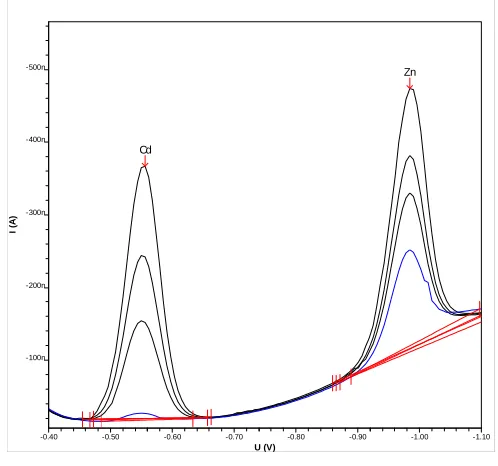
[image:3.595.181.430.328.561.2]Measurements were conducted at a potential of -1.2 Volt accumulation, accumulation time of 90 s, the concentration of 0.6 mM kalkon, pH 6, the concentration of the supporting electrolyte 0.1 M KCl sample voltammogram measurements using standard addition method can be seen in Fig.1
Fig. 1Voltammograms of Nypa fruticans Merr shell
Fig. 1 shows the results of the sample voltammogram metal ions Cd (II) and Zn (II) by using Nypa fruticans Merr shell as biomaterials using standard addition method at 797 Computrace Metrohm instruments. The sample is measured based on the optimum conditions that have been obtained in previous measurements. In the figure shows that the sample was measured with 0.2 mL of a mixture added standard solution of Cd (II) 5 mg / L and Zn (II) 5 mg / L, as much as three times the addition, an increase in the peak current is generated. This indicates that the sample contained metals Cd (II), and Zn (II). This can be seen in the voltammogram. The metal concentrations of Zn (II) 0.602 mg / L and the concentration of Cd (II) 0.502 mg / L.
For biomaterials of Arenga pinnata Merr shell performed at a potential of -1.2 (Volt) accumulation, accumulation time of 90 s, the concentration of 0.6 mM calcon, pH 6, the concentration of the supporting electrolyte 0.1 M KCl sample voltammogram measurements using standard addition method can be seen in Fig. 2. That shown are results of the sample voltammogram metal ions Cd (II) and Zn (II) by using Arenga pinnata Merr shell as biomaterials using standard addition method at 797 Computrace Metrohm instruments. The sample is measured based on the optimum conditions that have been obtained in previous measurements. In the figure shows that the sample was measured with 0.2 mL of a mixture diadisi standard solution of Cd (II) 5 mg / L and Zn (II) 5 mg / L, as much as three times the addition, an increase in the peak current is generated. This indicates that the sample contained metals
-0.40 -0.50 -0.60 -0.70 -0.80 -0.90 -1.00 -1.10
U (V)
-100n -200n -300n -400n -500n
I
(A
)
Zn
Cd (II), and Zn (II). This can be seen in the voltammogram. The metal concentrations of Zn (II) 1.398 mg / L and the concentration of Cd (II) 1.026 mg / L.
Fig. 2Voltammograms of Arenga pinnata Merr shell
Fig.3Voltammograms of Phaseolus lunatus beans
Fig. 3 shows the results of the sample voltammogram metal ions Cd (II) and Zn (II) by using Phaseolus lunatus beans as biomaterials using standard addition method at 797 Computrace Metrohm instruments. The sample is measured based on the optimum conditions that have been obtained in previous measurements. In the figure shows that the sample was measured with 0.2 mL of a mixture addition standard solution of Cd (II) 5 mg / L and Zn (II) 5 mg / L, as much as three times the addition, an increase in the peak current is generated. This indicates that the sample contained metals Cd (II), and Zn (II). this can be seen in the voltammogram.The metal concentration of Zn (II) 3.675 mg / L and the concentration of Cd (II) 2.098 mg / L.
The heavy metal ions were analysis by using AAS, but the result is better by using adsorptive stripping voltammetry. Measurements using these two methods can be seen in Table 1.
Table.1 Determination of Heavy Metal Ions from Aqueous Solution by some Biosorbent using AAS and adsorptive stripping voltammetry(AdSv)
Biomaterial Heavy metal ion AAS (mg/L))
Adsorptif stripping voltammetry (mg/L0
Nypa fruticans Merr shell Cd 5 5,02
Zn 10 12,04
Arenga pinnata Merr shell Cd 15 17,01
Zn 10 13,98
Phaseolus Lunatus Merr shell Cd 20 20,98
Zn 35 36,75
-0.40 -0.60 -0.80 -1.00 -1.20
U (V)
-100n -200n -300n -400n
I
(A
)
Zn Cd
-0.60 -0.80 -1.00 -1.20
U (V)
-50.0n -100n -150n -200n -250n -300n
I
(A
)
Zn
CONCLUSION
From the research that has been done can be concluded that the determination of the optimum conditions measurements of Cd (II) and Zn (II) simultaneously with adsorptive stripping voltammetry is pH 6, the concentration of 0.6 mM calcon, accumulation potential of -1.2 V, time accumulated 90 s. At the optimum conditions Relative Standard Deviation values obtained for 3 repetitions, the measurement of a standard solution of Cd (II) 5 mg / L and Zn (II) 5 mg / L. The concentrations of which are absorbed by the metal Nypa fruticans Merr shell Cd (II) of 0.502 mg / L and 0.602 mg / L for the metals Zn (II), which is absorbed by the metal Arenga pinnata Merr shell on Cd (II) of 1.026 mg / L and 1.398 mg / L for metals Zn (II) and is absorbed by the metal Phaseolus lunatus beans Cd (II) of 2.098 mg / L. and 3,675 mg / L for metals Zn (II)
This method was applied for the determination of Cd (II) and Zn (II) directly by using biomaterial Nypa fruticans Merr shell , Arenga pinnata Merr shell and Phaseolus lunatus beans.
REFERENCES
[1] Farghaly O., Hazzazi A., Hazzazi., E. Rabie M., Khodari. (2008) Int. J. Electrochem. Sci , 3 1055-1064 [2] Dariusz W., Barbara H. (1993). Appl Radiat Isot , 44:1101.
[3] Sahara E.,(2008). Tuk J. Chem., 2 105.
[4] R. Zein, R. Suhaili, F. Earnestly, Indrawati, E. Munaf. (2010).J Hazard Mater (181) 2010, 52-56.
[5] Beolchini, F., C. Pennesi, T. Romagnoli, C. Totti, M. Centofanti, L. Mosca,F. Veglio. (2005). Chemical Engineering Transaction. 6, 885-890.
[6] Nagase H., Inthorn D., Oda A., Nishimura J., Kajiwara Y., Park M., Hirat K. (2005). J. Bioscience and Bioengineering. 99 (4): 372-377.
[7] Ranjan D., Srivastava P., Talat M., Hasan S. (2009). Appl Biochem Biotechnol .158:524–539 [8] Acar O., Ozvatan S., Ilim M. (2005). Turk J. Chem. 29: 335-344.
[9] Deswati, Suyani H., Safni, (2012). Indo. J. Chem., 12 (1), 20
[10] Shams E., Babaei A., Soltaninezhad M. (2004). Anal .Chem. Acta , 501: 119. [11] Hu C., Wu K., Dai X., Hu S. (2003). Talanta , 60:17.