International Journal of Emerging Technology and Advanced Engineering
Website: www.ijetae.com (ISSN 2250-2459,ISO 9001:2008 Certified Journal, Volume 3, Issue 5, May 2013)
367
Optimization of Unit Commitment Problem and
Constrained Emission using Genetic Algorithm
S. Shobana
1, R. Janani
21
PGScholar,2Assistant Professor, Department of Electrical and Electronics Engineering, Paavai Engineering College, India.
Abstract — This paper presents a solution to Optimal Unit commitment (UC) of thermal units based on a evolutionary algorithm known as Genetic algorithm (GA). In this proposed method of GA for the UC problem, the scheduling variables are coded as integers, so that the minimum up/down time constraints can be handled directly. To verify the performance of the proposed algorithm, it is applied to systems with 10 generating units in one-day scheduling period. The test results reveal that not only does the GA consider the constraints very well, but also minimizes the operating cost and emission cost. It can also find solution very close to optimum value within a reasonable time. It is shown that the algorithm is capable to find better solutions in comparison with the conventional methods and most of the other computing techniques. The results also prove the efficacy and correctness of the method.
Keywords - Emission Constraint, Genetic Algorithm, System Constraint, Unit Commitment.
I. INTRODUCTION
Unit Commitment is a problem to schedule the generation units in order to serve the load demand at the minimum operating cost while meeting all plant and system constraints. Generation scheduling involves the determination of the start up and shut down time points and the generation levels for each unit over a given scheduling period (usually 24 hours). UC plays an important role in power system economic operation for reasonable scheduling will save large amount of fuel cost and bring huge economic benefit. The unit commitment problem involves large amount of 0-1 decision values as well as continuous variables, and a wide spectrum of equality and inequality constraints.
It is considered as a non-linear, large-scaled, mixed integer combinatorial optimization problem. Past UC method includes: priority list methods, dynamic
programming, integer and linear programming,
lagrangian relaxation, branch and bound, interior point optimization, tabu search, simulated annealing, artificial intelligence methods, evolutionary programming, ant colony search algorithm and particle swarm algorithms etc.
But each method exist some difficulties, such as: dimension disaster, search algorithm and particle swarm algorithms etc.
But each method exist some difficulties to treat mass constraints and the limitation for the objective function etc. So these methods can obtain only the local optimal solution. Genetic algorithms are global optimization techniques inspired by the study of genetics. They can be easily implemented for the solution of hard optimization problems and they provide great modeling flexibility.
This paper presents genetic operations suitable for UC problems. The experimental results demonstrate that not only does the GA consider the constraints very well, but also has some advantages, such as good convergence, fast calculating speed and high precision.
II. UCPROBLEM FORMULATION
A. Notation
The following notation is used in this paper
Number of Units
H Scheduling Horizon (in Hours) Output Power of Unit i at Hour t
C Number of Operating Cycles for each unit Duration of operating cycle c for unit i
System Load Demand at Hour t
System Reserve at Hour t
Maximum Output Power of unit i
Minimum Output Power of unit i
Maximum Output Power of unit i at hour t
Minimum Output Power of unit i at hour t
Operation Status of Unit i at Hour t
Fuel Cost of Unit i
Total Fuel Cost
Start – Up Cost of Unit i
Hot Start Cost of Unit i
Cold Start Cost of Unit i
Minimum Up – Time Limit of Unit i
International Journal of Emerging Technology and Advanced Engineering
Website: www.ijetae.com (ISSN 2250-2459,ISO 9001:2008 Certified Journal, Volume 3, Issue 5, May 2013)
368 Ramp – up rate of unit i
Ramp – down rate of unit i
B. Objective Function
In this paper it is assumed that the schedule periods are 24 hours and divide into 24 time-steps. The total cost is the sum of the running cost and start up cost for all of the units over the whole scheduling periods. Accordingly, overall objective function of the UC problem is
(1)
Generally, the running cost, per unit in any given time interval is a function of the generator power output. The cost function is usually in the form of
(2 )
The generator start up cost depends on the time the unit has been off prior to start up. In this paper, time-dependent start up cost is represented as follows:
(3)
The shut down cost is usually given a constant value for each unit. In this paper, the shut down cost is not considered for simplicity.
C. System Constraints 1) Power Balance Constraint
= (4)
PD (t) is calculated by the running units at time-step t according to equal loss incremental rate principle and met.
2) Spinning Reserve Constraint
If spinning reserve needs to be more than 7% of the total load at each time interval, it must be met
= (5)
3) Unit Generation Output Limitation
Each generator must obey the minimum and maximum limit of each unit that is going to serve the purpose or to be committed.
(6)
4) Ramp Up- and down times Limitation
The response – rate constraints of the unit
(7)
5) Minimum Up-and Down-time constraints
It is an important constraint which identifies the Minimum Up time and Minimum Down time limit of each unit.
(8)
(9)
6) Emission Constraint
The emission output of each unit committed is calculated as follows:
Total emission = Emission ( NOX + SOX + COX)
(10)
III. GENETIC BASED UC ALGORITHM
Genetic algorithm for solving unit commitment problem involves various steps. In order to obtain a good convergence and high precision solution, the parameter coding, fitness function, genetic operation such as crossover, mutation and convergence criteria are selected according to the characteristic of Unit Commitment problem.
International Journal of Emerging Technology and Advanced Engineering
Website: www.ijetae.com (ISSN 2250-2459,ISO 9001:2008 Certified Journal, Volume 3, Issue 5, May 2013)
369 Fig.1. Flow Chart for UCP Using GA
In order to obtain a good convergence and high precision solution, this paper presents the parameter coding, fitness function, and genetic operation, convergence criteria according to the characteristic of UC problem.
A. Parameter coding and initial individual setting
On/off state can be easily represented by binary coding: 1 is on state and 0 is off state. If the scheduling period is divided into 24 time-steps and there are total G units. Then each unit has 24 bits (Fig.2 shows). i.e. 2nd bit of unit 1 represents the on/off state of unit 1 at 2nd time-step. One binary coding individual can be combined according to the order of units and each individual has total G × 24 bits. Per bit of each individual in one population is produced randomly.
Fig.2. The Binary Representation of Unit Commitment
B. Fitness Function
The fitness function is given by;
(11)
Constant K is proportional coefficient. The value of K
and should be selected according to the specific
problem. The values should let the fitness value of feasible solution be around 1 to prevent computer treating too large or small value.
C. Genetic operation 1) Selection
The selection probability proportional to fitness value is
(12)
Where TFi is the fitness value of individual i. This project adopts roulette wheel selection. The criterion to choose the individuals is based on their fitness value and selection probability. Better individuals with a higher fitness are more probably selected than others.
2) Reproduction (Crossover and mutation)
Two-point crossover is adopted. Randomly select two crossover points and then exchange the genes between the two crossover points of the selected two individuals. The new offspring will be reproduced. Mutation is performed on the individuals in the sorted list i.e. new offspring. Fitness is evaluated on the mutated individuals.
3) Convergence Criteria
International Journal of Emerging Technology and Advanced Engineering
Website: www.ijetae.com (ISSN 2250-2459,ISO 9001:2008 Certified Journal, Volume 3, Issue 5, May 2013)
370 IV. TEST RESULTS
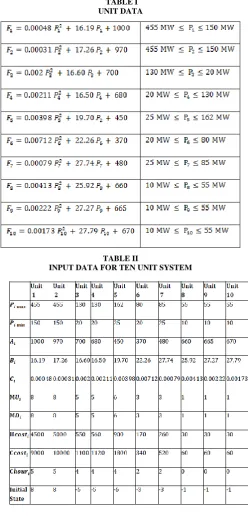
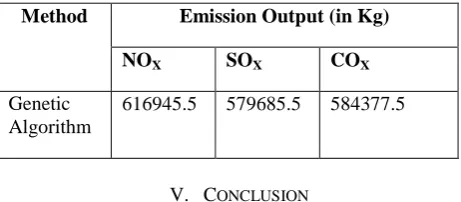
This paper developed the GA algorithm program using Matlab. The 10 generation units system for one day scheduling period is tested to verify the correctness, and the results are compared with other algorithms. Table I, II, III and Fig.3 shows unit input data for the ten unit system, various constraints, load demand for one day scheduling period and the results obtained respectively.
TABLE I UNIT DATA
[image:4.595.43.293.240.761.2]
TABLE II
INPUT DATA FOR TEN UNIT SYSTEM
The unit data and input data for ten unit system is provided in the above given table I, II
[image:4.595.315.557.354.728.2]TABLE III LOAD DEMAND FOR 24 hrs
TABLE IV
UNIT COMMITMENT SCHEDULE FOR 24 HOURS
0 20 40 60 80 100 120
2.34 2.36 2.38 2.4 2.42 2.44 2.46 2.48 2.5 2.52x 10
6 Convergence characteristics
Iternation number
O
p
e
ra
ti
o
n
co
st
(
$
)
International Journal of Emerging Technology and Advanced Engineering
Website: www.ijetae.com (ISSN 2250-2459,ISO 9001:2008 Certified Journal, Volume 3, Issue 5, May 2013)
[image:5.595.44.275.369.470.2]371 The convergence characteristics for operation cost versus iteration are performed. The operation cost ($) is minimized and found to be converged in hundred iterations. It can be seen in Table No.4, GA can find more qualified solutions with much lower execution time in comparison with LR,BF,HPSO. The obtained result in this paper represents a global optimal solution to the problem.
TABLE IV
a) COMPARISON OF EXECUTION TIME OF LR, BF, HPSO AND GA
Methods Total operating
cost ($)
Execution time (sec)
Lagrangian Method 565825 95
Bacterial Foraeging 565872 80
Hybrid PSO 563942.3 73
Genetic Algorithm 562892 56
b) EMISSION OUTPUT OF 10 UNITS USING GA
V. CONCLUSION
A new evolutionary algorithm known as GA is used for solving the UC problem is proposed in this paper. Also in the UC problem, minimum up/down time constraints is considered while producing the feasible solution and therefore no penalty function is used for these constraints. The effectiveness of this algorithm has been tested on systems comprising of ten generating units in one day scheduling period. The fuel cost and losses for each hour were obtained. The test results demonstrate the effectiveness of the GA in searching global or near global optimal solution to the UC problem. Results also show that GA can find high-quality solutions with better convergence and higher precision within a reasonable time. Hence GA is economically beneficial for the reduction of fuel cost.
REFERENCES
[1] V. S. Pappala and I. Erlich, “A new approach for solving the unit commitment problem by adaptive particle swarm optimization,” in Proc. IEEE PES General Meeting, Pittsburgh, PA, Jul. 20–24, 2008, pp. 1–6.
[2] T. O. Ting, M. V. C. Rao, and C. K. Loo, “A novel approach for unit commitment problem via an effective hybrid particle swarm optimization,” IEEE Trans. Power Syst., vol. 21, no. 1, pp. 411– 418, Feb. 2006.
[3] Y. W. Jeong, J. B. Park, S. H. Jang, and K. Y. Lee, “A new quantum inspired binary PSO for thermal unit commitment problems,” in Proc. IEEE 15th Int. Conf. Intelligent System Applications to Power Systems, Curitibia, Brazil, Nov. 8–12, 2009, pp. 1–6.
[4] R. M. Burns and C. A. Gibson, “Optimization of priority lists for a unit commitment program,” in Proc. IEEE Power Eng. Soc. Summer Meeting, 1975, Paper A 75 453-1.
[5] G.B.Sheble, “Solution of the unit commitment problem by the method of unit periods,” IEEE Trans. Power Syst., vol. 5, no. 1, pp. 257–260, Feb. 1990.
[6] W. L. Snyder, Jr., H. D. Powell, Jr., and J. C. Rayburn, “Dynamic programming approach to unit commitment,” IEEE Trans. Power Syst., vol. 2, no. 2, pp. 339–350, May 1987.
[7] Z. Ouyang and S. M. Shahidehpour, “An intelligent dynamic programming for unit commitment application,” IEEE Trans. Power Syst., vol. 6, no. 3, pp. 1203–1209, Aug. 1991.
[8] F. Zhuangand and F.D.Galiana, “Toward amore rigorous and practical unit commitment by Lagrangian relaxation,” IEEE Trans. Power Syst., vol. 3, no. 2, pp. 763–770, May 1988. [9] F. N. Lee, “A fuel-constrained unit commitment method,” IEEE
Trans. Power Syst., vol. 4, no. 3, pp. 691–698, Aug. 1989. [10] S. Virmani, C. Adrian, K. Imhof, and S. Mukherjee,
“Implementation of a Lagrangian relaxation based unit commitment problem,” IEEE Trans. Power Syst., vol. 4, no. 4, pp. 1373–1380, Nov. 1989.
[11] A. I. Cohen and M. Yoshimura, “A branch-and-bound algorithm for unit commitment,” IEEE Trans. Power App. Syst., vol. PAS-102, pp.444–451, Feb. 1983.
[12] J. A. Muckstadt and R. C. Wilson, “An application of mixed-integer programming duality to scheduling thermal generating systems,” IEEE Trans. Power App. Syst., vol. PAS-, pp. 1968– 1978, 1968.
[13] G. B. Sheble and T. T. Maifeld, “Unit commitment by genetic algorithm and expert-system,” Elect. Power Syst. Res., vol. 30, no. 2, pp. 115–121, Jul./Aug. 1994.
Method Emission Output (in Kg)
NOX SOX COX
Genetic Algorithm