Munich Personal RePEc Archive
Estimation of discount factor (beta) and
coefficient of relative risk aversion
(gamma) in selected countries
Ahmed, Waqas and Haider, Adnan and Iqbal, Javed
State Bank of Pakistan, Karachi
29 June 2012
Online at
https://mpra.ub.uni-muenchen.de/39736/
Estimation of Discount Factor
β
and Coefficient of
Relative Risk Aversion
γ
in Selected Countries
Waqas Ahmed
†∗, Adnan Haider
‡and Javed Iqbal
†† Research Department, State Bank of Pakistan.
‡Monetary Policy Department, State Bank of Pakistan.
June 29, 2012
Abstract: We estimate the long-run discount factor for a group of developed and de-veloping countries through standard methodology incorporating adaptive expectations of inflation. We find that the discount factor of developing countries is relatively nearer to unity as compared to that of the developed countries. In the second part, while consider-ing a standard Euler equation for household’s intertemporal consumption, we estimate the parameter of constant relative risk aversion (CRRA) for Pakistan by using the Generalized Method of Moments (GMM) approach. The resulting parameter value of CRRA confirms to the empirical range for developing countries (as given in, Cardenas and Carpenter, 2008). The GMM estimator for the discount factor reinforces its result from the first part of the paper. Consequently we show that different combination values for both the parameters result in different (in terms of magnitude) impulse response functions, in response to tight monetary policy shocks in a simple New Keynesian macroeconomic model.
Keywords: Discount Factor, Risk Aversion, Euler Equation, GMM.
JEL Classifications: C13, D91, E21.
∗Corresponding Author: Waqas Ahmed, Senior Joint Director, Research Department, State Bank of
Pakistan. I.I. Chandrigar Road, Karachi-74000, Pakistan. Email:[email protected], Telephone: +92-21-32453865.
Contents
Contents 2
1 Introduction 3
2 Intertemporal Discounting 4
2.1 Methodology to Calculate Discount Factorβ . . . 5 2.2 Empirical Setup and Estimation Results . . . 8
3 Coefficient of Constant Relative Risk Aversion (CRRA) γ for Pakistan 9
3.1 Estimation of Euler Equation of Consumption . . . 11 3.2 Test for Validity of the Model . . . 13 3.3 GMM Estimation Results . . . 14
4 Conclusion 16
1
Introduction
It is well understood in economics that when there is a need for intertemporal optimiza-tion, it raises the likelihood for discounting of future returns into present day terms,i.e., when economic decisions affecting both the present and the future are being made. All economic agents hence face such discounting issues and tend to have their specific discount factors, which may differ within homogeneous as well as across heterogenous agent space. Households have to intertemporally distribute consumption in order to maximize utility, firms have to manage production over time such that their profits get maximized, policy makers on the other hand are concerned with inter-generational issues, arising due to different fiscal policy stances, and are concerned with maximization of overall social welfare, etc. In short, all economic agents are exposed to the discount factor while dealing intertemporally.
When economic agents make intertemporal decisions they do attach some degree of risk to the future realization of returns. When this degree of risk aversion tends to remain fixed intertemporally then its value is depicted by the intertemporally fixed coefficient of ”constant relative risk aversion” (CRRA). Knowing the degree of risk aversion helps in determining the exact extent of the impact of certain policy shocks on real economic variables.
The paper follows with the discussion, theoretical parameterization and calculation of the discount factor in the next section. Then the third section is divided into various subsections outlining the literature, construction and estimation of Euler equation for consumption. Statistical testing procedures and results for the coefficient of CRRA follows. In the end, we also show that different values of the discount factor and corresponding CRRA coefficient provide impulse responses with different magnitudes from a simple calibrated macroeconomic model.
2
Intertemporal Discounting
Macroeconomic models are complex in nature as they try to establish links between different economic agents who are all otpimizing their returns intertemporally. In doing so these agents need to discount their future returns all the times in order to make decisions in the present. No doubt, when we talk about discount factor it is as subjective as it can be. All households or producers in the same economy can have different basis for their different subjective discount factors. As a result, empirically speaking, there are numerous discount factors in an economy at any given time. But the real issue is that how to first capture this vast information on discount factors and second how to use them in an economic model which is already mathematically challenging. Same has been concluded by Goldin (2007).
as inflation has to be considered in decision making by the economic agents because it tends to erode the real value of assets. Future inflation expectations based on lagged inflation level (technically explained by the term ”adaptive inflation expectations”) are gernerally used to convert the interest rate from nominal to real.
The issue with incorporation of such objectivity in determining the discount factor is that we cannot comment on the intertemporal decision making practices of the economic agents because we are tending to impose such a discount factor on them that may not be the one they follow in real. However, still the logical foundation of this particular method of calculating the discount factor is strong because, while keeping other factors constant, interest rate and inflation do effect intertemporal decision making of all economic agents. The degree of their importance, when compared with other subjective factors of interest, may be relatively lower but they do matter most of the times. This is the reason that we find almost no discussion in macroeconomic calibrated models on discounting behaviors of the economic agents as the behavior has been imposed upon them. This imposition of the discount factor may be relatively better matched with the subjective empirical evidence if any. However, it is difficult to generalize even this much in case of developing countries let alone existence of any solid empirical investigation being available.
Going forward with the calculations of the discount factor, it should be kept in mind that the purpose of this paper is not to discuss the issues of having a single economy wide discount factor. The main purpose is to point out that researchers should use actual data to calculate the parameter instead of taking it as it is from empirical literature especially on developed countries.
2.1
Methodology to Calculate Discount Factor
β
The steady-state discount factor can be easily derived from the optimization conditions of households. The infinite-lived households derive their life time utility based on consumption
ct, real money balances MPt
U0 =Et
∞
X
i=0
βiU i
ct+i,
Mt+i
Pt+i
,(1−nt+i)
(1) where β ∈(0,1) is subjective discount factor. For analytical simplicity, utility function is assumed to be separable and its specification is given as:
Ui
ct+i,
Mt+i
Pt+i
,(1−nt+i)
= (ct+i)
1−γ 1−γ +
ζm,t+i 1−η(
Mt+i
Pt+i
)1−η+ (1−nt+i)1−ν
1−ν (2)
where γ >1,(γ 6= 1) is the parameter of risk aversion, η∈(0,1) is the inverse of interest elasticity of money demand,ν ∈(0,1) is the inverse elasticity of labor supply andζm,t is the stochastic shock to money demand.
It is also assumed that ∂Ut
∂(◦) ≻ 0 and
∂2U
t
∂(◦)2 ≺ 0 which implies that the utility function
follows increasing and diminishing return in each of its arguments.
This above specification is consistent with standard textbook New-Keynesian Model, see for example Gali(2008) and Walsh(2010). Each agent maximizes his lifetime utility (1) based on the following intertemporal budget constraint:
ct+
Mt
Pt +Bt
Pt = Wt
Pt
nt+
Mt−1 Pt
+ (1 +it−1) Bt−1
Pt
+ Πt (3)
wherePt denotes general price level,Btdenotes interest bearing assets withitas nominal gross return on assets at time t. Wtnt is the nominal labor income of the agent and Πt is the real dividend.
Optimization process solves the following problem as:
£=Et
∞ X i=0 βi n
(ct+i)1−γ
1−γ + ζm,t+i
1−η ( Mt+i
Pt+i)
1−η+ (1−nt+i)1−ν
1−ν
o
+λt+i
Wt+i
Pt+int+i+
Mt+i−1
Pt+i + (1 +it+i−1)
Bt+i−1
Pt+i + Πt+i−
ct+i−MPt+i
t+i −
Bt+i
Pt+i
where λt is the langrange multiplier associated with the budget constraint (3). The solution of the above problem yields the following first order conditions (FOCs):
c−γ
t =λt (4)
ζm,t(
Mt
Pt )−η
=λt
1−βEtλt+1 λt
Pt
EtPt+1
(5)
(1−nt)−ν =λt
Wt
Pt
(6)
λt
Pt
=β(1 +it)Et
λt+1
Pt+1
(7) where πt is the gross inflation rate which is defined as change in price level:
πt+1 =
Pt+1−Pt
Pt
(8) Euler equation of intertemporal consumption can be derived by solving (4) and (7) as:
1 =β(1 +it)Et
c−γ t+1
(1 +πt+1)c
−γ t
(9) Using standard non-linear Fisher equation, (1 +rt) = (1 +it)/(1 +Etπt+1) which can be
expressed in log-linearized form as: ˆrt ≈iˆt−Etπtˆ+1, (9) can be simplify as:
1 =β(1 +rt)Et
c−γ t+1
c−γ
t
(10) Finally, steady state relationship can be obtain by setting t = t+ 1 = t∗
. It gives the steady-state discount factor as:
β = 1
(1 +r) (11)
2.2
Empirical Setup and Estimation Results
We start with simply calculating the real interest rates (RIRs) of a set of emerging and developed economies. The RIR is calculated, in general, by Fisher Equationrr =it−Etπt+1.
However, there is conflict regarding what inflation data to use. Should it be the inflation of the preceding time period, present time or an expected value for the future time period. Using the expected value of inflation is also supported by the common Fisher Hypothesis which delinks the real rate of return from all monetary phenomena. In a time series setting it is straight forward to find an expected value of inflation as it is simply the one period lead value of inflation as compared to the present value of the real rate of return. However, in practice we use the one period lag value for inflation as a proxy for its one period lead value, i.e., we make use of the adaptive expectations hypothesis.
Once the real rate of return (RIR) has been calculated from Fisher Equation the discount factor then can be calculated by the formula: β = 1
(1+r) as derived in the previous section.
Real interest rate (RIR) can be calculated for the short run as well as for the long run. In the short run the anchor for nominal interest rate is the 3 months government treasury bills whereas the anchor for the long run is the long-term government bond yield with maturities of 3 years and above.
For a group of developed and developing countries we calculate the discount factor based on the Fisher’s Hypothesis and using the long-run dimension. The data used is from 1960 to 2010.
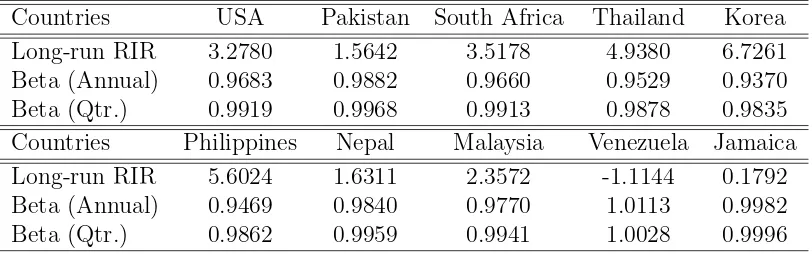
calculated on annual frequency show better comparison with each other because they are quite different for different countries whereas the quarterly values are relatively closer to each other. South Korea has the lowest discount factor whereas Pakistan, India and Nepal have discount factors almost near to one. It may be evident from this exercise that economic agents are more Impatient in countries with very high discount factors as compared to the countries with smaller discount factors. But this result cannot be generalized as such since the objectivity of the purpose of having a single discount factor for all the agents operating in an economy stops their respective subjectivities to creep in (as discussed above).
Table 1: Long-run RIR and Discount Factor β
Countries USA Pakistan South Africa Thailand Korea Long-run RIR 3.2780 1.5642 3.5178 4.9380 6.7261 Beta (Annual) 0.9683 0.9882 0.9660 0.9529 0.9370 Beta (Qtr.) 0.9919 0.9968 0.9913 0.9878 0.9835 Countries Philippines Nepal Malaysia Venezuela Jamaica Long-run RIR 5.6024 1.6311 2.3572 -1.1144 0.1792 Beta (Annual) 0.9469 0.9840 0.9770 1.0113 0.9982 Beta (Qtr.) 0.9862 0.9959 0.9941 1.0028 0.9996
3
Coefficient of Constant Relative Risk Aversion
(CRRA)
γ
for Pakistan
strong assumptions on the stochastic properties of the variables of interest. Once these assumptions fail we get inconsistence estimates of the preference parameters. However, the Generalized Method of Moments (GMM) estimation procedure needs no distributional assumption. GMM estimates are consistent even in the presence of heteroscadasticity and autocorrelation in the error terms. The necessary condition for the GMM method to estimate the structural parameters is that it must hold the moment conditions (or orthogonality conditions).
The performance of non-linear GMM estimators creates a number of problems when we apply it on small sample which create measurement errors (Alan and Browning 2006, Attanasio and Low 2004). One solution of this problem is the use of log-linearized version of Euler equation which has a couple of issues of its own i.e. the log-linearized equation does not give a specification linear in parameters and second the constant of a log-linearized Euler equation includes conditional higher moments of consumption growth and interest rate, which looses identification of discount factor (Alan and Browning, 2006). Attanasio and Low (2004) showed that we can use log-linearized Euler equation even when the income process is heteroscadastic only for long panel data (about 40 periods) but availability of long panel data is not easy. Alan and Browning (2006) developed two alternative GMM estimators that deal explicitly with measurement error. They showed through Monte Carlo simulations that their estimators are better than conventional alternatives even for short panel data. Holt and Laury (2002) found that the average coefficient for developing countries is approximately 0.4 when defining utility over gain and not wealth. Cardenas and Carpenter (2007) showed that the coefficient of relative risk aversion, by ignoring wealth, from risk experiments in developing countries lies between 0.05 (Ethiopia) and 2.57(Paraguay).
of the coefficient of relative risk aversion tends to have a negative bias due to small sample problem. He also showed that the other estimates in the equation are not biased. In the next sections we estimate and test the consumption based asset pricing model for Pakistan’s aggregate data on consumption with annual frequency (from 1960 to 2010) due to its non availability at higher frequencies. The GMM outcome also provides the parameter value for the discount factor as an externality.
3.1
Estimation of Euler Equation of Consumption
The Euler equation of consumption (10) shows the expected rate of return on the assets as well as relative expected consumption stream which is negatively related to the risk aversion parameter. This is what shows if the consumers prefer to trade-off their consumption in the present with that of more of it in the future. In order to estimate preference parameters of the Euler equation, CRRAγ and discount factorβ, GMM technique is used. The necessary condition for GMM method to estimate the structural parameters is that it must hold the moment.
To get the moment condition from equation (10) it is necessary to rearrange this equation as:
β(1 +rt)Et
ct+1
ct
−γ
−1 = 0 (12)
According to Hansen and Singleton (1982) the discrete-time models of the optimization behavior of economic agents often lead to first-order conditions of the form:
Et[h(xt, bo] = 0 (13)
h(xt, bo) =β(1 +rt)Et
ct+1
ct
−γ
−1 (14)
where xt = [rt, ct] and bo =
γ
β
. Let zt denote a q dimensional vector of variables
with finite second moments that are in agents information (e.g., consumption, interest rates, etc...) set. This is also called as a set of instrumental variables shown below:
f(xt, zt,bo) = h(xt, bo)⊗zt (15) From (13) and (15) let us assume (as in Hansen and Singleton, 1982) that:
E[f(xt, zt,bo)] = 0 (16) Now we will construct an objective function that depends only on the available infor-mation of the agents and unknown parameters b. Let g0(b) = E[f(xt, zt,bo)] according to Singleton (1982), if the model in (7) is true then the method of moment estimator of the function g is:
gT(b) = 1
T
T
X
t=1
[f(xt, zt,b)] (17) The value of gT(b) at b =b0 should be close to zero for large values ofT. In this paper,
we follow Hansen and Singleton (1982) and chooseb ∈ω (parameter space) to minimize the function Jt below:
JT(b) =g
′
W∗
T. This can be estimated as:
W∗
T = 1
T
T
X
t=1
[f(xt, zt,b)f(xt, zt,b)
′
] (19)
To compute W∗
T a consistent estimator of bo is needed. This can be obtained by initially using Wt =Ir×r (identity matrix) and suboptimal choice of b in minimizing (18) and we get
the values of bT. By using this value of b in (19) we get WT∗. Again by using the new values of W∗
T, bT can be obtained by minimizing equation (18). We repeat this process until the estimates converge. According to Puzzi (2003) this iterative GMM process is more efficient in small sample than a simple standard two-step procedure given by Hansen and Singleton (1982). There are two advantages of estimating non-linear Euler equation under GMM as given in Hansen and Singleton (1982):
(a) Unlike the maximum likelihood (ML) estimator, the GMM estimator does not require the specification of the joint distribution of the observed variables.
(b) The instrument vector does not need to be economically exogenous. The only re-quirement is that this vector be predetermined in the period when the agent forms his expectations. Both past and present values of the variables in the model can be used as instruments. Model estimator is consistent even when the instruments are not exogenous or when the disturbances are serially correlated.
3.2
Test for Validity of the Model
Following Hansen and Singleton (1982) we test the over identifying restrictions of the model. The test statistics is:
(qm − r) degree of freedom. Where q is the number of equation, m is the number of instruments andris the number of parameters estimated. The null hypothesis for theJ-test is that the over identifying restrictions (moment’s conditions) are accepted. The rejection of the null provides evidence for mis-specification of the econometric model estimated, as well as the underlying economic model from which the Euler equation is obtained.
3.3
GMM Estimation Results
[image:15.612.123.492.549.597.2]We estimate Euler equation (10) using annual data for Pakistan for 1960-2010. The choice of the data frequency is important for econometric practice. Most of the previous work is on the US monthly data series but the monthly or quarterly aggregate consumption and expenditure series are not available for Pakistan. The number of observations, even for the annual data, is only marginally sufficient for estimation however using annual data is the only available option for this study. Annual consumption per capita series for Pakistan for 1960-2010 has been extracted from Economic Survey of Pakistan. The requirement for Generalized Method of Moment estimation is that all variables in the model should be stationary. Before applying GMM stationarity of consumption growth and real interest rate need to be checked. We apply Augmented Dickey- Fuller unit root test to do so. Results in Table 2 show that both the variables are stationary at level.
Table 2: Augmented Dickey- Fuller Unit root Test Results Variables ADF test Statistics Probability Remarks Consumption growth -8.8422 0.0001 Reject null Interest rate -3.1214 0.0312 Reject null
we assume, ct+1 ct =c
∗
.
Instrument sets which we have used in estimation of Euler equation are given below: Set 1: Constant, rt−2, rt−3, c
∗
t−2, c ∗
t−3
Set 2: Constant,(1 +rt−2),(1 +rt−3), c ∗
t−2, c ∗
[image:16.612.75.538.208.285.2]t−3
Table 3: GMM Estimation Results with Different sets of Instruments
Model No. β γ J statistics=(T ×JT(b)) Degree of Freedom P-values 1. 0.992 0.576 4.903 1(=5-2) 0.18
(0.004) (0.045)
2. 0.986 0.571 4.921 1(=5-2) 0.22 (0.008) (0.048)
Note: The terms in parenthesis are standard errors
The estimated results of Euler equation (10) for Pakistan’s annual data are reported in Table 3. From the table, over identifying restrictions are valid for both models, as p values of
J-statistic indicate at 5% significance level. For both sets we get similar results, i.e., CRRA parameter’s value is 0.576 and average discount factor of two alternative specifications is 0.9885 and their standard errors indicate that both are different from zero. Also the estimate for the discount factor confirms the result from the simple Fisher equation used earlier in the paper.
According to Ogaki and Reinhart (1998), there is a negative relationship between γ and
4
Conclusion
References
Alan, S. and M. Browning (2006). Estimating Intertemporal Allocation Parameters Using Simulated Residual Estimation, Working Paper No. 284, Economics Working Papers Series, Department of Economics, University of Oxford.
Amemiya, T. (1985). Instrumental Variable Estimator for the nonlinear Errors-in-Variables model, Journal of Econometrics, 28(3), 273-289.
Attanasio, O. P. and H. Low (2004). Estimating Euler Equations, Review of Economic Dy-namics, 7, 405-435.
Brock, William A. (1982). Asset Prices in a Production Economy, In The Economics of information and uncertainty, edited by John J. McCall. Chicago: Univ. Chicago Press. Cardenas, J. C. and Carpenter, J. P. (2008). Behavioral development economics: Lessons from field labs in developing countries, Journal of Development Studies, 44(3), 311-328. Epstein, L.G. and S.E. Zin (1991). Substitution, Risk Aversion, and the Temporal Behavior of Consumption and Asset Returns: An Empirical Analysis. Journal of Economic Theory, 99(2): 263-286.
Fisher, I. (1930). The Theory of Interest, New York: Macmillan.
Fuhrer, J.C., Moore, G.R., Schuh, S.D. (1995). Estimating the linear-quadratic inventory model: maximum likelihood versus Generalized Method of Moments. Journal of Monetary Economics, 35: 115 - 157.
Gali, J. (2008). Monetary Policy, Inflation and the Business Cycle, Princeton University Press.
Hall, R. E., (1978). Stochastic Implications of the Life Cycle-Permanent Income Hypothesis: Theory and Evidence, Journal of Political Economy, 86: 971-987.
Hall, R. E., (1988). Intertemporal substitution in consumption.Journal of Political Economy, 96: 339–357.
Hansen, L.P., (1982). Large Sample Properties of Generalized Method of Moments Estima-tors. Econometrica, 50: 1029-1054.
Hansen, L. P. and T. J. Sargent (1980). Formulating and Estimating Dynamic Linear Ra-tional Expectations, Journal of Economic Dynamics and Control, Vol. 2, 7-46.
Hansen, L.P. and K.J. Singleton (1982). Generalized Instrumental Variables Estimation of Nonlinear Rational Expectations Models, Econometrica. 50: 1269-1286.
Hansen, L.P. and K.J. Singleton (1984). Generalized Instrumental Variables Estimation of Nonlinear Rational Expectations Models: Errata, Econometrica. 52: 267-268.
Hansen, L.P., Heaton, J., Yaron, A.(1996). Finite sample properties of some alternative GMM estimators. Journal Business and Economics Statistics, 14: 262-280.
Hansen, L.P. and K.J. Singleton (1996). Efficient Estimation of Linear Asset Pricing Models with Moving-Average Errors, Journal of Business and Economic Statistics, 14: 53-68. Holt, C. A. and Laury, S. K. (2002). Risk aversion and incentive effects,American Economic Review, 92: 1644-1655.
Kocherlakota, N.R. (1990). On tests of representative consumer asset pricing models,Journal of Monetary Economics, 26: 285-304.
Murat T. (2006). Aggregate Consumption and the Risk Free Rates in Turkey: An Empirical AnalysisSosyal Bilimler Dergisi.
Mao, C. (1990). Hypothesis testing and finite sample properties of Generalized Method of Moments estimators: a Monte Carlo study, Working Paper 90-12, Federal Reserve Bank of Richmond.
Ogaki, M., Reinhart, C.M. (1998). Measuring intertemporal substitution: the role of durable goods. Journal of Political Economy, 106: 1078–1098.
Pozzi, L. (2003). The coefficient of relative risk aversion: a Monte Carlo study investigating small sample estimator problems, Economic Modeling 20: 923-940.
Appendix
For counterfactual simulations, we have considered the following log-linearized version of textbook New-Keynesian model:
˜
yt =Et
n˜
yt+1
o
− 1
γ(it−Et(
˜
πt+1)−rn)→(Linearized−IS−Curve) (21) ˜
πt =βEt(
˜
πt+1) +κ ˜
yt →(Linearized−N K−P hillips−Curve) (22) Where, κ= (1−θ)(1−βθ)Θ
θ
rn=ρ+γψ(ρa−1)at→(Linearized−natural−rate−equation) (23)
˜
yt=at+ (1−α)nt→(Linearized−production−f unction) (24)
˜
mt=
˜
πt+
˜
yt−η(it)→(Linearized−money−demand−f unction) (25)
it =ρ+ϕπ
˜
πt+ϕy
˜
yt+vi,t →(Linearized−T aylor−rule) (26)
at=ρaat−1+ǫa,t→(Productivity−Shock) (27)
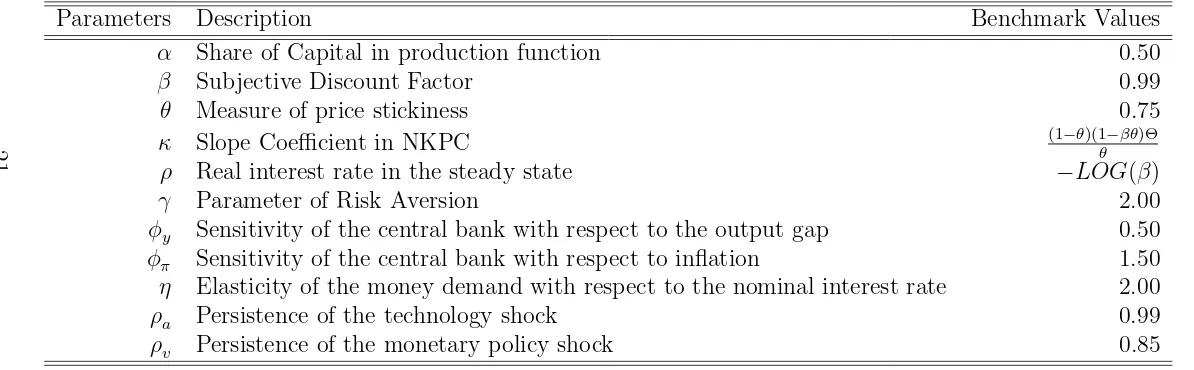
Table 4: Selected parameter values for simulations
Parameters Description Benchmark Values
α Share of Capital in production function 0.50
β Subjective Discount Factor 0.99
θ Measure of price stickiness 0.75
κ Slope Coefficient in NKPC (1−θ)(1−βθ)Θ
θ
ρ Real interest rate in the steady state −LOG(β)
γ Parameter of Risk Aversion 2.00
φy Sensitivity of the central bank with respect to the output gap 0.50
φπ Sensitivity of the central bank with respect to inflation 1.50
η Elasticity of the money demand with respect to the nominal interest rate 2.00
ρa Persistence of the technology shock 0.99
ρv Persistence of the monetary policy shock 0.85
Figure 1: Impact of Positive Monetary Policy Shock: When θ = 0 (i.e., Flexible Prices) -0.250 -0.200 -0.150 -0.100 -0.050 0.000
1 2 3 4 5 6 7 8 9 10 11 12 13 14 15 16 17 18 19 20
Sim1[β=0.99, γ=0.05] Sim2[β=0.99, γ=0.75]
Sim3[β=0.99, γ=1.50] Sim4[β=0.99, γ=2.00]
Sim5[β=0.95, γ=0.05] Sim6[β=0.95, γ=0.75]
Sim6[β=0.95, γ=0.75] Sim8[β=0.95 γ=2.00]
Response of Output Gap
Quarters -0.500 -0.450 -0.400 -0.350 -0.300 -0.250 -0.200 -0.150 -0.100 -0.050 0.000
1 2 3 4 5 6 7 8 9 10 11 12 13 14 15 16 17 18 19 20
Response of Money Demand
Quarters -0.650 -0.550 -0.450 -0.350 -0.250 -0.150 -0.050
1 2 3 4 5 6 7 8 9 10 11 12 13 14 15 16 17 18 19 20
Response of Inflation
Quarters -0.250 -0.200 -0.150 -0.100 -0.050 0.000
1 2 3 4 5 6 7 8 9 10 11 12 13 14 15 16 17 18 19 20
Response of Employment
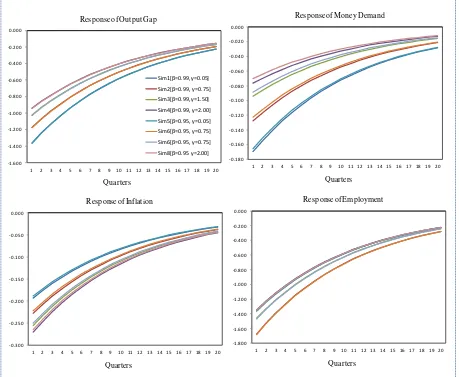
Figure 2: Impact of Positive Monetary Policy Shock: When θ= 0.75 (i.e., Sticky Prices) -1.600 -1.400 -1.200 -1.000 -0.800 -0.600 -0.400 -0.200 0.000
1 2 3 4 5 6 7 8 9 10 11 12 13 14 15 16 17 18 19 20
Sim1[β=0.99, γ=0.05] Sim2[β=0.99, γ=0.75]
Sim3[β=0.99, γ=1.50]
Sim4[β=0.99, γ=2.00]
Sim5[β=0.95, γ=0.05]
Sim6[β=0.95, γ=0.75]
Sim6[β=0.95, γ=0.75]
Sim8[β=0.95 γ=2.00]
Response of Output Gap
Quarters -0.180 -0.160 -0.140 -0.120 -0.100 -0.080 -0.060 -0.040 -0.020 0.000
1 2 3 4 5 6 7 8 9 10 11 12 13 14 15 16 17 18 19 20 Response of Money Demand
Quarters -0.300 -0.250 -0.200 -0.150 -0.100 -0.050 0.000
1 2 3 4 5 6 7 8 9 10 11 12 13 14 15 16 17 18 19 20
Response of Inflation
Quarters -1.800 -1.600 -1.400 -1.200 -1.000 -0.800 -0.600 -0.400 -0.200 0.000
1 2 3 4 5 6 7 8 9 10 11 12 13 14 15 16 17 18 19 20
Response of Employment