Journal of Chemical and Pharmaceutical Research, 2016, 8(8):922-928
Research Article
CODEN(USA) : JCPRC5
ISSN : 0975-7384
Hemoglobin concentration measurement based on magnetic sensor
Ahmad Aminudin
1*, Mitra Djamal
2,4, Suprijadi
2and Daryono Hadi Tjahyono
31
Department of Physics, Faculty of Mathematics and Natural Sciences Education, Universitas Pendidikan Indonesia, Jl. Dr.Setiabudi No.229, Bandung, Jawa Barat, Indonesia
2Theoretical High Energy Physics and Instrumentation Research Group, Faculty of Mathematics and Natural
Sciences, Institut Teknologi Bandung, Jl. Ganesha No.10, Bandung, Jawa Barat, Indonesia
3
Pharmacy School, Institut Teknologi Bandung , Jl. Ganesha No.10, Bandung, Jawa Barat, Indonesia
4Departement of Physics, Institut Teknologi Sumatera, Jl.Terusan Jenderal Ryacudu, Lampung Selatan, Indonesia
ABSTRACT
The paper presents the measurement system of hemoglobin concentration using ginat magnetoreistance (GMR) sensor. Hemoglobin was magnetized by a strong magnetic field 1,1T.The hemoglobin was influenced by an external magnetic field. Then, the magnetic field of hemoglobin was detected by GMR sensor. GMR sensor circuit was developed using wheatstone bridge.The results of tests are obtained using sensitivity parameter of GMR sensor . Respons of the voltage of GMR sensor versus the concentration of hemoglobin have been obtained the linear equations. A strong correlation between the voltage of GMR sensor and the concentration of hemoglobin was revealed. The sensitivity of GMR sensor were 20.22
/ , 20.34 / , 20.45 / , 20.59 / and 20.95 / for the
flow rate 0.29 cm/s, 0.31 cm/s, 0.33 cm/s, 0.35 cm/s and 0.37 cm/s respectively. The sensitivity of GMR sensor increased with increase of flow rate and concentration of hemoglobin. Incresing the flow rate, rising the unbalance of the bridge circuit and incresing the zero drift of GMR sensor. The prototype of hemoglobin concentration measurement has developed successfully.
Key words: Hemoglobin Concentration, GMR sensor, Sensitivity, Magnetization, Flow rate
INTRODUCTION
The Blood in the human body has a highly essential. In the human body consists of 55% of blood fluid and 45% of blood cells, if summed overall in adults about 4-5 liters. Blood cells consist of erythrocytes (99%), thrombosit (0.6 to 1.0%), and leukocytes (0.2%). Erythrocytes contain hemoglobin which serve to circulate oxygen. This means, blood cells are dominated by the hemoglobin. Hemoglobin is a protein molecule in red blood cells that carries oxygen from the lungs to the body's tissues and carbon dioxide from the tissues to the lungs. Hemoglobin has four protein molecules (chain globulin) are connected together. Each chain globulin contains important central structure called heme molecules. Iron-containing heme molecule that transports oxygen and carbon dioxide in the blood. This iron is what gives the red color of blood.
Figure 1. Heme structure consists of porphyrin dan Fe[2]
Magnetic properties of hemoglobin are obtained from oxyhemoglobin, carbonmonoxyhemoglobin, and ferrohemoglobin to fill four unpaired electrons per heme. Carbonmonoxyhemoglobin molecule has a zero magnetic moment and there are no unpaired electrons. Oxyhemoglobin molecules much like carbonmonoxyhemoglobin, zero magnetic moment and there are no unpaired electrons. Ferrohemoglobin, in contrast to oxyhemoglobin and carbonmonoxyhemoglobin, hemoglobin itself contains unpaired electrons, magnetic susceptibility shows paramagnetic contributions. Magnetic data interpretation can be made only in relation to the nature and magnitude of their mutual interaction of the four heme molecule. One possibility is that the heme-heme interaction is strong enough for a few moments all the electrons in the molecule becomes resultant moment, with the same value for all molecules. Magnetic data in this way result the value, = 10.92 Bohr magnetons [2]. The paramagnetic molar of deoxyhemoglobine susceptibility (HHb) is 3,000 mol/ml [3] and by determining a magnetisation curve for erythrocytes the magnetic dipole moment of HHb is estimated to be 8µB or µHHb = 7.42x10⁻²³ Am2 [4]. In a strong
static magnetic field an erythrocyte responds in such way that its disk plane is oriented parallel to the direction of the magnetic field, independently of the hemoglobin state, i:e., oxygenated (diamagnetic HbO2) or deoxygenated (paramagnetic HHb) [5].
[image:2.595.235.378.79.237.2]Magnetic properties of hemoglobin is very weak. To be able to detect the magnetic properties of magnetic sensors hemoglobin needed working weak magnetic field. One of the sensors that can detect weak magnetic field sensor is giant magnetoresistance (GMR). GMR sensor is a sensor that works based on the effect of changes very big obstacle on metallic materials when in an external magnetic field. GMR sensors have several advantages when compared to other sensors, such as having high sensitivity, high temperature stability, low power consumption, size is relatively small, and a fairly cheap price as well as the magnetic properties can be varied within a very wide range [6]. Comparative characterization in some field sensor with GMR sensors can be shown in Table 1.
Table 1. Characteristics different in magnetic field sensor [7]
Sensor
Range H (T)
Sensitivities (V/T)
Time Respon
Powe r
Consumtion head size
GMR 10-12-10-2 120 1 MHz 10 mw 10-100µm
Hall 10-6-102 0,65 1 MHz 10 mw 10-100µm
Squid 10-14-10-6 Okt-14 1 MHz 10 mw 10-100µm
Fluxgate 10-12-10-2 3.2 5 kHz 1 w 10-20mm
The magnetization was the number of magnetic dipole moment of hemoglobin per unit volume, can be symbolized by M and can be written in equation
∑ (1)
Where M is the magnetization (A / m), mHb is the magnetic dipole moment of hemoglobin, (Am 2
) and V is the volume (m3). Mangetization can be influenced by hemoglobin flow rate. For diamagnetic and paramagnetic material the magnetic suseptibility χ relates magnetization of hemoglobin can be written:
χ (2)
GMR sensor circuit was developed using wheatstone bridge. Four resistif elemens were used to wheatstone bridge circuite shown in Figure 2 [16]. GMR sensor used AA002 series from product of NVE corporation [17].
Figure 2. GMR Sensor Circuit
In Figure 2 , GMR1 sensor was used to detect hemoglobin magnetic feild, GMR2 sensor was used for noise compensator. Resistor R1 and R2 were fixed value, variable resistor VR was adjustable value. The variable resistor (VR) was used to adjust the balance of bridge circuit. Output voltage (Vout ) was calculated from the potential
difference Vb to Vc . If reference potential was the ground at the point d, the output voltage was expressed by the equation:
(3)
In balanced condition, potential at point b was equal point c. This condition determined the zero measurement and no environmental influences. When GMR sensor was induced by hemoglobin magnetic field, the potential at point b and c were not equal, so that resulting in a potential difference. Then, the potential difference was measured using a digital multimeter. Sensitivity of GMR sensor can be obtained from equation (1), (2) and (3):
, (4)
where SV,Hb ,Vout GMR, and nHb are the sensitivity of GMR sensor, the output Voltage of GMR sensor and the
concentration of hemoglobin, respectively [18].
EXPERIMENTAL SECTION
GMR sensor was measured using digital voltmeter. The Schematic of hemoglobin concentration measurement was shown in Figure 4.
Figure. 3. Sample of Package Red Cell (PRC)
Figure 4. Schematic of hemoglobin concentration measument
In Figure 3, when the hemoglobin flow past the magnet, the hemoglobin was influenced by an external magnetic field, so that change of the magnetic moment orientation. Hemoglobin had been magnetized by a strong magnetic field 1,1T. Then, the magnetic field of hemoglobin was detected by GMR sensor.
RESULTS AND DISCUSSION
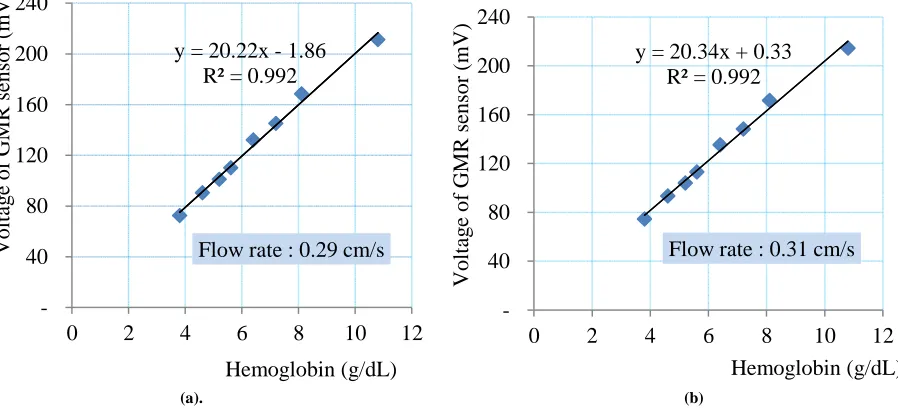
Prototype tests of hemoglobin concentration measuremen system have been done and have been analyzed based on linearity, sensitivity and zero drift correlate with flow rate and concentration. Figure 5 shows the results of the response tests of the GMR sensor versus hemoglobin concentrations at various flow rates.
(a). (b)
Figure 5. Voltage of GMR sensor versus hemoglobin concentration with (a) flow rate 0.29 cm/s and (b) flow rate 0.31 cm/s
y = 20.22x - 1.86
R² = 0.992
40
80
120
160
200
240
0
2
4
6
8
10
12
V
ol
ta
g
e
of
G
M
R
s
ens
or
(
m
V
)
Hemoglobin (g/dL)
Flow rate : 0.29 cm/s
y = 20.34x + 0.33
R² = 0.992
40
80
120
160
200
240
0
2
4
6
8
10
12
V
ol
ta
g
e
of
G
M
R
s
ens
or
(
m
V
)
(a) (b)
Figure 6. Voltage of GMR sensor versus hemoglobin concentration with (a) flow rate 0.33 cm/s and (b) flow rate 0.35 cm/s
(e)
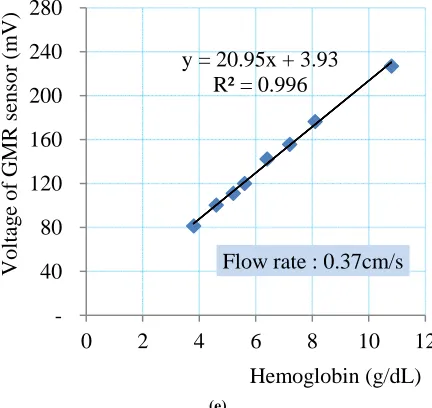
Figure 7. Voltage of GMR sensor versus hemoglobin concentration with flow rate 0.37cm/s
Based on the linearity, the curves in Figure 5 obtained highly linear with a correlation coefficient of tests 1-5 ware 0.992, 0.992, 0.993, 0.994 and 0.995 respectively. Figure 5, 6 and 7 shown curves of the voltage of GMR sensor versus the concentration of hemoglobin. From curves have been obtained the linear equations. The linear equations are
! 20.22 % ! 1.86 on the flow rate 0,29cm/s, (5)
) 20.34 % )+ 0.33 on the flow rate 0,31cm/s, (6)
- 20.45 % -+ 1.96 on the flow rate 0,33cm/s, (7)
0 20.59 % 0+ 3.65 on the flow rate 0,35cm/s and (8)
1 20.95 % 1+ 3.93 on the flow rate 0,37cm/s. (9)
Figure 5, 6 and 7 obtains the impact of hemoglobin concentration to voltage of GMR sensor. A strong correlation between the voltage of GMR sensor and the concentration of hemoglobin was revealed. From this figure, it is confirmed that the voltage of GMR sensor increased with increase of hemoglobin concentration.
y = 20.45x + 1.96
R² = 0.993
40
80
120
160
200
240
0
2
4
6
8
10
12
V
ol
ta
g
e
of
G
M
R
s
ens
or
(
m
V
)
Hemoglobin (g/dL)
Flow rate :0.33cm/s
y = 20.59x + 3.65
R² = 0.994
40
80
120
160
200
240
0
2
4
6
8
10
12
V
ol
ta
g
e
of
G
M
R
s
ens
or
(
m
V
)
Hemoglobin (g/dL)
Flow rate : 0.35 cm/s
y = 20.95x + 3.93
R² = 0.996
40
80
120
160
200
240
280
0
2
4
6
8
10
12
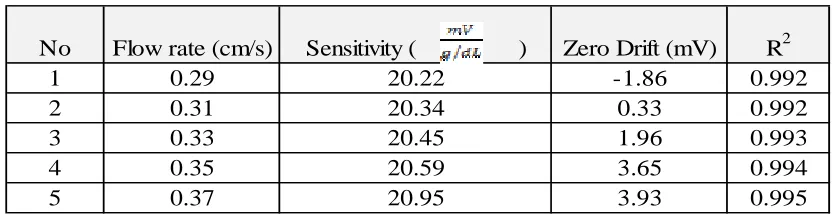
[image:5.595.197.413.304.508.2]Table 2 showns list of sensitivity, zero drift and correlation coefficient (R2) on various flow rate.
Based on Table 2, the sensitivity of GMR sensor were 20.22
/ , 20.34 / , 20.45 / , 20.59 / and 20.95 /
for the flow rate 0.29 cm/s, 0.31 cm/s, 0.33 cm/s, 0.35 cm/s and 0.37 cm/s respectively.
[image:6.595.97.513.221.328.2]Table 2 shown, increasing the flow rate, rising the volume of hemoglobin. Incresing the volume of hemoglobin, rising magnetic susceptibility and increasing magnetization according to the equation (2). Incresing the magnetization, rising the sensitivity of GMR sensor. Finally, the sensitivity of GMR sensor increased with increase of flow rate. The zero drift of GMR sensor were 1,86 mV, 0.33 mV, 1.96 mV, 3.65 mV and 3.93 for the flow rate 0.29 cm/s, 0.31 cm/s, 0.33 cm/s, 0.35 cm/s and 0.37 cm/s respectively. Incresing the flow rate, rising the unbalance of the bridge circuit and incresing the zero drift of GMR sensor.
Table 2. List of sensitivity, zero drift and correlation coefficient (R2) on various flow rate
1
0.29
20.22
-1.86
0.992
2
0.31
20.34
0.33
0.992
3
0.33
20.45
1.96
0.993
4
0.35
20.59
3.65
0.994
5
0.37
20.95
3.93
0.995
No
Flow rate (cm/s)
Sensitivity ( )
Zero Drift (mV)
R
2CONCLUSION
From above data, we conclude that experimental system can be used for hemoglobin level measurement based on magnetic sensor. Respons of the voltage of GMR sensor versus the concentration of hemoglobin have been obtained the linear equations. A strong correlation between the voltage of GMR sensor and the concentration of
hemoglobin was revealed. The sensitivity of GMR sensor were 20.22
/ , 20.34 / , 20.45 / , 20.59 / and
20.95
/ for the flow rate 0.29 cm/s, 0.31 cm/s, 0.33 cm/s, 0.35 cm/s and 0.37 cm/s respectively. The sensitivity
of GMR sensor increased with increase of flow rate and concentration of hemoglobin. The zero drift of GMR sensor were 1,86 mV, 0.33 mV, 1.96 mV, 3.65 mV and 3.93 for the flow rate 0.29 cm/s, 0.31 cm/s, 0.33 cm/s, 0.35 cm/s and 0.37 cm/s respectively. Incresing the flow rate, rising the unbalance of the bridge circuit and incresing the zero drift of GMR sensor.
Acknowledgements
The authors thank to Mrs. Fitri as laborant at Blood Center PMI Cabang Bandung, for preparing hemoglobin sampels.
REFERENCES
[1] Murray,Granner,Mayes,Rodwell, Harper’s Illustrated Biochemistry, McGraw-Hill Companies Inc 2003, 40-48 [2] Linus Pauling , Magnetic properties and structure of oxyhemoglobin, Institute of Science and Medicine 2700 Sand Hill Road, Menlo Park, California 94025, 1977, 74 (7), 2612-2613,
[3] M. Cerdonio, S. Morante and S. Vitale, Methods Enzymol.1981, 76, 354. [4] L. Sakhnini and R. Khuzaie, Eur. Biophys J. 2001, 30, 467.
[5] T. Higashi et al., Blood ,1993, 82, 1328.
[6] M.Djamal,Ramli,R.Wirawan, E.Sanjaya , Sensor Magnetik GMR,Teknologi dan Aplikasi Pengembangannya, Prosiding Pertemuan Ilmiah XXV HFI Jateng & DIY, 2011, 25, 4-10
[7] M.Han, D.F. Liang, L.J. Deng, Journal of Material Science, 2005, 40, 557-5580.
[8] Baibich,M.N, Broto, J.M.,Fert, A.,Nguyen Van Dau, F., Petroff, F., Etienne, P.,Creutz.,A., Friederich,A., Chazalas, Giant Magnetoresistance of (001) Fe/(001) Cr Magnetic Superlattices, J,Phys. Rev. Lett. 1988, 68, 2472-2475
[9] Wang, W., Wang, Y., Tu, L., Klein, T., Feng, Y., Wang, J.-P. IEEE Transactions on magnetic, 2013, 49 (1), 296-299
[10] A. Shoshi, J.Schotter, P.Schroeder, M.Milnera, P.Ertl, R.Heer, G.Reiss, H.Brueckl, Biosensors and
Bioelectronics, elseiver, 2013, 40, 82–88
[12] Drew A. Hall, Shan X. Wang, Boris Murmann , Portable Biomarker Detection with Magnetic Nanotags, Stanford University Department of Electrical Engineering Stanford, CA, USA IEEE , 2010.
[13] Chee Teck Phua; Lissorgues, G., "Non-invasive measurement of blood flow using magnetic disturbance method," Biomedical and Pharmaceutical Engineering,. ICBPE '09. International Conference on , 2009, 1(4), 2-4 [14] J.C.Rife,M.M.Miller, P.E.Sheehan, C.R.Tamanaha,M. Tondra and L.J.Whitman, Physical, 2003, 107, 209-218, [15] Adam Kurnicki, Needle type GMR sensor in biomedical applications, PRZEGLĄD ELEKTROTECHNICZNY, 2013, ISSN 0033-2097, R. 89 NR 3b
[16] William David Cooper, Electronic Instrumentation and measurement, 2nd Edition, Prentice Hall,Inc., Englewood Cliffs, N.J., USA, 1994, 148-157
[17] NVE Corporation, 2007, Application Note, www.nve.com
![Table 1. Characteristics different in magnetic field sensor [7]](https://thumb-us.123doks.com/thumbv2/123dok_us/8738667.889427/2.595.235.378.79.237/table-characteristics-different-magnetic-field-sensor.webp)