An Optimized Ambulance Dispatching Solution for
Rescuing Injures After Disaster
Hazan Da˘glayan
,
Murat Karakaya
∗Department of Computer Engineering, Atilim University, ˙Incek, 06836, Ankara, Turkey
Copyright c2016 by authors, all rights reserved. Authors agree that this article remains permanently open access under the terms of the Creative Commons Attribution License 4.0 International License
Abstract
In this work, we propose a Genetic Algorithm (GA) for effectively scheduling ambulances aftermath of a disaster. Given the limited number and capacity of ambulances, we aim to minimize the number of ambulance tours and the average time to take all injured people to a hospital. Both of these goals require that the total tour length of all routes should be minimized as well. This problem can be considered as an extension of the well-known Ca-pacitated Vehicle Routing Problem (CVRP). We developed a Genetic Algorithm (GA) and tested using some of the CVRP benchmark files. For the possible number of injures at each location, we define three different scenarios. The proposed GA aims to minimize the tour lengths of the ambulances while respecting all real life constraints given in these scenarios. In order to evaluate the proposed GA, we also developed a rival method based on the Nearest Neighbor (NN) heuristic. The results of extensive simulation tests NN heuristic.Keywords
Genetic Algorithm, Vehicle Routing Problem, Capacitated Vehicle Routing Problem, Ambulance Routing, Nearest Neighbor Heuristic1
Introduction
The disaster can happen naturally or due to human effects. These disasters can damage both the existing infrastructures and human beings at a larger scale. In those situations, effec-tive logistic operations are hard to be carried out, and, thus, efficient medical aid may not be provided on time, which, in turn, causes more losses. Therefore, after a disaster, rescue and aid operations must be well planned and must be con-ducted efficiently [1].
In an emergency situation, firstly injured people are to be transferred to hospitals. To perform this task efficiently, we have to know the location and number of the injured people, the number and the capacity of the ambulances since all these values are the input to the problem solution. After collecting these inputs, we have to develop a ambulance scheduling so that injures can be transferred to hospitals in a short time.
The above mentioned problem is related with the Capac-itated Vehicle Routing Problem (CVRP) [2] which is a type
of Vehicle Routing Problem (VRP). In VRP, there are cos-tumers and their demands. The aim is to minimize the total distance for transmitting goods according to the customer de-mands to all customer location from the depot location by a vehicle. The vehicle is loaded with goods from the depot, and the goods are distributed to customers. If the carried goods are run out off, the vehicle returns to the depot. If the vehicle’s carrying capacity is limited with a given quan-tity, the VRP is called Capacitated Vehicle Routing Prob-lem (CVRP). There are various types of solutions are pro-posed for CVRP: exact solutions, heuristic, or meta-heuristic methods. Some researchers propose methods to find the ex-act solution. However, these methods may be infeasible for large number of customers because the CVRP is defined as a non-deterministic polynomial problem (NP-hard). There-fore, meta-heuristic and heuristic methods are usually imple-mented to solve CVRP with larger number of customers ef-ficiently such as Simulated Annealing [3], Particle Swarm Optimization [4], Ant Colony [5], Genetic Algorithm [6] etc. For these types of optimization problems, the solution quali-ties of different meta-heuristics are not found to be drastically different [7]. In this paper, we opt to use the GA for its ma-tured methodology and proven robustness [8].
To compare the proposed GA, we also implement a heuris-tic method called Nearest Neighbor (NN). We tested both so-lutions using many CVRP benchmarks under different sce-narios. In each scenario, the number of injured people at each location is determined randomly using some threshold val-ues. We simulated all the scenarios and solutions via MAT-LAB tool. The results indicates the successo the proposed GA solution over the NN heuristic.
The remainder of this paper is organized as follows. The related work of the ambulance routing problem is given in Section 2. The GA and its operators are described in details in Section 3. In Section 4, the adaptation of NN algorithm to our problem is presented while the implementation of the proposed GA is provided in Section 5. The simulation test results of the solutions are given in Section 6, and finally, Section 7 covers conclusions and implications.
2
Related Work
deal with picking up injured peoples information from dif-ferent locations and delivering them to the hospital after an earthquake disaster [9]. Gong et. al. proposed that data fu-sion center helps to improve dispatching efficiency by de-creasing travel time to hospital. In their work, the considered key factors are patient priority, cluster information, and dis-tance. Thus, the authors assume that ambulance capacity is only one. However, in this work, we consider the fact that there can be some ambulances with larger capacities. In an-other work, Nordin et. al. attempt to solve the problem by finding the shortest path of the ambulance with the A* algo-rithm [10]. In the experiments, they used the data collected at a clinic. However, the calculated path is from a specified ambulance station to a specified emergency site. Thus, the researchers do not consider multiple emergency sites when creating paths. In our study, we consider a specified hospital but multiple locations of injured people.
While some studies classify the injured people according to their emergency as being serious or moderate when they search for an optimal path, some other studies consider risk properties involved in the given problem [1, 11]. For exam-ple, Kula [11] uses the medium-integer linear programming to find the path after classifying locations according to their risk evaluations aftermath of an earthquake. The problem resembles Dynamic Vehicle Routing Problem. Talarico [1] proposes a large neighborhood search meta-heuristic to the dynamic and uncertainty conditions for ambulance routing after a disaster. The method categorizes peoples situations about being serious or slightly serious.
In a previous work, we propose a simplified solution to a version of this problem [12]. In this work, we extended the solution by improving crossover operators and conducted ex-tensive simulation test using CVRP benchmarks. Moreover, we analyzed the effect of the GA parameter values such as generation number, population size, and location numbers.
3
Genetic Algorithm
Genetic Algorithm (GA) is a meta-heuristic depends on the evolutionary approach. Each possible solution is encoded as a chromosome which consists of genes. GA begins with solving a problem with an initial population of chromosomes Each chromosome has a fitness value computed according to the quality of the encoded solution in itself. By applying crossover and mutation operators on the existing population, GA creates a new generation. A selection method picks up two chromosomes as parents from the population. Crossover operator exchanges genes of these parents to create two off-springs. Mutation operator modifies the constructed chromo-some structure. Until the given termination condition is met, GA continues to create new generations and improves the quality of found solution. When the termination condition is satisfied, GA outputs the best chromosome with the high-est fitness value as the optimum solution. Below, we provide the details of the GA operators and procedures.
3.1
Fitness ValueFitness value is calculated after each new individual is cre-ated. It evaluates the quality of the generated solution accord-ing to the given optimization goal. Accordaccord-ing to the elitism principle, the individual with the maximum fitness value in the current population is maintained for the next generation.
3.2
Selection OperatorThe selection operator is used to choose two chromosomes as the parents from the current population to create new indi-vidual for the next generation by applying crossover or mu-tation operators.
Some well-known selection operators are tournament se-lections, roulette wheel selection, and steady-state approach . The tournament selection helps to find the best individual of tournament size number individual [13, 14, 15]. For instance, if the tournament size is 2, which is called binary tournament size, two individuals are selected randomly, and better one of the two will be the winner.
The Roulette Wheel Selection is proposed to select the chromosomes considering their fitness value: Greater the fit-ness value is, greater the probability of being selected as a parent is [16, 14].
The steady-state approach ensures that two parents and two offsprings are compared; the best two chromosomes of them are selected [17].
3.3
CrossoverCrossover is the main process of the GA to vary the chro-mosomes from one generation to the next. Two selected par-ents produce two offsprings according to the given crossover operator. The main idea is to combine parents to create off-springs whose fitness values are higher. Some most popu-lar crossover operators are Edge Recombination Crossover (ERX) [17, 18, 19], one point or two points crossover [20, 21] and order crossover [22].
3.4
MutationMutation operator is used to getting rid of the local opti-mum points. When mutation is not used, the local optiopti-mum solution can be reported as global optimum solution. Swap [18, 21, 23], insertion [23] and inversion [18, 23] mutations are well-known mutation types.
4
Adaptation of NN Heuristic
Nearest Neighbor (NN) is a heuristic method which is pro-posed in Travelling Salesman Problem (TSP) and Vehicle Routing Problem (VRP) [24]. In NN method, the nearest unvisited node to the current one is selected as the next node until all nodes are visited.
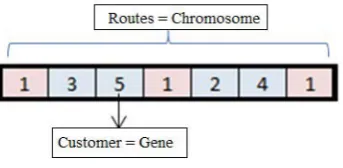
Figure 1.Representation of the relation between CVRP and GA
Figure 2.Representation of the relation between CVRP and the problem
5
Implementation of GA
5.1
Representation of the ProblemThe stated problem has similar properties to the CVRP problems. Each of the customer location is represented as an injured people location while customers demands are rep-resented as the number of injured people in each location. Moreover, the capacity of the vehicle in CVRP corresponds to the number of the injured people that an ambulance can take, and the depot is represented as the hospital.
The CVRP can be encoded into GA as follows. The cus-tomer locations in the CVRP are represented as genes in chromosomes. That is, in our problem, the locations of in-jured people are represented in genes by the location num-ber. Moreover, the routes which consist of these locations are chromosomes in GA and all possible routes construct the population. Besides, the total distance among all locations in a chromosome is defined as the fitness value. By applying the proposed crossover and mutation operators to the chromo-somes at each generation, the minimal distance (maximum fitness value) is found.
5.1.1 Encoding Schema
In the CVRP, the location of customers and depot is rep-resented with a number. These numbers are reprep-resented as genes in a chromosome while the proposed solution which consists of these numbers is represented as the chromosome in GA illustrated in the Figure 1. Moreover, the depot in CVRP is encoded as hospital and the customers are repre-sented as the location of injures. Each customer has coordi-nates (x,y) and demands in CVRP whereas the locations have the information of coordinates and the number of injures in our problem shown in Figure 2
5.2
Genetic Algorithm OperationsBelow, we explain how we modified the GA to adopt our problem. In each cycle, a new generation is constructed and off-springs are created applying crossover and mutation op-erators. Termination condition is a fixed number for the
gen-Figure 3.Flowchart of the proposed GA solution
[image:3.595.56.277.215.285.2]erated generations. The flowchart of the algorithm is given in Figure 3.
5.2.1 Validation
Each produced chromosome is tested against validation rule. Basically, a chromosome is valid if the total number of injures picked-up from the locations as in the order of the genes does not violate the capacity constraint of ambulance. That is, when the ambulance is fully loaded with the injures, it must return to the hospital. In addition, the ambulance does not return to the hospital when it is not fully occupied un-less all injures already transferred. When a chromosome is not validated, it is trimmed such that the ambulance returns to hospital. In other words, an invalid chromosome can be fixed by inserting the hospital location into proper order of the genes. Thus, modified chromosome becomes a valid one. To solve the validation problem, all 1’s (depots) are removed from the chromosome and then according to demands, 1’s are inserted when the capacity is fulled.
5.2.2 Initialization
The initial population is created randomly. After random-ization, the population must be validated according to process described above.
5.2.3 Fitness Value
In our problem, fitness value of a chromosome is the total route distance. The minimum value of the distance is main-tained for the next generation. The fitness function F can be formulated as
F = n
X
i=1
p
(xi−xi−1)2+ (yi−yi−1)2 (1)
where(xi, yi)is the coordinate of the geneiandnis the number of total genes in a chromosome.
5.2.4 Selection
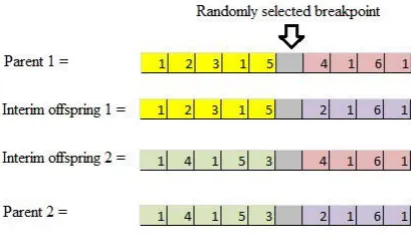
off-Figure 4.First step of a sample of One Point Crossover
Figure 5.Legalized offspring of a sample of One Point Crossover
springs. In the proposed algorithm, the tournament selection is applied as described in Section 3.3.
5.2.5 Crossover
In proposed algorithm, we use two different crossover methods to observe the possible impact of the selected crossover method. In the first crossover method, a cut point is selected randomly. The first offspring consists of the first part of the first parent and the second part of the second parent. The second off-spring is constructed with remaining parts of the parents. Then, the constructed off-springs are vali-dated according to above validation. The following example demonstrates the process. Assume that selected two parents are as follows:P1 = (123154161)andP2 = (141532161). Moreover, the number of injures at locations are (012637). That is, the first location which is the hospital does not have any injury, but the location 2 has 1 injury and location 2 has 2 injures. furthermore, assume that the capacity of the ambu-lance is4injures.
After the interim off-spring is constructed as above, until all demands supply the vehicle visits the depot. In the exam-ple, in the starting location 1 (hospital), the initial capacity is 4 and after location 2 is visited, remaining capacity is 3. Then, location 3 where 2 injures exit is visited. With the re-maining capacity 1, location 5 is visited and only 1 injured is picked up. Since capacity is full, the ambulance must re-turn to the hospital (location 1) and the location 5 must be re-visited for collecting up the remaining injured people. All locations of the constructed off-spring are visited and the in-jures located there are picked up. The remaining locations of the first part of the second parent are used as explained above. In the second crossover method, Periere’s crossover is modified to our problem [26]. First, a sub-route is selected randomly from first parent and the next point of the first point of the route is found from second parent. Then, the sub-route is inserted to the next point and all duplicated points are removed. Finally, validation process is run over the off-springs.
[image:4.595.70.276.78.198.2]The following example shows how the second crossover method operates. Assume that (5,6) sub-route is selected and
Figure 6.Legalized offspring of a sample of Pereira’s Crossover
9 is the next location to the location 5. The sub-route is in-serted to the point 9.
In the crossover methods, two offspring are constructed from two parents. The process explained above is also ap-plied to the second spring as a reverse of the first off-spring.
5.2.6 Mutation
In the proposed GA, we use swap, insertion and inversion mutations. In swap mutation, two points are selected ran-domly and they swap. In insertion mutation, a gene is se-lected randomly. Then, it is removed from the position and reinserted to a new position while in inversion mutation, the points between two positions, which are selected randomly are reversed. Then, the mutated individuals are validated as described above.
5.2.7 Elitism
The chromosomes with higher fitness value may be kept intact by not applying the crossover and mutation operators. Therefore, these chromosomes are carried to next genera-tions without any changes. We apply elitism by selecting the half of best individuals of the new and old generations as the member of the new generation.
6
Simulation Results
We have implemented the proposed GA and NN solutions on MATLAB and their experimental results are compared us-ing well-known CVRP benchmarks. Moreover, we define three scenarios considering number of injured people at loca-tions as given in Table 1. In the first scenario, we assume that disaster has a light damage and each location has less num-ber of injures than the given capacity of the ambulance. In the second one, we assume that damage is heavy and the num-ber of injured people at each location is more than the given capacity. In the last scenario, we consider a medium damage in which the locations have medium number of injured peo-ple such that the number of injures at some location is less than capacity of ambulance whereas the number of injures at the rest is more than capacity of ambulance. For each sce-nario, the numbers of injured people are assigned randomly and the ambulance capacity is given 4 injures. The parame-ters and their default values which are used in the simulation are given in Table 2. Each scenario are executed ten times and their average values are presented.
[image:4.595.324.537.81.140.2]Table 1.Number of injures at each scenario
Scenario # injures at each location Light Damage 1..|Ambulance capacity|
Medium Damage 1..8
[image:5.595.56.275.78.281.2]Heavy Damage (|Ambulance capacity|+ 1)..8
Table 2.GA parameters and their values
Parameter Default Value Range
Population Size 200
-Crossover Probability 1
-Mutation Probability 0.5
-Generation number 2000 500-2000
Crossover Operator Periere Periere, One Point
Improvement=|N N| − |GA|
|N N|+|GA|
2
∗100 (2)
where|N N|is the total tour length of the solution by Near-est Neighbour method and|GA|is the total tour length of the solution value of Genetic Algorithm.
The algorithm is implemented on an Intel Core i5 3.2 Ghz, 4 RAM machine with MATLAB version R2016A. The dura-tion of the soludura-tion changes according the nodes and scenario of the problem. For instance, when the ulysses-n22-k4 is se-lected as the benchmark and the considered scenario is light, the GA solution takes around 2 minutes. On the other hand, when the number of node is more and the scenario is heavy, the solution takes longer time. For example, when P-n101-k4 is selected as the benchmark, the solution generation takes about 20 minutes on the average.
Below, we present the results of the simulation tests under two main sets. In the first one, we compare the performance of the proposed GA and the adapted NN heuristic. Next, we investigate the proposed GA closer by observing the effect of setting different values as generation number and implement-ing different crossover operators.
6.1
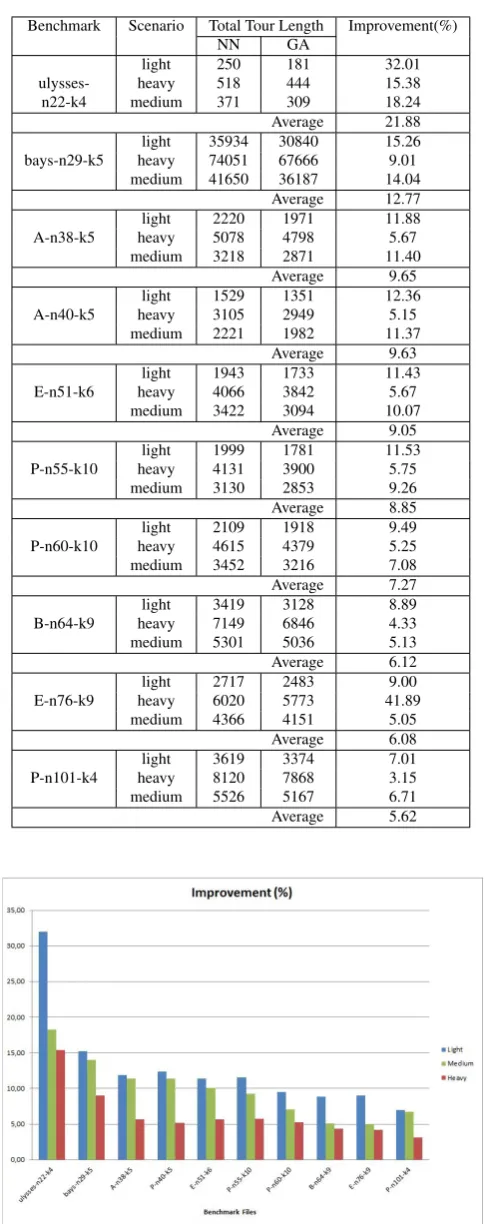
Results of GA and NN solutionsWe conducted extensive simulation tests to compare the performance of both solutions. The obtained results of these tests are presented in Tables 3 and 4, and at Figure 7.
The best values obtained at the experiments for the pro-posed GA and NN solutions are given in Table 3. For each scenario, all 10 benchmarks are tested and their results show that GA has better values on all dataset and all scenarios. Moreover, Figure 7 shows the success of GA is reported more clearly.
When we consider the case in which the probable number of injures at each location is less than the capacity of ambu-lances (light scenario), we observe in Figure 7 that the im-provement of the proposed algorithm is better than those of the other scenarios ( i.e. heavy and medium ).
When all the benchmark files in light scenarios are consid-ered, the average improvement is about %12.89. On the other hand, the average improvements of the heavy and medium scenarios are %6.36 and %10.36, respectively. Similarly, in the medium hand scenarios the obtained performance results are better compared to the results observed in heavy scenar-ios.
Table 3.Comparison of GA and NN solutions
Benchmark Scenario Total Tour Length Improvement(%)
NN GA
light 250 181 32.01
ulysses- heavy 518 444 15.38
n22-k4 medium 371 309 18.24
Average 21.88
light 35934 30840 15.26
bays-n29-k5 heavy 74051 67666 9.01
medium 41650 36187 14.04
Average 12.77
light 2220 1971 11.88
A-n38-k5 heavy 5078 4798 5.67
medium 3218 2871 11.40
Average 9.65
light 1529 1351 12.36
A-n40-k5 heavy 3105 2949 5.15
medium 2221 1982 11.37
Average 9.63
light 1943 1733 11.43
E-n51-k6 heavy 4066 3842 5.67
medium 3422 3094 10.07
Average 9.05
light 1999 1781 11.53
P-n55-k10 heavy 4131 3900 5.75
medium 3130 2853 9.26
Average 8.85
light 2109 1918 9.49
P-n60-k10 heavy 4615 4379 5.25
medium 3452 3216 7.08
Average 7.27
light 3419 3128 8.89
B-n64-k9 heavy 7149 6846 4.33
medium 5301 5036 5.13
Average 6.12
light 2717 2483 9.00
E-n76-k9 heavy 6020 5773 41.89
medium 4366 4151 5.05
Average 6.08
light 3619 3374 7.01
P-n101-k4 heavy 8120 7868 3.15
medium 5526 5167 6.71
Average 5.62
Figure 7. Improvement of the proposed GA for each injured distribution scenario and benchmark file
Figure 8.Average improvement(%) for each benchmark
[image:6.595.55.296.278.447.2]Figure 9. Average improvement (%) achieved by two different crossover operators
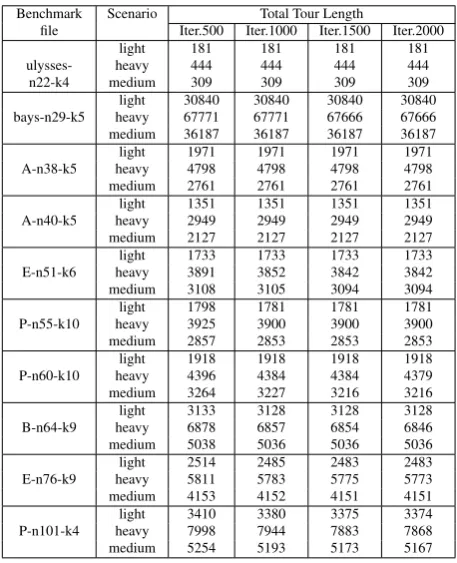
Table 4.Total Tour Lengths for various Generation Number
Benchmark Scenario Total Tour Length
file Iter.500 Iter.1000 Iter.1500 Iter.2000 light 181 181 181 181 ulysses- heavy 444 444 444 444 n22-k4 medium 309 309 309 309 light 30840 30840 30840 30840 bays-n29-k5 heavy 67771 67771 67666 67666 medium 36187 36187 36187 36187 light 1971 1971 1971 1971 A-n38-k5 heavy 4798 4798 4798 4798 medium 2761 2761 2761 2761 light 1351 1351 1351 1351 A-n40-k5 heavy 2949 2949 2949 2949 medium 2127 2127 2127 2127 light 1733 1733 1733 1733 E-n51-k6 heavy 3891 3852 3842 3842 medium 3108 3105 3094 3094 light 1798 1781 1781 1781 P-n55-k10 heavy 3925 3900 3900 3900 medium 2857 2853 2853 2853 light 1918 1918 1918 1918 P-n60-k10 heavy 4396 4384 4384 4379 medium 3264 3227 3216 3216 light 3133 3128 3128 3128 B-n64-k9 heavy 6878 6857 6854 6846 medium 5038 5036 5036 5036 light 2514 2485 2483 2483 E-n76-k9 heavy 5811 5783 5775 5773 medium 4153 4152 4151 4151 light 3410 3380 3375 3374 P-n101-k4 heavy 7998 7944 7883 7868 medium 5254 5193 5173 5167
Table 5. Comparison of Modified One Point Crossover and Modified Periere’s Crossover
Total Travelled Distance Benchmark Scenario One Impro. Periere Impro.
file Point (%) (%)
light 181 32.02 181 32.02
ulysses- heavy 444 15.38 444 15.38
n22-k4 medium 309 18.24 309 18.24
light 30904 15.05 30840 15.26
bays-n29-k5 heavy 67722 8.93 67666 9.01
medium 36900 12.09 36187 14.04
light 1971 11.88 1971 11.88
A-n38-k5 heavy 4798 5.67 4798 5.67
medium 2890 10,74 2871 11.40
light 1351 12.36 1351 12.36
A-n40-k5 heavy 2949 5.15 2949 5.15
medium 2002 10.37 1982 11.37
light 1733 11.43 1733 11.43
E-n51-k6 heavy 3853 5.38 3842 5.67
medium 3098 9.94 3094 10.07
light 1781 11.53 1781 11.53
P-n55-k10 heavy 3915 5.37 3900 5.75
medium 2882 8.25 2853 9.26
light 1920 9.38 1918 9.49
P-n60-k10 heavy 4414 4.45 4379 5.25
medium 3233 6.55 3216 7.08
light 3129 8.86 3128 8.89
B-n64-k9 heavy 6849 4.29 6846 4.33
medium 5040 5.05 5036 5.13
light 2500 8.32 2483 9.00
E-n76-k9 heavy 5791 3.88 5773 4.19
medium 4155 4.95 4151 5.05
light 3382 6.77 3374 7.01
P-n101-k4 heavy 7899 2.76 7868 3.15
medium 5227 5.56 5167 6.71
6.2
Investigating the proposed GA performanceWe investigated the impact of selecting different genera-tion numbers on the solugenera-tion quality. The results presented at Table 4 indicate that increasing number of generations can cause better optimizations for some benchmarks. Especially, the benchmarks with larger number of locations are more sensitive to increase in generation number. For example, for the benchmark P-n101-k4 the total tour length decreases from 7998 to 7868 for the heavy scenario when the gener-ation number changes from 500 to 2000. However, for the benchmarks with relatively less number of locations, we do not observe the considerable change in the obtained results as the number of generation increases. We can explain this observation as follows. The proposed GA can find the opti-mum solution for small size problems faster (less generation number), but for the larger size problems the GA needs more generations to produce better results.
We also compare the success of two type crossovers: One point crossover and Periere’s crossover. The results of the simulation tests are depicted in Figure 9 and at Table 5. In general, we can argue that Periere’s crossover generates bet-ter results compared to One Point crossover. However, as seen in Figure 9, the improvement is slight. This means that crossover type does not affect the quality of the produced so-lution largely.
7
Conclusions
[image:6.595.62.291.528.810.2]GA generates better solutions than these of the NN method. In all considered scenarios, the GA method achieved shorter total tour distances compared to the NN method. There-fore, we can argue that the GA method is robust against the changes of the underlying topologies, the number of loca-tions, and the number of injured people at each locations. Thus, the GA consistently produces better results even the important problem parameters vary.
We would like to extend this study for multiple ambulances and multiple hospital locations as a future study. Thus, we can apply the proposed solution to the real life problems suc-cessfully. Moreover, we would like to implement other meta-heuristics (PSO or ACO) to observe the performance of dif-ferent meta-heuristics.
REFERENCES
[1] L. Talarico, F. Meisel, and K. Srensen. Ambulance routing for disaster response with patient groups, Computers and Operations Research 56, 120-133,2015.
[2] G. B. Dantzig, J. H. Ramser. The truck dispatching problem, Management science 6.1, 80-91, 1959.
[3] A. S. Alfa, S. S. Heragu, M. Chen. A 3-opt based simulated annealing algorithm for vehicle routing problems. Computers & Industrial Engineering, 21, 635–639. 1991. Elsevier
[4] J. Ai, K. Voratas. Particle swarm optimization and two solution representations for solving the capacitated vehicle routing problem. Computers & Industrial Engineering 56.1 ,380-387. 2009.
[5] S. Mazzeo, L. Irene. An ant colony algorithm for the capacitated vehicle routing. Electronic Notes in Discrete Mathematics 18, 181-186. 2004.
[6] J. Berger, M. Barkaoui. A hybrid genetic algorithm for the ca-pacitated vehicle routing problem. Genetic and evolutionary computation conference. Springer Berlin Heidelberg, 2003.
[7] R. K. Ahuja, J. B. Orlin, A. Tiwari. A greedy genetic algorithm for the quadratic assignment problem. Computers & Operations Research 27.10 , 917-934. 2000.
[8] H. Savuran, M. Karakaya. Efficient route planning for an unmanned air vehicle deployed on a moving carrier. Soft Computing, 1-16. 2015.
[9] Q. Gong, A. Jotshi, R. Batta R. Dispatching/Routing of Emergency Vehicles in a Disaster Environment using Data Fusion Concepts. The 7th International Conference on Information Fusion, 2004.
[10] N. A. M. Nordin, Z. A. Zaharudin, M. A. Maasar, N. A. Nordin. Finding Shortest Path of the Ambulance Routing: In-terface of A* Algorithm using C# Programming. Humanities, Science and Engineering Research, 1, 1569 1573, 2012.
[11] U. Kula, O. Tozanli, S. Tarakcio. Emergency Vehicle Routing in Disaster Response Operations. POMS Conference Pro-ceedings, 2012.
[12] H. Daglayan, N. Kilinc, S. Aktas, I. Cereci, M. Karakaya. Ef-ficient Routing of Ambulances Aftermath of a Disaster. The 1st International Conference on Engineering and Natural Sci-ences (ICENS 2015), Skopje, Macedonia. 145. 2015.
[13] H. Nazif, L. S. Lee. Optimized crossover genetic algorithm for capacitated vehicle routing problem. Applied Mathemati-cal Modelling, 36, 2110-2117, 2012.
[14] M. A. Mohammed, M. S. Ahmad, S. A. Mostafa. Using genetic algorithm in implementing capacitated vehicle routing problem. Computer and Information Science, 1, 257-262, 2012.
[15] C. Bermudez, P. Graglia, N. Stark, C. Salto, H. Alfonso. A Comparison of Recombination Operators for Capacitated Vehicle Routing Problem. Inteligencia Artificial, 46, 34-44, 2010.
[16] A. S. Tasan, M. Gen. A genetic algorithm based approach to vehicle routing problem with simultaneous pick-up and delivers. Computers and Industrial Engineering, 62, 755761, 2012.
[17] M. Filipec, D. Skrlec, S. Krajcar. An efficient implementation of genetic algorithms for constrained vehicle routing problem. Systems, Man, and Cybernetics, 3, 2231 2236, 1998.
[18] S. T. Bae, H. S. Hwang, G. S. Cho, M. J. Goan. Integrated GA-VRP solver for multi-depot system. Computers & Industrial Engineering, 53, 233240, 2007.
[19] E. Alba, B. Dorronsoro. Solving the Vehicle Routing Problem by Using Cellular Genetic Algorithms. Computer Science, 3004, 11 20, 2004.
[20] N. LI , S. Wang, Y. Li. A Hybrid Approach of GA and ACO for VRP. Computational Information Systems, 7, 4939-4946, 2011.
[21] B. M. Baker, M.A. Ayechew. A Genetic Algorithm For The Vehicle Routing Problem. Computers & Operations Research, 30, 787-800, 2003.
[22] Y. Chang, L. Chen. Solve The Vehicle Routing Problem With Time Windows Via A Genetic Algorithm. Discrete Continuous Dynamical Systems, 1, 240249, 2007.
[23] E. Alba, B. Dorronsoro. Computing nine new best-so-far solutions for Capacitated VRP with a cellular Genetic Algorithm. Information Processing Letters 98, 225230, 2006.
[25] G. B. Dantzig, and J. H. Ramser. The truck dispatching problem. Management science 6.1, 80-91, 1959.
[26] F. B. Pereira, J. Tavares, P. Machado, E. Costa. GVR: a new genetic representation for the vehicle routing problem. Irish