Strength Development of Fine Grained Mortar Containing Palm Oil Fuel
Ash as a Partial Cement Replacement
Wan Yuslinda Wan Yusof
*
,
Suraya Hani Adnan
,
Zalipah Jamellodin
and
Noor Shuhada Mohammad
Universiti Tun Hussein Onn Malaysia, 86400, Parit Raja,
Batu Pahat, Johor, Malaysia
Keywords: fine grained mortar, palm oil fuel ash, x-ray fluorescence, particle size analyzer, compressive strength, flexural strength
Abstract. This study was focusing on the utilization of Palm Oil Fuel Ash (POFA) and the effect of fine sand to develop the strength of the mortar. The flexural and compressive strength of fine grained mortar (FGM) with the addition of POFA and the sand usage with a size less than 1 mm were investigated. Then, the optimum percentage of POFA as a replacement material for cement was determined. Cement was partially replaced with POFA at various percentage of 0 % to 40 % by weight of cementitious materials with three (3) samples for each percentage. The laboratory test was conducted for this study are divided into two which are properties of samples (X-ray fluorescence and particle size analyzer), and hardened mortar (compressive and flexural strength). The prism specimens size are 40 mm x 40 mm x 160 mm and were tested at the age of 7 and 28 days according to BS EN 196-1:2005: Method of Testing Cement. The results showed that the highest flexural and compression strength is at 10 % due to a factor which is the effect of POFA and fine sand produce a strong bond between the particles with the longer curing time, that is after 14 days. This is indicated that an additional of 10 % POFA in FGM is the optimal percentage of POFA as a replacement for cement.
Introduction
A good quality of the mortar has high strength and durability. Fine particle size affects the performance of the mortar with a change in the air flow, compressive strength and mortar voids content [1]. These improvements can enhance the strength and durability and makes the structures and buildings constructed more attractive in surface structure [2]. Other than that, the utilization of materials such as ordinary portland cement (OPC) can cause the problem when carbon dioxide (CO2) produced by the OPC can harm the environment [3]. So that, the solution to reduce the
optimum percentage of FGM. The application of FGM is necessary to improve the durability of mortar.
Materials and Methods
Materials
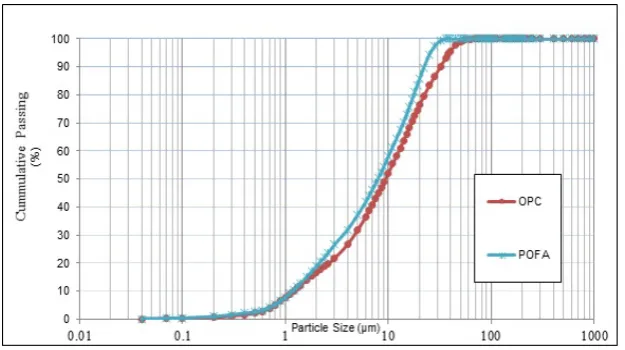
[image:2.595.144.457.320.495.2]The study was conducted using OPC and POFA that is obtained from palm oil mill located in Kluang, Johor. Firstly, to get the properties of sample the POFA was grinded by using ball mill grinder for 30 minutes with the speed of 350 rpm. Then, the POFA was sieved with size less than 45 µm in order to get the 97 % passing from the particle size analyzer (PSA) as shown in Fig 1. The amount of POFA used to replace OPC are 0 %, 10 %, 20 %, 30 % and 40 %. The OPC that used was a mixture of 0.15 kg for both the OPC and POFA. The three (3) samples were produced for each percentage. Fine aggregate (sand) was sieved according to the size less than that of 1 mm passing. The total amount of sand used was 0.45 kg for each sample. The superplasticizer (SP) was as much as 1 % of cement to produce a sample with the same workability even with the low water content of the cement ratio [11].
Fig. 1 Particle size distribution of POFA and OPC.
Mixture proportion
According to the BS EN 196-1 [11], a ratio of cementitious material (OPC + POFA) to sand was 1:3. The water binder ratio is 0.5. The percentage flow of mortar was adjusted to ±5% by mixing with water. The OPC was replaced by POFA at a percentages of 0 % to 40 % by weight of cementitious materials. Mortar were cast in 40 mm x 40 mm x 160 mm and was removed from moulds after casting for 24 hour. It was cured in water for 7 and 28 days [11]. All materials and mixture proportions of FGM for each sample are as shown in Table 1.
Table 1: Materials and mixture proportion
*SP = Superplasticizer
Mix No. Specimen Binder (g) Fine Sand Water SP (1%)
OPC Pozzolans Total (g) (mL) (mL)
1 Control 150 0 150 450 75 1.5
2 POFA10 135 15 150 450 75 1.35
3 POFA20 120 30 150 450 75 1.2
4 POFA30 105 45 150 450 75 1.05
Compressive and flexural testing
The test was done according to the BS EN 196-1 [11]. The flexural strength testing use the methods for applying axial loading on three points bending. Meanwhile, the compression tests were made to determine the level of the FGM which is increased by age and by the continued strength. In general, this flexural and compressive testing is using bending machine bearing capacity and the load applied vertically.
Results and Discussions
Characteristics of OPC and POFA
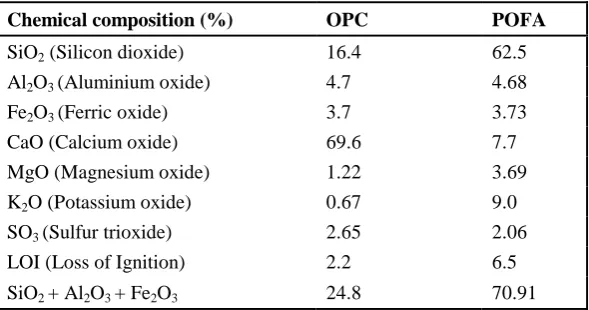
The chemical composition are as tabulated in Table 2. From the X-ray fluorescence (XRF) testing, the silica content of the POFA is 62.50 % while the OPC is 16.40 %. Al2O3 content of OPC is
4.70 % higher than that of POFA that is 4.68 %. The CaO content of POFA is relatively low at 7.7 % compared to 69.6 % of OPC. The others chemical components consisting of Fe2O3, MgO,
SO3 and K2O showed an insignificant difference between the OPC and POFA.
This is indicates that POFA has a high amount of silica content compared to OPC and it can be used in the construction industry as a cement replacement in order to avoid the carbon dioxide emissions that will pollute the environment [6, 12]. According to the ASTM C618 [4], the value of SiO2 + Al2O3 + Fe2O3 of POFA that is 70.91 % is closer to the required minimum of 70 % of
[image:3.595.146.441.413.568.2]pozzolans. Also, this POFA is in class F because the value of CaO is less than 10%.
Table 2: Chemical composition of POFA and OPC
Chemical composition (%) OPC POFA
SiO2 (Silicon dioxide) 16.4 62.5
Al2O3 (Aluminium oxide) 4.7 4.68
Fe2O3 (Ferric oxide) 3.7 3.73
CaO (Calcium oxide) 69.6 7.7
MgO (Magnesium oxide) 1.22 3.69
K2O (Potassium oxide) 0.67 9.0
SO3 (Sulfur trioxide) 2.65 2.06
LOI (Loss of Ignition) 2.2 6.5
SiO2 + Al2O3 + Fe2O3 24.8 70.91
Flexural and Compressive strength
The flexural and compressive strength results of FGM containing POFA are shown in Fig. 2 (a) and Fig. 2 (b) respectively. The results of flexural strength at the age of 7 days with a control mortar obtained the highest strength of 3.59 MPa. At the age of 28 days, the percentage of cement replaced with 10 % POFA has the highest value of 4.62 MPa. Based on these results, the trend of compressive strength was similar with the flexural strength. The results of compressive strength at the age of 7 days shows the control mortar is at highest strength with the value of 28.13 MPa. At the age of 28 days, an additional 10 % of POFA has the highest compressive strength with the value of 50.06 MPa.
or lime and calcium hydroxide during the hydration of OPC. Then, it was produced calcium silica hydrate (C-S-H) and calcium alumina hydrate which serves to cover up cracks and pores. It also reduce the permeability of the cement matrix [2, 13].
Fig. 2 (a) Fig. 2 (b)
Fig. 2 Flexural and compressive strength according to POFA percentage.
Relationship between flexural and compressive strength
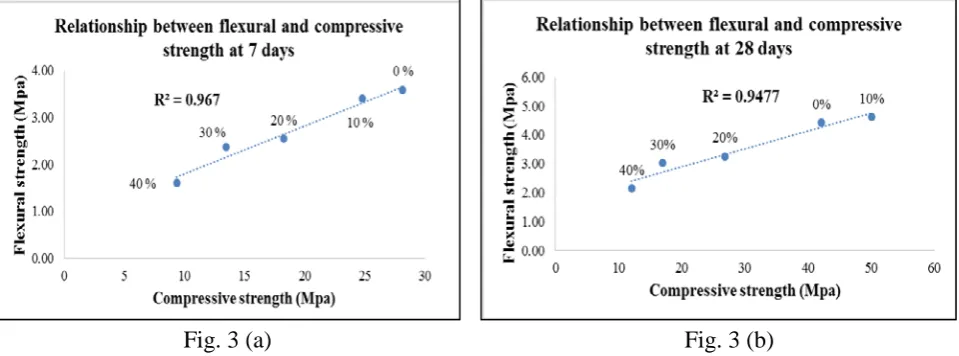
The relationship between flexural and compressive strength at the age of 7 and 28 days was shown in Fig. 3 (a) and Fig. 3 (b) respectively. From the figures, the relationship is decrease when the POFA content is increasing. This situation occurred due to the low cement content which is resulted in reduction of strength. Thus, calcium silicate hydrate gel are not produced due to the reduction of hydration agent [14]. At the early age, the control mortar was achieved the highest strength compared to additional of POFA in FGM. It was due to the slow formation of the pozzolanic reaction and generally starting after one or two weeks [2]. Mortar containing 10 % to 40 % of POFA starting to show pozzolanic reaction with a significant increase in strength for 28 days. Replacement of 10 % POFA was observed at an early stage which shows the low strength and when reached the age of 28 days, a sudden change occurred when it achieved the higher percentage of mortar and thus the optimal percentage for the study.
Moreover, the relationship between the flexural and compressive strength can also be shown by R2 value which are 0.967 for 7 days and 0.9477 for 28 days respectively. Therefore, this relationship is used to determine the compressive strength and flexural strength in improving the study of FGM using POFA for longer curing age.
Fig. 3 (a) Fig. 3 (b)
[image:4.595.57.538.126.312.2] [image:4.595.58.538.592.770.2]Conclusion
From this study, it can be concluded that:
i) The addition of POFA by 10 % to 40% as a partial cement replacement material can improve the flexural and compressive strength of FGM at 28 days. It occured when POFA are added to the mortar which will react after the age of 14 days. It also proves that the strength of FGM with the addition of POFA are better than that of the normal mortar.
ii) The optimum percentage of flexural and compression strength is at additional of 10 % of POFA because it cannot replace the conventional filler material as a whole and the use of hydrated lime was still required.
iii)The flexural and compressive strength were decrease when the addition of POFA up to 20 % - 40 %. If the POFA are fully replaced as a cement replacement material, it is unable to perform his functions as a binder.
References
[1] S. Tabata, S. Miyazato, T. Habuchi, T. Corporation, T. Amino, and H. Tanaka, “Influence Of Fine-Grained Fraction Amount In Recycled Influence Of Fine-Grained Fraction Amount In Recycled,” 2011.
[2] A. M. Neville, Properties of Concrete 5th edition, London: Pearson Education, 2011. [3] C. Sujivorakul, “Utilization of Fly Ash, Rice Husk Ash, and Palm Oil Fuel Ash in Glass
Fiber–Reinforced Concrete,” J. Mater. Civ., vol. 0, pp. 1281–1288, 2011.
[4] C. ASTM, “618, Standard Specification for Coal Fly Ash and Raw or Calcined Natural Pozzolan for Use in Concrete,” ASTM Int., pp. 4–6, 2005.
[5] B. J. Tay, “Ash From Oil - Palm Waste As Concrete Material,” vol. 2, pp. 94–105, 1990. [6] W. Kroehong and T. Sinsiri, “Effect Of Palm Oil Fuel Ash Fineness On The Microstructure
Of Blended Cement Paste,” Build. Mater., vol. 25, pp. 4095–4104, 2011.
[7] M. W. Hussin, M. A. Ismail, A. Budiea, and K. Muthusamy, “Durability Of High Strength Concrete Containing Palm Oil Fuel Ash Of Different Fineness,” vol. 21, pp. 180–194, 2009. [8] C. Jaturapitakkul, J. Tangpagasit, S. Songmue, and K. Kiattikomol, “Filler Effect And
Pozzolanic Reaction Of Ground Palm Oil Fuel Ash,” Constr. Build. Mater., vol. 25, pp. 4287–4293, 2011.
[9] W. Tangchirapat, C. Jaturapitakkul, and P. Chindaprasirt, “Use Of Palm Oil Fuel Ash As A Supplementary Cementitious Material For Producing High-Strength Concrete,” Constr. Build. Mater., vol. 23, pp. 2641–2646, Jul. 2009.
[10] M. P. O. Board, “Issues related to the Impact of Oil Palm on the Environment,” pp. 1–3, 2014.
[11] B. EN, “196-1, Methods of testing cement,” Determ. setting times soundness, vol. 3, 2005. [12] N. M. Altwair, M. A. M. Johari, and S. F. S. Hashim, “Flexural Performance Of Green
Engineered Cementitious Composites Containing High Volume Of Palm Oil Fuel Ash,”
Constr. Build. Mater., vol. 37, pp. 518–525, 2012.
[13] W. Kroehong, T. Sinsiri, and C. Jaturapitakkul, “Effect of Palm Oil Fuel Ash Fineness on Packing Effect and Pozzolanic Reaction of Blended Cement Paste,” Procedia Eng., vol. 14, pp. 361–369, 2011.
[14] W. Tangchirapat and C. Jaturapitakkul, “Cement & Concrete Composites Strength , Drying Shrinkage , And Water Permeability Of Concrete Incorporating Ground Palm Oil Fuel Ash,”