Effect of Cr to Fe onthe Solid Solubility, Lattice Parameter and Strain of
Fe
80Cr
20Alloy Powder
Dafit Feriyanto
1,a, M. I. Idris
1,b, Darwin Sebayang
2,c 1Faculty of Mechanical and Manufacturing Engineering, University Tun Hussein Onn Malaysia (UTHM), Parit Raja, BatuPahat, 86400 Johor, Malaysia
2
Faculty of Mechanical Engineering, MercuBuana University, Indonesia a
[email protected], [email protected], [email protected]
Keywords: Fe80Cr20, ultrasonic technique, ball milling, solid solubility, and strain
Abstract. -Fe-Cr phase was investigated using formula Fe80Cr20. Ball milling process and
ultrasonic technique is successfully done to develop solid solubility and improve homogenous, respectively. However, the effect of the Cr to Fe powder is not complete investigated using combination of its process. Ball milling is conducted by milling time of 60 hours and ultrasonic technique were carried out at ultrasonic time of 3 h, 3.5 h, 4 h, 4.5 h and 5 h. From the strain effect analysis is obtained that the strain increased with crystallite size decreased and broad peaks due to the micro strain that is obtained from the increasing d-spacing. The solid solubility and lattice parameter of the material relatively increased from the untreated sample to treated samples with the highest solid solubility of 62.1% and highest lattice parameter of 3.091 nm which is located at the milled and UB 4.5 hours. It is caused the temperature increased that effect to the higher diffusion of the atom. Therefore, the combination treatment is highest promote to improve the properties of the metallic materials.
1. Introduction
Interaction of Cr powder in Fe powder has became important knowledge field in engineering steels for make steel and controls the properties [1]. On the Fe-Cr phase diagram, -iron phase
plays a critical property in ferritic steel product. However, slightly data which is describe those fields specifically. Many challenge of -iron chromium phase on the experimental action such as
low solubility Cr. In order to achieve the true equilibrium, long time treatment should be conducted [1]. -Fe-Cr phase have high stability in high temperature operation and improve some useful
properties. That phenomenon has became highly desirable effect. Different with -Fe-Cr phase,
high corrosion resistance in high temperature has observed while it thermodynamically unstable. This phenomenon has unwanted properties [2]. Therefore, it is very interesting to develop -Fe-Cr
phase for investigation physical properties and need as reference system. This research investigate the FeCr alloy for interconnect application. According to Fe-Cr diagram Fig.1, one of the formulas for developing -Fe-Cr phase was achieved using different composition of Fe and Cr. According to
[3, 4] the formula is Fe80Cr20 alloy in order to create the -Fe-Cr phase and the desired properties.
Lattice spacing usually shows a few thousand atoms distance. Lattice parameter is based on quantity of most solid solution objects. Analysis of lattice parameters as a basis for a solution has become a topic in solid state physics and materials science. The analysis uses vagard's formula as considered [6 - 8].
The differences of the solubility product are depending on the solid phase. Large monocrystal have the constant thermodynamic solubility and it will be increased by the monocrystal size decreased because the surface energy also increased. The solid solubility relative increased with the temperature increased is named as endothermic reaction. Meanwhile, the exothermic reactions occur when the solid solubility decreased with temperature increased. These phenomenon is due to the temperature effect on the by recrystallization process, change of the enthalpy and entropy [9-12]. According to [13-15] that high solid solubility has been achieved in small crystallite size, high strain material and high lattice parameter. Crystallite size has increased by decreasing the strain. This phenomenon is related to the strength and fatigue. Strain of material has increased and indicated that the strength and fatigue properties have increased. The solid solubility increased shown by the increasing of kinetic energy which is allows the solvent molecules are more effective to break apart the solute molecules that are held together by intermolecular attractions. From the researcher above is obtained from the ball milling process. Introducing the ultrasonic technique is successfully done by many researchers [16-20] to improve the homogenous. However, the combination of it is not complete investigated.
2. Methodology
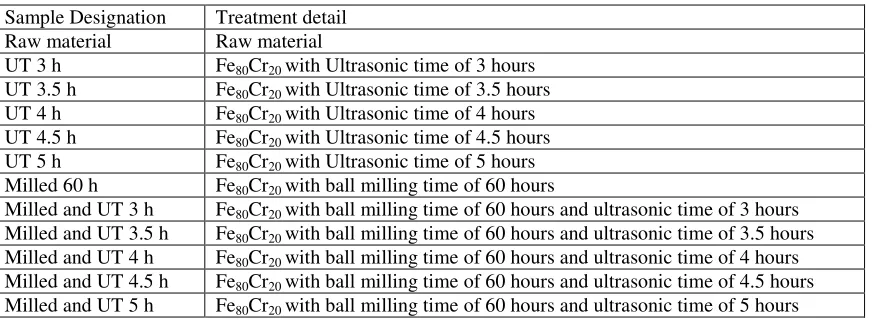
[image:2.595.83.520.477.637.2]The treatment was conducted by using ultrasonic technique, mechanical alloying using high energy ball milling and combination treatment (ball milling combined with ultrasonic technique). The sample designation is listed in Table 1.
Table 1 Various sample designation
Sample Designation Treatment detail Raw material Raw material
UT 3 h Fe80Cr20 with Ultrasonic time of 3 hours UT 3.5 h Fe80Cr20 with Ultrasonic time of 3.5 hours UT 4 h Fe80Cr20 with Ultrasonic time of 4 hours UT 4.5 h Fe80Cr20 with Ultrasonic time of 4.5 hours UT 5 h Fe80Cr20 with Ultrasonic time of 5 hours Milled 60 h Fe80Cr20 with ball milling time of 60 hours
Milled and UT 3 h Fe80Cr20 with ball milling time of 60 hours and ultrasonic time of 3 hours Milled and UT 3.5 h Fe80Cr20 with ball milling time of 60 hours and ultrasonic time of 3.5 hours Milled and UT 4 h Fe80Cr20 with ball milling time of 60 hours and ultrasonic time of 4 hours Milled and UT 4.5 h Fe80Cr20 with ball milling time of 60 hours and ultrasonic time of 4.5 hours Milled and UT 5 h Fe80Cr20 with ball milling time of 60 hours and ultrasonic time of 5 hours
Refer to Table 1that the ultrasonic technique was carried out using various times of 3 to 5 hours with different time of 0.5 hours. The ball milling process was carried out using fixed milling time of 60 h. Meanwhile, the combination treatment is combination between milling time of 60 h and various ultrasonic times. Raw material is formulated as Fe80Cr20 alloy powders.
2.1 Measuring lattice parameter
The distance equals an integer multiple of the wavelength is called diffraction order. Bragg's law is used to obtain the lattice spacing of a particular cubic system through the relation as follow:
2 2 2
. h xk xl
d
where, h, k, l = The miller indices of the diffracting plane a = The lattice parameter of the cubic material d = Interplanar spacing
Cu-K ray were produced where the step size of 0.017 (2) was used for a range of 10-900 (2)
for lanthanum hexaboride (LaB6). Traditionally, X-Ray diffraction has been used for describing the
crystallite size change and disorder/defect in the crystal structure [22]. The mechanism of the X-Ray Diffraction is to analyze the samples as shown in Fig.2.
Fig.2 X-Ray Diffraction [21]
Three dimensional space are described with reciprocal axes x, y and z to eliminate the effects of texturing. The diffraction intensity is a function of the scattering angle 2θ or scattering of vector q which make it independent.Study lattice parameter has been studied by some researcher such as [23, 24]. They found that the highest and lowest shear stresses having the largest and smallest lattice parameter, respectively.
2.2 Measuring solid solubility
Solid solubility of the sample designation of Fe80Cr20 alloys powders could be estimated by the
vegards’ formulas as showed in equation number 2 [25] and this equation or principle has been used for many researcher [6, 23, 26]. Solid solubility is introduced to determine the ability of one substance and to combine with another as well as to form a homogenous. Besides, solid solubility is needed to make the solution with another substance [25]. Phase stability of the Fe-Cr ally can be predicted from the deviation of the lattice parameter from Vagard’s formula as reported by [26] on the atomic level.
) (
) (
1 2
1
a a
a a
x ss
ss
− − =
(2) where, ass = lattice parameter of solid solubility
a1 = lattice parameter of pure solvent element
a2 = lattice parameter of solute element
xss = solid solubility
3. Result and discussion
Combination process (milled and UB) were most effective to develop nanocrystalline Fe80Cr20 by
Fig.3 Effect of strain on the diffraction peaks
The higher strain of material lead to the broader diffraction peaks. It is because the d-spacing of the materials in increase which is caused by micro-strain. Sharper diffraction peaks are shown in the larger crystallite size. It is possible caused the larger crystallite size led to smaller lattice parameter. The solid solubility (xss) vs. Lattice parameter (a) of the sample designation is shown in Fig.4.
Fig.4 Lattice parameter vs solid solubility of the treated and untreated samples
Fig.4 shows the pattern of lattice parameter and solid solubility is one line. It is due to the determining solid solubility which depends on lattice parameter. Therefore, if the lattice parameter is increased, the solid solubility is increased. Solid solubility of the combination (milled and UB) samples are better than raw material, UB samples and milled 60 h sample. It was proved by solid solubility of the combination treatment (milled and UB) increase up to 89% when compared with raw material, 77.3 % when compared with ultrasonic (UB) sample and 63% when compared with milled 60 h sample. It shows the combination treatment was effective to produce the solubility of Cr powder to Fe powder. Developing solid solubility is dependent on the temperature. According to [27] that the Cr powder has higher thermal resistance and it used as coating material. Therefore, the significant effect of the Cr powder in the Fe80Cr20 alloy is shown when ball milling process. When
the Fe80Cr20 dissolves in a ball milling machine and ultrasonic machine temperature has increased,
the average kinetic energy of the Fe80Cr20 alloy powder also increases. The increasing of kinetic
energy allows the solvent molecules are more effective to break apart the solute molecules that are held together by intermolecular attractions. The solid solubility was investigated by [14, 15, 27] that the ball milling effective to develop solid solubility of Cr to Fe powder because the high energy kinetics and the balls slugging the sample powder during ball milling process.The solid solubility when ball milling process is increased because the diffusion of the component atom increased. It is caused by larger volume friction of the atom samples in the grain boundaries [27, 28]. The vibration in ultrasonic process and the ball collision on sample in ball milling process has increased and this lead to less able to hold together.
4. Conclusion
Higher solid solubility, lattice parameter and strain is successfully obtained using combination treatment between ball milling and ultrasonic technique. Moreover, effect of the Cr to Fe is closely
Small crystallite size
Strain Diffraction peaks
Large crystallite size
improve the corrosion resistance promoted by -Fe-Cr phase. It approved when the ball milling
process, the temperature is raise lead to the larger volume friction of the atom of -Fe-Cr.
Anknowledgments
The authors would like to thank the Ministry of Higher Education Malaysia and UniversitiTun Hussein Onn Malaysia (UTHM) through the funding supported GIPS (Postgraduate Incentive Research Grant) with No. Vote 1248 and then Centre for Graduate Studies – UTHM.
Reference
[1] H. Numakura. Graduate School of Engineering, Osaka Prefecture University, 2005.
[2] M. D. Stanisław and Jakub Cieslak. AGH University of Science and Technology, 30-059 Kraków, Poland 2011.
[3] D. S. Khaerudini. University Tun Hussein Onn Malaysia, Malaysia, 2011, Master Thesis. [4] H. Saryanto. UniversitiTun Hussein Onn Malaysia, Malaysia, 2011, Master Theses. [5] ASM Handbook Vol. 3. Materials Park, OH: ASM International 1992.
[6] B.F.O. Costa, G. Le Caer, and N. Ayres de Campos.phys. stat. sol. Vol. 183, No. 2(2001), pp. 235–250.
[7] S. Prithu, K. Biswas, and A. K. Mondal.ScriptaMaterialia 61 (2009) 600–603. [8] W.H. Qi, and M.P. Wang. Journal of Nanoparticle Research (2005) 7: 51–57. [9] L. B. Hong, and B. Fultz. Actamater , Vol. 46, No. 8(1998), pp. 2937-2946. [10] S. Dileep. University of New Orleans, 2003, Theses and Dissertations.
[11] L. Lyubenova, T. Spassov, M. Spassova. Bulgarian Chemical Communications, Vol. 43, No. 2 (2011), pp. 288–292.
[12] C. Suryanarayana. ISBN: 0-8247-4103-X, Publisher: Marcel Dekker, Cimarron Road, Monticello, New York 12701, 2003, U.S.A.
[13] A. Cimino, P. Porta and M. Valig.Journal of the American Ceramic Society, Vol. 49, Issue 3 (2006), pages 152–156.
[14] C. T. Michael, H. Kurokawa, C. P. Jacobson, L. C. De Joghe, and S. J. Visco. Jounal of power sources, Vol.160 (2006), pp. 130-138.
[15] A.D. S. K. Das, K. Nakayashiki, B. Rounsaville, V. Meemongkolkiat, and A. Rohatgi. J. Electrochem. Soc. Vol. 157(6) (2010), pp.H684-H687.
[16] K.S. Suslick. The Yearbook of Science and The Future 1994, Encyclopedia Britannica. Chicago, 1994.
[17] K. S. Suslick, Gareth J. Price. Annu. Rev. Mater. Sci. 29 (1999), pp. 295–326. [18] A. G. J. Juan. Physics Procedia, 3 (2010), pp.35–47.
[19] T. M. Thomas, Qingyou Han. University of Tennessee,2006.
[20] N. Krisztian, Daniel E. Morse. Elsivier, Nano Today, 5 (2010), p. 99-105. [21] D. C. William. Seven Editions.The University of Utah, 2006.
[22] A. A. Baig, J. L. Fox, R. A. Young, Z. Wang, J. Hsu, W. I. Higuchi, A. Chhettry, H. Zhuang, M. Otsuka. Calcif Tissue Int, Vol. 64 (1999), pp. 437–449.
[23] V.A. LubardaMechanics of Materials 35 (2003) 53–68.
[24] L. K. Hyung, J. S. Park, Y. W. Chang. Materials Science and Engineering A 540 (2012) 198– 206.
[25] R. D. Tilley, J. Ren. Small, 3 (2007), pp. 1508-1512.
[26] V. Ponomareva, A. V. Ruban, O.Yu. Vekilova, S. I. Simak, and I. A. Abrikosov.Physical Review B 84(2011), 094422.
[27] C. Suryanarayana.Progress in Materials Science. Vol. 46 (2001), pp. 1-184.