Journal of Chemical and Pharmaceutical Research, 2017, 9(5):231-236
Research Article
CODEN(USA) : JCPRC5
ISSN : 0975-7384
231
Comparative Study of the Antioxidant Properties of Trolox, Ascorbic Acid
and Butyl Hydroxytolene (BHT) by the Methods of Quantum Chemistry
R Chabi Doco, MTA Kpota Houngue*, Gaston A Kpotin, Urbain A Kuevi and YGS
Atohoun et Jean-Baptiste Mensah
Laboratory of Theoretical Chemistry and Molecular Spectroscopy, Faculty of Sciences and Techniques, University of Abomey-Calavi, Cotonou-Benin
_____________________________________________________________________________
ABSTRACT
By functional B3LYP of the DFT, and in two bases set (6-311G (d, p), cc-pDVZ), and by the semi-empirical method AM1 a theoretical study of the antioxidant properties of three molecules (the trolox, the ascorbic acid and butyl hydroxy toluene) was carried out. The electronics parameters as gap HOMO-LUMO, antioxidant power w, hydrophilic index Hy, dipole moment), oxidation reduction potentials, potential of ionization and electronic affinity were calculated, and also thermodynamics parameters as, of Proton Transfer and of Hydrogen Atomic Elimination. The electronic calculated parameters allowed to estimate the powers electron donors and electron acceptors hardness (η), the softness (S), the electronegativity (χ), the electrophilic index (ω) of molecules and to confirm their classifications in the literature according to the oxidizing power.
The results of the various calculations have revealed that:
Functional B3LYP of the DFT is more appropriate than the semi-empirical method AM1, for this study trolox is the most reductive of the three molecules and can then be used as reference molecule for the evaluation of the antioxidant properties of the bioactive molecules for the trolox and ascorbic acid which have several hydroxyl groups, the most important sites for the manifestation of the antioxidant activity are the hydroxyl groups OH9 and H3 respectively.
Keywords: Trolox; Butyl hydroxy toluene; Ascorbic acid; Antioxidizing activity
_____________________________________________________________________________
INTRODUCTION
Now days, interest in antioxidants, in relation to their therapeutic properties, has increased considerably. Scientific research in various specialties has been developed for extraction, identification and quantification of these compounds from several natural substances such as medicinal plants and agri-food products [1] Antioxidant activity of compound corresponds to its ability to resist to oxidation. The best known antioxidants are β-carotene (provitamin A), ascorbic acid (vitamin C), tocopherol or vitamin E, Trolox, butyl hydroxy toluene and phenolic compounds [2]. Antioxidant properties of these compounds are attributed to their natural ability to trap free radicals such as hydroxyl (OH•) and superoxide (O2 •) radicals [3]. Several methods are used to evaluate the antioxidant activity of the compounds:
(1,4-232
phenylenebis (methanylylidene)) bis (azanylylidene) (2-methyl-quinazolin-4 (3H) -one), have revealed strong antioxidant power and therefore better activity of trapping DPPH radical, relative to the ascorbic acid. By the same method and with the same reference molecule, other authors have shown that 5-chlorocurcumine and curcumin have a higher antioxidant power than ascorbic acid [9]. A comparative study of the antioxidant powers of curcumin, gallic acid, ascorbic acid and xanthone, carried out in 2015 by the TEAC method with trolox as a reference molecule, has proved that gallic acid is the most antioxidant of all these molecules and that curcumin is more antioxidant than ascorbic acid and xanthone.
In 2006, by a kinetic study, identified the hydroxyl (OH) group of trolox as the site of its antioxidant properties. The complexity of the exercise of evaluating the antiradical strength of plant extracts was clearly highlighted which demonstrated in 2011 that the manifestation of the antioxidant activity of molecule also depends on the other molecules present in the reaction medium, even if the latter do not possess any anti-radical activity. From the theoretical point of view, results have also been published in the literature on trolox, ascorbic acid and BHT. Using the DFT method, Dvood Farmanzadeh et al. showed in 2016, that the substitution of methyl group for ortho or meta of trolox by the NH2, OH and NHMe groups lowers the antioxidant power of the trolox derivatives. By calculations made at the approximation level B3LYP / 6-31 + G (d, p), a linear correlation was found between the HOMO energy, the length of the C-O bond and the spin density of trolox oxygen atom and the BHT when these molecules trap the DPPH radical. The work of these authors also revealed that the hydroxyl groups are the sites of manifestation of the antioxidant properties of each of these molecules. The objective of this work is to carry out a comparative study of the antioxidant properties of trolox, ascorbic acid and BHT, by the methods of quantum chemistry. For this, different electronic and energy parameters have been calculated and the results will make it possible to deduce the best reference molecule that can be used to evaluate the antioxidant properties of natural bioactive or synthetic molecules.
MATERIALS AND METHODS
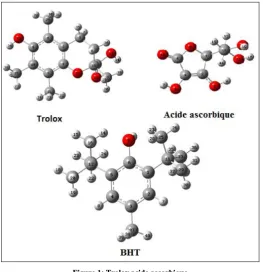
[image:2.595.167.431.371.644.2]The chemical systems studied represent three molecules: trolox, ascorbic acid and BHT (Figure 1).
Figure 1: Trolox acide ascorbique
Taking into account the size of molecules, electronic parameters, energy and thermodynamic parameters requested, the calculations were carried out by Semi-empirical AM1 and the DFT functional B3LYP in Pople atomic orbitals base, 6-311G (d, p) and Dunning cc-pDVZ base [10] using the Gaussian09 program [11] and the Gauss View5 .0.8 reading and visualization interface.
For each molecule (noted ArOH), the calculated electronic parameters were:
The electron affinity , [12] whose value indicate the ability of a molecule to accept electron or free radical;
233
the [14].
The comparison of the antioxidant powers of the studied molecules was carried out on the basis of electron acceptor and electron donor powers ( respectively), calculated for each molecule [15,16].
et
The hardness (η) which expresses the resistance of molecule to change its number of electrons or to the transfer of charge. The harder the hardness, the less the molecule is reactive: η =
Softness, defined as the inverse of the hardness: S =
Electronegativity (χ), which measures the tendency of a chemical species to attract electrons: χ =
The electrophilic index (ɷ) representing the stabilization energy of a molecule saturated by electrons from its surroundings [17]: ω =
The hydrophilic factor that measures the ability of a molecule to yield a hydrogen atom. The greater this electronic parameter Hy is, the more easily the molecule liberates the hydrogen atom [18].
Hy =
NHy is the number of hydrophilic group (-NH2, -SH or -OH); nC is the number of carbon atoms and NSK is the number of atoms in the molecule except for the hydrogen atoms.
Antioxidant power W: by a linear regression method, established, in 1999, a correlation between the antioxidant power w and the ionization potential (IP) on the one hand, and between w and the chemical shift of the carbon
13C (δ) of the antioxidant molecules, on the other hand.
W= exp (-13 + ) ;(3) W= -80 + ; (4)
W= exp (-12 + ) ; (5) W= -70 + ; (6)
More w is higher, more antioxidant the molecule would be. However, it should be noted that the best correlations are obtained with the exponential form of w.
Oxidoreduction potential of molecules, a thermodynamic quantity that measures the oxidizing or reducing power of a redox system. The calculation of the redox potential requires the calculation of the Gibbs standard exchange energy variation (ΔG0) for the reaction:
The energy (ΔG0
) is related to the redox potential by the thermodynamic relation of Nerst ; n is the number of transferred electron and F is the Faraday constant. To calculate ΔG0, it is necessary to use the
Born-Haber thermodynamic cycle in order to elucidate the transfer mechanism of all the chemical species involved in the transformation from the gas phase to the solvation phase [19].
Energy parameters such as O-H bond dissociation energy (BDE). It is the energy necessary for the homolytic rupture of an O-H bond in a molecule:
More lowly the energy is, more favorable is the homolytic rupture, and therefore the more antioxidant is the molecule possessing the hydroxyl site. The work was performed in the Laboratory of Theoretical Chemistry and Molecular Spectroscopy (LACTHESMO) of Chemistry Department of Sciences and Technology Faculty of University of Abomey Calavi.
RESULTS AND DISCUSSION
Electronic Properties of Molecules
234
According to these results, we can make the following observations:
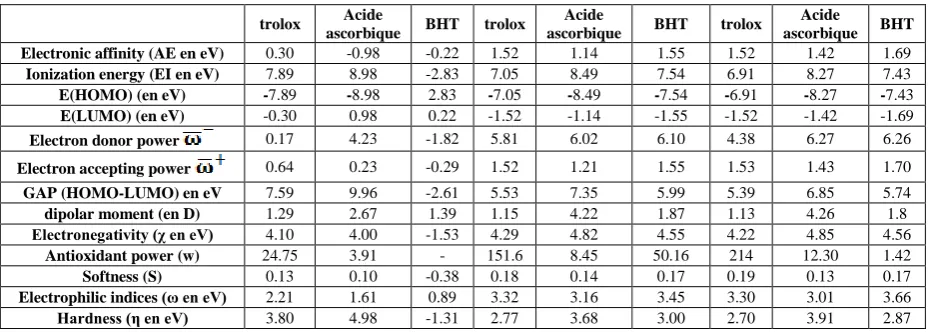
Highest dipole moment was obtained for the ascorbic acid which then appears as the most polar of the three molecules. The results of the electronic affinity (EA) given by the semi-empirical method were in agreement with the experimental data published in the literature [20]: trolox would be more active than butyl-hydroxyl-toluene and ascorbic acid (AEtrolox> AEBHT> AEascorbic). On the other hand, with functional B3LYP of the DFT, the classification obtained in the two bases (6-311G (d, p) and cc-pDVZ) indicates (BHT) as the most antioxidant followed by trolox and ascorbic acid (AEBHT> AEtrolox> AEascorbic).
The ionization energy values (EI) calculated at the B3LYP / 6-311G (d, p) and B3LYP cc-pDVZ approximation levels are in the order of Eascorbic> EIBHT> EItrolox and give trolox as more antioxidant than BHT and ascorbic acid,
according to experimental data published in the literature [20]. With the semi-empirical method, the order of storage obtained was not in agreement with the data of the literature (EIascorbic> EItrolox> EIBHT)
The negative value of the electron donor power ( obtained for the BHT by the semi-empirical method does not allow a consistent conclusion to be drawn. The DFT calculations gave the lowest value of the electron donor power for the trolox, which thus appears to be the most antioxidant of the three molecules. As regards the electron accepting power ( , the results concordant with the data of the literature are those given by the semi-empirical method, in contrast to those of the DFT calculations which contradict them; The highest values of this parameter being given by ascorbic acid and BHT.
[image:4.595.66.533.495.661.2]With the B3LYP / 6311G (d, p) and B3LYP / cc-pDVZ methods, the highest Gap values (HOMO-LUMO) were obtained for ascorbic acid and BHT. These results indicating trolox as the most antioxidant of the three molecules is in agreement with those of the literature [20]. On the other hand, the results given by the semi-empirical method rather indicate BHT as more antioxidant than trolox and ascorbic acid. The results obtained by the semi-empirical method and by the DFT methods were not contradictory with regard to the calculation of softness (S). The highest values were obtained for the trolox, thus giving it as the best antioxidant of the three molecules. With the semi-empirical method, the lowest values of the electronegativity index (χ) were obtained for BHT and ascorbic acid. This makes BHT appear to be the most antioxidant of the three molecules. On the other hand, at the B3LYP / 6311G (d, p) and B3LYP / cc-pDVZ approximation levels, the lowest index value was obtained for the trolox. In addition, the highest antioxidant power values (w) were obtained for trolox and BHT; this indicates that the trolox would be the most antioxidant, followed by BHT. Calculations of electrophilic indices (ω) performed by the semi-empirical method gave the trolox as the most electrophilic and hence the strongest antioxidant. By the DFT calculations it is rather the BHT which appears as the most antioxidant of the molecules. The values of the hardness (η) have been ranked in the order η ascorbic> η trolox> η BHT, for the semi-empirical method and in the order η ascorbic> η BHT> η trolox for DFT calculations. Between these two sets of contradictory results, the results in agreement with the experimental data of the literature are those obtained by the DFT method and according to which the trolox is more antioxidant than the BHT [7]
Table 1: Calculated values (in eV) of the electronic parameters of the molecules
trolox Acide
ascorbique BHT trolox
Acide
ascorbique BHT trolox
Acide
ascorbique BHT
Electronic affinity (AE en eV) 0.30 -0.98 -0.22 1.52 1.14 1.55 1.52 1.42 1.69
Ionization energy (EI en eV) 7.89 8.98 -2.83 7.05 8.49 7.54 6.91 8.27 7.43
E(HOMO) (en eV) -7.89 -8.98 2.83 -7.05 -8.49 -7.54 -6.91 -8.27 -7.43
E(LUMO) (en eV) -0.30 0.98 0.22 -1.52 -1.14 -1.55 -1.52 -1.42 -1.69
Electron donor power 0.17 4.23 -1.82 5.81 6.02 6.10 4.38 6.27 6.26
Electron accepting power 0.64 0.23 -0.29 1.52 1.21 1.55 1.53 1.43 1.70
GAP (HOMO-LUMO) en eV 7.59 9.96 -2.61 5.53 7.35 5.99 5.39 6.85 5.74
dipolar moment (en D) 1.29 2.67 1.39 1.15 4.22 1.87 1.13 4.26 1.8
Electronegativity (χ en eV) 4.10 4.00 -1.53 4.29 4.82 4.55 4.22 4.85 4.56
Antioxidant power (w) 24.75 3.91 - 151.6 8.45 50.16 214 12.30 1.42
Softness (S) 0.13 0.10 -0.38 0.18 0.14 0.17 0.19 0.13 0.17
Electrophilic indices(ω en eV) 2.21 1.61 0.89 3.32 3.16 3.45 3.30 3.01 3.66
Hardness (η en eV) 3.80 4.98 -1.31 2.77 3.68 3.00 2.70 3.91 2.87
235
literature, the values of redox potentials and enthalpies of dissociation by homolytic disruption of OH (BDE) binding of trolox, ascorbic acid and BHT will be calculated in order to draw more precise conclusions.
Determination of the Probable Hydroxyl Sites for the Manifestation of the Antioxidant Activity of the Molecules
For the various O-H bonds in the molecules of trolox, ascorbic acid and BHT, values of BDEs were calculated at the AM1 and B3LYP approximation levels. The results obtained are recorded in Table 2.
The results in Table 2 show that:
Enthalpy values of dissociation by homolytic OH-binding fracture (BDE) obtained for trolox, ascorbic acid and BHT, with the semi-empirical method, were all negative rather than positive. This result makes it possible to say that the semi-empirical method AM1 would not be appropriate for the study of the properties of these molecules. By both methods, lowest values of enthalpy of dissociation by homolytic disruption of OH (BDE) binding are mainly obtained for the OH9 and OH3 bonds of trolox and ascorbic acid respectively. These results indicate that the hydrogen atoms H9 and H3 can easily dissociate from the two molecules in order to release radicals capable of trapping free radicals. Thus, the OH9 and OH3 sites appear to be the most important for the manifestation of the antioxidant activity of trolox and ascorbic acid respectively.
Table 2: Values (in kcal / mol) of the BDE bonds calculated at the AM1 and B3LYP approximation levels for trolox, ascorbic acid and BHT
Liaisons AM1 B3LYP / B3LYP /
6-311G (d, p) CC-PDVZ
Trolox O-H
9 -277.36 92.24 89.73
O-H16 -253.51 113.58 111.09
Ascorbic acid
O-H3 -281.12 98.52 96.01 O-H2 -276.73 102.28 99.77
O-H11 -254.14 - -
O-H 13 -184.49 116.09 109.19 BHT O-H6 -276.10 92.87 90.36
Overall, by B3LYP / 6311G (d, p) and B3LYP / cc-pDVZ method, the BDE values given for the trolox are lower than those given by BHT and ascorbic acid. The antioxidant activity of the trolox would therefore be greater than those of the other two molecules. However, the lowest enthalpies were obtained with B3LYP / cc-pDVZ, which then appear to be the most suitable for the study of the energy properties of the three molecules. Also, the trolox could be used as a reference molecule for studying the anoxidizing properties of bioactive molecules.
Calculation of the Redox Potentials of Molecules
The redox potentials (Eo) of the three molecules, calculated by the semi-empirical method AM1 and the methods B3LYP // 6-311G (d, p) and B3LYP // cc-pDVZ are recorded in Table 3.
Table 3: Calculated values (in volts) of the redox potential of trolox, ascorbic acid and BHT at the AM1 and B3LYP levels
EXP (volt) [14,16,18] AM1 B3LYP / B3LYP / 6-311G (d, p) cc-pDVZ
Trolox 0.48 -1.98 0.68 0.58 Ascorbic acid 0.39 -15.87 0.48 0.4
BHT 0.71 0.72 0.7
According to these results, we can make the following observations:
The results given by B3LYP / cc-pDVZ are closest to the experimental data; the cc-pDVZ basis would be more appropriate for this calculation. The lowest values of redox potentials obtained for ascorbic acid indicate this compound as a good reducing agent and thus more antioxidant among the three moleculs. This result is not in agreement with the experimental data published in the literature. This can be explained by the fact that the electrochemical parameters are directly related to the stability of the free radical created after the reduction of the reactive species [21].
Calculation of Hydrophilic Factor of Molecules
236
CONCLUSION
A theoretical study of the antioxidant properties of three molecules (trolox, ascorbic acid and BHT) used as reference molecule in the experimental determination of the antioxidant or antiradical activities of the bioactive molecules was performed by the semi-empirical method AM1 and by the functional B3LYP of the DFT in the bases 6-311G (d, p) and cc-pDVZ. The comparison between the calculated values of the various electronic and thermodynamic parameters made it possible to reveal the trolox as the most antioxidant molecule of the three molecules. This molecule can thus be used as reference molecules in the theoretical prediction of the antioxidant activity of the bioactive molecules. For the prediction of the antioxidant properties of the molecules studied, the theoretical results are in agreement with the experimental data, especially for the functional B3LYP which gave the results closest to the experimental data.
REFERENCE
[1] C Chen; AM Pearson; JI Gray. Food Chem. 1992, 43, 177-180. [2] D Farmanzadeh; MJ Najafi. J SerbChem Soc.2016, 81, 277-290. [3] IF Benzie; J Strand. Anal Biochem. 1996, 239, 70-76.
[4] R Re; N Pellegrini; A Proteggente; A Pannala; M Yang; RC Evans. Free Radical Biol Med. 1999, 26, 1231-1237.
[5] AA Khalida. J Chem Int Open Free Access Peer Reviewed. 2016, 32, 585-590. [6] R Ashwell Nadella; M Moyo; JV Staden. Molecules. 2010, 15, 6905-6930. [7] L Andrzej; Dawidowicz; M Olszowy. Eur Food Res Technos. 2011, 232, 837-842 [8] O Naksuriya; S Okonogi. Drug Discoveries Therapeutics. 2015, 9, 136-141
[9] AA Al Amiery; AAH Kadhum; HR Obayes; ABM Hindawi. Bioinorg Chem Appl. 2013, 7.
[10]L Hanane, Prédiction théorique de l'activité antioxydante de composés d'espèces naturelles, magister, 2011, 97, 19, 29, 34.
[11]PK Chattaraj; SJ Sengupta. Phys Chem. 1999, 103, 6122.
[12]RG Parr, W Yang. Density-functional theory of atoms and molecules. Oxford University Press, New York,
1989, 105
[13]JE Bartmess. J Phys Chem. 1994, 98, 6420-6424.
[14]L Yan; Yi Lub; X Lia. Phys Chem Chem Phys. 2016, 18, 5529
[15]V Aleksandr; Marenich; Junming Ho; LM Coote; JC Cramer; GT Donald. Phys Chem Chem Phys. 2014, 16, 15068
[16]Nijveldlt; E Van Nood; DEC Van Hoorn; PG Boelens; VK Norren; PAM et Van Leeuwen. American J Clin Nut. 2001, 74, 418-425.
[17]P Molyneux. J Sci Technol. 2004, 26, 211-219.
[18]I Fleming. Frontier orbitals and organic chemical reactions, John Wiley and Sons, New York, 1976. [19]MD Liptak; KG Gross; PG Seybold; S Feldgus; GC Shields. J Am Chem Soc. 2002, 124, 6421-6427. [20]R Hammoudi; K Dehak; MHM Didi Ouldelhadj. Lebanese Sci J. 2015, 16, 37-36.