Department of Management
London School o f Economics and Political Science
Houghton Street, London WC2A 2AE, United Kingdom
Are computerised profiling tools effective in support of AML
procedures as required by MLROs and compliance officers
in a banking sector context?
A n inquiry into determ ining effectiveness despite am biguity
Jeffrey J. Wasel
A dissertation submitted to the Department of Management (Information Systems and Innovation Group)
of the London School of Economics and Political Science for the Degree of Doctor of Philosophy
UMI Number: U61B446
All rights reserved
INFORMATION TO ALL USERS
The quality of this reproduction is dependent upon the quality of the copy submitted.
In the unlikely event that the author did not send a complete manuscript and there are missing pages, these will be noted. Also, if material had to be removed,
a note will indicate the deletion.
Dissertation Publishing
UMI U613446
Published by ProQuest LLC 2014. Copyright in the Dissertation held by the Author. Microform Edition © ProQuest LLC.
All rights reserved. This work is protected against unauthorized copying under Title 17, United States Code.
ProQuest LLC
789 East Eisenhower Parkway P.O. Box 1346
F
Library
British Library of Political and Econom ic S cienceAbstract
This dissertation aims to contribute to the emerging field o f automated
behavioural profiling tools/technology (AMLPT) as applied to anti-money laundering
(AML) and fraud detection. We research the effectiveness o f the use o f profiling
technology within the context o f compliance Organisations located in large and medium
sized retail and commercial banks within the City of London. The phenomena o f
profiling and money laundering are quite complex. Subsequently, their study
encompasses several academic disciplines: language use, artificial intelligence,
categorisation, and the managerial domains of organisational behaviour, networking, and
innovation. Using an interpretivist approach, we examine the AMLPT artefact’s
effectiveness through the use o f Rogers’ Diffusion o f Innovation (Dol) theory, utilising a
pluralist methodology that encompasses two case studies for contextual understanding of
the domain and survey-based field work. In furthering our understanding of innovation
within organisations, we utilise Organisational Effectiveness (OE) theory to provide an
analytical framework for the fieldwork and measurement methodology.
The proliferation o f AMLPT raises a variety o f issues arguably more important
than market share and technical functionality, particularly such issues as data privacy and
the potential for the egregious use of personal or proprietary information (Schwartau
1994; Jennings and Fena 2000; Lyon 2003). Furthermore, what was once perceived as
“normal” identity management, data security and data privacy practice may no longer be
acceptable in the application o f next generation AMLPT in risk-aversive, highly
sensitive global financial contexts. Moreover, are the cost and Organisational demands
inherent in deploying AMLPT proportionate to the desired result (Bisantz and Ockerman
2002; Vavpotic and Bajec 2009). In understanding the effectiveness o f AMLPT, we look
beyond the traditional methods of information systems evaluation, and draw on other IS
Organisational effectiveness measures, and their applicability in further defining
effectiveness through measures o f innovativeness. Critically, we look to examine
innovation in an Organisational context, rather than the more traditional domain of
individual innovation, the core construct of Rogers’ original (1962) work on diffusion.
Acknowledgements
• To Tamra and Emma, whose love and unwavering support made this all possible.
• To my father, Dr. Albert D. Wasel, and my mother, Helen, who nurtured the intellectual curiosity that started me on this journey.
• To my long-suffering advisor, Professor Ian Angell - Thank you fo r believing in me.
• To Dr. Shirin Madon and the Information Systems Integrity Group - Thank you all fo r your patience and understanding, and most o f all, your gracious accommodation o f my many personal challenges that accompanied this journey.
• To Edgar and Tony - thank you fo r allowing me to start on this path o f intellectual and self-discovery
Lastly, a heartfelt thanks to the many compliance professionals who made
this research project a rewarding and fruitful endeavour. I am indebted to the cohort
for their patience, openness, and willingness to answer the innumerable questions
that arose from our daily interactions. Lastly, I am grateful for their accommodation
o f the many scheduling changes and cancelled meetings that resulted from the
accompanying events in my personal life.
List o f Figures and Tables
Figure 2.3.1 - The International & UK AML Legal & Regulatory Framework...42
Figure 2.5.1 - Stages within the Crime-Terror Continuum (Makarenko 2004)... 48
Table 2.7.1 - AML Trigger Criteria - From Gill and Taylor(2003)...63
Figure 2.8.1.1 - Representative AML Transaction monitoring system ... 69
Figure 2.9.1 - Research Question Component M o d el... 73
Table 3.1.1 - Theories used in individual and organisational IT adoption research ... 83
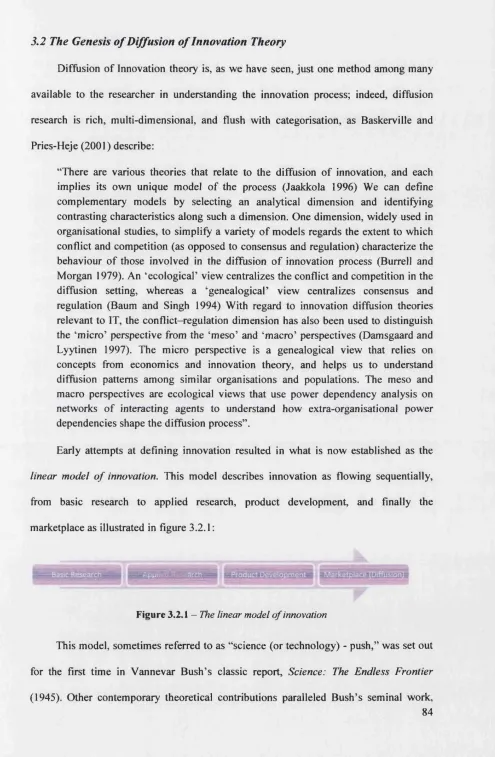
Figure 3.2.1 - The linear model o f innovation...84
Table 3.2.1 - Taxonomies o f Innovation (from Goudin)... 85
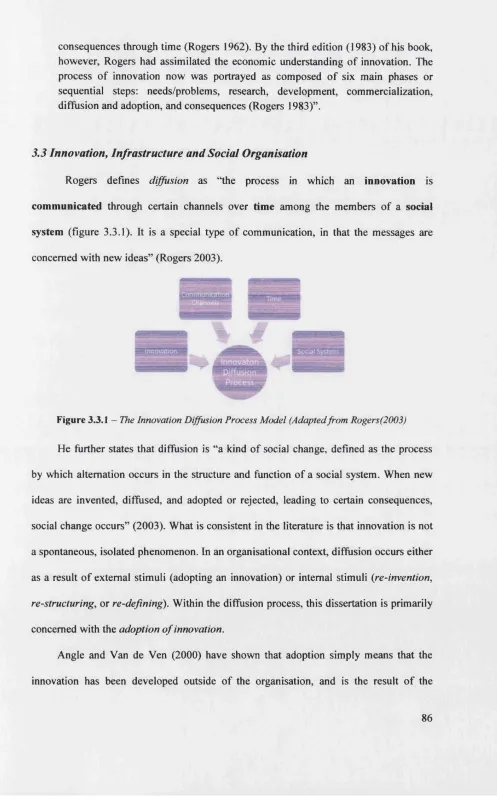
Figure 3.3.1 - The Innovation Diffusion Process M odel... 86
Figure 3.3.2 - A Model o f Five States in the Innovation-Decision Process... 92
Figure 3.3.3 - Adopter Categorization on the Basis of Innovativeness... 94
Figure 3.3.4 - S-Curve rate of adoption model showing rate of adoption... 95
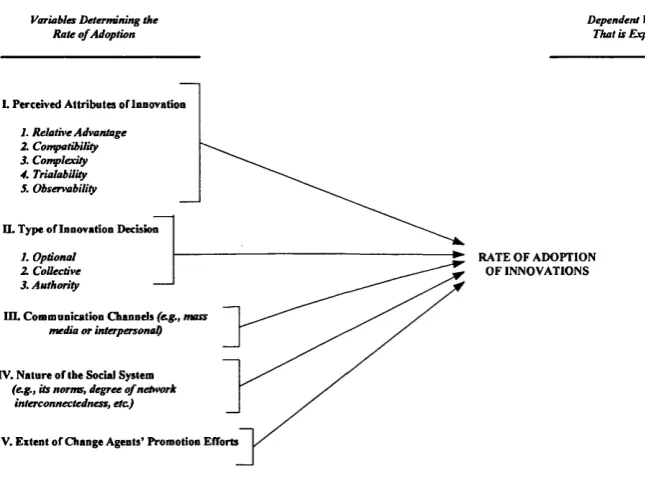
Figure 3.3.5 - Variables Determining the Rate of Adoption o f Innovations... 96
Figure 3.4.2 - Five Stages in the Innovation Process in Organisations...103
Table 3.6.1 - Main Features of the Three Perspectives (from Slappendel (1996)... 110
Figure 3.6.1 - Structuration Model o f Technology (From Orlikowski (1992))... 113
Table 3.7.1 - Sample set of compatible attributes between organisation...120
Table 3.7.2 - The Historical Search for Organisational Effectiveness...121
Figure 4.1.1 - Laudan's (1984) triad o f justification;... 128
Figure 4.1.3 - Minger’s (2001)Three Worlds Relevant to Research Methods... 127
Figure 4.5.1 - Determinates in the rate o f adoption... 144
Table 4.5.1 - Measures o f Effectiveness... 144
Table 4.7.1.1 - Secondary Data Collection Sources... 149
Table 4.7.2.1 - Breakdown o f Interview participants by role and interview type... 150
Table 5.1.1 - Early regime fines to institutions (FSA 2003)... 157
Figure 5.2.1 - Typical survey cohort compliance organisation reporting structure 160 Figure 5.3.1 - Roles and staff levels in cohort organisations...163
Figure 5.4.1.1 - Monitoring process for flagged transaction... 167
Figure 5.4.2.1 - AMLPT as locus o f innovation...170
Figure 5.4.2.2 - Filtration sequence in profile development... 171
Figure 5.4.2.3 - Transaction monitoring workflow and discrete components...172
Figure 5.6.1 - Organisational effectiveness attributes as measures o f effectiveness ... 178
Figure 6.0.1 - Managerial motives for authority innovative-decisions...186
Figure 6.0.2 - Managerial motives for collective innovative-decisions...186
Table 6.0.1 - Formal and informal stimuli for types o f innovation decisions... 187
Figure 6.2.1 - Distribution, frequency, and level of MLRO/Compliance officers 195 Table 6.2.1 - Homophilous and heterophilous behaviours across the cohort...196
Figure 6.2.3.1 - Internal and external AMLPT innovation stimuli...199
Table 6.2.4.1 - Cohort institutionally-mandated New Account KYC Vetting... 202
Figure 6.2.5.1 - Cohort perceptions o f AML-CFT regime, tools, and regulations... 205
Figure 6.2.5.2- Correlations in perceived effectiveness of AML-CFT elements...206
Figure 6.3.2.1- Lickert aggregate correlation o f AI and OE attributes... 211
Figure 6.3.2.2 - Individual correlations o f AI and OE attributes as a measure... 212
Table 6.3.2.1 - Original “Measures o f Effectiveness” ... 213
Table 6.3.2.2 - Revised and consolidated “Measures o f Effectiveness” ... 213
Figure 6.3.2.3 - Frequency of Innovation Attributes... 214
Table 7.1.1 - Summary of dissertation’s contributions to practice...227
Figure 7.2.1 - Revised Independent Variables Related to Organisational... 236
Table 7.2.2 - Summary of dissertation’s contributions to Theory...238
Exhibit 8.1.1 - FinCEN Currency Transaction Report (CTR)...275
Exhibit 8.1.2 - FinCEN Suspicious Activity Report (SAR)...276
Figure 8.5.1 - Simplified H aw ala- IVTS Flow (Passas 2003)...299
Figure 8.6.1 - Brinks-Mat Placement Stages - (Blunden 2001)...313
Figure 8.6.2 - Brinks-Mat Layering and Integration Stages (Blunden 2001)... 314
List o f Acronyms
ABA: American Bankers Association
ATCSA 2001: Anti-Terrorism, Crime and Security Act 2001 (UK)
AML: Anti Money Laundering
AMLPT: Anti Money Laundering (Behavioural) Profiling Technology AML-CFT: Anti-Money Laundering - Countering the Financing of Terrorism AMA: Advanced Measurement Approaches (Basel II)
AI: Artificial Intelligence BBA: British Bankers’ Association
BCCI: Bank of Credit and Commerce International
BI: Business Intelligence
BIS: Bank o f International Settlements
BSA: Bank Secrecy Act (US)
BSU: Behavioural Sciences Unit (US) CFATF: Caribbean Financial Action Task Force CARICOM: Caribbean Community
C J A 1993: The Criminal Justice Act 1993 (UK)
CoE: Council of Europe
CTR: Currency Transaction Report (US) DEA: Drug Enforcement Agency (US) Dol: Diffusion o f Innovation (theory)
DTOA 1986: Drug Trafficking Offences Act o f 1986 (UK) EFF: Electronic Frontier Foundation (US)
EIS: European Information Society (EU)
EU: European Union
FATF: Financial Action Task Force
FBI: Federal Bureau of Investigation (US) FSRB: FATF-Style Regional Bodies
FIDIS: Future of Identity in the Information Society (EU) FIU: Financial Intelligence Unit
FinCEN: Financial Crimes Enforcement Network (US) FSA: Financial Services Authority (UK)
G-7: Group o f Seven leading industrial countries - Canada, France,
GBP:
Germany, Italy, Japan, United Kingdom and the United States Great Britain Pound (Sterling)
GDP: Gross Domestic Product
IMOLIN: International Money Laundering Information Network IDB: International Development Bank
IMF: International Monetary Fund IVTS: Informal Value Transfer System
JMLSG: Joint Money Laundering Steering Group (UK) KDD: Knowledge Discovery through Data mining
KM: Knowledge Management
KYC: Know Your Customer
LCN: La Cosa Nostra
MLCA 1986: Money Laundering Control Act of 1986 (US) MLDC: Money Laundering Detection Core
MLR 1993: The Money Laundering Regulations 1993 (UK) MLRO: Money Laundering Reporting Officer
MSB: Money Service Business /Bureau
NCCT: Non-Cooperative Countries and Territories (FATF) NCIS: National Criminal Investigative Service (UK) NGO: Non-Governmental Organisation
NTFIU: National Terrorist Financial Investigation Unit (UK) OECD: Organisation for Economic Co-operation and Development OE: Organisational Effectiveness (theory)
OFC: Off-shore Financial Centre PEP: Politically Exposed Person(s) POCA 2003: Proceeds o f Crime Act 2003 (UK) SAR: Suspicious Activity Report
SEC: Securities and Exchange Commission (US) SOCA: Serious and Organised Crime Authority (UK) STR: Suspicious Transaction Report
SQL Structured Query Language TA: Terrorism Act of 2000 (UK)
TNC: Trans-National Crime
UNODCCP UN Office for Drug Control and Crime Prevention
USAPA: PATRIOT Act (US)
USD: United States Dollars
VAT: Value Added Tax
WCO: World Customs Organisation
Table o f Contents
Abstract...2
Acknowledgements... 4
List o f Figures and Tables...5
List o f A cronym s... 7
Table o f Contents ... 9
Introduction... 13
Chapter 1. Problem Domain and Scope of Research... 14
1.1 Applicability of the Research... 16
1.2 Current Academic & Practitioner Research...19
Chapter 2. Historical Context, Thematic Discussion and Research Question... 23
2.1 The Rise o f Regulation: Ontological and Taxonomic Ambiguity... 27
2.2 Regulatory Excess - The Cayman Islands Case Study...32
2.3 The United Kingdom’s Regulatory Regime... 37
2.4 September 11th - Apres le ‘Deluge: Regulation and the Dawn of the Age of Control... 42
2.5 Ambiguity and Quantification - how big is big?... 46
2.6 The Evolution of a Response: Profiling use pre-9/11 ... 59
2.7 Profiling as a Response to post-9/11 Regulation: Mitigating Risk and Ambiguity 61 2.8 The Locus o f Activity - Identifying Money Laundering and Financial Crime ..66
2.9 Desired Research Outcomes and Research Question... 72
Chapter 3. Philosophical and Theoretical Foundations...76
3.1 The Appropriateness of Diffusion of Innovation Theory...79
3.2 The Genesis o f Diffusion of Innovation Theory... 84
3.3 Innovation, Infrastructure and Social Organisation... 86
3.4 Diffusion o f Innovation and the Innovation Process within Organisations... 98
3.5 Critique o f Diffusion o f Innovation Theory... 106
3.6 Secondary Theoretical Support - theories of technology use, adoption and effectiveness within organisations... 109
3.7 Applicability o f theories o f technology use, adoption and effectiveness within organisations... 113
3.8 Critique o f theories of technology use, adoption and effectiveness within organisations... 122
Chapter 4. Research Methodology... 124
4.1 Research Strategy...124
4.2 Paradigmatic Foundations - grounded within interpretivist tradition... 130
4.3 Strategy o f Inquiry: Structured and Unstructured Interviews and Survey... 136
4.4 Research perspective - the neutral, outside observer... 142
4.5 Data Presentation and Analysis... 142
4.6 Unit o f Analysis - Compliance Officers and MLROs in the City o f London... 145
4.7 Data Collection...146
4.8 Conclusion... 153
Chapter 5. Fieldwork... 155
5.1 Money Laundering Detection in Banks in the City o f London...155
5.2 Description o f the AML Compliance Function... 156
5.3 Innovation within the Compliance Organisation... 161
5.4 The Money Laundering Detection Process within the Survey Cohort...165
5.5 Social System Attributes: formal and informal behaviours... 174
5.6 Effectiveness behaviours... 177
5.7 Key Findings... 179
5.8 Concluding rem arks...183
Chapter 6. Analysis... 185
6.1 How Innovation Adoption Emerges... 191
6.2 Countering the inherent ambiguity in identifying money laundering...193
6.2.4 Innovation and formal norms within the MLRO-compliance organisation...201
6.3 AMLPT innovation, organisational effectiveness, and the AML-CFT Regime207 6.4 A summary o f the findings and their applicability to the research question 216 Chapter 7. The Contribution, Future Research Directions, and Conclusion...221
7.1 Contributions to Practice... 221
7.2 Contributions to Theory... 228
7.3 Contributions to Methodology... 239
7.4 Limitations o f the research... 240
7.5 Suggested Directions for Future Research... 242
Bibliography...245
Appendix...275
8.1 Examples o f US CTR and SA R ...275
8.2 UK Financial Services Authority S A R ... 277
8.3 BCCI Case Study... 279
8.4 Legitimate and illegitimate Terrorist Fundraising in the UK - the PIRA and
LTTE Case studies... 290
8.5 Funding 9/11: Saudi largesse, charity, hawala and IV T S...297
8.6 The Brinks-Mat Case Study - Detection without Automation... 302
Introduction
This dissertation aims to contribute to the emerging field o f automated
behavioural profiling tools/technology (AMLPT) as applied to anti-money laundering
(AML) and fraud detection. We research the effectiveness of using profiling technology
within the context of compliance organisations located in large and medium-sized retail
and commercial banks within the City o f London. The phenomena o f profiling and
money laundering are quite complex, and subsequently their study encompasses several
academic disciplines: language use, artificial intelligence, categorisation, and the
managerial domains o f organisational behaviour, networking, and innovation. Using an
interpretivist approach, we examine the effectiveness of AMLPT artefacts through the
use of Rogers’ Diffusion o f Innovation (Dol) theory, utilising a pluralist methodology
that encompasses two case studies for understanding the context of the domain and
survey-based field work (Mingers 2001). In furthering our understanding o f innovation
within organisations, we utilise Organisational Effectiveness (OE) theory to provide an
analysis framework for the fieldwork and measurement methodology.
A Note on the Duration of the Research Project:
The field research began December o f 2004 and finished in August o f 2006;
however, due to serious illness in the author’s family, which necessitated repeated,
extended international travel, the analysis and collating o f the data took an additional two
years. The final dissertation was written during 2009, and submitted in April o f 2010.
Chapter 1. Problem Domain and Scope of Research
Type “profiling” into Google and the subsequent 4,360,000 hits (Wasel 2009)
illustrates the many guises and sheer breadth of “profiling”. Profiling serves as an
analytical tool in a variety o f applications, be they characterising types of criminal
behaviour or how much Coca-Cola is consumed in Boston, Massachusetts in a given
year. Subsequently, a more formal definition becomes necessary, in this case, one culled
from the Oxford Dictionary o f the English Language. While we are concerned with the
act o f profiling, the definition is best found using the root word “profile”:
1. a. trans. To represent in profile; to delineate the side view or outline of; to draw in section; to outline. Also fig. (1715) LEONI Palladio's Archit. (1742) I. 2 1 ,1 have profil'd the Imposts of the Arches. Ibid. 30 The method of profiling each Member. (1882) E. P. HOOD in Leisure Ho. Apr. 225 Instances in which he thus profiles his contemporaries. (1902) Contemp. Rev. Dec. 838 The delicate tracery of the leaves [was] profiled against the sunset sky.
Interestingly, in analysing the numerous definitions of a profile, either as a noun or
verb, there is no reference to either profiling or a profile in a demographic context, nor is
reference made to the profiling of a constituency. Furthermore, there is no mention o f
profiling as applied to an information system medium or within an information systems
context. Lastly, there is no mention of profiling in a legal context. When “profile” is
used as a noun, the definition given below provides a start in helping narrow the
contextual parameters o f the verb to profile, at least lexicographically, particularly in the
use o f “an attitude” as a definitive device.
Definition: to profile - A characteristic personal manner; an attitude, a policy (of a country, government, etc.). low profile: see LOW a. 23. (OED 2004) This is o f particular interest, as the “profiling tool" or “profiler” is trying to ascertain a particular “attitude" or behaviour more so than a general state o f being
(author’s italics).
While this may appear somewhat existential, the distinction becomes more
apparent when investigating the design logic in the various AMLPTs discussed in later
chapters, such as the choice o f algorithm or data mining model that assist in categorising
the various detection methods used in profiling. However, the similarity to the other
profiling definitions cited (relative to the specific focus o f this investigation),
substantiates that, as an infinitive, “to profile” appropriately describes the activity of
using data, characteristics, monitored behaviour and other elements to create a profile.
This can then be referred to in certain contexts as a behavioural profile (Canhoto and
Backhouse 2008), which assists in further understanding o f behaviour that may be of
interest. However, it should be noted that, while defining one’s individual characteristics,
such as intent or motive, and that such behaviour comprises a key locus in profiling,
there is still much ambiguity in accurately defining “behaviour” (Canhoto and
Backhouse 2007). In current practice, behavioural profiling sets out to assess a subjects’
situated actions, contextualising and classifying those actions and facilitating
development of a relational understanding o f suspect behaviour, particularly among
actors o f varying significance (Suchman 1987; Suchman 1993; Ashforth and Humphrey
1997; Star 2002; Yang and Huh 2008). At its essence, profiling depicts this effort to
separate the “wheat from the chaff’, helping to narrow-down traits, habits, and other
identifiers that result in the creation o f accurate behavioural models.
Arguably, the proliferation of AMLPT raises issues more important than market
share and technical functionality, particularly those regarding data privacy and the
potential for the egregious use o f personal or proprietary information (Schwartau 1994;
Jennings and Fena 2000; Lyon 2003). Furthermore, what was once perceived as
“normal” identity management, data security and data privacy practice may no longer be
socially acceptable in the application o f next generation AMLPT in risk-aversive, highly
sensitive global financial contexts (Badenhorst and Eloff 1990; Birch and McEvoy 1992;
Baskerville 1993; Backhouse and Dhillon 2001; Hildebrandt 2006). Moreover, we
should also ask whether the cost and organisational demands are proportionate to their
desired effectiveness (Bisantz and Ockerman 2002; Vavpotic and Bajec 2009).
In understanding the effectiveness o f AMLPT, we look beyond the traditional
methods of information systems evaluation, and draw on other IS reference disciplines
such as IS success (DeLone and McLean 1992; DeLone and McLean 2003; DeLone,
McLean et al. 2005; Wu and Wang 2006; Bradley 2008; Petter, DeLone et al. 2008), user
competence (Munro, Huff et al. 1997), as well as a variety o f organisational
effectiveness measures, (Cameron and Whetten 1981; Fry and Slocum Jr. 1984;
Cameron 1986; Lewin and Minton 1986), and their applicability in further defining
effectiveness through measures of innovativeness (Rogers 1976; Van de Ven 1986; Van
de Ven and Poole 1990; Slappendel 1996; Mahler and Rogers 1999; Rogers 2003).
Critically, we look to examine innovation in an organisational context, rather than the
more traditional domain of individual innovation, the core construct of Rogers’ original
work on diffusion (1962).
1,1 Applicability o f the Research
To understand the impetus behind the use o f behavioural profiling, specifically its
applicability in countering money laundering within a context o f banking and financial
services, one must comprehend the behaviours and agency amongst several inter-related
themes: money laundering as it relates to trans-national crime (TNC) and international
terrorism, along with the role o f institutional and organisational regulators, and
subsequently, the place o f AMLPT within the regulatory and compliance regime. While
an in-depth analysis o f global terrorism is beyond the remit o f this dissertation, the
convergence and resultant prevalence o f these themes emanates from the events of
September 11, 2001, when al-Qaida terrorists attacked the World Trade Centre in New
York City, an event now commonly referred to as “9/11”. This event has served as a
significant motivator for many o f the laws, statutes and other formal instruments
introduced on a global scale to halt the spread of money laundering as a means of
terrorist financing, and furthermore, has spurred on the introduction and development of
behavioural profiling tools examined within the scope of this research. These legal and
regulatory instruments have methodically created an enforcement regime charged with
the prevention o f terrorist financing since 9/11; yet addressing the more fundamental
question, that of determining what is in fact money laundering or what may constitute
terrorist financing (versus the legitimate movement o f capital amongst individuals,
groups or extra-national organisations) has proved problematic (Collier, Hoeffler et al.
1999).
There is considerable research available as to the use and accuracy of profiling
technology when applied to business intelligence, or its traditional demographic uses
such as product market research and consumer behaviour, as well as customer
relationship management and analytics (Blahunka 2000; Osterfelt 2001). Profiling, when
applied to detecting money laundering, is a relatively unexplored area of academic study.
When viewed in an anti-money laundering context, behavioural profiling pertains to
technologies tailored for use by compliance professionals within banks and other
financial institutions and regulators, along with law enforcement, fraud investigators and
other governmental entities. Indeed, such has been the demand for behavioural profiling
capabilities that the market for AMLPT has shown considerable growth since the events
of 9/11 (Brenneman and DeLotto 2001; Aberdeen Group 2002; FinCEN 2002; McGuire
2002). Given that since 2001 banks have been purchasing “profiling systems” on a
regular basis, and subsequently spending a great deal o f money and time on their
purchase and implementation, understanding what (and why) banks are purchasing
becomes o f interest. On the surface, many factors seem obvious, such as automating the
regulatory, compliance, and risk analysis functions; however, other domain issues are
more subtle. These include the design and engineering o f these technologies, (for
instance, what rationale separates the various vendor’s product innovations or selection
of specific features and functionality), along with unforeseen ancillary uses, such as the
potential for data abuse through use of AMLPT, due to the quantities o f extremely
sensitive information these technologies gather.
In some quarters, profiling technology is perceived as the “silver bullet” in
helping identify current threats, along with providing a means to better classify
behavioural types, to provide an historical context to prevent potential threats, and to
deliver this information in a timely manner to interested parties worldwide. The use of
AMLPT is an innovation in varying stages of early adoption and development (Rogers
1976; Olshavsky 1980; Bridges, Coughlan et al. 1991; Bunker, Kautz et al. 2000;
Galliers, Swan et al. 2000; Moore 2002; Hausman and Stock 2003; Sadik 2008; Tucker
2008) and the subsequent dearth of long-term analysis provides opportunities for
academic research in a variety o f management, information systems, and organisational
research disciplines.
Furthermore, for practitioners in the engineering and technology fields,
understanding how profiling technologies are designed, specified, engineered, and
brought to market, may uncover improvements in software development practices that,
with additional refinement, could enhance the probability o f detection beyond current
capabilities. For civil libertarians, law enforcement and government parties,
understanding the advantages, limitations and inherent complexities of the current
generation o f AMLPT could be of great benefit. Such understanding should enhance the
contextual coherence needed to address the unforeseen consequences o f the use o f
AMLPT, for instance, in addressing the legal ramifications regarding data protection,
search, seizure and surveillance. Indeed, further research may firmly establish if the use
of behavioural profiling is in fact the most efficient means o f identifying and quantifying
illegitimate behaviour.
Given the rapid proliferation o f behavioural profiling, researchers seeking further
understanding of the process of innovation adoption within organisations (in this case,
through the adoption o f AMLPT), may find several questions within this study
insightful. For instance, if designers use practices perceived as innovative, to what extent
do they contribute to enhancing organisational effectiveness and compliance practice? In
an organisational context, how do innovative norms improve AMLPT performance?
Conversely, in what way is the innovation and implementation process static,
subsequently having a null or depreciative impact? To what extent is the input from
traditional knowledge sources, such as professional associations, customers, or other
interested parties, over-valued? Lastly, could these technologies be simply check boxes
on a compliance list, a process that involves nothing more than compliance for
compliance’s sake? Given current regulatory pressures versus practical application, this
last question could prove quite revealing as to the acceptance and legitimacy of
behavioural profiling.
1.2 Current Academic & Practitioner Research
Distinctions in theoretical approaches abound in evaluating the current status of
research into behavioural profiling and the use o f AMLPT. From a cultural perspective,
practitioner and academic research in the United States tends toward the techno-centric,
focussing on racial profiling by law enforcement and other government bodies, as well as
electronic surveillance and the resultant implications in both the real and virtual worlds.
Specifically, the locus o f techno-centric research tends towards the applicability
and effectiveness of data mining, knowledge management, business intelligence and
other like technologies in addressing the aforementioned, and is usually undertaken from
a functionalist perspective. Beyond the functionalist, techno-centric perspective, the US
PATRIOT Act (USAPA), given its broad regulatory remit, is a primary impetus for
much of the purely social-institutional and organisational-centric research currently
underway in the US, and is extensively grounded in constitutional considerations and the
individual rights therein, along with investigations into the nature o f the “surveillance
state” (Bogard 1996; Lyon 2003; Vlcek 2008). Research in the European Union (EU)
tends to focus on privacy and identity management (Brownsword 2008), in areas such as
identity cards and biometrics (Prabhakar, Pankanti et al. 2003; Andronikou,
Yannopoulos et al. 2008), a result o f the long-established body of technology and
procedural compliance instruments required by the extensive data protection regime in
place, as well as the extant neo-socialist reality that defines financial regulation in the
EU.
In the United States, academia, private sector, and NGO groups such as the
Electronic Frontier Foundation (EFF), along with a diverse community o f privacy
advocates, have driven the investigations into USAPA and similar acts (EFF 2001);
conversely, the EU took a decidedly more formalised, government-sponsored research
approach and created a research body specifically to investigate not only profiling, but
other privacy and data protection concerns resulting from technological impetus. The
Future o f Identity in the Information Society (FIDIS) was formed in 2004 to draw on a
variety of disciplines to study the domains o f identity, surveillance and other related
norms that comprise the European Information Society (EIS) (FIDIS 2009). Portions of
the core research used in this dissertation come from FIDIS-related investigations as well
as the author’s participation therein.1 Aside from FIDIS and localised academic research,
AMLPT as a research domain has not been widely investigated. For example, how do all
the various artefacts within the domain, (such as those o f compliance, regulation and
1 The reader is encouraged to visit http://www.fidis.net/resources/deliverables/profiling/, which contains a rich archive o f research papers that address the European perspective on not only behavioral profiling, but also identity management and a variety o f other domain-related subjects.
technology platforms) interact and shape the use of AMLPT artefacts, actions which
Hildebrandt and Backhouse (2005) describe as “technique, technology, and practice”?
Research within the computer science fields of cognitive systems, “intelligent”
machines and other artificial intelligence (Al)-based disciplines are dedicating more
studies to improving the contextualising o f profiling and the modelling of human
behaviour, exploiting breakthroughs in the military use o f semantic networks and
knowledge discovery through data mining (KDD) (Fayyad, Piatetsky-Shapiro et al.
1996; Spence and Tsai 1997; Zhang, Salerno et al. 2003; Gersh, Lewis et al. 2006; Siau
and Wang 2007; W olff2007).
A survey of practitioner contributions shows a marked tendency towards end-user
organisational surveys and product delivery methodology, as well as positioning papers
relative to deploying propriety technology, consulting services and support. AMLPT
vendors use an information-oriented approach rather than one o f traditional marketing,
and stress technical sophistication through the use of “white papers” and case studies,
rather than touting organisational transformation or vague statements promising “order-
of-magnitude” improvements in AMLPT detection performance (Aberdeen Group 2002;
Kentouris, Kite et al. 2002; Katkov 2006; Ltd. 2006; Sandman 2008).
Overall, current trends in AMLPT research within the finance sector continues to
evolve, with an emphasis on improving contextual understanding o f the social
ramifications o f AMLPT use. Much o f this emphasis is a result o f concerns now arising
that these tools will no longer simply reside in the compliance group, but may indeed
become a “customer service” aid, and therefore a means to determine one’s suitability
for financial products and services. Such boundary-spanning use (Tushman 1977; Manev
and Stevenson 2001) induces further lines of inquiry, such as:
• If similar technology can be employed in an actuarial fashion - for instance, to determine suitability for health care, insurability, and other lifestyle behaviours
are there controls to ensure individuals are not the victims of ambiguity, erroneous categorical schemas or identity fraud?
Lastly, taxonomic, categorical and ontological ambiguity is consistently evident
within the development and use o f behavioural profiling, and is a recurrent contextual
motif throughout this dissertation.
Chapter
2. Historical Context, Thematic Discussion and Research QuestionAlthough this dissertation is specifically aimed at the use o f technology in anti
money laundering methods, the subject’s complexity demands a substantial analysis of
money laundering regulations and the domain o f AML-CFT, along with a discussion o f
the numerous socio-institutional considerations therein, so that technological factors can
be placed in context. This chapter starts by supplying that analysis.
In practice, money laundering has evolved in parallel with the needs o f the ever-
increasing complexity o f transnational crime and terrorism, particularly as a result of
globalization (Cooper and Deo 2006; Stana 2006). Criminals are utilising the concept o f
the Trans-National Corporation (TNC) to spread their wealth, thus hindering the creation
o f a money “audit trail” that would facilitate tracking both cross-border financial crime
and the trafficking of contraband (Naylor 1994; Robinson 1998; Blunden 2001; Naim
2005). Underworld figure Meyer Lansky was the first “mobster” to realise that if he had
no money to tax, then the US Department o f the Treasury’s income tax enforcement
officers would have no cause to harass either him or his “business partners”. Lansky’s
dictum was that “any money the Internal Revenue Service does not know about is not
taxable” (Robinson 1998; Blunden 2001). Lansky’s motivation was Al Capone’s fall in
1931 through his subsequent conviction and imprisonment for income tax evasion, a
crime some say pales in comparison to Capone’s record of murder, extortion and bribery.
Lansky saw Capone’s mistake as an indelible lesson in how not to handle the proceeds of
crime.
Looking for alternate means to dispose o f large sums o f cash, Lansky was one of
the first criminals to recognize the benefits o f Swiss banking secrecy laws and
procedures. Subsequently, over a period o f some 20 years, Lansky was able to squirrel
away upwards o f $100,000,000 dollars, all profits from the mob’s various enterprises,
such as gambling, racketeering, bootlegging and extortion, and make it invisible to
United States tax authorities. In his oft-cited work “The Laundrymen, ” Jeffrey Robinson
provides a succinct description o f exactly what exactly constitutes money laundering:
"Money laundering is called what it is because that perfectly describes what takes place - illegal, or dirty, money is put through a cycle o f transactions, or washed, so that it comes out the other end as legal, or clean, money. In other words, the source o f illegally obtained funds is obscured through a succession o f transfers and deals in order that those same funds can eventually be made to appear as legitimate income" (Robinson 1998).
Robinson and others agree that the exact timing o f when the term “money
laundering” enters the mainstream vocabulary is unclear. Its first use in the press was
during the Washington P ost’s reporting on the Watergate hearings in 1973, held to
investigate the burglary o f the Democratic National Committee’s offices, by individuals
at the direction o f White House officials, up to and including then-president Richard M.
Nixon (Group 1973-2009). While other anecdotal evidence attributes the term’s origin to
the use of coin Laundromats by American mobsters as a legitimate front to “launder”
profits from their various rackets, Blunden (2001) disputes this, stating that “this is
wrong - the term perfectly describes the cycle o f transactions that dirty money passes
through so that it becomes clean on the other end”. Following the trail o f money
launderers was often foiled by the bank secrecy laws in many o f the target jurisdictions,
particularly Luxemburg, Switzerland, and numerous Caribbean nations, such as Antigua,
Bermuda, and the Cayman Islands. Many of these “offshore” entities that hid behind
their nation’s various banking secrecy laws were created simply for the purpose of
money laundering or specifically in many instances, tax avoidance; merely “following
the money” in many cases was the best “process,” rather than any established
“procedure” in tracking a money launderer.
In a 16-year period, from 1970 to 1986, the United States was in the midst o f a
battle between law enforcement and drug traffickers who appeared to be targeting the US
from a variety o f locales with illicit drugs such as cocaine, marijuana, heroin, and
hashish. This 16-year span encapsulated a period of intense innovation on both the part
o f traffickers and law enforcement. However, cocaine was the catalyst, as it provided
traffickers with unprecedented profits, and specifically, the need to launder vast amounts
o f cash. Such was the scale and efficiency o f the cocaine economy that the street price of
a gram of cocaine dropped considerably, from a high of $378.70 USD in 1981, to a low
o f $169.20 USD in 1998 (Policy 2000). For example, Pablo Escobar-Gaviria’s
accountant states that such was the physical scale of cash processed monthly by
Escobar’s Medellin cartel, that he regularly spent $2,500 a month simply on rubber
bands to bundle the cartel’s cash proceeds.2 He even incorporated a “wastage” factor of
10% to his monthly balance sheet to account for cash that may have been eaten by rats or
simply rotted away, given the unusual means taken to secret the cash around the cartel’s
various caches. One estimate o f this “wastage” has Escobar losing $400 million in cash
to rot in the basement of one o f his safe houses (Naylor 1999). Given Escobar-Gaviria’s
greatest run o f profitability was some 13 years, from roughly 1980 until his death on the
third o f December, 1993, this represents an outlay of $390,000 on rubber bands, simply
to bundle notes (Gaviria and Fisher 2009).
While Escobar’s “problem” was unique to the size of his organisation, the physical
movement of drug profits created the need for criminal organisations to separate the
“operational” or trafficking side of the enterprise, from that o f the financial side, as
money management demands were cutting into operational needs. Subsequently, other
methods to integrate cash were further refined. For instance, along the US border with
Mexico, money changing stores called “cambios” were doing a brisk trade in dollars for
pesos, as were Mexican banks (Parker 1994-1995). These cambios, money remittance
companies and other “Money Service Businesses” (MSBs) would morph, over the next
2 On December 3, 1993, Pablo Escobar-Gaviria shot himself on the roof o f a building in Medellin, having been cornered there by a combined force o f Columbian national police and American DEA agents; his death had no apparent effect on the global flow o f Columbian-sourced cocaine.
decade, into the preferred means o f laundering, for not only drug traffickers, but also for
trans-national criminals and terror organisations (FinCEN and Smith 2003; Passas 2003;
Robinson 2003; Passas 2006).
However, the ease of integrating cash into both the Mexican and Canadian banking
system was nothing compared to the ease o f integration once the cash found its way to
the Caribbean. “Banks” with no physical presence in places like Montserrat were
“chartered” by a government desperate for hard currency. Money was now circulating
around the globe in huge amounts, without regard to borders, institutional constraints, or
provenance. Given that those who were primarily responsible for both generating and
safekeeping these vast amounts o f cash were making a fortune, little regard was given to
any thought o f regulation or government interference. This ambivalence was due in no
small part to the fact that regulation in many areas of the globe simply didn’t exist, or
existed in a vacuum and that the potential for huge profits mitigated the small risk that
did exist. For instance, during the mid-1980s, it was estimated that the Cali cocaine cartel
was moving annual profits o f $7 billion, at that time roughly three times the profits of
General Motors; it was estimated by the start o f the 1990s that the Cali Cartel was
exporting 80% o f the world’s cocaine (Robinson 2003; Control 2007; Gaviria and Fisher
2009). As a result o f efforts in prosecuting drug traffickers, American authorities were
beginning to prove adept at “following the money”, and it was an anti-drug cartel
operation that provided the first significant “victory” against large-scale money
launderers. Ironically, this first victory was against an off-shoot o f Lucky Luciano’s
original “French connection” heroin operation, wherein morphine “base” was moved
from Turkey to Sicily, where it was then refined into pure heroin and moved on to
Canada for distribution in the United States. Called the “Pizza Connection”, it moved
approximately $1.6 billion worth o f heroin through Canada and the Northwest and
Midwest o f the United States over an 8-year period, from 1976 to 1984. Using a chain of
pizzerias, the Mafia - La Cosa Nostra’s (LCN) intent was to launder the drug profits
through pizza sales, and while successful at first, the large quantities o f cash soon
overwhelmed this method (Jacobs and Gouldin 1999; Paoli 2002; Robinson 2003; FBI
2009).
2.1 The Rise o f Regulation: Ontological and Taxonomic Ambiguity
The scale o f the “Pizza Connection” case, as well as growing evidence that
money laundering and organised crime were inextricably linked in the majority o f high
profile cases then under investigation, spurred the United States Congress to pass the
Bank Secrecy Act (BSA) in 1970. Also known as The Currency and Foreign Transaction
Reporting Act, the BSA was the first legislative attempt anywhere to codify money
laundering as a specific crime (BSA 1970; Currency 2000). The BSA required banks and
other financial institutions to keep certain records as determined by the Secretary of the
Treasury, as well as requiring banks and financial institutions to report any transaction,
to include deposits, withdrawals, exchange of currency or other payment or transfer, over
$10,000 (BSA 1970).
While not specifically an anti-money laundering law, due to its primary aim of
policing institutions rather than individuals, as well as requiring reporting o f legal, or
“clean” cash as a means to identify tax evasion, it still provided a paper trail that would
prove helpful to future investigations in establishing the presence o f money laundering
(Amann 2000; Cuellar 2003; Gouvin 2003). The BSA was timely, as launderers were
becoming more innovative, utilising complex layering and integration methods to
legitimize their profits. For instance, criminals employed teams of old age pensioners,
later known as “smurfs” (Richards 1999; Bell 2002). “Smurfs” were contemporary
cartoon characters with a distinctly blue skin tone, and given that a large percentage o f
the hired pensioners were women with rinsed grey hair that manifested a distinctly bluish
hue, the name was uniquely appropriate (Bell 2002; Mathers 2004). Anyone willing to
look the other way for a few dollars was employed for the sole purposed o f moving and
then integrating small amounts o f money under the $10,000 limit.
Such was the prevalence o f smurfing that a specific law was created in the US,
the 1987 Anti-Smurfing Statute, which further clarified the original smurfing clause
within the Money Laundering Control Act o f 1986 (Langford 2002). “Smurfing” would
later be known as “structuring,” wherein a launderer knowingly arranges, or “structures”
a series of transactions that 1) obscures the money source through multiple layers, and 2)
distributes the integration efforts in multiple transactions under a specific regulatory
threshold, thus avoiding the given reporting requirements o f a particular jurisdiction
(Plombeck 1988; Welling 1989; Cuellar 2003; Gouvin 2003; Mathers 2004). A further
outcome o f this statute were substantial improvements to the bank reporting provisos of
the BSA, and more importantly, formalising the Currency Transaction Report (CTR)
requirements. The CTR was the precursor to the Suspicious Activity Report, or SAR;
one o f the defining artefacts o f the post-Millennial money laundering compliance regime
in both the United States and the United Kingdom.3 The CTR became the primary
reporting mechanism between banks and the legal/regulatory realm (Welling 1989).
Despite Congress passing the BSA, and in 1986, the Money Laundering Control
Act o f 1986 (MLCA), as well as the United Kingdom’s enactment o f the Drug
Trafficking Offences Act o f 1986 (DTOA), the law in both the United States and United
Kingdom would continue to struggle with establishing what constituted criminal money
laundering. Moreover, many o f the alleged “criminal” cases brought in the early 1980s
were actually civil or regulatory infractions. In many cases, the legitimate sequestering
o f funds, sometimes referred to as “flight capital”, or the use of non-traditional tax
reduction measures, was misconstrued as laundering (Nichols 1997; Rider 1999;
Lewisch 2008). This confusion necessitates a key distinction: the difference between
illicit flight capital and licit flight capital. Illicit flight capital are the proceeds o f crime,
while licit flight capital denotes actions taken by the wealthy to shield their legitimate
income from the risks o f “perceived excessive taxation, interest rates, inflation, and the
business cycle” (Collier, Hoeffler et al. 1999; Kennedy 2003). This legal ambiguity
would aid launderers and vex prosecutors, particularly when organised crime and cartel
heads began to hire accountants and advisors well-versed in the loop-holes created by
these procedural ambiguities (Naylor 1999; Amann 2000).
The 1980s would witness further regulatory proliferation, particularly at the
international level, primary as a result o f the Bank o f Credit and Commerce International
(BCCI) scandal.4 All through the decade, the US Drug Enforcement Agency (DEA) was
investigating numerous drug trafficking and laundering conspiracies that encompassed a
variety o f locales, transaction sizes, and product mixes. The BCCI scandal unfolded as a
result o f a multi-jurisdictional operation, “Operation C-Chase,” (“C” for “cash”), which
had begun in the summer o f 1986 (Lohr 1991). C-Chase was a classic “follow the
money” operation, driven primarily by US Customs agents, led by agent Robert Mazur.
C-Chase involved a “sting” operation targeting Medellin cartel members in Los
Angeles, Miami, and New York (Circuit 1992; Passas and Groskin 2001). Acting as
couriers, the cartel members laundered drug profits through the Tampa branch o f BCCI;
such was BCCI’s complicity in the cartel’s efforts, that employees suggested alternative
means to structure accounts, as well as the use o f other branch locations to mitigate the
risk of detection (Passas 1996). C-Chase provided a wealth o f information through the
collection o f 1,200 secretly recorded conversations and 400 hours o f video surveillance,
which exposed an offshore laundering web running through Britain, France, Italy, and
Panama. Indictments were handed down in 1990 as a result o f all the evidence gathered,
4 A case study o f the BCCI scandal is included in section 8.3 o f the Appendix.
which helped amass the convictions o f 5 senior BCCI executives, as well as numerous
cartel members and other criminal intermediaries (Circuit 1992; Robinson 2003).
However, while C-Chase represented a significant victory for US law
enforcement, it revealed startling complacency in other international jurisdictions, the
United Kingdom in particular. Significantly, while the BCCI investigation was the
largest money laundering investigation to date anywhere, what was more startling was
that the targeted “Laundromat” was not so much in BCCI; it was BCCI (Lascelles,
Donkin et al. 1991; Passas and Groskin 2001; Robinson 2003). Given the scope o f what
was nothing less than institutionalised money laundering, as well as the vast scope and
complexity o f trans-national crime (TNC) exposed by the scandal and BCCFs
complicity, the international community finally began to acknowledge the threat posed
by the proliferation o f money laundering. Furthermore, the threat posed by well-funded
transnational crime organisations and drug cartels was now augmented by the appearance
o f increasingly sophisticated fund raising techniques, both legitimate and illegitimate,
employed by terror and “liberation” movements to fund their operations. Consequently,
the need for a cohesive international approach was identified by central bankers,
regulatory authorities, and national governments, albeit targeting only money laundering
involving the proceeds derived from drugs trafficking.
In June o f 1989, the finance ministers of the Group of Seven (“G-7”) countries -
Canada, France, Germany, Italy, Japan, United Kingdom and the United States - met in
Paris to discuss the threat posed by the proliferation o f money laundering, and
furthermore, what counter-measures were available, or should be developed, to curb the
increasing abuse o f the world’s banking system and financial institutions. Using many of
the core anti-money laundering procedural recommendations outlined in the 1988 UN
Vienna Conference, the Financial Action Task Force (FATF) was created. In addition to
the members o f the G-7, the President o f the European Commission, and eight other
countries were also in attendance (FATF-GAFI 1990; Johnson 2008; FATF-GAFI2009).
This task force was given the mandate o f assessing money laundering trends and
techniques, along with examining the efficacy of actions already underway at both the
national and international level. Per its founding charter, dated July 16, 1989, this
mandate was to:
“ ...assess the results o f co-operation already undertaken in order to prevent the utilisation of the banking system and financial institutions for the purpose o f money laundering, and to consider additional preventative efforts in this field, including the adaptation of the legal and regulatory systems so as to enhance multilateral judicial assistance” (FATF-GAFI 1990; Gilmore 1995; Doyle 2002).
These assessments resulted in the creation o f a body o f standards, incorporating
measures designed to augment perceived omissions in the various national and regional
anti-money laundering approaches then in practice. In 1990, the FATF issued its Forty
Recommendations, the first in a series of reports that would provide a comprehensive,
standards-based approach to combating money laundering. The Forty Recommendations
would become the sin qua non o f multi-lateral money laundering regulation, or as it was
being described with increasing frequency, “anti”-money laundering (AML) regulation.
The Forty Recommendations remain at the heart o f international initiatives to counter
money laundering, and while not legally binding, realise their efficacy through
consensual persuasion and the practice of “naming and shaming” non-compliant nations.
While generally accepted as the most consistent, if not necessarily effective
organisational approach to date, the Forty Recommendations are not without
controversy. Over time the Recommendations would prove to conflict with notions o f
sovereignty, “deliberative equality” - wherein all parties to a treaty or statutory
instrument are treated equally - and the desire for economic “command and control”
held by many o f its member states (Wessel 2006).
2.2 Regulatory Excess - The Cayman Islands Case Study
The perils inherent in implementing such a far-ranging scheme are illustrated in the
following case study involving regulatory sanctions against the Cayman Islands. These
sanctions were spurred, in part, by perceived enforcement inconsistencies, stemming
from the FATF’s primary regulatory method, a process known as “mutual evaluation”.
Mutual evaluation consists o f a visit by a committee, derived from member states, with
expertise in law, financial regulation, law enforcement, and international co-operation.
The committee evaluates the member nation compliance with the Forty
Recommendations, flags problems, and identifies strengths and weaknesses in the
member’s compliance regime. To date there have been two rounds o f mutual evaluations
(Johnson 2008). Pursuant to the “naming and shaming” process, both member and non
member states, should their AML processes be found wanting, face two significant
FATF actions. Initially, “naming and shaming” occurs as a result o f a non-compliant
nation being placed on the “Non-Cooperative Countries and Territories” or NCCT list.
As a result o f the FATF’s success in harmonizing AML standards, there is a
significant stigma attached to nations placed on the NCCT list; consequently, they tend
not to remain on the list for more than one evaluation cycle. The second, and more
severe procedure, is the application of Recommendation 21 that provides for a series of
significant steps, requiring FATF members to apply special attention to transactions with
named jurisdictions. Recommendation 21 states that
“Financial institutions should give special attention to business relationships and transactions with persons, including companies and financial institutions, from countries which do not or insufficiently apply the FATF Recommendations. Whenever these transactions have no apparent economic or visible lawful purpose, their background and purpose should, as far as possible, be examined, the findings established in writing, and be available to help competent authorities. Where such a country continues not to apply or insufficiently applies the FATF Recommendations, countries should be able to apply appropriate countermeasures” (FATF-GAFI 2003).
The FATF’s first NCCT Review was held in 1990. One measure resulting from
this review placed The Cayman Islands on the NCCT list for “deficient” money
laundering controls. The FATF’s scrutiny o f The Caymans was understandable to some
extent, given that prior to the FATF’s review, the US Treasury’s Financial Crimes
Enforcement Network branch (FinCEN) had expressed concerns over the Island’s robust
financial sector. As a result o f a March 2000 report from the Island’s financial
authorities, which detailed the presence o f 570 bank and trust companies, 2,230 mutual
funds, and 499 captive insurance companies, FinCEN expressed concerns as to the
Island’s rather languid regulatory approach. Further concerns highlighted the fact that
approximately 40,000 offshore companies had registered in The Cayman Islands.
Additional scrutiny called attention to the fact that most Cayman Islands financial
institutions were not required to identify their customers, nor were they required to
maintain records o f customers, their financial transactions, or to document the opening o f
an account. For instance, Cayman Islands law makes it impossible for the supervisory
and regulatory authority to obtain information held by financial institutions regarding
their client’s identity without a court order. Lastly, officials have no access to
information relating to investment funds held by 15 or fewer persons. FinCEN did not
explicitly call for sanctions against the Cayman Islands; however, FinCEN’s
observations, as those o f a financial regulatory body o f an FATF member state - and a
very powerful one at that, did carry significant weight as a party to the mutual evaluation
process (Sloan 2000; Wessel 2006).
The Cayman’s NCCT listing caused considerable outrage among the Islands’
regulators, bankers and neighbouring states, especially given the Islands’ regulatory
efforts prior to its NCCI listing. While the appearance o f such a vast network o f financial
institutions could be construed as facilitating an unregulated banking “paradise”, the
Cayman Islands had taken significant steps, prior to the NCCT review, to improve both
the regulatory and reputational environment on the island. On the surface, the disparate
nature o f the relationship between small nations and the FATF was not as simple or as
one-sided as it appeared.
As part o f its founding ideals, the FATF, rather than being confined to the G-7
nations, initiated the formation o f FATF-Style Regional Bodies (FSRBs) throughout the
globe as an inclusive means for smaller nations to be FATF accredited. In 1973 the
Commonwealth nations o f the Caribbean basin formed the Caribbean Community
(CARICOM) as a trade body, but did not include a regional crime fighting alliance. The
expansion of drugs trafficking during the 1980s hastened the realization that a common
approach against the commensurate increase in money laundering was needed. Several
regional meetings resulted in a consolidation o f law enforcement and regulatory efforts
over several years, culminating in the Aruba Conference.
The Aruba Conference on Money Laundering in June of 1990 had resulted in 21
Recommendations with specific applicability to the region; however, as a result o f the
Kingston Ministerial Meeting on Money Laundering, held November 5 - 6, 1992, they
were simplified to 19 Recommendations and unanimously adopted. Indeed, the CFATF
was to exhibit an innovative and flexible approach in defining its anti-money laundering
guidelines and regulations. Wilson and Rattray (2007) state that:
“Although complementary to the FATF recommendations the CFATF 19 recommendations were in some respects very forward looking. For example, action against politically exposed persons is a rather recent creation in the FATF anti money laundering panorama. However, CFATF Recommendation Five, promulgated in 1990 recognised the possibility that public officials, a political candidate or political party could be the recipient of tainted proceeds and as such, CFATF member countries were encouraged to criminalize such behaviour with the imposition o f enhanced punishment or other sanctions such as forfeiture of office”.
Recognizing the need for identifying “politically exposed persons”, soon to be
known as “PEPs”, was prescient, as it was not until publication o f the EU’s Third
Directive, and the Joint Money Laundering Steering Group’s (JMLSG) guidelines in
2006, that the term would enter the accepted anti-money laundering lexicon (Herridge
2007; Choo 2008). The PEP concept, while in later usage analogous to money laundering
and terrorist financing, was initially concerned with corruption akin to influence
peddling and political graft, an endemic problem in developing Caribbean economies.
Further disenchantment with the FATF process stemmed from the apparent “one-
size fits all” nature of the Forty Recommendations. What was entirely appropriate for the
developed world was in many ways unsuited for specific regional exigencies. It is
perhaps telling that a FATF reference to PEPs does not occur until some 14 years later,
in the 2003 - 2004 “Money Laundering Typology Report” (FATF-GAFI 2003-2004), the
FATF’s annual report to members on trends, techniques and potential concerns relative
to current money laundering practice.
This perceived lack o f regional sensitivity, despite the promulgation o f the FSRB
relationship, coupled with the NCCI listing, caused the Cayman’s Financial Secretary,
George McCarthy, to claim that "[t]he decision was made without due process, and is
inconsistent with reports made by the FATF as late as last week... We were assured by
the FATF that the review process would be fair and transparent throughout". He further
castigates the FATF, adding “that repeated requests that the FATF conduct an on-site
evaluation o f Cayman's anti-money laundering system were disregarded, as were
requests to be given adequate time to respond to aspects of the FATF report with which
Cayman disagreed” (International 2002; Wessel 2006). Further questions were raised as
to the denial o f due process and a fundamental lack of transparency as to the way in
which the decision to list was reached.
What was in effect the “final straw” and illustrates the dubious nature of
“deliberative equality”, were revelations from other Caribbean nations that European
jurisdictions, Austria and Monaco specifically, were being allowed to rectify FATF
concerns without being NCCT listed. Austria had been sanctioned for its practice of
anonymous savings passbooks, and Monaco for a variety of lapses in regulatory
reporting and transparency. The FATF’s hypocrisy in handling the situation was telling,
and suspicions were raised among the CFATF’s member states as to the true intention of
the FATF’s, and by extension, the Organisation for Economic Co-operation and
Development’s (OECD) inconsistent behaviour.
It was felt that the listing action was simply a way to marginalize the Cayman’s
considerable advantages as a tax haven, relative to European competitors such as
Liechtenstein, Switzerland, and the Channel Islands. The Cayman’s stay on the NCCT
list was short, as the 2001 NCCT review found the Islands largely compliant, given their
implementation o f dedicated money laundering laws and other regulatory improvements.
In this instance, the FATF’s actions, given its imperious behaviour, was perceived as
regulatory hegemony, in pursuit of a European competitive advantage in the financial
services market. Wessel states “[t]he exclusion o f the European jurisdictions was offered
as evidence o f an effort to reduce the flow of taxable capital from the high tax
jurisdictions o f EU to the lower tax regions o f the Caribbean” (FATF-GAFI 2003;
Wessel 2006).
The concept of “deliberate equality” is meant to provide individual nation-states,
organisations, or individuals - all affected parties - the right to del