2020 4th International Conference on Modelling, Simulation and Applied Mathematics (MSAM 2020) ISBN: 978-1-60595-674-9
3D Reconstruction of Multi-view Images Based on Modificated
Histogram Equalization
Huan-xi XU, Wen-hua QIAN, Dan XU, Yuan-yuan PU and Guo-wu YUAN
Department of Computer Science and Engineering, Yunnan University, Kunming 650504, Yunnan Province, China
Keywords: 3D reconstruction, Image enhancement, Structure from motion, Point cloud reconstruction, Surface reconstruction.
Abstract. Aiming at the unsatisfactory effect of three-dimensional reconstruction of multi-scale image set and the fact that the reconstruction effect of large-scale scenes such as buildings is not realistic and the details are not prominent, this paper proposes a new image enhancement algorithm to preprocessed images, and uses the floating scale surface reconstruction algorithm to improve the surface reconstruction effect. Firstly, an image enhancement algorithm is proposed, which is based on histogram equalization. Secondly, the Structure from Motion algorithm is used to recover camera parameters, extract and match features, and generate sparse point clouds. And then,the MVS algorithm is used for dense reconstruction. Finally, the floating scale surface reconstruction algorithm is used for reconstruction. The experiment proved the proposed image enhancement algorithm improves the effect of feature point extraction. The surface reconstruction algorithm we use is efficiently for surface reconstruction and improves the 3D reconstruction effect.
Introduction
3D Reconstruction is a method for generating a three-dimensional model of a scene or an object by establishing a suitable mathematical model, analyzing and processing the model in a computer environment [1]. 3D reconstruction involves many fields, for example, image processing, computer vision, and so on. It is used in many fields such as medicine [2], architecture [3], etc., and has great significance for the reproduction and protection of material cultural heritage, and becomes a hotspot of computer vision.
The image-based 3D reconstruction process mainly includes point cloud reconstruction and surface reconstruction. Sparse reconstruction of point clouds involves the extraction and matching of feature points, camera calibration, etc. David Lowe proposed an operator (Scale-invariant feature transform) that describes local features, which essentially finds feature points in different scale spaces and calculates the direction of feature points [4]. Bay proposed SURF algorithm on the basis of SIFT algorithm. The SURF algorithm maintains invariance under both scale and affine transformation, and the operation speed is several times higher than that of SIFT. The advantages of rich image information and strong matching ability of SIFT operator are retained [5].
Surface reconstruction is the process of accurately recovering the 3D surface shape of an object using point cloud. Kazhdan proposed the Poisson Surface Reconstruction algorithm [6], which transforms the surface reconstruction of a directed set into a spatial Poisson problem and recovers the surface of the object by solving the Poisson equation. And in 2013, they proposed the Screened Poisson Surface Reconstruction algorithm [7]. Gao Shan proposed a fast surface reconstruction method [8], proves the reconstruction speed can be improved under the premise of satisfying the sampling conditions. Wang Lei et al. used a gradient field instead of a traditional wavelet channel to implement multi-scale Haar wavelet transform, and proposed an improved multi-scale wavelet transform algorithm [9]. The researchers also used the samples of different scales as the input data, and achieved good results. Therefore, the FSSR algorithm was used to input the directed and scalable samples [10].
algorithm as preprocess. Secondly, the SfM algorithm is used to recover camera parameters, extract and match features, and generate sparse point clouds. Again, Multi-view Stereo algorithm is used for dense point cloud reconstruction. Finally, Floating Scale Surface Reconstruction algorithm is used for reconstruction [11].
3D Reconstruction Preprocessing
Because the 3D reconstruction effect of multi-scale image set is not ideal, and the reconstruction effect of 3D reconstruction algorithm on large scenes and buildings is not realistic, the details are not prominent, this paper uses image enhancement algorithm to preprocess the images. High-pass filtering and histogram equalization are two commonly used enhancement methods.
Gaussian high-pass filter is a linear smoothing filter, its transfer function is:
𝐻(𝑢,𝑣) = 1 − 𝑒−𝐷2(𝑢,𝑣)/2𝐷
02 (1)
Where 𝐷0 is cutoff frequency, 𝐷(𝑢,𝑣) is the distance from the center.
Histogram equalization is a method of correcting the gray histogram and obtaining a uniform histogram by some transformation [12]. The r and s respectively represent the original image gradation and the histogram equalized image gradation. For continuous images, the transform function is:
𝑠 = 𝑇(𝑟) = ∫ 𝑝0𝑟 𝑟(𝑟)𝑑𝑟 (2)
Where 𝑝𝑟(𝑟) is the probability density of r.
Since the histogram equalization algorithm reduces the number of gray levels and the information entropy of the image, and does not consider the images’ edge, it is easy to cause the loss of details. Therefore, based on the Gaussian high-pass filter and histogram equalization algorithm, this paper proposes a new algorithm. The mathematical model of the algorithm is as follow:
𝐼 = 𝛼𝐼𝐻𝐸+ (1 − 𝛼)𝐼𝐺 (3) Where 𝐼𝐻𝐸 represents the histogram equalization effect; 𝐼𝐺 represents the Gaussian high-pass filtering effect; α is the weighting parameter. The following is a comparison of the effects of different image enhancement algorithms.
[image:2.595.176.422.502.571.2](a) (b) (c) (d)
Figure 1. Comparison of different image enhancement methods.
Fig 1(a) is the target image, Fig 1(b) is the enhanced image by the proposed algorithm (α = 0.5), Fig 1(c) is the processed image by histogram enhancement algorithm, Fig 1(d) is processed by the contrast adjustment enhancement algorithm. By contrast, our algorithm has rich details in the enhancement results under the optimization parameters.
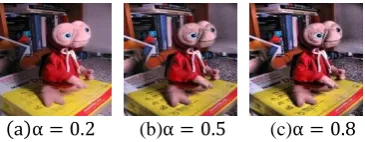
By comparing the enhancement effect of the image under different parameters α (as shown in Fig.2, α is 0.2, 0.5, 0.8 respectively), when α=0.5, the enhancement effect is the best, the detail information is richer, and the image contrast is also enhanced.
[image:2.595.207.390.706.777.2]3D Reconstruction
After image preprocessing by the image enhancement algorithm, image-based 3D reconstruction is performed. The process of 3D reconstruction is as follow:
Point Cloud Reconstruction
The Structure from Motion algorithm is to determine the spatial and geometric relationship of the target through the movement of the camera, The main processes are as follows:
a. Feature Extraction and Matching b. Camera Calibration
After sparse reconstruction, the dense reconstruction is practicable with the fusion of the sparse point cloud and the depth map using the MVS algorithm. The purpose of MVS is to reconstruct a complete, dense 3D model of images [13].
The method of generating a dense point cloud by depth map fusion uses an image space-based method to obtain a series of depth maps. A more mature method of dense point cloud reconstruction is to classify images first by CMVS to optimize SFM input and reduce dense matching time and space cost. Then, the PMVS is used to complete the final dense matching by matching, expanding and filtering [14].
Surface Reconstruction
The FSSR algorithm uses a simple mathematical formula to reconstruct implicit function efficiently. The process is as follows:
1. Implicit function construction
The basis function is expressed by a Gaussian distribution in the normal direction of the sample:
𝑓(𝒙𝒊) =2𝜋𝜎𝑥4∙ 𝑒
−𝑥2+𝑦2+𝑧2
2𝜎2 (4)
The weighting function is:
𝑤(𝒙𝒊) = 𝑤𝑥(𝑥) ∙ 𝑤𝑦𝑧(√𝑦2+ 𝑧2) (5)
2. Function sampling and estimation
The generated octree hierarchy defines the samples of the implicit functions, then estimates the implicit functions at these locations. After creating the octree, complete the implicit function with the octree. To define the implicit function at x, recursively traverse the octree, select the samples that affect the implicit function, and think that point N affects the implicit function at x if satisfy equation (11):
‖𝑥 − 𝑐𝑒𝑛𝑡𝑒𝑟(𝑁)‖ −√32 𝑆𝑁 < 3 ∙ 2𝑆𝑁 (6) Where 𝑆𝑁 is the side length of the node N. In order to limit the number of samples used to estimate the implicit function, a cutoff scale value 𝑆𝑚𝑎𝑥 is determined, and only the samples within the cutoff scale are used to reconstruct the implicit function.
3. Isosurface extraction
The sample is no longer needed in the process of extracting the isosurface, then we can extract the isosurface from the implicit function (𝐹(𝑥) = 0).
Experiments
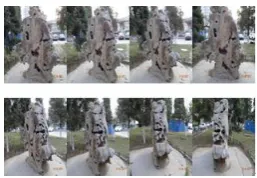
Figure 3. ET dataset partial sample. Figure 4. Stone dataset partial sample.
The ET dataset is enhanced by the proposed algorithm of this paper and the existing histogram enhancement method to obtain the ET-1 and ET-2 datasets. The stone dataset is preprocessed with same methods.
Feature Extraction and Matching
In this paper, the SIFT algorithm is used for feature extraction and matching. Fig. 5 shows the results of feature extraction (Fig. 5(b), Fig. 5(d)). Among them, the feature points number extracted by the two images is 3072, 3015, and the feature points matching is 508 pairs, which indicates that the feature extraction and matching algorithm used in this paper has a good effect.
(a) Original image1 (b) Feature detection (c) Original image2 (d) Feature detection
Figure 5. Feature detection and matching results.
For different image data sets, Table 1 shows the feature point detection results. The difference in feature points number of single image and the total number indicate that the result of feature point detection after image enhancement is greatly improved, and the improvement effect of our algorithm is better than the histogram enhancement algorithm, which further validates the effectiveness and feasibility of our algorithm.
Table 1. Number of feature points extracted.
Number ET ET-1 ET-2 1 3072 4428 3761 2 3015 4477 3811 3 2644 4250 3309 4 2995 4168 3682 5 4003 5379 5028 6 2814 4787 3637 7 2245 4565 3248 8 2150 3584 2826 9 3104 4426 3994 total 26042 40064 33296
Point Cloud Reconstruction
[image:4.595.111.484.326.399.2] [image:4.595.151.447.510.663.2](a) ET dataset (b) ET-1 dataset (c) ET-2dataset (d) ET dataset (e) ET-1 dataset (f) ET-2 dataset
Figure 6. Sparse point and dense point cloud reconstruction results.
Surface Reconstruction
The results of surface reconstruction from dense point clouds are shown in Fig. 7, where Fig. 7(a), Fig. 7(b), and Fig. 7(c) are results of surface reconstruction from ET, ET-1, and ET-2 dataset. Fig. 7(d), Fig. 7(e), and Fig. 7(f) are the surface reconstruction results of the stone, stone-1, and stone-2 dataset, respectively. By comparing, the light and dark and detail effects of Fig. 7(b) are clearer and more complete than those of Fig. 7(a) and Fig. 7(c), focusing on the red frame area in the figure; The light and dark and detail effects of Fig. 7(e) are also better than those of Fig. 7(d) and Fig. 7(f). In contrast to the red box area in Fig. 7, the reconstruction results in Figure 7(d) are rough and the detail reconstruction is incomplete. Figure 7(f) is smooth and degree of completeness is better than Fig. 7(d), and the reconstruction effect of Fig. 7(e) exceeds Fig. 7(d) and Fig. 7(f). The validity and feasibility of our image enhancement algorithm are further verified.
(a) ET dataset (b)ET-1 dataset (c)ET-2 dataset (d)stone dataset (e)stone-1 dataset (f)stone-2 dataset
Figure 7. Surface reconstruction results.
Summary
In this paper, the key steps of the existing 3D reconstruction algorithm are deeply studied. Focusing on image preprocessing, we take image preprocessing as a breakthrough to research 3D reconstruction problem based on multi-view image, and propose a new algorithm based on existing enhancement algorithm to perform 3D reconstruction of the multi-scale image set. The effect improvement of 3D reconstruction in the experimental results proves the validity and feasibility of methods proposed in this paper.
Further research and development is still needed in the field of 3D reconstruction. At present, deep learning technology is developing rapidly, it is possible to use neural networks to reconstruct.
References
[1] Huang R J, Zhong S D and Tu L F. Automatic three-dimensional modeling based on four-view stereo vision. Computer Engineering and Design, 2015(2):431-435.
[2] Yang W, Liu J B, Liao M S and Yang J. 3D Reconstruction Based on CT Images of Mandible. Journal of Image and Graphics,2002,7(09): 911-917.
[3] Wang J and Zhu L. 3D Building Façade Reconstruction Based on Image Matching-Point Cloud Fusing. Chinese Journal of Computers, 2012, 35(10):2072-2079.
[4] Choe T E, et al. Evaluation of 3-D shape reconstruction of retinal fundus[J]. Med Image Compute Assist Interv.2006,9(Pt 1):134-141.
[image:5.595.58.506.324.398.2][6] Bay H, et al. Speeded-Up Robust Features (SURF)[J]. Computer Vision and Image Understanding, 2008, 110(3):346-359.
[7] Kazhdan M, et al. Poisson surface reconstruction[C]. Eurographics Symposium on Geometry Processing. 2006.
[8] Kazhdan M, et al. Screened Poisson Surface Reconstruction[J]. ACM Transactions on Graphics, 2013, 32(3):1-13.
[9] Gao S, Lu H Q and Zhou W N. A Fast Algorithm for Surface Reconstruction from Unorganized Points. Journal of Image and Graphics, 2018,7(12):1329-1333.
[10] Wang L, Xu K, Zhou P and Yang CL. Fast 3D Reconstruction Algorithm of Photometric Stereo Using Multi-Scale Wavelet Transform. Journal of Computer-Aided Design & Computer Graphics, 2017(1):124-129.
[11] Fuhrmann S, et al. Floating scale surface reconstruction[M]. Floating scale surface reconstruction, 2014:1-11.
[12] Li K and Zhang Y. Research on Image Enhancement Method Based on Matlab Histogram Technology. Automation & Instrumentation, 2017(10):45-48. [13] Seitz S M,et al. A comparison and evaluation of multi-view stereo reconstruction algorithms [C]. Proceedings of IEEE Conference on CVPR, 2006:519-528.