2017 2nd International Conference on Software, Multimedia and Communication Engineering (SMCE 2017) ISBN: 978-1-60595-458-5
Speech Emotion Recognition Based on PSO-optimized SVM
Chuan-zhen LI
1, Fang-kun LIU
1, Yu-tian WANG
2, Hui WANG
2,*and Qin ZHANG
21Information Engineering School, Communication University of China, Beijing, China
2Key Laboratory of Media Audio & Video (Communication University of China) Ministry of Education,
Beijing, China
*Corresponding author
Keywords: Speech emotion recognition, Fourier parameter, Particle Swarm Optimization, Support Vector Machine, Frame length.
Abstract. Speech emotion recognition, as a significant part of man-machine interaction, has been widely used in manufacture, information industry, criminal investigation and security protection. However, recent research shows that it is hard to get a high recognition rate. This paper intends to enhance precision of recognition based on Support Vector Machine and Particle Swarm Optimization algorithm. Particle Swarm Optimization algorithm is applied to SVM's parameter selection and optimization. The experimental results on German EMO-DB database and Chinese CASIA database show that the accuracy rate using with PSO-optimized SVM reaches 90.09% and 73.5% respectively.
Introduction
Speech emotion recognition (SER) has become one of the major issues in the study of artificial intelligence. The recognition results can be used to analyze the emotion characteristics, judge and simulate the speaker's emotions. Consequently, the above applications can be widely applied to information industry, entertainment, criminal, security areas, as well as medical fields.
To recognize speech emotion, Renée Van Bezooijen etc.[1] created the precedent of classifying emotions using acoustic statistical characteristics. After that, R. Picard etc.[2] proposed the concept of Affective Computing, and stated that "Affective Computing is computing that relates to, arises from, or deliberately influences emotion or other affective phenomena." Moriyama etc.[3] proposed a linear correlation model between voice and emotion, which conducted the emotion recognition through linear system with the relation information. The above studies established theoretical basis for speech emotion recognition.
Recently, different techniques and different features have been generally applied to speech emotion recognition. Yelin Kim[4] used Deep Belief Network (DBN) to get the complex non-linear feature interactions in multimodal data, which was effective for emotion recognition. It even could be used for unsupervised data. Hari Krishna Vydana[5] adopted Gaussian Mixture Modeling with a universal background model (GMM-UBM) to speech emotion recognition. In this way, researchers could improve the recognition rate by studying the presence of emotion information of smaller segments of speech. Reza Lotfian and Carlos Busso[6] adopted test to speech (TTS) technology to synthesize normal voice to contrast with emotional voice, which can be used to recognize speech emotion in non-label mode. The Fourier parameters were used as the features of speech emotion recognition by Kunxia Wang etc[7]. The recognition rate reached 88.88% for the six types of emotions in the EMO-DB database and 79% for the six types of emotions in the CASIA database respectively. Yu Gu[8] extracted the voiced segments of a piece of audio through the spectrograms. Features were extracted from the voiced segments in order to get better recognition rate. In [7] and [8], researchers used SVM as the classifier for speech emotion recognition.
The rest of the paper is organized as follows. Section 2 describes the system design, signal preprocessing, feature extracting and the procedure of optimize the SVM parameters. Section 3 presents the experimental results with different database and different frame length. Finally, our conclusions are given in Section 4.
Design of Speech Emotion Recognition System
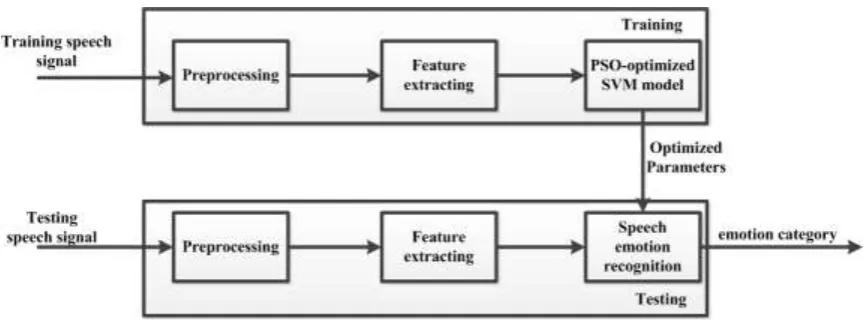
[image:2.595.82.515.204.366.2]To improve the recognition accuracy, we design a speech emotion recognition system based PSO-optimized SVM. The framework of this recognition system is shown as Fig.1.
Figure 1. Speech emotion recognition system.
The system includes several parts:preprocessing of speech signals, the features extraction, SVM training and parameters optimization, SVM classifier modeling, and speech emotion recognition. The system will be described in detail as below.
Preprocessing of Speech Signal
This paper adopts Fourier parameters as emotion features of the speech. Fourier parameters can be obtained by Fourier transform. However, since the speech signal is non-stationary, we could not get the spectral features of the signal at specific point in time through global Fourier transform. It is necessary to divide the speech signal into frames and add window before conducting discrete-time Fourier transform (DTFT). It should be noted that, in the preprocessing, the frame length is a significant factor which affects the final recognition rate. If the frame length is too long, the Fourier transform is meaningless because the signal is in a non-stationary state; if the frame length is too short, the amount of information contained in each frame is too small, and the spectrum will result in the low final recognition rate.
After dividing the signal into frames, we add window on each frame. There are three major windows: rectangular window, Hamming window and Hanning window. Hamming window is chosen because it has the largest side-lobe attenuation and spectrum leakage could be minimized.
Feature Extraction
Each speech signalframe could be regarded as a stationary signal, and discrete-time Fourier transform can be conducted. The Fourier parametric model[7] of each frame is shown as Eq.1 and Eq.2.
𝑥(𝑛) = ∑ 𝐻𝑘𝑙(𝑛)(𝑐𝑜𝑠(2𝜋𝑓𝑘𝑙 𝐹𝑠 𝑁
𝑘=0 𝑛) + 𝜑𝑘𝑙) (1)
𝐻𝑘𝑙(𝑛) = ∑ 𝑥(𝑛)𝑒−𝑗
2𝜋𝑘𝑚 𝑁 𝑁−1
𝑚=0 (2)
where l represents the number of frames of one piece of speech signal. Hlk and φlk respectively
represent the amplitude and phase of the kth frequency components. Fs represents the sampling rate of
PSO-optimized SVM
This paper applies PSO to SVM classifier to optimize SVM parameters. Then optimized parameters are used for speech emotion recognition.
Support Vector Machine. SVM[9] has unique advantages in solving small sample and nonlinear pattern of recognition. In general, if the data are linearly separable, the solution is to find a hyperplane that satisfies the classification requirements and to make the train-to-focus points far from the classification surface as much as possible. However, the feature data for speech emotion classification are not linearly separable. In this case, it is required toconvert the low-dimensional, nonlinear problem to a high-dimensional, linearly separable problem. In order to avoid the curse of dimensionality, we have to use kernel function to project all sample points to the high-dimensional space[10]. Currently there are three kernel functions of common use:
Polynomial kernel function:
𝐾(𝑥𝑖, 𝑥𝑗) = (𝑟 + 𝛾𝑥𝑖𝑇𝑥𝑗)𝑑 (3) Gaussian radial basis function:
𝐾(𝑥𝑖, 𝑥𝑗) = exp(−𝛾‖𝑥𝑖− 𝑥𝑗‖2) (4) Sigmoid kernel function:
𝐾(𝑥𝑖, 𝑥𝑗) = tanh(𝛾𝑥𝑖𝑇𝑥𝑗 + 𝑟) (5)
where d represents the terms' degree of the polynomial kernel function. γ represents the width value of the kernel function. r represents the bias coefficient of the kernel function. We have to notice that
d>0, γ>0, r>0.
We use Gaussian radial basis function as the kernel function of SVM in this paper, which is widely used in nonlinear classification.
Particle Swarm Optimization. PSO[11] simulates the bird flock’s behavior of foraging, in which the flock coordinate and cooperate to achieve the optimal goal. It is a global search algorithm with simple procedure, brief parameters, and uncomplicated adjustment, so it is very suitable for solving optimization problems. In the standard particle swarm algorithm, the velocity and position update of the particle in the search space are determined according to Eq.(6) and Eq.(7) [12].
𝑣𝑖𝑗(𝑡 + 1) = 𝑤(𝑡) × 𝑣𝑖𝑗(𝑡) + 𝑐1× 𝑟𝑎𝑛𝑑() × (𝑝𝑏𝑗(𝑡) − 𝑥𝑖𝑗(𝑡)) + 𝑐2× 𝑟𝑎𝑛𝑑() × (𝑔𝑏𝑗(𝑡) − 𝑥𝑖𝑗(𝑡)) (6)
𝑥𝑖𝑗(𝑡 + 1) = 𝑥𝑖𝑗(𝑡) + 𝑣𝑖𝑗(𝑡 + 1) (7)
where w(t) represents inertia weight. c1 and c2 are acceleration factors. rand() is any number that is
evenly distributed in interval [0,1]. pbj is the best flied position of the present particle. gbj is the best
position of the entire population corresponding to the particle and it is the best position that current iteration has experienced. xij(t) and vij(t) is the position and velocity at the time t.
SVM parameter optimization by PSO.This optimized SVM algorithm is based on Lin Zhiren's Lib-SVM, and its parameters γ and c are optimized to improve the accuracy of the speech emotion recognition rate. γ is the parameter of the kernel function in SVM, c is the penalty factor.
Each particle represents the combination of (c,γ). Parameters in SVM model are modified according to the particle velocity and position shown in eq.(6) and eq.(7), so that the exhaustive artificial experiment can be avoided.
Figure 2. The pseudocode of PSO-SVM.
Experimental Results and Analysis
EMO-DB German Corpus
The EMO-DB German corpus includes 7 categories of emotions performed by 10 actors and 5 actresses and each emotion induces 10 sentences. The emotions contain anger, joy, neutral, sadness, anxiety, disgust, and boredom. A total of 535 sentences were collected. The distribution of the emotions in the corpus is as follows: 127 for anger, 81 for boredom, 71 for joy, 64 for anxiety, 51 for disgust, 62 for sadness, and 79 for neutral.
[image:4.595.75.522.586.649.2]In this experiment, five categories of emotions in the EMO-DB corpus are selected: anger, boredom, joy, sadnessand neutral. There are 355 training sentences and 55 test sentences. The results of all experiments are averaged over five cross validation experiments. And we compare our results with those of [7] and [13], as shown in Table 1.
Table 1. Speech Emotion Recognition Rate Based on SVM and Speech Emotion Recognition Rate of SVM Based on Particle Swarm Optimization Algorithm (%).
Emotion Type Anger Boredom Joy Sadness Neutral Average
SVM 72.7 81.8 90.9 72.7 54.6 74.55
SVM Based on PSO 100.0 72.73 100.0 100 81.82 90.09
Result in [7] 98.29 71.48 92.92 91.21 87.64 88.31
Result in [13] 86.88 92.02 81.24 90.68 93.80 88.92
The recognition rates with different frame length are shown in Table 2. It can be seen that,with frame length changes from 256 to 2048, the average emotion recognition rate changes from 90.09% to 80%. It is because the short frame length contains less confusing information.
Table 2. Comparison of Speech Recognition Rate of German Speech in Different Input Signal Frame Length (%).
Emotion Type Anger Boredom Joy Sadness Neutral Average
N=256 100.0 72.73 100.0 100 81.82 90.09
N=512 100.0 81.8 100.0 72.7 90.9 89.09
N=1024 72.73 72.73 100.0 81.82 72.73 80
N=2048 63.64 45.45 100.0 100 90.91 80
CASIA Chinese Corpus
The CASIA Chinese Corpus includes 6 categories of emotions performed by 2 actors and 2 actresses. The emotions contain anger, joy, surprise, neutral, sadness and fear. A total of 9600 sentences were collected.
In this experiment, all the categories of emotions are selected. 6000 training sentences and 1200 test sentences are selected from the database. The results of all the experiments are averaged over five cross validation experiments. And we compare our results with those of [7], as shown in Table 3.
Table 3. Speech Emotion Recognition Rate Based on SVM and Speech Emotion Recognition Rate of SVM Based on Particle Swarm Optimization Algorithm (%).
Emotion Type Anger Surprise Fear Joy Sadness Neutral Average
SVM 78.5 65.5 73.9 68.5 63.3 83.0 72.1
SVM Based on PSO 83.5 60.5 74.4 69.5 67.8 85.0 73.5
Result in [7] 86 84 81 81 67 75 79
For the CASIA corpus, we could see from Table.3 that the average recognition rate (73.5%) of PSO-SVM classifier is higher than that (72.1%) of general SVM classifier. The pattern is similar to the results of experiments on EMO-DB corpus. The improvement is also because of the optimized combination of parameter γ and penalty factor c.
[image:5.595.56.545.551.625.2]The recognition rate with different frame length are shown in Table 4. The pattern is also similar to the results of the experiments on EMO-DB. It means that the frame length leads to the difference in the final recognition results directly. If the frame is too long, the Fourier transform is meaningless and the signal is in a non-stationary state; even if the signal is in a stationary state, it would contain more confusing information.
Table 4. Comparison of Speech Recognition Rate of German Speech in Different Input Signal Frame Length (%).
Emotion Type Anger Surprise Fear Joy Sadness Neutral Average N=256 83.5 60.5 74.4 69.5 67.8 85.0 73.5 N=512 71.0 65.5 72.9 69.0 61.30 74.5 69.0 N=1024 71.0 44.0 66.8 63.5 62.3 71.0 63.1 N=2048 69.5 40.0 68.8 54 62.3 72.5 61.2
Conclusion
Acknowledgments
This research is supported by the National Natural Science Foundation ofChina (Grant No. 61231015, 61501410), The State Administration of Press, Publication, Radio, Film and Television of the People's Republic of China scientific research project (Grant No. 2015-53) and the Engineering Planning Project of Communication University of China (Grant No.3132014XNG1425).
References
[1] Renée Van Bezooijen, Stanley. A. Otto, and Thomas. A. Heenan, "Recognition of vocal expressions of emotion: a three-nation study to identify universal characteristics", Journal of Cross-Cultural Psychology, vol.14, Issue 4, 1983.
[2] Rosalind W, “Affective Computing is computing that relates to, arises from, or deliberately influences emotion or other affective phenomena”. Affective Computing., The MIT Press, 1997-09-19.
[3] T. Moriyama, and S. Ozawa, "Emotion recognition and synthesis system on speech", Proceedings IEEE International Conference on Multimedia Computing and Systems, vol.1, 1999, pp. 840-844.
[4] Yelin Kim, Honglak Lee, and Emily Mower Provost. "Deep learning for robust feature generation in audiovisual emotion recognition", 2013 IEEE International Conference on Acoustics, Speech and Signal Processing(ICASSP), pp.3687-3691.
[5] Hari Krishna Vydana, P. Phani Kumar, K. Sri Rama Krishna , and Anil Kumar Vuppala, "Improved emotion recognition using GMM-UBMs", 2015 International Conference on Signal Processing and Communication Engineering Systems, pp.53-57.
[6] Reza Lotfian, and Carlos Busso. "Emotion recognition using synthetic speech as neutral reference", 2015 IEEE International Conference on Acoustics, Speech and Signal Processing (ICASSP), pp. 4759-4763.
[7] Kunxia Wang, Ning An, Bingnan Li, Yanyong Zhang, and Lian Li, "Speech emotion recognition using fourier parameters", IEEE Transactions on Affective Computing., vol. 6, no. 1, Jan.-Mar. 2015, pp.69-75.
[8] Yu Gu, Eric Postma,Hai-Xiang Lin, and Jaap Van Den Herik," Speech emotion recognition using voiced segment selection algorithm", Ecai, 2016.
[9] Vapnik V. The Nature of Statistical Learning Theory., New York: Springer-Verlag, 1995.
[10] Di Pillo. G,and Giannessi. F, Nonlinear Optimization and Applications., New York: Springer, pp. 283-295, 1996.
[11] Kennedy J. and Eberhart R, "Particle swarm optimization", IEEE International Conference on Neural Networks., vol.4, 1995, pp. 1942-1948.
[12] Yu Peng, Xiyuan Peng, and Zhaoqing Liu, "Statistical analysis of particle swarm algorithm performance", Acta Electronic Journal., vol.32,2004, pp.209-213.