2016 International Conference on Computer, Mechatronics and Electronic Engineering (CMEE 2016) ISBN: 978-1-60595-406-6
Experimental Research of Spherical Underwater Robot
Based on Fuzzy Sliding Mode Control System
Xin-yu WANG
1*and Wu-han MA
21Class Fifteen, Grade Two, Baoquanling Senior High School, Baoquanling, Heilongjiang Province,
China.
2College of Automation, Harbin Engineering University, Heilongjiang Province, China.
*Corresponding author
Keywords: Spherical underwater robot, Control, Motion.
Abstract. Fuzzy sliding mode control is a combination of fuzzy control and sliding mode control. This paper uses the fuzzy sliding mode control system to carry out the experimental study on the motion of the spherical underwater robot to investigate the operation of spherical underwater robot. The experimental results show that the linear motion, heave motion and rotary motion of spherical underwater robot using fuzzy sliding mode control system can achieve stability in static water and run well. The experimental data provides a powerful data reference for the application of multiple control methods.
Introduction
There are all kinds of abundant marine resources in the ocean, such as mineral, marine organisms and ocean energy. Most of these resources are not fully developed to date. Therefore, many new devices and equipments are developed for ocean applications such as ocean surveillance and measurements. Unmanned underwater vehicles (UUVs) are the most widely used equipment nowadays. The features of UUVs are unoccupied, reliable and highly maneuverable. An underwater vehicle will complete missions as instructed, and exchange information and data with the ship or station. Generally speaking, UUVs can be applied for scientific research, acquiring information of oceans. They can also be used for inspections and operations of the facilities under the water [1,2,3].
In order to make the spherical underwater robot better finish the task of underwater operation, the good control system and control method are essential. Researchers have proposed a variety of motion control methods, and the control algorithms of underwater which have been applied: PID control, improved PID control, fuzzy control, adaptive control, sliding mode control, neural network control, robust control, and some combination of these control algorithms. Sliding mode control (SMC), which is robust to model uncertainty and to parameter variations, and it has good disturbance rejection features. There have been a wide variety of applications of it [4,5,6,7,8,9,10,11]. However, it inherits a discontinuous control action and hence chattering phenomena will take place when the system operates near the sliding surface. Sometimes this discontinuous control action can even cause the system performance to be unstable. Fuzzy Control (FC) has supplanted conventional technologies in many applications. One major property of fuzzy logic is its ability to express the amount of ambiguity in human thinking. Therefore, when the mathematical model of the process does not exist, or exists but with uncertainties, FC is an alternative way to deal with the unknown process. However, the huge number of fuzzy rules for high-order systems makes the analysis complex [12,13,14,15]. The system used in this paper is a combination of fuzzy control and the sliding mode control.
traditional fuzzy control system structure in higher order system. Therefore, this paper uses the fuzzy sliding mode control system to carry out the experimental study on the motion of the spherical underwater robot.
Organization of the Text
The Prototype of the Spherical Underwater Robot
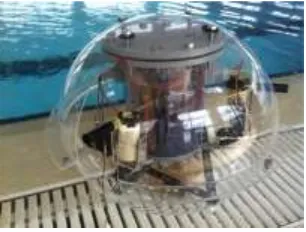
The prototype of the spherical underwater robot is shown in Figure 1. The robot is a kind of open frame structure. Water is easy to go through the robot, and all of the control parts are contained in the water proof box. In this paper, the spherical underwater robot on Z axis symmetry has two
hemispheres which connect with each other by connecting wings.As shown in Figure 1, the triangle
[image:2.595.221.374.273.389.2]bracket supports 3 water-jet propellers which are symmetrically distributed into a 120 degree angle on the same circumference in the robot and 6 servo motors.
Figure 1. The spherical underwater robot.
Description of Control System
In order to keep the generality, the dynamic equations of the n-order nonlinear systems can be expressed as follows:
{ẋi = xi+1, 1 ≤ i ≤ n − 1.
ẋn= f(x,t) + d(t) + g(x,t)u(t). (1) where the x(t)=[𝑥1(t),𝑥2(t),…,𝑥𝑛(t)]T∈𝑛 is the state vector,the 𝑓(𝑥,t) and 𝑔(𝑥,t) both are the unknown functions belong the 𝑛→ space. 𝑑(𝑡) is the external disturbance term and the 𝑢(𝑡) is the control input.
e = 𝑥𝑑− 𝑥 = [𝑒 𝑒̇,⋯,𝑒(𝑛−1)]𝑇. (2) The switching function is as follows:
s(x,t) = ce = c1e + c2ė + ⋯ + cn−1e(n−2)+ e(n−1). (3) where c = [𝑐1 𝑐2… 𝑐𝑛 1].
The Fuzzy Sliding Mode Controller
Let the derivative of the switching function be 0 and the function is shown as follows:
ṡ(x,t) = c1ė + c2ë + ⋯ + cn−1e(n−1)+ en = c1ė + c2ë + ⋯ + cn−1e(n−1)+ xd
(n)
− x(n) = ∑ cie(i)+ xd
(n)
−
n−1
ueq = 1
g(x,t)(∑ cie (i)+ x
d (n)
−
n−1
i=1 f(x,t)). (5)
The use of switching controller can meet the conditions of sliding which is the s(x,t) ∙ 𝑠̇(𝑥,t) ≤ −𝛾|𝑠|,where the 𝛾 is the positive constant. The switching controller is as follows:
𝑢𝑠 = 1
𝑔(𝑥,t)𝛾𝑠𝑔𝑛(𝑠). (6) So the sliding mode controller is as follows:
u = 𝑢𝑒𝑞+ 𝑢𝑠. (7) The formulas from (5) to (7) are introduced into formula (4) to obtain the equation about s(x,t)𝑠̇(𝑥,t):
s𝑠̇ = 𝑠 ∙ (−𝛾 ∙ 𝑠𝑔𝑛(𝑠)) − 𝑠 ∙ 𝑑(𝑡) = −𝛾|𝑠| − 𝑠𝑑(𝑡) ≤ 0. (8) So this control system is stable.
According to the equivalent and switching mode control, the fuzzy controller could be designed. When the s(t) = 0, the fuzzy controller selects equivalent controller and the fuzzy controller selects switching controller when the s(t) ≠ 0. By defuzzification method, the fuzzy controller can be designed as follows:
u = 𝜇𝑧(𝑠)𝑢𝑒𝑞+𝜇𝑁𝑍(𝑠)(𝑢𝑒𝑞+𝑢𝑠)
𝜇𝑍(𝑠)+𝜇𝑁𝑍(𝑠) = 𝑢𝑒𝑞+ 𝜇𝑁𝑍(𝑠)𝑢𝑠.
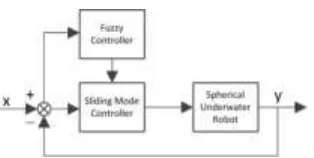
𝜇𝑁𝑍(𝑠)(𝑢𝑒𝑞+ 𝑢𝑠) = 1. (9) From the formula (9), the control rule is the traditional equivalent sliding mode control when the value of 𝜇𝑁𝑍(𝑠) is 1 and the controller reduce the chattering phenomena through the changes of
[image:3.595.221.378.440.519.2]𝜇𝑁𝑍(𝑠). The Figure 2 is the frame of fuzzy sliding mode controller.
Figure 2. Frame of fuzzy sliding mode controller.
Results and Discussion
Straight Forward Motion
[image:3.595.143.455.591.761.2]In this paper, the basic principle of the control method is illustrated by the example of straight forward motion experiment. First of all, the azimuth information values of inertial sensors inside the spherical underwater robot must be obtained and some of the values are extracted. Then the values are set to First moment, Second moment, and to N moment. The corresponding values are 𝜃1, 𝜃2, …,𝜃𝑛. The D-value of the azimuth information is as follows: ∆1= 𝜃2− 𝜃1 , ∆2= 𝜃3 −
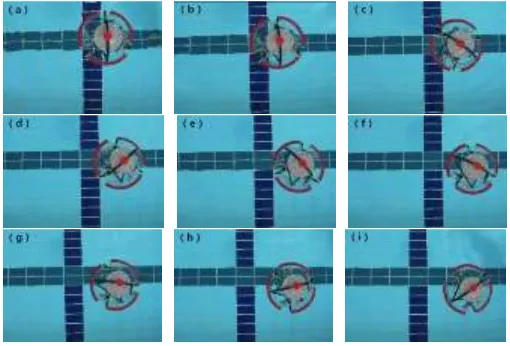
𝜃2,…, ∆𝑛−1= 𝜃𝑛− 𝜃𝑛−1. According to the changes of deviation, the corresponding assemblage does some correcting actions, such as the input voltage or the incident angle of water-jet propeller is changed by the change of servo motor or duty ratio of the propeller, which changes the water-jet direction and speed to make the spherical underwater robot reach a desired motion state. Figure 3 is the overlooking screen captures of nine moments in the forward motion experiment. From (a) to (i), the recoding time interval is two seconds. Every picture shows changes of the positon and attitude of spherical underwater robot in every two seconds interval. The left front part of the black mark on the hell is the bow of the spherical underwater robot. The spherical underwater robot moved from Figure 3 (a) to Figure 3 (i) after 16 seconds.
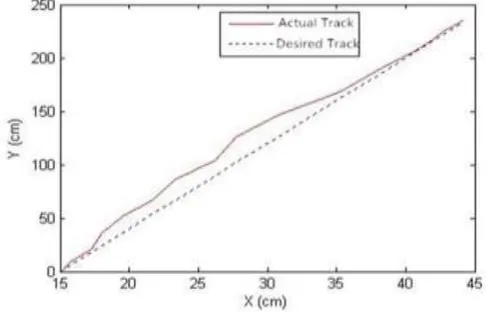
The intersection of black tiles in the pool is selected as the origin (O) of fixed coordinate system in Figure 3. The downward direction is selected as the positive direction of X axis and the left direction is selected as the positive direction of Y axis. The red point on the center of the spherical underwater robot is selected as the origin (O) of coordinate system of spherical robot. The changes of central position are studied according to the data. Figure 4 which corresponds to Figure 3 is the trajectory of center point of spherical underwater robot in the XY plane of fixed coordinate system during the straight forward motion. The initial coordinate of spherical underwater robot which is relative to fixed coordinate system is (15, 0) and the unit is centimeter. The Figure 4 shows that the straight forward trajectory of spherical underwater robot is basically a straight line although there is a certain deviation between the actual track and the desired track, which shows that the robot with the above mentioned system basically meets the expected requirements and can achieve straight forward motion.
Figure 4. Trajectory of XY plane (straight forward).
Heave Motion
[image:4.595.168.411.439.595.2]motion of the spherical underwater robot with the fuzzy sliding mode control system is relatively easy and stable in the static water.
[image:5.595.179.417.140.253.2]The upward motion experiment is the subsequent process of the downward motion. At this time, the angle of every water-jet propeller and X axis is -60° in the XZ plane, which provides the power of upward motion of the underwater robot.
[image:5.595.175.422.277.420.2]Figure 5. Downward motion of underwater robot (a) 0 second; (b) 2 seconds; …; (f ) 10 seconds.
Figure 6. Upward motion of underwater robot (a) 11 seconds; (b) 13 seconds; …; (f) 21 seconds.
The Figure 6 is the side screen captures in every two seconds during the upward motion of the spherical underwater robot. Every picture shows changes of the positon and attitude of spherical underwater robot in every two seconds interval during the upward motion. Because this upward motion is the continuous process of the downward motion, the 11th-second screen capture is selected and the calibration time starts in the 11th second to indicate the change of motion at adjacent times. In the same way, the picture shows that the changes of the positon of the underwater robot are very not obvious in the initial two seconds with the reference line, which is due to the braking action. However, the spherical underwater robot goes out of the surface of the water under the propulsive force in the last two seconds. Then, the position of the robot changes to the initially suspended positon due to the recovery of position of water-jet propellers and stopping jetting water. The feasibility and stability of the motions of the underwater spherical robot with the above fuzzy sliding mode control system is fully verified by the experiment of downward motion and upward motion.
[image:5.595.170.425.609.782.2]Rotary Motion
Figure 7 is the overlooking screen captures of nine moments in the rotary motion experiment. The Figure 7 shows the changes of the positon and posture of spherical underwater robot in the two seconds interval. Among the Fig.7, the picture (a) is the initial state. In order to achieve the anti-clockwise rotation movement, the three water-jet propellers rotate clockwise in 30 degrees at the same time, as shown in Figure 7 (b). In Fig.7 (b), the spherical underwater robot has already begun to rotate anticlockwise. From figure 7 (b) to Figure 7 (e), the rotation speed increases gradually. The water-jet propellers of the spherical underwater robots shown in Figure 7 (e) in eighth second rotate anticlockwise in 60 degrees, which is relative to Figure 7 (d). Because the change of angle has braking function, the Figure 7 (e) and the Figure 7 (f) show that the anti-clockwise rotation speed of spherical underwater robot has already slowed down. The change of the angle achieves the braking effect. The results show that this spherical underwater robot with the fuzzy sliding mode control system can achieve the rotary motion of 0 degree rotary diameter. Although the whole robot moves to the lower right direction during the anti-clockwise rotation movement, the change of the distance is too small to be ignored.
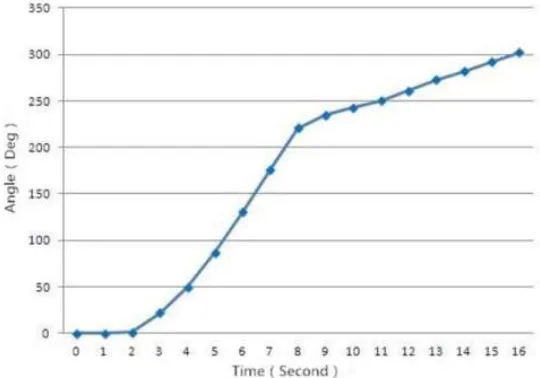
Figure 8. Angle changes in rotation motion.
According to the data obtained from the experiment, the changes of angle during the rotary motion of spherical underwater robot have been studied. Figure 8 shows the changes of the angle with changes of time when the underwater spherical robot is rotated. The Figure 7 shows that the spherical underwater changes the water-jet direction to start braking in eighth seconds, which is similarly shown in Figure 8. In Figure 8, the eighth second is a turning point and the rotary speed of spherical underwater robot has begun to slow down at this point.
Summary
References
[1] Kihun Kim, Hang S. Choi, Analysis on the controlled nonlinear motion of a test bed AUV– SNUUV I, Ocean Engineering, 34 (2007) 1138-1150.
[2] O. Saout, P. Ananthakrishnan, Hydrodynamic and dynamic analysis to determine the directional
stability of an underwater vehicle near a free surface, Applied Ocean Research, 33 (2011) 158-167.
[3] Giacomo Marani, Song K. Choi, Junku Yuh, Underwater autonomous manipulation for
intervention missions AUVs, Ocean Engineering, 36 (2009) 15-23.
[4] Radu-Emil Precup, Hans Hellendoorn. A survey on industrial applications of fuzzy control, Computers in Industry, 62 (2011) 213-226.
[5] J. Guo, F. C. Chiu, C. C. Huang, Design of a sliding mode fuzzy controller for the guidance and control of an autonomous underwater vehicle, Ocean Engineering, 30 (2003) 2137-2155.
[6] Kashif Ishaque, S. S. Abdullah, S. M. Ayob, Z. Salam, Single input fuzzy logic controller for
unmanned underwater vehicle, Journal of Intelligent and Robotic Systems: Theory and Applications, 59 (2010) 87-100.
[7] K. Ishaque, S. S. Abdullah, S. M. Ayob, Z. Salam, A simplified approach to design fuzzy logic
controller for an underwater vehicle, Ocean Engineering, 38 (2011) 271-284.
[8] Bin Xu, Shunmugham R. Pandian, Norimitsu Sakagami, Fred Petry, “Neuro-fuzzy control of underwater vehicle-manipulator systems”, Journal of the Franklin Institute, 349 (2012) 1125-1138. [9] Alessandro Pisano, Elio Usai, Output-feedback control of an underwater vehicle prototype by higher-order sliding modes, Automatica, 40 (2004) 1525-1531.
[10]T. Chatchanayuenyong, M. Parnichkun, Neural network based-time optimal sliding mode
control for an autonomous underwater robot, Mechatronics, 16 (2006) 471-478.
[11]Hyun-Sik Kim, Yong-Ku Shin, Expanded adaptive fuzzy sliding mode controller using expert
knowledge and fuzzy basis function expansion for UFV depth control, Ocean Engineering, 34 (2007) 1080-1088.
[12]Seung-Keon Lee, Kyoung-Ho Sohn, Seung-Woo Byun, Joon-Young Kim, Modeling and
controller design of mata-type unmanned underwater test vehicle, Journal of Mechanical Science and Technology, 23 (2009) 987-990.
[13]Serdar Soylu, Bradltey J. Buckham, Ron P. Podhorodeski, A chattering-free sliding-mode controller for underwater vehicles with fault-tolerant infinity-norm thrust allocation, Ocean Engineering, 35 (2008) 1647-1659.
[14]Mohan Santhakumar, Thondiyath Asokan, Investigation on the hybrid tracking control of an underactuated autonomous underwater robot, Advanced Robotics, 24 (2010) 1529-1556.