University of Huddersfield Repository
Alviano, Mario and Faber, Wolfgang
The Complexity Boundary of Answer Set Programming with Generalized Atoms under the FLP
Semantics
Original Citation
Alviano, Mario and Faber, Wolfgang (2013) The Complexity Boundary of Answer Set
Programming with Generalized Atoms under the FLP Semantics. In: Logic Programming and
Nonmonotonic Reasoning. Lecture Notes in Computer Science, 8148 (8148). Springer Verlag, pp.
6772. ISBN 9783642405631
This version is available at http://eprints.hud.ac.uk/id/eprint/21032/
The University Repository is a digital collection of the research output of the
University, available on Open Access. Copyright and Moral Rights for the items
on this site are retained by the individual author and/or other copyright owners.
Users may access full items free of charge; copies of full text items generally
can be reproduced, displayed or performed and given to third parties in any
format or medium for personal research or study, educational or notforprofit
purposes without prior permission or charge, provided:
•
The authors, title and full bibliographic details is credited in any copy;
•
A hyperlink and/or URL is included for the original metadata page; and
•
The content is not changed in any way.
For more information, including our policy and submission procedure, please
contact the Repository Team at: [email protected].
The Complexity Boundary of Answer Set Programming
with Generalized Atoms under the FLP Semantics
Mario Alviano and Wolfgang Faber
Department of Mathematics University of Calabria 87030 Rende (CS), Italy {alviano,faber}@mat.unical.it
Abstract. In recent years, Answer Set Programming (ASP), logic programming under the stable model or answer set semantics, has seen several extensions by generalizing the notion of an atom in these programs: be it aggregate atoms, HEX atoms, generalized quantifiers, or abstract constraints, the idea is to have more complicated satisfaction patterns in the lattice of Herbrand interpretations than traditional, simple atoms. In this paper we refer to any of these constructs as gen-eralized atoms. It is known that programs with gengen-eralized atoms that have mono-tonic or antimonomono-tonic satisfaction patterns do not increase complexity with re-spect to programs with simple atoms (if satisfaction of the generalized atoms can be decided in polynomial time) under most semantics. It is also known that gen-eralized atoms that are nonmonotonic (being neither monotonic nor antimono-tonic) can, but need not, increase the complexity by one level in the polynomial hierarchy if non-disjunctive programs under the FLP semantics are considered. In this paper we provide the precise boundary of this complexity gap: programs with convex generalized atom never increase complexity, while allowing a single non-convex generalized atom (under reasonable conditions) always does. We also discuss several implications of this result in practice.
1
Introduction
Various extensions of the basic Answer Set Programming language have been proposed by allowing more general atoms in rule bodies, for example aggregate atoms, HEX atoms, dl-atoms, generalized quantifiers, or abstract constraints. The FLP semantics de-fined in [5] provides a semantics to all of these extensions, as it treats all body elements in the same way (and it coincides with the traditional ASP semantics when no general-ized atoms are present). The complexity analyses reported in [5] show that in programs with single simple atom rule heads, the main complexity tasks do not increase when the generalized atoms present are monotonic or antimonotonic (coN P-complete for cau-tious reasoning), but there is an increase in complexity otherwise (ΠP
2-complete for
cautious reasoning). These complexity results hold under the assumptions of dealing with propositional programs and that determining the satisfaction of a generalized atom in an interpretation can be done in polynomial time. Also throughout this paper, we will work under these assumptions.
for such easy nonmonotonic generalized atoms are count aggregates with an equality guard, cardinality constraints with upper and lower bounds, or weight constraints with non-negative weights and upper and lower guards. All of these have the property of be-ing convex, which can be thought of as a conjunction of monotonic and antimonotonic. Convex generalized atoms have been studied in [7], and it is implicit in there, and in general not hard to see that there is no increase in complexity in the presence of atoms of this kind.
In this paper, we show that convex generalized atoms are indeed the only ones for which cautious reasoning under the FLP semantics remains incoN P. Our main result is that when a language allows any kind of non-convex generalized atom,Π2P-hardness of cautious reasoning can be established. We just require two basic properties of gener-alized atoms: they should be closed under renaming of atoms, and only a subset of all available (simple) atoms should be relevant for the satisfaction of a single generalized atom (this subset is the domain of the generalized atom). All types of generalized atoms that we are aware of meet these assumptions. Essentially, the first requirement means that it is possible to rename the simple atoms in the representation of a generalized atom while retaining its semantic properties, while the second means that modifying truth values of simple atoms that are irrelevant to the general atom does not alter its semantic behavior.
Our result has several implications that are discussed in more detail in section 4. The main ones concern implementation and rewriting issues, but also simpler identifi-cation of the complexity of ASP extensions. In the following, we will present a simple language for our study in section 2; essentially, we view a rule body as a single “struc-ture” that takes the role of a generalized atom (sufficiently detailed and expressive, since the FLP semantics treats rule bodies monolithically anyway and because convexity is closed under conjunction). In section 3 we present our main theorem and its proof, and in section 4 we wrap up.
2
Syntax and Semantics
LetUbe a fixed, countable set of propositional atoms. An interpretationIis a subset of U. A structureSonU is a mapping of interpretations into Boolean truth values. Each structureShas an associated domainDS ⊂ U, indicating those atoms that are relevant
to the structure. A general ruleris of the following form:
H(r)←B(r) (1)
whereH(r)is a propositional atom inU referred as the head ofr, andB(r)is a struc-ture onUcalled the body ofr. No particular assumption is made on the syntax ofB(r), in the case of normal propositional logic programs these structures are conjunctions of literals. We assume that structures are closed under propositional variants, that is, for any structureS, alsoSσ is a structure for any bijectionσ : U → U, the associated domain isDSσ={σ(a)|a∈DS}.
A general programP is a set of general rules. By datalogSwe refer to the class of
LetI ⊆ U be an interpretation.Iis a model for a structureS, denotedI|=S, ifS
mapsIto true. Otherwise, ifSmapsIto false,Iis not a model ofS, denotedI6|=S. We require that atoms outside the domain ofSare irrelevant for modelhood, that is, for any interpretationIandX ⊆ U \DS it holds thatI |=Sif and only ifI∪X |=S.
Moreover, for any bijectionσ:U → U, letIσ={σ(a)|a∈I}, and we require that
Iσ|=Sσif and only ifI|=S.Iis a model of a rulerof the form (1), denotedI|=r, ifH(r) ∈ I wheneverI |= B(r).I is a model of a programP, denotedI |= P, if
I|=rfor every ruler∈P.
The FLP reductPI of a programP with respect toIis defined as the set{r|r∈
P ∧I |=B(r)}.Iis a stable model ofP ifI|=PI and for eachJ ⊂Iit holds that
J 6|= PI. A propositional atomais a cautious consequence of a programP, denoted
P |=ca, ifabelongs to all stable models ofP.
Structures can be characterized in terms ofmonotonicity as follows: Let S be a structure. S is monotonic if for all pairs X, Y of interpretations such that X ⊂ Y,
X |= S implies Y |= S.S is antimonotonic if for all pairs Y, Z of interpretations such thatY ⊂ Z,Z |= S impliesY |= S.S is convex if for all triplesX, Y, Zof interpretations such thatX ⊂Y ⊂Z,X|=SandZ|=SimpliesY |=S.
3
Main Complexity Result
It is known that cautious reasoning over answer set programs with generalized atoms under FLP semantics isΠP
2-complete in general. It is also known that the complexity
drops tocoN P if structures in body rules are constrained to be convex. This appears to be “folklore” knowledge and can be argued to follow from results in [7]. An easy way to see membership incoN P is that all convex structures can be decomposed into a conjunction of a monotonic and an antimonotonic structure, for which membership in
coN P has been shown in [5].
We will therefore focus on showing that convex structures define the precise bound-ary between the first and the second level of the polynomial hierarchy. In fact, we prove that any extension of datalog by at least one non-convex structure and its variants raises the complexity of cautious reasoning to the second level of the polynomial hierarchy.
The hardness proof is similar to the reduction from 2QBF to disjunctive logic pro-grams as presented in [2]. This reduction was adapted to nondisjunctive propro-grams with nonmonotonic aggregates in [5], and a similar adaption to weight constraints was pre-sented independently in [6]. The fundamental tool in these adaptations in terms of struc-tures is the availability of strucstruc-turesS1, S2that allow for encoding “need to have either
atomxTorxF, or both of them, but the latter only upon forcing the truth of both atoms.”
S1, S2have domainsDS1 =DS2 ={x
T, xF}and the following satisfaction patterns:
∅ |=S1 {xT} |=S1 {xF} 6|=S1 {xT, xF} |=S1
∅ |=S2 {xT} 6|=S2 {xF} |=S2 {xT, xF} |=S2
A program that meets the specification isP ={xT ←S
1, xF ←S2}. Indeed,∅is
not an answer set ofP asP∅ =P and∅ 6|=P (so also any extension ofP can never have an answer set containing neitherxT norxF). Both{xT}and{xF}are answer sets
P because of minimality (P{xT,xF}
=P and{xT, xF} |=P, but also{xT} |=Pand
{xF} |=P), but can become an answer set in an extension ofPthat forces the truth of
bothxT andxF.
A crucial observation is thatS1 andS2are not just nonmonotonic, but also
non-convex. The main idea of our new proof is that any non-convex structure S that is closed under propositional variants can take over the role of bothS1andS2. For such
anS, we will create appropriate variantsSσT andSσF that use indexed copies ofxT
andxF in order to obtain the required multitudes of elements:
{a1, . . . , ap} |=S {xT1, . . . , xTp} |=SσT {xF1, . . . , xFp} |=SσF
{a1, . . . , ap, . . . , aq} 6|=S {xT1, . . . , xqT} 6|=SσT {xF1, . . . , xFq} 6|=SσF
{a1, . . . , ap, . . . , aq, . . . ar} |=S {xT1, . . . , xTr} |=SσT {xF1, . . . , xFr} |=SσF
We can then create a programP0 acting likeP by usingxTq,xFq,SσF andSσT in
place of xT,xF,S
1 andS2, respectively. In addition, we need some auxiliary rules
for the following purposes: to forcexT
1, . . . , xTp, xF1, . . . , xFp to hold always; to require
the same truth value forxT
p+1, . . . , xTq and similar forxFp+1, . . . , xFq; to force truth of
xT
p+1, . . . , xTr whenever any ofxTq+1, . . . , xTr is true and to force truth ofxFp+1, . . . , xFr
whenever any ofxFq+1, . . . , xFr is true. The resulting program can then give rise to an-swer sets containing eitherxTq orxFq, or bothxTq, xFq when they are forced in an
exten-sion of the program. In particular, the answer sets ofP0are the following:{xT
1, . . . , xTq,
xF
1, . . . , xFp}, corresponding to{xT}; and{xT1, . . . , xTp, xF1, . . . , xFq}, corresponding to
{xF}. Model{xT
1, . . . , xTr, xF1, . . . , xFr}instead is not an answer set ofP0because of
minimality, but it can be turned into an answer set by extending the program suitably. In the proof, we need to make the assumption that all symbolsxTi andxFj are outside the domainDS, which is not problematic ifU is sufficiently large.
Theorem 1. LetS be any non-convex structure on a set{a1, . . . , as}. Cautious rea-soning over datalogS isΠ2P-hard.
Proof. Deciding validity of a QBFΨ = ∀x1· · · ∀xm∃y1· · · ∃yn E, where E is in
3CNF, is a well-known Π2P-hard problem. Formula Ψ is equivalent to ¬Ψ0, where
Ψ0 = ∃x1· · · ∃xm∀y1· · · ∀yn E0, and E0 is a 3DNF equivalent to¬E and obtained
by applying De Morgan’s laws. To prove the claim we construct a datalogS program
PΨ such thatPΨ |=cw(wa fresh atom) if and only ifΨ is valid, i.e., iffΨ0is invalid.
SinceSis a non-convex structure by assumption, there are interpretationsA, B, C
such thatA⊂B ⊂C,A|=SandC|=S butB 6|=S. Without loss of generality, let
A={a1, . . . , ap},B ={a1, . . . , aq}andC={a1, . . . , ar}, for0≤p < q < r≤s.
LetE0= (l1,1∧l1,2∧l1,3)∨ · · · ∨(lk,1∧lk,2∧lk,3), for somek≥1.
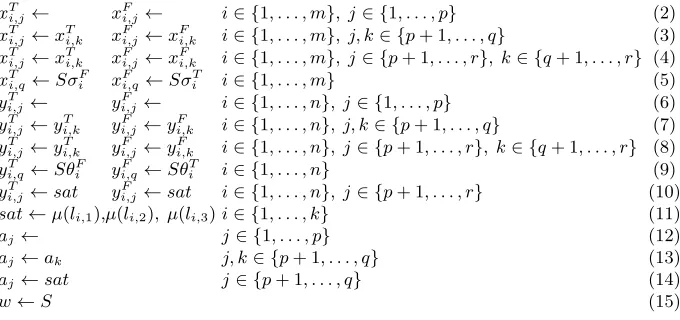
ProgramPΨ0 is reported in Fig. 1, whereσTi (aj) =xTi,jandσiF(aj) =xFi,jfor all
i= 1, . . . , mandj = 1, . . . , q;θT
i(aj) = yi,jT andθiF(aj) =yi,jF for alli = 1, . . . , n
andj = 1, . . . , q;µ(xi) =xTi,randµ(¬xi) =xFi,rfor alli= 1, . . . , m;µ(yi) =yi,rT
andµ(¬yi) =yi,rF for alli= 1, . . . , n.
Rules (2)–(9) represent one copy of the programP0 discussed earlier for each of the xi andyj (i = 1, . . . , m;j = 1, . . . , n), and so force each answer set of PΨ to
contain at least one ofxT
xT
i,j← xFi,j← i∈ {1, . . . , m}, j∈ {1, . . . , p} (2)
xT
i,j←xTi,k xFi,j←xFi,k i∈ {1, . . . , m}, j, k∈ {p+ 1, . . . , q} (3)
xTi,j←x T
i,k x
F i,j←x
F
i,k i∈ {1, . . . , m}, j∈ {p+ 1, . . . , r}, k∈ {q+ 1, . . . , r} (4)
xTi,q←SσiF xFi,q←SσTi i∈ {1, . . . , m} (5)
yi,jT ← yi,jF ← i∈ {1, . . . , n}, j∈ {1, . . . , p} (6)
yT
i,j←yTi,k yi,jF ←yFi,k i∈ {1, . . . , n}, j, k∈ {p+ 1, . . . , q} (7)
yi,jT ←y T
i,k y
F i,j←y
F
i,k i∈ {1, . . . , n}, j∈ {p+ 1, . . . , r}, k∈ {q+ 1, . . . , r} (8)
yi,qT ←SθFi yi,qF ←SθTi i∈ {1, . . . , n} (9)
yi,jT ←sat yi,jF ←sat i∈ {1, . . . , n}, j∈ {p+ 1, . . . , r} (10)
sat←µ(li,1),µ(li,2), µ(li,3)i∈ {1, . . . , k} (11)
aj← j∈ {1, . . . , p} (12)
aj←ak j, k∈ {p+ 1, . . . , q} (13)
aj←sat j∈ {p+ 1, . . . , q} (14)
[image:6.612.138.478.124.284.2]w←S (15)
Fig. 1.ProgramPΨ0
of the propositional variables in Ψ0. Rules (10) are used to simulate universality of they variables, as described later. Having an assignment, rules (11) derivesat if the assignment satisfies some disjunct ofE0(and hence alsoE0itself). Finally, rules (12)– (15) derivewifsatis false.
We first show thatΨnot valid impliesPΨ 6|=cw. IfΨis not valid,Ψ0is valid. Hence,
there is an assignmentν forx1, . . . , xmsuch that no extension toy1, . . . , yn satisfies
E, i.e., all these extensions satisfyE0. Consider the following model ofP Ψ:
M ={xTi,j|ν(xi) = 1, i= 1, . . . , m, j=p+ 1, . . . , q}
∪ {xF
i,j|ν(xi) = 0, i= 1, . . . , m, j=p+ 1, . . . , q}
∪ {xTi,j, xFi,j |i= 1, . . . , m, j= 1, . . . , p} ∪ {yT
i,j, yFi,j|i= 1, . . . , n, j= 1, . . . , r}
∪ {aj |j= 1, . . . , q} ∪ {sat}
We claim thatM is a stable model of PΨ. ConsiderI ⊆ M such thatI |= PΨM.I
contains allxatoms inM due to rules (2)–(5).I also contains an assignment for the
yvariables because of rules (6)–(9). Since any assignment for theys satisfies at least a disjunct ofE0, from rules (11) we derivesat ∈I. Hence, rules (10) force allyatoms to belong toI, and thusI=M holds, which proves thatM is a stable model ofPΨ.
Now we show thatPΨ 6|=c w implies thatΨ is not valid. To this end, letM be
a stable model of PΨ such thatw /∈ M. Hence, by rule (15) we have thatM 6|= S.
Since A ⊆ M because of rules (12), in order to haveM 6|= S, atoms in B have to belong to M. These atoms can be supported only by rules (13)–(14), from which
sat ∈ M follows. From sat ∈ M and rules (10), we have yT
i,q, yi,qF ∈ M for all
i= 1, . . . , n. AndM contains eitherxT
i,qorxFi,qfori= 1, . . . , mbecause of rules (2)–
(5). Suppose by contradiction thatΨis valid. Thus, for all assignments ofx1, . . . , xm,
there is an assignment for y1, . . . , yn such that E is true, i.e., E0 is false. Let ν be
xF
i,q∈M for alli= 1, . . . , m. ConsiderI=M\ {sat} \ {yTi,j, yi,jF |i= 1, . . . , n, j=
q+ 1, . . . , r} \ {yT
i,j |ν(yi) = 0, i= 1, . . . , n, j =p+ 1, . . . , q} \ {yi,jF | ν(yi) =
1, i= 1, . . . , n, j =p+ 1, . . . , q}. Sinceν satisfiesE,νdoes not satisfyE0, i.e., no disjunct ofE0 is satisfied byν. Hence, all rules (11) are satisfied, and thusI |=PM
Ψ ,
contradicting the assumption thatM is a stable model ofPΨ, and soΨis not valid. ut
4
Discussion
Our results have several consequences. First of all, from our proof it is easy to see that convex generalized atoms also form the complexity boundary for deciding whether a program has an answer set (in this case the boundary is betweenN P andΣP
2) and for
checking whether an interpretation is an answer set of a program (fromP tocoN P). It also means that for programs containing only convex structures, techniques as those presented in [1] can be used for computing answer sets, while the presence of any non-convex structure requires more complex techniques such as those presented in [4]. There are several examples for convex structures that are easy to identify syntactically: count aggregates with equality guards, sum aggregates with positive summands and equality guards, dl-atoms that do not involve∩−and rely on a tractable Description Logic [3]. However many others are in general not convex, for example sum aggregates that involve both positive and negative summands, times aggregates that involve the factor 0, average aggregates, dl-atoms with∩−, and so on. It is still possible to find special cases of such structures that are convex, but that requires deeper analyses.
The results also immediately imply impossibility results for rewritability: unless the polynomial hierarchy collapses to its first level, it is not possible to rewrite a program with non-convex structures into one containing only convex structures (for example, a program not containing any generalized atoms), unless disjunction or similar constructs are allowed in rule heads.
The results obtained in this work apply only to the FLP semantics. Whether the results carry over in any way to other semantics is unclear and left to future work.
References
1. Alviano, M., Calimeri, F., Faber, W., Leone, N., Perri, S.: Unfounded Sets and Well-Founded Semantics of Answer Set Programs with Aggregates. JAIR 42, 487–527 (2011)
2. Eiter, T., Gottlob, G.: On the Computational Cost of Disjunctive Logic Programming: Propo-sitional Case. AMAI 15(3/4), 289–323 (1995)
3. Eiter, T., Ianni, G., Lukasiewicz, T., Schindlauer, R., Tompits, H.: Combining answer set pro-gramming with description logics for the semantic web. Artif. Intell. 172(12–13), 1495–1539 (2008)
4. Faber, W.: Unfounded Sets for Disjunctive Logic Programs with Arbitrary Aggregates. In LPNMR’05. LNCS, vol. 3662, pp. 40–52. (2005)
5. Faber, W., Leone, N., Pfeifer, G.: Semantics and complexity of recursive aggregates in answer set programming. AI 175(1), 278–298 (2011), special Issue: John McCarthy’s Legacy 6. Ferraris, P.: Answer Sets for Propositional Theories. In LPNMR’05. LNCS, vol. 3662, pp.
119–131. (2005)