A Monthly Double-Blind Peer Reviewed Refereed Open Access International e-Journal - Included in the International Serial Directories.
GE-International Journal of Management Research (GE-IJMR) ISSN: (2321-1709)
113 | P a g e
GE-International Journal of Management Research
Vol. 5, Issue 5, May 2017 Impact Factor- 5.779 ISSN(O): 2321-1709, ISSN(P): 2394-4226
© Associated Asia Research Foundation (AARF)
Website: www.aarf.asiaEmail : [email protected] , [email protected]BASIC INDICATORS FORMING EFFECTIVENESS IN DEVELOPING
PRODUCT INNOVATIONS
Siyka Demirova
Associate Professor, PhD, Department “Industrial Management” Technical University - Varna, Bulgaria.
ABSTRACT
The article examines the main indicators that characterize a product development as
innovative and the design technical solution as an innovation. The requirements for
innovation in the development of product innovation projects and their ability to be effective
and competitive are analyzed. The conditions and the possibilities for impact of these
indicators on the degree of innovation and efficiency of product innovations, as well as on the
economic results, have been studied. An attempt has been made to determine the degree of
innovation impact, which also serves as a basis for quantifying the indicators included in the
project solutions. Conclusions are given on impacts and impacts when using this approach to
develop innovative projects.
Keywords: Innovation, Product Innovation, Efficiency, Innovative Projects, Innovation
Introduction
The innovative development of the industry is characterized by the fact that the reserves in its
development can be successfully realized by choosing the best project solutions. What is
characteristic here is that the effectiveness of innovative projects depends on many indicators,
of which more important are: innovation, resource, social, environmental and other
indicators. In addition, the main production processes are closely related to ancillary and
service processes whose performance also influences production efficiency. Therefore, when
developing innovative projects, account must be taken of the impact of all these factors both
on the parameters of the project solutions and on the quantifiable indicators for the
A Monthly Double-Blind Peer Reviewed Refereed Open Access International e-Journal - Included in the International Serial Directories.
GE-International Journal of Management Research (GE-IJMR) ISSN: (2321-1709)
114 | P a g e
product base, incl. technological, auxiliary and informational activities and minimization of
human labor will increasingly be a major factor in the development of the industry. This
means that on the basis of new innovative communication and computer achievements,
nanotechnology, Technical solutions will not only change the structure of production
globally, but also the approaches and ways of designing innovative products will change. In
the future, production will be considered as one, involving both technology, technology and
information processes, and functionally integrated components that deliver effective
innovative solutions.
The creation of an optimal innovation program of the project development, ie. Such project
implementations, which would allow for the dynamics of changing the indicators, are of the
utmost importance. These projects usually define a set of diverse techno-economic solutions
that vary in terms of execution times, costs, deployment modes, and so on. If analysis of these
indicators is analyzed, programs can be created that characterize the technical and
economical and innovative nature of the system for a certain period of time. The
consideration of such tasks where decisions can be executed in this sequence, and their
material implementation is done in this order, allows for better use of investments. In
addition, conditions for higher innovation efficiency are created.
Looking at the development of production, in which different product innovations are being
implemented, we have different cases of realization of project solutions. Experience shows,
however, that it is best to implement these decisions selectively, depending on efficiency.
Scientifically-applied projects are the most typical case in this sequence of product
innovation. They are developed on the basis of a feasibility or other information technology
study, which proves the innovation of the future development. The experience gained so far
in the development and assessment of innovative projects undoubtedly proves that the
consistency of the development and evaluation of project solutions depends on the impact of
a number of factors influencing and creating restrictive conditions in this process. The nature
of the influencing factors allows them to be grouped by nature into three main and two
A Monthly Double-Blind Peer Reviewed Refereed Open Access International e-Journal - Included in the International Serial Directories.
GE-International Journal of Management Research (GE-IJMR) ISSN: (2321-1709)
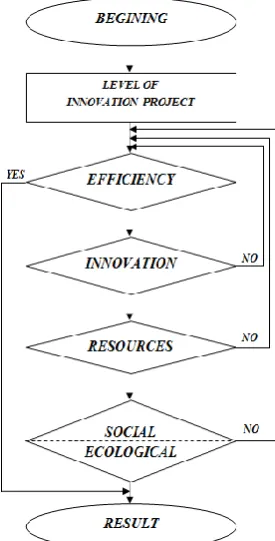
[image:3.595.231.369.42.313.2]115 | P a g e FIGURE 1. ALGORITHM OF DEVELOPING INNOVATIVE PROJECTS
Consequently, the level of innovation projects (N) depends and is a function of the following
indicators:
NF E In Rs Sc Ec
f, , , ,
(1)where:
Ef - Efficiency;
In - Innovation
Rs - Resourcefulness;
Sc - Social;
Ec - Ecological.
1. Efficiency
Efficiency is determined by the following indicators: return on funds (years), profitability and
expected profit, economic outlook (years). Efficient economic strands are related to the
A Monthly Double-Blind Peer Reviewed Refereed Open Access International e-Journal - Included in the International Serial Directories.
GE-International Journal of Management Research (GE-IJMR) ISSN: (2321-1709)
116 | P a g e
generalized marketing study with a rationale for the efficiency of manufacturing the
innovative product.
1.1. Return on funds /investments/ for innovative solutions is done with the following
methods for quantification of indicators:
Payback period (PBP). It determines the time period during which the investments made
must be returned using the calculations:
СО IP
ПП А
(2)
where:
СО – Payback period;
IP – Investment;
РР – Average annual net cash flow;
А – Amortization.
Internal rate of return. It equates to zero the net present value (NPV) to a provisionally
deducted discount rate. The so-called discount rate for each innovation project is compared to
the required income rate for projects with similar risk. The investment is profitable only if
NPV>0 or IRR = NPV = 0, where IRR - internal rate of return.
1.2.Profitability. The profitability index (IPp) is determined by the following formula:
p PP IP
IP
(3)
1.3. Economic Perspective. This means that the innovative product will have a guaranteed
market for at least three years. Practice shows that many innovative products have no place
on the market, making them unrealistic and non-marketable despite good innovation.
2.Innovation
Innovativeness is determined by the criteria of innovation and their quantitative measurement
- a degree of novelty. Classification of innovation is based on the impact of different factors
and the purposes of their research. In this way, they are distinguished and classified by
distinctive signs. For the purposes of our research, we will adopt the classification definition,
which forms their innovation essence (novelty). That is why the degree of novelty will be
appreciated only in the qualitative definition that forms the essence of product innovation. In
doing so, we have to distinguish between innovation and an innovative product (machine.) In
A Monthly Double-Blind Peer Reviewed Refereed Open Access International e-Journal - Included in the International Serial Directories.
GE-International Journal of Management Research (GE-IJMR) ISSN: (2321-1709)
117 | P a g e
Generally more innovative solutions are included in the innovative product, Dimityr
Damyanov, (2002), Clayton Christensen, Erik Roth, Scott Anthony, (2013).
The level of innovation is determined by the degree of innovation aging of the previous
innovation with the same purpose, the same type and satisfying the same human or social
need.
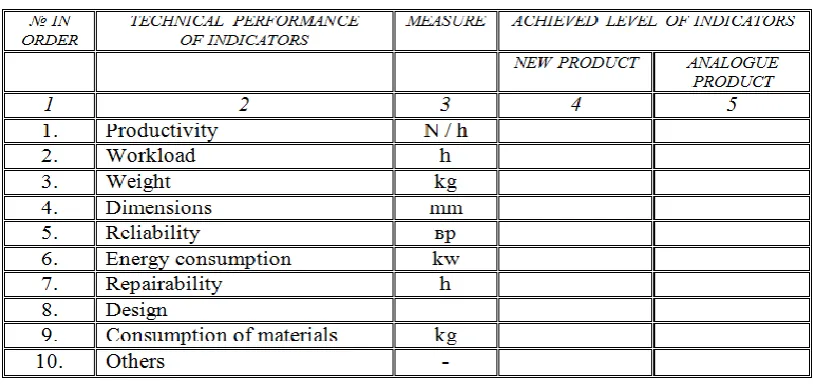
Degree of innovation. The degree of novelty is an evaluation criterion and involves many
dependencies. Typically, these are performance, efficiency, resource reliability, etc., such as
weight, time, fuel economy, materials, work convenience, serviceability, and more (Table 1).
According to Dimityr Damyanov, (2009), the quantitative measurement of these criteria can
be determined by comparing the levels reached in leading companies and organizations
around the world, including weight and material savings, overall dimensions, energy and fuel
savings, reliability, time savings in their production (Productivity), design and workplace
convenience, generally new technical, technological, organizational and other solutions,
resulting in quantifiable benefits for the user. Other benefits that can be quantified are
ecology, hygiene, labor protection, and so on.
There are three novelties for product innovation: a new product (underlying); upgraded
[image:5.595.101.508.428.620.2]product (enhanced); adapted.
TABLE 1. INDICATORS DEFINING THE DEGREE OF INNOVATION OF THE
NEW PRODUCT
The degree of innovation saturation (Is) of the product can be determined by the formula:
Is Кап1 Кап2 Кап3.100%
а
(4)
where:
1 n
a - Relative share of indicators defining the growth of time savings as
A Monthly Double-Blind Peer Reviewed Refereed Open Access International e-Journal - Included in the International Serial Directories.
GE-International Journal of Management Research (GE-IJMR) ISSN: (2321-1709)
118 | P a g e 2
n
a - The relative share of the indicators determining the growth of the economy of
materials, fuels, etc., expressed in value units (BGN);
3
n
a
- Relative share of the economy resulting from the influence of qualityindicators such as design, etc., expressed in value units (BGN);
с
а
- Relative share of the value of the same indicators of the analogue product.1
n
a
Is defined as the difference in the levels of the indicators between theinnovative and the base (analogue) product expressed in terms of time savings. The results
are valued in BGN.
2
n
a
Is defined as the difference in the levels of the indicators between theinnovative and the basic (analogous) product, expressed through the economics of material
components (materials, energy, etc.). The results are valued in BGN.
3
n
a
Is defined as the difference in the levels of the indicators between theinnovative and the base (analogue) product, expressed through the savings obtained from the
quality improvements (design, working comfort, etc.). The results are valued in BGN.
К1, К2, К3 are coefficients of significance (weight) of the groups of indicators
1 n a , 2 n a , 3 n
a . Usually К1=1, К2 =1, К3=1. If one of the indicators is given a heavier
weight, then the ratio remains in all cases С < 100%.
If we want to express C with a coefficient, then the formula gets the type:
I n c а К
a
(5)
where:
a
n
a a a
n1 n2 n3
(6)KI is within the limits: 0< KI< 1
Indicators defining the degree of innovation of an upgraded product
These indicators are similar to those used with a new product, but the benchmark is defined
and calculations are easier.
The degree of innovation saturation is determined by the formula:
м
.100%
с
а
Is
а
A Monthly Double-Blind Peer Reviewed Refereed Open Access International e-Journal - Included in the International Serial Directories.
GE-International Journal of Management Research (GE-IJMR) ISSN: (2321-1709)
119 | P a g e
where:
м
а
- Relative share of the value of the upgraded product (BGN);ас - Relative share of the value of the old product (BGN).
Indicators defining the degree of innovation of an adapted product
The same indicators are used for a new and upgraded product, but the final calculations are
considerably simplified.
The degree of innovation saturation is determined by the formula:
a
.100%
b
а
Is
а
(8)where: аа- relative share of the fittest (adapted) product expressed in a single
dimension;
аb- relative share of the underlying product, expressed in a single dimension.
3. Resourcefulness
Resource is determined by resource areas such as human resources (HR), material resources
(МR) and financial resources (FR) or:
R, R, R
R FHМF
3.1.Human Resources
According to Mark Huselid ,(1995), Patrick Wright, Gary Mahan, (1992), R. Amit, Monica
Belcourt, (1999), successful management of human resources is of strategic importance and
creates competitive advantages for each organization [4,5,6]. It is an extremely important
element in the success of both the execution of the project and the rapid marketing of the
product. It is important for the company to have its own working team, incl. Researchers,
organizers, workers, etc. In addition, it must also have newly appointed researchers, incl.
Contract workers. It is also desirable to have a partner organization such as Bulgarian
Academy of Sciences, Universities and others.
3.2. Material resources
Material resources are the other important component of the firm to have the necessary
technical capacity to complete the project. It is of particular importance that you have your
own material base to carry out the project with your own strengths. It can also use
subcontractors using the facilities of subcontractors or partners. Or material resources can
A Monthly Double-Blind Peer Reviewed Refereed Open Access International e-Journal - Included in the International Serial Directories.
GE-International Journal of Management Research (GE-IJMR) ISSN: (2321-1709)
120 | P a g e
of production opportunities. The process of rational use of material resources in the
development of product innovation also influences the profits from product realization. With
equal other conditions, the maximum resource usability rate may increase if product
innovation is highly effective.
3.3.Financial resources
These include the conditions and alternatives for project financing. If the company has its
own funds, it can invest in project activities. But it can only invest with some of the means to
implement the project and the other part to complement it with borrowing, bank and other
resources. That is why the financial resource is of the utmost importance because it is related
to the return and the efficiency of the production as a whole. One of the important strands in
the development of production is the decision to introduce innovative products. Typically, in
practice, individual solutions are implemented without the necessary technical and economic
justifications, but only on the basis of subjective assessment or reporting data. Therefore, the
problem of searching for and choosing a good option arises from the fact that the
development of production needs is most often determined under the conditions of limited
financial resources. Most often, cash is available. Moreover, money resources are not always
optimized for production needs.
Additional Indicators
The additional indicators refer to the so-called Social and environmental indicators.
4. Social Indicators are those that relate to the creation of new jobs, with the project being
able to achieve other social benefits for the company's employees, etc. Adapting to the social
environment is a very important issue for increasing the efficiency of the production of
innovative products. In such cases, the ambition is to meet the social requirements not only of
the environment in which it operates but also of the social requirements of the area or of the
country in which it operates. It should seek to create new jobs and improve working
conditions, participate in various social events that will lead to building an image that meets
the company's interests for greater efficiency and well-being. Martina Huemann, Anne
Keegan, J Rodney Turner, (2007) examined that namely, ensuring well-being and ethical
treatment of employees is a matter of vital importance to the organization.
5. Environmental Indicators are those through which ecology is improved - company
environmental requirements are respected and others. Here we take into account the
A Monthly Double-Blind Peer Reviewed Refereed Open Access International e-Journal - Included in the International Serial Directories.
GE-International Journal of Management Research (GE-IJMR) ISSN: (2321-1709)
121 | P a g e
innovative products. This means compliance with environmental standards and standards that
are mandatory in the production of a particular product. Because every innovative product
defines strictly the individual environmental impacts that must be known and respected.
These environmental norms and standards will in the future be an integral part of the
euphoric assessment of the effectiveness of product innovation.
Apart from the suggested indicators, other ones may also be used. They are usually specific
and have a higher quality character such as: educational level and qualification of staff,
industrial motivation of staff, electronic adaptation and electronic environment, psychological
attitude towards the technical arming of activities, processes, etc.
Conclusions
On the basis of this analytical study of the influencing factors on innovation projects (product
innovation), the following conclusions can be drawn:
1. The innovativeness of project solutions depends on many factor effects, forming additional
restrictive conditions for the efficiency of the implementation of the innovation project.
2. Novelty in the innovation project is a mandatory condition, but it is not always decisive for
the marketability of the innovative product. The overriding influence of other factors may not
provide the required performance of the product.
3. Innovative efficiency can not be seen as a permanent aggregation of the quantitative
measurement of these indicators due to the fact that each of them at different times and
different impacts changes its relative share in it.
In conclusion, it can be assumed that an approach is proposed to use quantifiable indicators in
the development of innovative projects such as product innovation. The impact factors have
been studied and a selection of the key indicators determining the effectiveness of the project
solutions has been made. It has been proven that the effectiveness of innovative projects
depends on the manifestation of these factors, creating new impacts, dynamically changing
over time. Under different production and market conditions, they have a different impact on
impact and different impact on the innovations of project solutions. The proposed sequencing
of the impact of these dependencies can also serve as a practical tool for companies and
organizations developing and evaluating innovative projects such as product innovation.
References
A Monthly Double-Blind Peer Reviewed Refereed Open Access International e-Journal - Included in the International Serial Directories.
GE-International Journal of Management Research (GE-IJMR) ISSN: (2321-1709)
122 | P a g e
2. C.Christensen, et al., (2013), Seeing what's next: Using the theories of innovation to
predict industry change, Publisher: Harvard Business Review Press
3. D.Damyanov, (2009), Innovation-Technology, Organization, Management, Financing,
Politics, Primax, Ruse,
4. M.A. Huselid, (1995), The impact of human resource management practices on turnover,
productivity, and corporate financial performance, Acad Manage J, 38(3), pp. 635–672
5. P.Wright, G.McMahan, (1992), Theoretical perspectives for strategic human resource
management, J Manage, 18(2), pp. 295–320
6. R. Amit, M. Belcourt, (1999), Human resource management processes: a value-creating
source of competitive advantage Eur Manage J, 17(2), pp. 174–181
7. M. Huemann, et al., (2007), Human resource management in the project-oriented
company: A review, International Journal of Project Management, Volume 25, Issue 3,