THE EXPECTED VARIATION OF RANDOM BOUNDED
INTEGER SEQUENCES OF FINITE LENGTH
RUDOLFO ANGELES, DON RAWLINGS, LAWRENCE SZE, AND MARK TIEFENBRUCK
Received 24 November 2004 and in revised form 15 June 2005
From the enumerative generating function of an abstract adjacency statistic, we deduce the mean and variance of the variation on random permutations, rearrangements, com-positions, and bounded integer sequences of finite length.
1. Introduction
When the finite sequence of integersw=1, 3, 2, 2, 4, 3 is sketched as below,
w=
4
3 3
2 2
1
(1.1)
its most compelling aspect is its verticalvariation, that is, the sum of the vertical distances between its adjacent terms. Denoted by varw, the vertical variation of the sequence in (1.1) is varw=2 + 1 + 0 + 2 + 1=6. Our purpose here is to compute the mean and vari-ance of var on four classical sets of combinatorial sequences.
To formalize matters and place our problem in the context of other work, let [m]n
denote the set of sequencesw=x1x2···xnof lengthnwith eachxi∈ {1, 2,...,m}. For
a real-valued function f on [m]2, the f-adjacency numberofw=x
1x2···xn∈[m]n is
defined to be
adfw= n−1
k=1
fxkxk+1
. (1.2)
Copyright©2005 Hindawi Publishing Corporation
Table 1.1
Sequences Expected value of var Variance of var
Sn n
2−1
3
(n−2)(n+ 1)(4n−7) 90
[m]n (n−1)(m2−1)
3m
(m2−1)(6m2n+ 6n−7m2−2)
90m2
Rn(i)
2 n
1≤x<y≤m
(y−x)ixiy See (3.10)
Cn(m) 2(n−
1) (m−1)n−1
m/2
x=1
(m−2x)n−1 See (3.18)
Some specializations of thef-adjacency number have been considered elsewhere. For in-stance, iff(xy) is 1 whenx < yand 0 otherwise, then adfwis known as therise numberof w[1,3,4]. For the selection f(xy)= |y−x|, adfw=varw. In a sorting problem of com-puter science, Levcopoulos and Petersson [5] introduced the related notion of oscillation (varw−n+ 1) as a measure of the presortedness of a sequence ofndistinct numbers. In [6], compositions were enumerated by theirascent variation, the f-adjacency statis-tic induced by f(xy)=y−x ifx < yand 0 otherwise. For the case f(xy)=h(|y−x|) wherehis a linear, convex, or concave increasing real-valued function, Chao and Liang [2] described the arrangements ofndistinct integers for which adf achieves its extreme values.
Besides considering the distribution of var on the set [m]n, we also consider it on
the set of rearrangementsRn(i1,i2,...,im) consisting of sequences of lengthn=i1+i2+
···+imwhich containlexactlyil times, on the set of permutationsSn=Rn(1, 1,..., 1)
of{1, 2,...,n}, and on the set of compositions ofmintonpartsCn(m)= {x1x2···xn∈
[m]n:x1+x2+···+x
n=m}. For m,n≥2,Table 1.1 displays the mean and variance
of var on these four sets. Thekth falling factorial ofn isnk=n(n−1)···(n−k+ 1),
i=(i1,i2,...,im), and, forra real number,r denotes the greatest integer less than or equal tor. The results inTable 1.1are new. David and Barton [3, Chapter 10] present the distributions of several statistics (some f-adjacency numbers, some not) primarily on permutations. We also note that Tiefenbruck [7] derived a generating function for compositions with bounded parts by a close relative of var. We leave open questions con-cerning the asymptotic behavior of var.
2. Enumerative factorial moments for f-adjacencies
Before working specifically with var, we discuss the enumerative generating function for adf on sequences as developed by F´edou and Rawlings [4]. Let [m]∗denote the set of sequences of 1, 2,...,mof finite length (including the empty sequence of length 0). For w=x1x2···xn∈[m]∗, we defineZw=zx1zx2···zxn. The enumerative generating func-tion for adf over [m]∗is then defined to beG(p)=w∈[m]∗padfwZw.
By manipulatingG(p), we will obtain all of the information inTable 1.1(and more). As a brief outline of our approach, note that the coefficient ofpkzi1
just the number of rearrangementswinRn(i) with adfw=k. Thus, by dividing the coeffi
-cient ofzi1
1zi22···zmiminG(1) by the cardinality ofRn(i), we will obtain the mean of adf. So,
in general, we compute thedthenumerative factorial momentG(d)(1)=
w∈[m]∗(adfw)d
Zw.
From the work of F´edou and Rawlings [4], it follows that
G(p)= 1
D(p), (2.1)
where
D(p)=1− n≥1
x1···xn∈[m]n Zx1···xn
n−1
k=1
pf(xkxk+1)−1. (2.2)
Examples are presented in [4,6] for whichDhas a closed form. We do not know a closed form forDwhen adf=var (that is, when f(x,y)= |y−x|). Nevertheless, (2.1) is still useful in computing the mean and variance of var.
Although the formula for taking thed-fold derivative with respect to pof a function of the form in (2.1) is known, we provide a short derivation. To avoid the quotient and chain rules, rewrite (2.1) asGD=1. Differentiating the latterdtimes,d≥1, and dividing byd! gives
d
j=0 G(d−j) (d−j)!
D(j)
j! =0. (2.3)
To solve forG(d), consider the system
G(d) d!
D(0) 0! +
G(d−1) (d−1)!
D(1) 1! +
G(d−2) (d−2)!
D(2) 2! +···+
G(0) 0!
D(d) d! =0, G(d−1)
(d−1)! D(0)
0! + G(d−2) (d−2)!
D(1) 1! +···+
G(0) 0!
D(d−1) (d−1)!=0,
.. . G(1)
1! D(0)
0! + G(0)
0! D(1)
1! =0, G(0)
0! D(0)
0! =1,
(2.4)
to the above system yields
G(d) d! =
(−1)d
Dd+1
D(1) 1! D(2) 2! D(3) 3! ···
D(d) d! D(0) 0! D(1) 1! D(2) 2!
D(d−1) (d−1)!
0 D
(0)
0! D(1)
1!
D(d−2) (d−2)! ..
. ...
0 ··· 0 D
(0) 0! D(1) 1! (2.5)
which, when expanded, implies that
G(d)=d
ν=1 (−1)ν
Dν+1
j1+···+jν=d jk≥1
d j1···jν
D(j1)···D(jν). (2.6)
To determine the enumerative factorial momentG(d)(1), we see from (2.2) that
D(j)(1)= − j+1
r=2
D(rj), (2.7)
where
D(rj)=
x1···xr∈[m]r
Zx1···xr
l1+···+lr−1=j
lk≥1
j l1···lr−1
r−1
k=1
fxkxk+1
lk
. (2.8)
For instance,
D2=
xy∈[m]2
f(xy)zxzy, D2 =
xy∈[m]2
f(xy)2z
xzy,
D3=2
vxy∈[m]3
f(vx)f(xy)zvzxzy.
(2.9)
Further settingj=(j1,...,jν),s(j)=j1+···+jν,
d j = d j1···jν
, and D(µj)=
r1+···+rν=µ rk≥2
D(j1)
r1 ···D (jν)
rν , (2.10)
it follows from (2.6) and (2.7) that
G(d)(1)=d
ν=1 1 Dν+1(1)
s(j)=d jk≥1
d
j d+ν
µ=2ν
AsD(1)=1−(z1+···+zm), extracting the contributions made by allw∈[m]n from
both sides of (2.11) gives thedth enumerative factorial moment of adf over [m]nas
w∈[m]n
(adfw)dZw= d
ν=1
s(j)=d jk≥1
d
j
d+ν
µ=2ν
n+ν−µ ν
m
i=1 zi
n−µ
D(µj) (2.12)
valid ford≥1. Whend=1, 2, (2.9) and (2.12) imply that
w∈[m]n
adfw Zw=(n−1)
m
i=1 zi
n−2
xy∈[m]2
f(xy)zxzy (2.13)
and that
w∈[m]n
(adfw)2Zw=(n−1)
m
i=1 zi
n−2
xy∈[m]2
f(xy)2zxzy
+ 2(n−2)
m
i=1 zi
n−3
vxy∈[m]3
f(vx)f(xy)zvzxzy
+ (n−2)(n−3)
m
i=1 zi
n−4
xy∈[m]2
f(xy)zxzy 2
.
(2.14)
3. Discussion ofTable 1.1
The entries inTable 1.1are consequences of (2.13) and (2.14) with f(xy)= |y−x|and with appropriate substitutions for Z. For the mean and variance of var on the set of bounded sequences [m]n, putz
i=1 for 1≤i≤m. Noting that
xy∈[m]2
|y−x| =
1≤x<y≤m
2(y−x)=2
m+ 1 3
, (3.1)
it follows from (2.13) that the mean of var on [m]nis
1 mn
w∈[m]n
varw=2(n−1)mn−2
mn
m+ 1 3
=(n−1)
m2−1
3m . (3.2)
As
xy∈[m]2
|y−x|2=4
m+ 1
4
and as
vxy∈[m]n
|x−v||y−x| =
1≤v<x<y≤m
2(x−v)(y−x)
+
1≤x<y≤v≤m
4(v−x)(y−x)−
1≤x<y≤m
2(y−x)2
=7m2−8
10
m+ 1 3
,
(3.4)
(2.14) implies that 1 mn
w∈[m]n
(varw)2=4(n−1)
m2
m+ 1
4
+(n−2)
7m2−8 5m3
m+ 1
3
+4(n−2)(n−3) m4
m+ 1
3 2
.
(3.5)
Then, subbing the last result into 1
mn
w∈[m]n
(varw)2+(n−1)
m2−1
3m −
(n−1)m2−1 3m
2
(3.6)
and simplifying gives the variance of var as recorded inTable 1.1.
ForRn(i), extracting the coefficient ofz1i1zi22,···,zmimfrom (2.13) leads to
w∈Rn(i)
varw=2(n−1) 1≤x<y≤m
(y−x)
n−2
i1···ix−1···iy−1···im
. (3.7)
As the cardinality ofRn(i) is
n i1i2···im
=
n i
, (3.8)
it follows that the mean of var onRn(i) is
n i
−1
w∈Rn(i)
varw=2
n
1≤x<y≤m
(y−x)ixiy. (3.9)
Leti\r=(i1,...,ir−1,...,in). For example, (3, 2, 1, 4)\3\2\3=(3, 1,−1, 4). The variance on Rn(i) is then
n i
−1
w∈Rn(i)
varw2+2 n
1≤x<y≤m
(y−x)ixiy−
2 n
1≤x<y≤m
(y−x)ixiy 2
where, upon extraction of the coefficient ofzi1
1zi22,...,zmimfrom (2.14), we have
w∈Rn(i)
(varw)2=(n−1) 1≤x,y≤m
|y−x|2
n−2 i\x\y
+ 2(n−2)
1≤v,x,y≤m
|x−v||y−x|
n−3 i\v\x\y
+ (n−2)(n−3) 1≤u,v,x,y≤m
|v−u||y−x|
n−4 i\u\v\x\y
.
(3.11)
The permutation entries inTable 1.1follow from (3.9) and (3.10). Selectingm=nand ik=1 for 1≤k≤nin (3.9) reveals the mean of var onSnas
1 n!
w∈Sn
varw=2
n
1≤x<y≤n
(y−x)=2
n
n+ 1 3
=n2−1
3 . (3.12)
From (3.11), withm=nandik=1 for 1≤k≤n,
w∈Sn
(varw)2=(n−1)! 1≤x,y≤n
|y−x|2
+ 2(n−2)! 1≤v,x,y≤n
|x−v||y−x|
+ (n−2)!
1≤u,v,x,y≤m
{u,v}∩{x,y}=∅
|v−u||y−x|
= 4
15
(n−2)!10n2+ 14n−27
n+ 1
4
.
(3.13)
So the variance of var onSnis
1 n!
w∈Sn
varw2+n2−1
3 −
n2−1 3
2
=(n−2)(n+ 1)(4n−7)
90 . (3.14)
For w=x1···xn∈[m]n, let w =x1+···+xn. For the composition results in
Table 1.1, setzk=qkfor 1≤k≤m. Then (2.13) implies that
w∈[m]n
varw qw=(n−1)qn−2 1−qm 1−q
n−2
1≤x,y≤m
and (2.14) leads to
w∈[m]n
(varw)2qw=(n−1)qn−2 1−qm 1−q
n−2
1≤x,y≤m |y−x|2
qx+y
+ 2(n−2)qn−3 1−qm 1−q
n−3
1≤v,x,y≤m
|x−v||y−x|qv+x+y
+ (n−2)(n−3)qn−4 1−qm 1−q
n−4
1≤u,v,x,y≤m
|v−u||y−x|qu+v+x+y.
(3.16)
Extracting the coefficient ofqmfrom (3.15) to obtain
w∈Cn(m)
varw=2(n−1) 1≤x<y≤m
(y−x)
m−1−x−y n−3
=2(n−1)
1≤x≤m/2
m−2x
n−1
(3.17)
and then dividing by the cardinalitymn−−11
[image:8.468.63.423.349.623.2]
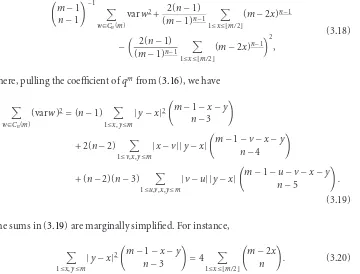
ofCn(m) gives the mean of var as stated in
Table 1.1. The variance is
m−1 n−1
−1
w∈Cn(m)
varw2+ 2(n−1) (m−1)n−1
1≤x≤m/2
(m−2x)n−1
− 2(n−1)
(m−1)n−1
1≤x≤m/2
(m−2x)n−1 2
,
(3.18)
where, pulling the coefficient ofqmfrom (3.16), we have
w∈Cn(m)
(varw)2=(n−1) 1≤x,y≤m
|y−x|2
m−1−x−y n−3
+ 2(n−2)
1≤v,x,y≤m
|x−v||y−x|
m−1−v−x−y n−4
+ (n−2)(n−3) 1≤u,v,x,y≤m
|v−u||y−x|
m−1−u−v−x−y n−5
.
(3.19)
The sums in (3.19) are marginally simplified. For instance,
1≤x,y≤m |y−x|2
m−1−x−y n−3
=4
1≤x≤m/2
m−2x
n
As a part of the second sum on the right-hand side of (3.19), we note that
1≤v<x<y≤m
(x−v)(y−x)
m−1−v−x−y n−4
=
2≤x≤(m+1)/2
m−3x+ 1 n
−
m−2x+ 1 n
+x
m−2x
n−1
.
(3.21)
The four-fold sums arising in the last sum in (3.19) reduce to double sums.
Acknowledgment
This work is based on work supported by the National Science Foundation under Grant no. 0097392.
References
[1] L. Carlitz,Enumeration of compositions by rises, falls and levels, Math. Nachr.77(1977), 361– 371.
[2] C.-C. Chao and W.-Q. Liang,Arrangingndistinct numbers on a line or a circle to reach extreme total variations, European J. Combin.13(1992), no. 5, 325–334.
[3] F. N. David and D. E. Barton,Combinatorial Chance, Hafner, New York, 1962.
[4] J.-M. F´edou and D. P. Rawlings,Adjacencies in words, Adv. in Appl. Math.16(1995), no. 2, 206–218.
[5] C. Levcopoulos and O. Petersson,Heapsort—adapted for presorted files, Algorithms and Data Structures (Ottawa, ON, 1989), Lecture Notes in Comput. Sci., vol. 382, Springer, Berlin, 1989, pp. 499–509.
[6] D. P. Rawlings,Restricted words by adjacencies, Discrete Math.220(2000), no. 1-3, 183–200. [7] M. Tiefenbruck,Enumerating compositions with bounded parts by variation, REU report,
Cali-fornia Polytechnic State University, CaliCali-fornia, 2003.
Rudolfo Angeles: Department of Mathematics, College of Science and Mathematics, California, Polytechnic State University, San Luis Obispo, CA 93407, USA
Current address: Department of Statistics, Stanford University, Palo Alto, CA 94305-4065, USA
E-mail address:[email protected]
Don Rawlings: Department of Mathematics, College of Science and Mathematics, California Polytechnic State University, San Luis Obispo, CA 93407, USA
E-mail address:[email protected]
Lawrence Sze: Department of Mathematics, College of Science and Mathematics, California, Poly-technic State University, San Luis Obispo, CA 93407, USA
E-mail address:[email protected]
Mark Tiefenbruck: Department of Mathematics, College of Science and Mathematics, California Polytechnic State University, San Luis Obispo, CA 93407, USA
Current address: 8989 Jasmine Lane Street, Cottage Grove, MN 55016-3436, USA