N A N O E X P R E S S
Open Access
Fabrication of Fe-Al nanoparticles by selective
oxidation of Fe-Al thin films
Pyungwoo Jang
1*, Seungchan Shin
1, Chip-Sup Jung
1, Kwang-Ho Kim
2and Kyu Seomoon
3Abstract
The possibility of a new technique for fabricating nanoparticles from thin films using selective oxidation in an atmosphere mixture of water vapor and hydrogen was investigated. Fe-5wt.%Al films were RF-sputtered and annealed in the atmosphere mixture at 900°C for up to 200 min, in order to oxidize aluminum selectively.
Thermodynamics simulation showed that temperatures exceeding 800°C are necessary to prevent iron from being oxidized, as confirmed by the depth profile of XPS. As the annealing time increased, the morphology of the 200-nm Fe-Al films changed from the continuous to the discontinuous type; thus, particulate Fe-Al films formed after 100 min. The particulate 10- to 100-nm Fe-Al films showed super-paramagnetic behavior after the oxidation. Thus, a new technique for fabricating nanoparticles was successfully introduced using selective oxidation.
Keywords:Selective oxidation of aluminum, Particulate Fe-Al films, Fe-Al nanoparticles, Water vapor, Hydrogen
PACS:81.07.Bc, 75.70-I, 75.75.Fk
Background
Aluminum oxide, Al2O3, formed on the surface can be used as a mechanically protective, oxidation-resistive, electricity-insulating film. For example, it was reported that in Fe-Al-X bulk alloys, the aluminum elements out-diffused along theα-Al2O3grain boundary formed in an alumina network on the boundary by the selective oxida-tion of aluminum when the alloys were annealed in the
atmosphere [1]. The Al2O3 layer could also be formed
exclusively by selective oxidation when Fe-Al alloys were annealed in a mixed atmosphere of water vapor and hydrogen at elevated temperatures [2,3]. It was also reported that the Fe depletion zone appeared in the annealed Fe films on an Al2O3substrate [4]. This indi-cates that continuous Fe films changed to discontinuous films, i.e., particulate films. However, they did not focus on the morphological change of the Fe/Al2O3films, nor the reasons for it. It is interesting to investigate the morphological changes and related properties of Al2O3/ Fe-Al films, in which oxide is formed on the surface of Fe-Al films by the selective oxidation of aluminum in Fe-Al films in a mixed atmosphere.
In this study, morphological change, as well as analyses of the chemical, structural, and magnetic properties of se-lectively oxidized Fe-Al films formed on SiO2substrates are investigated by X-ray photoelectron spectroscopy (XPS), scanning electron microscope (SEM), transmission electron microscope (TEM), and vibrating sample mag-netometer (VSM), with a special emphasis on the possibil-ity that nanoparticles in the shape of a sphere can be formed by the selective oxidation of aluminum in Fe-Al films.
Methods
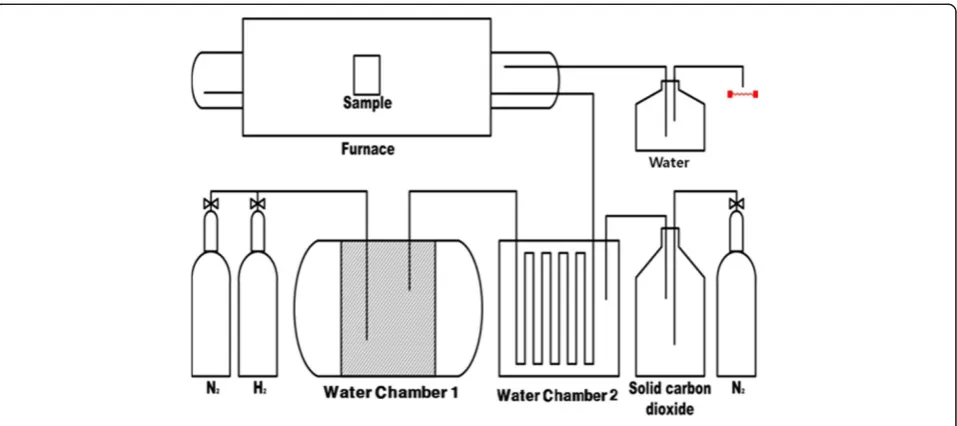
The STANJAN program was used to determine the optimum annealing conditions for the selective oxida-tion of aluminum in Fe-Al films [5]. For this, 10- to 200-nm-thick Fe-5wt.%Al films were radio frequency (RF) sputtered from a 4-inch Fe-5wt.%Al alloy target at room temperature on 100-nm-thick SiO2substrates, for which the Si wafers had been oxidized at 1,000°C for 110 min. The sputtering pressure, input power, and Ar flow rate were 5 mTorr, 100 W, and 10 sccm, respectively. As-sputtered films were annealed at 900°C for up to 200 min in an atmosphere mixture of water vapor and hydrogen, for which hydrogen passed through a copper pipe whose temperature was kept at−17°C at flow rates of 500 and 1,800 sccm (Figure 1). The concentration of
* Correspondence:[email protected]
1
Department of Optical Engineering, Cheongju University, Cheongju 360-764, South Korea
Full list of author information is available at the end of the article
© 2013 Jang et al.; licensee Springer. This is an Open Access article distributed under the terms of the Creative Commons Attribution License (http://creativecommons.org/licenses/by/2.0), which permits unrestricted use, distribution, and reproduction in any medium, provided the original work is properly cited.
the water vapor in the atmosphere mixture was con-trolled by adjusting the temperature of water chamber 2. At −17°C, the vapor pressure of water is about 1 Torr [6]. The magnetic properties of the films were measured using a VSM. The surface morphology and composition were analyzed using SEM (VEGA/SBH, TESCAN, Brno-Kohoutovice, Czech Republic) with an energy dispersive X-ray spectrometer (EDS) attachment. Cross-sectional images of the particulate films were observed using TEM (JEM-2100F, JEOL Ltd., Akishima-shi, Japan). Vari-ations of chemical state and the composition with film depth were analyzed using XPS with MgKαradiation.
Results and discussion
Because the standard molar enthalpies of the
forma-tion of Al2O3, FeO, Fe2O3, and Fe3O4 at 298.15 K
are −1675.7, −272, −824, and −1118.4 kJ/mol,
[image:2.595.60.539.88.301.2]re-spectively, it can be inferred that Al2O3is preferentially formed under oxidation conditions. To confirm this, as well as in order to simulate the optimum conditions for the selective oxidation of aluminum, the STANJAN pro-gram was used. Figure 2 shows the simulation results of the reaction temperature versus the product content, with the input amounts of Fe, Al, H2O, and H2given as 0.01, 5×10⁻⁴, 1, and 1 mol (left figure), and 100 mol (right), re-spectively. Al2O3is formed exclusively at all temperatures. In addition, Fe3O4 is dominant at lower temperatures, while the formation of iron oxides is hampered with in-creasing temperatures; therefore, temperatures exceeding 800°C were considered ideal for the selective oxidation of aluminum. However, if the hydrogen content is not enough, formation of FeO is expedited even at a high
Figure 1Schematic diagram of the experimental setup for selective oxidation of Fe-Al films.
[image:2.595.59.539.539.716.2]temperature. When the ratio of hydrogen and water vapor content is 1:1, FeO is dominant at a high temperature, as shown in the left-hand figure of Figure 2.
Selective oxidation of aluminum was also confirmed by the XPS depth results of post-oxidized Fe-Al films. Figures 3 and 4 show the XPS compositional depth pro-file and the variation in aluminum Al2p binding energies with depth, respectively, when the Fe-Al film was annealed for 20 min at 900°C. Iron is not detected until 3,200 s, while the content ratio of aluminum to oxygen is approximately 2:3, which means that Al2O3is formed on the surface of the film. The Al2O3layer was assumed to be thicker than 50 nm because the etching rate during XPS depth profiling was approximately 1 nm/min. From the fact that the binding energies of aluminum in metal-lic aluminum and in aluminum oxide (Al2O3) are 73 and 74.3 eV, respectively, Al2O3is formed on the top surface of the film. Also, it can be inferred that the oxide thick-ness is about 53 nm because metallic aluminum is not detected until 3,200 s after etching. It was reported that γ-Al2O3 is formed when Fe-5wt.%Al bulk alloy is annealed in the atmosphere mixture at a temperature higher than 920°C [3]. However, peaks diffracted from the (110), (200), and (211) plane of α-Fe were found in the XRD experiment. No peak from aluminum oxide was found.
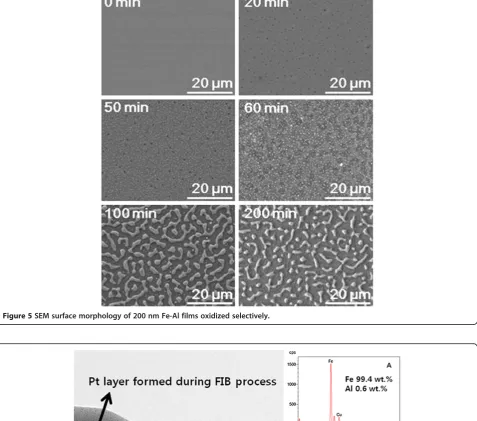
SEM analysis was conducted (Figure 5) with films that were oxidized for up to 200 min at 900°C, with a
hydro-gen flow rate of 500 sccm and a dew point of −17°C.
Very small, white and black dots were observed after 20 min of oxidation. After 50 min, the dots became larger, and after 60 min, the black dots became substantially larger, as well as irregular. The gray particles corre-sponding to oxidation for 20, 50, and 60 min indicate a continuous Fe-Al film. After 100 min, the Fe-Al film
became discontinuous and particulate. After 200 min, the particles of the Fe-Al film became completely dis-connected. The compositions of the three particle types, that is, large particles, small particles, and black particles of films oxidized for 50 min, were analyzed using EDS. The Al compositions of the white, gray, and black parti-cles were 5.6, 8.8, and 33.5 wt.%, respectively. The Fe, Al, and O compositions of the large and white particles of the 200-min-annealed film were 90.8, 4.5, and 4.8 wt. %, respectively, while those of the black region were 19, 33.6, and 47.4 wt.%, respectively. Therefore, it was in-ferred that the large and small white particles are Fe-Al alloy grains covered by Al2O3. However, the mechanism by which these different Fe-Al particles were formed dif-fered. The small particles were formed in an early stage of oxidation and then grew through Ostwald ripening. In contrast, the large particles were formed by the growth of the black dots, which were holes. If holes are formed and grown in the films, the films will contract and become discontinuous. The contraction or shrink-age of the film and the growth of the holes reduce the interfacial energy. However, it seems that the Fe-Al films become particulate at a faster rate only when the films are annealed in the mixed atmosphere. If the films are annealed at 900°C for 200 min in an atmosphere with a
very low dew point of −196°C (liquid nitrogen's
temperature), the films do not become particulate. No equilibrium vapor pressure at−196°C has been reported yet. However, the equilibrium vapor pressure at −196°C can be inferred to be extremely low, from the fact that the equilibrium vapor pressure at −80°C is reported to be 0.055 Pa (4.12×10⁻⁴Torr) [6].
[image:3.595.305.539.89.245.2]TEM cross-sectional analysis was also done, as shown in Figure 6. The film was oxidized for 200 min at 900°C, with a hydrogen flow rate of 500 sccm and a dew point of−17°C. The large black particles (A), white region (B), and small black particles (C) in Figure 6 correspond to
Figure 3XPS depth profile of Fe-Al film oxidized for 20 min at 900°C.(TAnneal= 900°C,TDew=−17°C, andt= 20 min).
Figure 4Variation of binding energy of aluminum Al2p state with depth of the Fe-Al film oxidized selectively.
[image:3.595.57.291.522.705.2]Figure 5SEM surface morphology of 200 nm Fe-Al films oxidized selectively.
the large white particles, black region, and small white particles, respectively, in the SEM image of the 200-min -annealed Fe-Al film shown in Figure 5. Contrary to the EDS analysis of SEM, in which the depth of the affected zone stimulated by incident electrons is several micro-meters, the affected zone in the EDS analysis of TEM is
very thin. The large particles (A) are nearly pure iron, while the oxide layer (B) contains lots of silicon and small particles. The small black particles (C) also contain several weight percentages of silicon. Silicon is detected because of the large difference in the standard enthalpy of formation between SiO2and Al2O3, as shown below.
2 Alþ3
2O2→Al2O3 ΔHo¼ 1;675:7 kJ=mol
SiþO2→SiO2 ΔHo¼ 877 kJ=mol
3 SiO2þ4Al→3 Siþ2Al2O3 ΔHo¼ 720:4 kJ
Therefore, silicon dioxide in contact with the Fe-Al film is reduced to silicon while the metallic aluminum in the Fe-Al films is oxidized into Al2O3. The silicon cre-ated diffuses out while the Al2O3diffuses into SiO2and
forms a mullite (3Al2O3·2SiO2). Thus, the SiO2 layer
transforms into a mixture of mullite and SiO2. The out-diffused silicon can be dissolved into small Fe-Al parti-cles, which are formed in an early stage of oxidation. The reason for non-detection of Si in large particles is not clear yet.
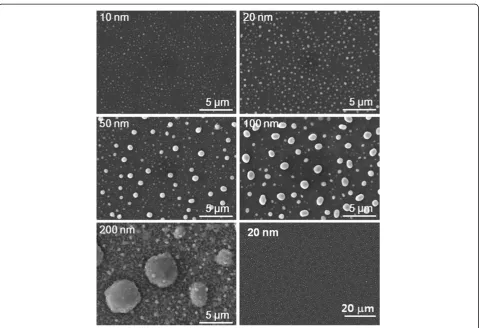
[image:5.595.59.540.86.414.2]The particles shown in Figure 5 are too large to exhibit the properties of nanoparticles. The 10 to 100 nm Fe-Al films were RF-sputtered and then annealed for 200 min
Figure 7SEM images of 10 to 200 nm Fe-Al films selectively oxidized at 900°C for 200 min.
Figure 8Normalized VSM loops of 10 to 200 nm Fe-Al films selectively oxidized at 900°C for 200 min.
[image:5.595.57.291.538.705.2]at 900°C, with a hydrogen flow rate of 500 sccm and a dew point of 0°C. As shown in Figure 7, the films also become particulate after oxidation. The thinner the films become, the smaller the particles become. In addition, particle sizes were not uniformed, and their shape is ra-ther spherical. Moreover, black holes found in the films oxidized for 20 to 60 min can be seen in Figure 5: they are clearly observable at lower magnification (right lower photo). In the black region, very small particles are found. It seems that the white particles are Fe-Al parti-cles, which are very similar to the small particles formed in the early stage of oxidation shown in Figure 5. From the fact that there are not many small particles near lar-ger particles in the 50-nm-thick film, Ostwald ripening is promoted by the increasing film thickness. In the 200-nm-thick film, the particles have a spherical shape, which is very different from the maze-like shape in the films shown in Figure 5, which were oxidized at an at-mosphere with a lower dew point. Maximum particle sizes of the 10-nm- and 20-nm-thick films are about 0.3 and 0.47μm, respectively. The minimum particle size in the 20-nm-thick films is smaller than one-tenth of the maximum size.
When the Fe-Al films were selectively oxidized, the slope of the hysteresis loops at the origin decreased, due to the demagnetization field, as the oxidation time in-creased. Figure 8 shows normalized VSM loops of the Fe-Al films of Figure 7 measured at room temperature. The slope of the magnetization curve of the as-sputtered Fe-Al film was very high near the origin. Further, it de-creased gradually as oxidation time inde-creased. The 200-nm-thick film shows hysteresis, while the other films do not show hysteresis. Moreover, the normalized loops of the 10- to 100-nm-thick films have nearly same slope and shape, which means that these particles are superparamagnetic at room temperature. Because magnetocrystalline easy axis and the magnetocrystalline anisotropy energy of iron are <100> and K1 = 4.8×10⁴ J/m3, respectively, superparamagnetic behavior appears, even though the maximum particle size is about 1 μm, which is very much larger than materials with uniaxial crystalline anisotropy.
Conclusions
The 10- to 200-nm-thick RF-sputtered Fe-Al films were oxidized in the atmosphere mixture at 900°C for up to 200 min. Small particles formed in the early stage of oxi-dation while large particles formed by contraction of the film or the growth of black holes. Formation of Al2O3on the surface of the film was confirmed by both the depth profile and chemical shift of the Al2p state upon XPS analysis. The 10- to 100-nm-thick films after oxidation showed superparamagnetic behavior that was due to Fe-Al nanoparticles. Thus, a new technique for fabricating
nanoparticles by selective oxidation has been successfully introduced.
Competing interests
The authors declare that they have no competing interests.
Authors’contributions
PWJ is in charge of this project and designed it. SCS carried out most of the experiment including deposition, oxidation, and VSM measurement. CSJ and KHK provided thin film deposition and analysis technique. KS analyzed the XPS results. All authors read and approved the final manuscript.
Acknowledgments
This work was supported in part by the 2011 WATC program of Korea Ministry of Knowledge Economy and in part by the 2011 R&D program of Korea Ministry of Education Science and Technology.
Author details 1
Department of Optical Engineering, Cheongju University, Cheongju 360-764, South Korea.2Department of Semiconductor Engineering, Cheongju
University, Cheongju 360-764, South Korea.3Department of Applied Chemistry, Cheongju University, Cheongju 360-764, South Korea.
Received: 15 July 2012 Accepted: 8 February 2013 Published: 2 April 2013
References
1. Tolpygo VK, Clarke DR:Microstructural evidence for counter diffusion of aluminum and oxygen during the growth of alumina scales.Materials at High Temperature2003,20:261–271.
2. Grace RE, Seybolt AU:Selective oxidation of Al from an Al-Fe alloy.
J Elec Chem Soc1958,105:582–585.
3. Nakayama T, Kaneko K:Selective oxide films of a 5% aluminum-iron alloy in a low oxygen potential atmosphere.Corrosion1970,26:187–188. 4. Arranz A, Perez-Dieste V, Palacio:Growth, electronic properties and thermal stability of the Fe/Al2O3interface.Surf Sci2002,521:77–83.
5. Reynolds WC:The element potential method for chemical equilibrium analysis: implementation in the interactive program STANJAN.Department of Mechanical Engineering, Stanford University; 1986.
6. Lide DR:CRC Handbook of chemistry and physics.86th edition. Boca Raton: CRC Press; 2005:6–7.
doi:10.1186/1556-276X-8-152
Cite this article as:Janget al.:Fabrication of Fe-Al nanoparticles by selective oxidation of Fe-Al thin films.Nanoscale Research Letters2013 8:152.
Submit your manuscript to a
journal and benefi t from:
7Convenient online submission 7Rigorous peer review
7Immediate publication on acceptance 7Open access: articles freely available online 7High visibility within the fi eld
7Retaining the copyright to your article