International Research Journal of Mathematics, Engineering and IT Vol. 3, Issue 9, September 2016 IF- 3.563 ISSN: (2349-0322)
© Associated Asia Research Foundation (AARF)
Website: www.aarf.asia Email : [email protected] , [email protected]Fuzzy Optimization Model on Maintaining Inventory for Roadside
Caterers of Fast Food
Tahseen Jahan. A and Dr. Maragatham
ABSTRACT
This paper studies the maintenance of inventory for fast food sellers of roadside
caterers using fuzzy set theory which helps in modeling any inventory problem for its ability
to overcome vagueness and imprecision. We develop a fuzzy model applicable to single
period inventory problem. Uncertain demand causes uncertain total cost function. In this
paper we find an analytical method for determining the exact expected value of total cost
function for a fuzzy single period inventory problem for roadside caterers. The optimum
order quantity that minimizes the fuzzy total cost function is determined using the expected
value of a fuzzy function based on credibility theory and hence closed form solutions to
optimum order quantities & corresponding to total cost values are derived.
Keywords: Fuzzy demand, membership function, uncertainty, inventory problem.
1 Introduction:
Inventory management is an important aspect of all business undertakings as it is a
function of directing the movement of goods through the entire manufacturing cycle from the
requirement of raw materials to the inventory of finished goods so as to meet the objective of
maximum customer service with minimum investment and efficient low cost plant operation
with simultaneous balance between over-stocking and under-stocking.
In single period inventory problem, product orders are given before the selling period
penalty cost for this re-order. The assumption of the single period inventory problem is that if
any inventory remains at the end of the period, either a discount is used to sell it if it is
non-perishable item or it is disposed of, if it is non-perishable item. Fast food items served hot by
roadside caterer refers to single period inventory problem as it is valuable for a limited time.
Customers are only interested in consuming freshly prepared hot cooked food item. The fast
food vendor in a roadside eatery has to sell all of the prepared fast food items, then it
becomes worthless the next day. So he ends up in a loss as the inventory in stock to prepare
the food items are perishable.
In the literature survey, most of the extensions have been made in the probabilistic
framework in which the uncertainty of demand is described by probability distribution. But in
realistic terms, the probability distributions of the demands for products are difficult to
acquire due to lack of information and data in which case the demands are specified
approximately based on the experience and managerial subjective judgements. In such cases,
the fuzzy set theory introduced by Zadeh is the best form that adapts all the uncertainty in the
model. The fuzzy set modeling using possibility instead of probability theory, can represent
linguistic data which cannot be easily modeled by other methods.
Our paper intends to find an analytical method for determining the exact expected value of
total cost function for a single-period inventory problem under uncertainty. To determine the
optimal order quantity that minimizes the fuzzy total cost function we use the expected value
of a function of a fuzzy variable with a continuous membership function .
2 Preliminaries
In this paper the optimization of single period inventory problem of food items
prepared for each day is analyzed. If there is less preparation of that particular foodie then
there is possibility of less profit as the customers are lost and if there is more preparation and
no consumption then it becomes obsolete and it cannot be used the next day as it is perishable
item and there is loss again for the seller. Our goal is to find an analytical method to
determine the exact expected value of total cost function for single period inventory problem
under uncertainty. The source of the uncertainty in the analyzed problem results from the
imprecise demand. The preliminary concepts about the fuzzy set theory and the credibility
theory which will be useful for understanding the proposed model and the solution procedure
approach as human reasoning. The major characteristic of fuzzy logic is its ability to
eradicate ambiguity in human thinking, subjectivity and knowledge to the model.
Fuzzy Set
L.A.Zadeh invented fuzzy sets in mathematical terminology to represent ambiguity
and vagueness as a generalization of crisp set. It is a class of objects with membership grades
defined by a membership function. A fuzzy set can be mathematically represented as
, A( ) :
A x x xX whereX is the universal set and A( )x is the membership
function.
Fuzzy Number
It is a common fuzzy set whose membership function is piecewise continuous. If X is
a generalized fuzzy number (known as L-R type fuzzy number), whose membership function
( )
X x
satisfies the following conditions with 0 w 1and l m n u .
1) X( )x is a continuous mapping from , to the closed interval [0,1],
2) ( )
X x
= 0, x l,
3) ( )
X x
= ( )L x , is strictly increasing on [ , ]l m ,
4) X( )x = ,w m x n,
5) X( )x = ( )R x , is strictly decreasing on [ , ]n u ,
6) X( )x = 0,u x .
This type of generalized fuzzy number is denoted as X ( , , , ; )l m n u w LR. Whenw1,
it can be simplified as X ( , , , )l m n u LR.
Lattice of Fuzzy Numbers
The linear ordering of real numbers does not extend to fuzzy numbers. In order to
define the lattice operations of fuzzy numbers corresponding to those of crisp numbers we
have to define MIN and MAX for any two fuzzy numbers A and B as follows:
min( , )
, ( ) sup min ( ), (y)
Z x y
MIN A B Z A x B
max( , )
, ( ) sup max ( ), (y)
Z x y
MAX A B Z A x B
The symbol MIN and MAX are continuous operation and hence are different from the
Credibility Theory
The credibility theory developed as a branch of mathematics for studying the behavior
of fuzzy phenomena. The possibility theory was proposed by Zadeh[2], and developed by
many researchers such as Dubois and Prade[18]. In the possibility theory, there are two
measures including possibility and necessary measures. A fuzzy event may fail even though
its possibility achieves 1, and hold even though its necessity is 0. Possibility measure is
thought as a parallel concept of probability measure. However, as many researchers
mentioned before, these two measures have partial differences. Necessity measure is the dual
of possibility measure. However, either possibility measure nor necessity measure has
self-duality property. A self-dual measure is absolutely needed in both theory and practice. In
order to define a self-dual measure, Liu[14] introduced the concept of credibility measure in
2002. In this concept credibility measure resembles the similar properties by probability
measure. Credibility measure plays the role of probability measure in fuzzy world.
Let
i,i1, 2,...n
be a fuzzy variable with the membership function ( ) x and rbe areal number, then the possibility and necessity measure of the fuzzy event
i r
can berespectively represented as follows:
supp ( )x r
i
Pos r x
(1)
i
1
i
1 supp ( )x r
Nec r Pos r x
(2)
The credibility measure which is introduced by Liu is the average of possibility
measure and necessity measure. The credibility measure of the fuzzy event
i r
can berepresented as follows:
1
2
i i i
Cr r Pos r Nec r (4)
Similarly the credibility measure of the fuzzy event
i r
can be represented asfollows:
1
2
i i i
Cr r Pos r Nec r
Expected Value of a Function of a Fuzzy Variable
Several ranking methods for fuzzy numbers are used to find the expected value of a fuzzy
number which was a complex process for researchers in previous years. Now the expected
errors. Hence, Xue et al. introduced an analytical method which uses the properties of the
credibility measure, to calculate the expected value of a function of a fuzzy variable.
Let i be a fuzzy variable and r be a real number, the expected value of a fuzzy
variable E
i can be calculated as follows:
0
0
i i i
E Cr r dr Cr r dr
(5)provided that at least one of the two integrals is finite.
Let i be a fuzzy variable with a continuous membership function ( )
i x
, and
:
f is a strictly monotonic function. If the Lebesgue integrals,
0 Cr i r dr
and
0 i
Cr r dr
are finite, then the expected value of a function of a fuzzy variable
iE f can be calculated as follows:
i ( )
i
E f f r dCr r
(6)Let i, be a fuzzy variable with a continuous membership function ( )x and
:
f andg: be two different strictly monotonic functions. If the expected
values of i, ( )f i and ( )g i exist, the following properties can be defined for any numbers
pand q,
i
iE pf q pE f q (7)
i
i
i
iE f g E f E g (8)
Let i be a fuzzy variable whose support is
a b, and f : is a strictlymonotonic function. If the Lebesgue integrals,
0 Cr i r dr
and 0 Cr
i r dr
arefinite, then the expected value of a function of a fuzzy variable E f
i can be calculatedas follows:
i b ( )
i
aMethodology
A. Expected Value of a Function of a Fuzzy Variable
Consider a single-period inventory problem where the demand is subjectively
believed to be imprecise and represented by a generalized fuzzy number
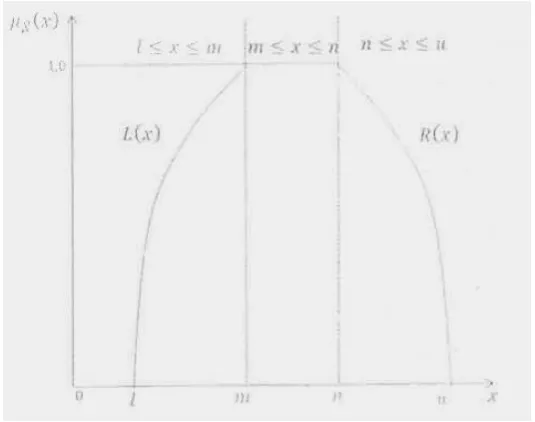
X with thefollowing membership function given by (10) and Fig.1;
( ),
1, ( )
( ),
0,
x
L x l x m
m x n
x
R x n x u
other
(10)
Here [m,n] are the most likely values of fuzzy number X , l and u are the lower and
[image:6.595.165.433.293.504.2]upper values; L(x) and R(x) are the left and right shape functions, respectively.
Fig. 1 Membership function of a generalized fuzzy number
Contrary a demand, inventory cost coefficients are known precisely. A product is
produces (or produced) at a cost of v for a single–period. h is the unit inventory holding cost
per unit remaining at the end of the period , (h< 0 represents have salvage value per
remaining unit), normally the salvage value is less than the unit production cost, i.e. (v>-h)
[12]. The selling price per unit is assumed to be equal to the unit inventory shortage cost
which is represented by b in the model (b>v). We assume that there is no on-hand inventory
at the beginning of the period.
Uncertain demand will cause an uncertain total cost function. If we order Q unit, the
( ) ( )
( )
Qv h Q X X Q
TC Q
Qv b X Q X Q
(11)
Since the demand is a generalized fuzzy number (X ), the fuzzy total cost function
( )
TC Q will also be a generalized fuzzy number with the same membership function of
demand. The problem is to determine the optimal order quantity (Q*) that minimizes the
fuzzy total cost. The membership function of demand the fuzzy total cost. The membership
function of demand is represented as in fig. 1. According to this membership faction, it is
obvious that the optimal order quantity (Q*) will remain between l and u, since (b>v>-h).
B. Analytical Model and Solution Methodology
We consider the above single-period inventory problem where the demand and total
cost faction, which are formulated as in (11), are generalized fuzzy numbers. The fuzzy total
cost function, is strictly decreasing in lxQ and strictly increasing Qxu. In order to
optimize the single-period inventory problem with fuzzy demand, we use the expected value
method which is proposed by Xue et al. [20]. In this context, by using (6) and (8), the
expected value of total cost function [E TC Q( )] of fuzzy demand X will be formulated as in
(12);
[ ( )] Q ( )
l
E TC Q
Qvh Qr dCr X r
( )
u
Q Qv b r Q dCr X r
(12)
u Q
Q l
Qv hQ dCr X r h rdCr X r
u u
Q Q
b rdCr X r bQ dCr X r
The optimal order quantity (Q*), will be the value that minimizes the expected value
of fuzzy total cost function. The find the minimizing value of Q, we set
(Q) 0 dE TC
dQ
(13)
Thus, the following equations are obtained,
(Q) Q u
l Q
dE TC
v h dCr X r b dCr X r
dQ
0 v (hb) Cr X Q b, (14)
b vCr X Q
h b
To find the optimum order quantity, we will determine the value of cr X
Q
.The credibility of fuzzy demand with the membership function as in (10) will be as in (16);
0, ( ) , 2 , 2 (Q) 1 , 2 1, Q l L Ql Q m
Cr X Q m Q n
R
n Q u
Q u (16)
There are three cases to be analyzed for the value of Q in discussing the credibility
value of fuzzy demand; cr X
Q
:l Q m m, Q n and n Q uCase l: lQm
( )2
b v L Q
Cr X Q
h b
(17)
Thus, the following equations are obtained,
1
2( ) 2( )
( ) b v * b v
L Q and Q L
h b h b
(18)
Here, the value of 2
b v
/ h b
must lie between [0,1], thus we can say that underthe conditions of bv and b v h v,Q* will lie in [l,m]. Moreover, the second derivative of
(Q)
E TC with respect to Q is
2
( ) ( )
' 2
d E TC Q h b
L Q dQ
(19)
Since, L(Q) is an increasing function in [l,m], we find that L‟(Q)>0. The values of h
and b are positive, so that we obtain
2
( ) 0 d E TC Q
dQ
which implies that Q* is the
optimum value which minimizes E TC Q ( ). The expected fuzzy total cost value for the
2 ( ) 1
2 ( ) 1 ( ) ( *) 2 ( ) 2 ( ) 1 2 b v h b b v h b L l m L u n L r
E TC Q h rd
L r b rd R r b rd
(20) Case 2:mQn
12 b v
Cr X Q
h b
(21)
Optimum order quantity (Q*) is the value that the first derivative of the expected
value of fuzzy total cost equals to zero, in this case,
( )
( ) ( }
dE TC Q
v h b Cr X Q b
dQ
0=v+(h+b)1/2 –b (22)
If there exits b-v = h+v case, then E TC Q ( )will be minimized byQ[m,n]. There by
under the condition of b-v=h+v, we can say that Q*[m,n]. The expected fuzzy total cost
value for the optimum order quantity will be as in (23);
( ) R( )
( *) 1
2 2
m u
r n
L r r
E TC Q h rd b rd
(23)Case 3: nQu
( )1 2
b v R Q
Cr X Q
h b
(24)
and the following equations are obtained,
2(h )
( ) v
R Q h b and
1 2* h v
Q R
h b
(25)
Since the value of 2(h+v)/(h+b) must be in the range of 0 and 1, under the conditions
of v -h and b-v h +v, we can say that the value of Q* will lie in [n,u]. additionally, the
second derivative of E TC Q ( ) with respect to Q will be,
2
( ) (h )
'( ) 2
d E TC Q b
R Q dQ
Since R(Q) is a decreasing function in the range of l and m, with L‟(Q) > 0 and the
values of h and be are positive, we obtain
2
( ) 0 d E TC Q
dQ
which implies that Q* is the
optimum value which minimize E TC Q ( ). The excepted fuzzy total cost value for the
optimum order quantity will be as in (27);
( ) ( *) 2 m l L r
E TC Q h rd
2 ( 1 ( ) 1 2 h v h b R n R r h rd
(27)2( ) 1 ( ) 1 2 h v h b u R R r b rd
In the literature, trapezoidal fuzzy numbers are used commonly in the applications.
Let the demand for the single-period inventory problem to be represented by a trapezoidal
fuzzy number with the following membership function,
, 1, ( ) , 0, X x l
l x m
m l
m x n
x
u x
n x u
u n other (28)
In this case, optimum order quantity will be calculated as in (29);
2( )
1 ( )
Q* [ , ]
2( )
( )
b v
m l b v h v
h b
m n b v h v
h v
u u n b v h v
h b (29)
The closed-form solutions for single-period inventorymodeldemand,for multi item
case is given by the above equations under fuzzy demand. Optimum order quantity and the
corresponding optimum cost values for singe-period inventory problem can be calculated
easily by using the proposed approach. Moreover the closed-form solutions give the
opportunity to analyze the effects of model parameters on optimum order quantity and
Illustration
Suppose the roadside the caterer gets a regular demand for his food product in the form of the
regular customers of the nearby commercial outlets in his vicinity.Let the demand be
represented as a trapezoidal fuzzy number as follows:-
X̃ = (30, 50,100,150)
The member of fuzzy demand is given below :-
µX̃ (𝑥) =
𝑥−30
20 , 30 ≤ 𝑥 ≤ 50 1, 50 ≤ 𝑥 ≤ 100 150−𝑥
50 , 100 ≤ 𝑥 ≤ 150 0 𝑜𝑡ℎ𝑒𝑟𝑤𝑖𝑠𝑒
Suppose the unit product cost is v= ₹ 20 for a single period and inventory holding cost and
shortage cost values are respectively h = ₹5 and b =₹ 30.Since the following equationholds 30-20 ≤ 5+20,the optimum order quantity will be in the interval [30,50].In this case Q* can be calculated using (29)and we get Q*=40 and Corresponding cost value for Q* =40 can be
calculated using (20) and we get
E [ T̃C̃ (Q*)] = ₹ 14,373.312
If we decrease the unit production cost to v = ₹10 then the second case will remain valid (b-v
= h+ v), and the value in the interval [50,100] will be optimal, that is Q*∈ [50,100] and the corresponding cost will be equal to₹ 7173.317 .We can inference from the above calculations
that the optimum order quantity and the corresponding cost values change according to the
unit production cost values. As the unit cost values decrease, corresponding optimum cost
values also decrease. We also observe that by decreasing the demand fuzziness the optimum
order quantity increase and the total cost values decreases. The reason behind this,is that the
less demand uncertainty causes less inventory overage and underage cost which lead to less
total cost.
Conclusion
The proposed single-period inventory problem deals with finding the product‟s order
quantity which minimizes the expected cost of seller with random demand. However, in real
world, sometimes the probability distribution of the demand for products is difficult to
acquire due to lack of information and historical data. This study focuses on possibilitic
situations, where the demand causes an uncertain total cost function.
The paper has proposed an analytical method to obtain the exact expected
unit production costs for a singe-period inventory problem under uncertainty. It has
determined optimum order quantity that minimizes the fuzzy total cost function, the expected
value of a fuzzy function based on the credibility theory. By this method, closed-from
solutions to the optimum order quantities and corresponding total cost values are derived. The
advantages of the closed-from solutions obtained are those that they eliminate the need for
enumeration over alternative values and give the opportunity order quantity and optimum
cost value. The proposed methodology, used for optimization based on the credibility theory
can be applied to the solution of other complex real world problems where this complexity
arises from uncertainty in the form of vagueness.
In this enumerated model when we consider the unit inventory shortage cost as the
cost of missed profit, the value of b-v represents the unit profit gained from selling one unit of
the item. On the other hand, the value of h+vrepresents the loss incurred for each unsold item
when the unit production cost isv. When the unit profit gained from selling one unit is smaller
than the loss incurred for each item left unsold, the inventory policy of the management
should consider reducing the leftover unit conservatively. In contrast, if the profit gained is
larger than the loss incurred, then the inventory policy should be aggressive to meet the
possible demand. When the profit equals the loss incurred, the order quantity should be equal
to the most likely demand.
This model has analyzed for multi product case develop from the case of single type
of product enumerated by Behret and Kahraman and the solution procedure can be applied
as a further research for the single period inventory problems of uncertainty besides
imprecise demand.
References:
[1] L.A. Zadeh, “Fuzzy sets”, Information and Control, vol. 8, pp. 338353, 1965.
[2] L.A. Zadeh, “Fuzzy sets as a basis for a theory of possibility”, Fuzzy Seta and
Systems, vol. 1, pp. 3-28, 1978.
[3] D. Dubois, H. Pradc, Fuzzy Sets and Systems: Theory and Applications, Academic
Press, New York, 1980.
[4] A.L. Guiffrida, “Fuzzy inventory models” in: Inventory Management:
Non-Classical Views, (Chapter 8). M.Y. Jaber (Ed.), CRC Press, FL,
[5] D. Petrovic, R. Petrovic, M. Vujosevic, “Fuzzy models for the newsboy problem”,
International Journal of Production Economics, vol. 45,
pp. 435441, 1996.
[6] H. lshii, T. Konno, “A stochastic inventory problem with fuzzy shortage cost”,
European Journal of Operational Research, vol.106, pp. 90-94, 1998.
[7] L.S. Li, S.N. Kabadi, K.P.K. Nair, “Fuzzy models for single-period inventory
problem”, Fuzzy Sets and Systems, vol.132, pp. 273-289, 2002.
[8] C.Kao, W.K. Hsu, “A single-period inventory model with fuzzy demand,”
Computers& Mathematics with Applications, vol. 43, pp, 841-848, 2002.
[9] P. Dutta, D. Chakraborty, A.R. Roy, “A single-period inventory model with fuzzy
random variable demand”, Mathematical and Computer Modelling,
vol. 41, pp. 915-922, 2005.
[10] P. Dutta, D. Chakraborty, A.R. Roy, “An inventory model for single-period products
with reordering opportunities under fuzzy demand”, Computers & Mathematics with
Applications, vol. 53, pp. 1502-151 7, 2007.
[11] X.Y. Ji, Z. Shau, “Model and algorithm for bilevel newsboy problem with fuzzy
demands and discounts”, Applied Mathematics and Computation, vol. 172, pp.
163-174, 2006.
[12] Z. Shao, X.Y Ji, “Fuzzy multi-product constraint newsboy problem”, Applied
Mathematics and Computation, vol. 180, pp. 7-15, 2006. H.F. Lu, “A fuzzy
newsvendor problem with hybrid data of demand”, Journal of the Chinese Institute of
Industrial Engineers, vol. 25, pp. 472-480, 2008
[13] S.P. Chen, Y.H. Ho, “Analysis of the newsboy problem with fuzzy demands and
incremental discounts”, Int. J. of Production Economics, to be published.
[14] B.Liu, Y.K. Liu, “Expected value of fuzzy variable and fuzzy
expected value model”, IEEE Transactions on Fuzzy Systems, vol. 10,
pp445-450, 2002.
[15] F.Xue, W.Tang, R Zhao, “The expected value of a function of a fuzzy
variable with a continuous membership function”, Computers and
Mathematics with Applications, vol. 55, pp. 1215-1224, 2008.
[16] T. J. Ross, Fuzzy Logic with Engineering Applications, New York. McGraw-Hill Inc.
1995.
[17] S.H. Chen and C.H. Hsieh, “Graded mean integration representation of generalized
[18] D.Dubois, ft. Pmtte. Possibility Theory, Plenum. New York. 1988
[19] D. Dubois, H. Praile, “The mean value of a fuzzy number”, Fuzzy sets and Systems,
vol. 24. pp. 279-300, 1987.
[20] H. Behret& C. Kahraman, “A fuzzy optimization for single period inventory
problem”, Proceedings of world congress engineering, vol.2, 2011.
[21] B.Liu, Uncertainty theory: An Introduction to its axiomatic foundations, Springer –
Verlag, Berlin. 2004.
[22] B. Liu, “a survey of entropy of fuzzy variable”, Journal of uncertain systems, vol. 1.
No.1, pp. 4-13, 2007.
[23] F.Xue, W.Lang,R.Zhao, „„The expected value of a function of a fuzzy variable with
continuous membership function‟‟ Computers and Mathematics with applications,