0095-1137/06/$08.00⫹0 doi:10.1128/JCM.44.2.302–306.2006
Copyright © 2006, American Society for Microbiology. All Rights Reserved.
Rapid Detection of
Mycobacterium tuberculosis
Beijing Genotype
Strains by Real-Time PCR
Doris Hillemann,
1Rob Warren,
2Tanja Kubica,
1Sabine Ru
¨sch-Gerdes,
1and Stefan Niemann
1*
Forschungszentrum Borstel, National Reference Center for Mycobacteria, D-23845 Borstel, Germany,1and MRC Centre for
Molecular and Cellular Biology, Department of Medical Biochemistry, University of Stellenbosch, Tygerberg 7505, South Africa
Received 10 August 2005/Returned for modification 16 September 2005/Accepted 7 November 2005
Mycobacterium tuberculosis strains of the Beijing genotype were first identified in China and neighboring
countries and have attracted special attention due to their global emergence and association with drug resistance. To further analyze the spread and special characteristics of Beijing genotype strains, accurate, rapid and sensitive methods that overcome the drawbacks of the classical methods such as IS6110 DNA fingerprinting or spoligotyping for the identification of strains of this genotype are needed. Based on the nucleotide sequences ofM. tuberculosisSAWC0780 and H37Rv, primers and fluorogenic 5ⴕnuclease (TaqMan) probes for real-time PCR assays specific for Beijing and non-Beijing strains, respectively, were designed. The detection limits for the real-time PCR assays were about 5 and 10 copies of chromosomal DNA, respectively. In mixtures of Beijing and non-Beijing DNA, a multiplex assay was able to detect (i) one copy of Beijing DNA in approximately 1,000 copies of non-Beijing DNA and (ii) one copy of non-Beijing DNA in approximately 2,000 copies of Beijing DNA. In a blinded analysis of a collection of 103 multidrug-resistant strains isolated in Germany in 2001, all 62 Beijing and all 41 non-Beijing strains were correctly identified. In conclusion, the real-time assay allows for the rapid and specific detection of Beijing and non-Beijing strains. The major advantages of this test in comparison to other methods used for the identification of Beijing strains are its simplicity and sensitivity and the fact that amplification and detection occur within one reaction tube.
In recent years the Beijing genotype of Mycobacterium
tu-berculosishas attracted special attention because of its global
emergence (2). The strains were first described in China and neighboring countries in 1995 (12), and subsequently the oc-currence of Beijing genotype strains has been documented in several parts of the world, especially in Asian countries but also in the former Soviet Union, Europe, Africa, and the United States (1, 2, 12). The Beijing genotype has caused outbreaks of multidrug-resistant (MDR) tuberculosis (8, 9), and some in-vestigations have indicated an association with drug resistance (2). Additionally, reported differences in the clinical picture of Beijing genotype infection and the immune response it evoked stimulated a discussion on the special characteristics of Beijing genotype strains (6, 7, 10).
Accurate methods for the identification of Beijing genotype strains are a prerequisite for further studies analyzing the spread and the characteristics of the Beijing genotype family. The main methodologies used so far are IS6110DNA finger-printing (13) and spoligotyping (3), and recently a consensus definition based on these methods has been published (4). Both techniques, however, involve different working steps in the laboratory, and especially the IS6110 fingerprinting method requires a high level of standardization and normal-ization procedures to ensure comparable results. Furthermore, the sensitivity of both methods to identify the presence of subpopulations of Beijing or non-Beijing strains, e.g., in the
case of mixed infections, or to differentiate Beijing and non-Beijing strains directly in clinical material is low.
Warren and coworkers (14) recently described a very sensi-tive PCR-based methodology that is easier to perform. They successfully applied two PCRs targeting a specific chromo-somal deletion present in Beijing strains to identify a large number of mixed infections with Beijing and non-Beijing strains in sputum samples, a finding with important implica-tions for the understanding of tuberculosis epidemiology. The combination of a very sensitive PCR technology with subse-quent analysis of the PCR products by agarose gel electro-phoresis, however, is inherently hampered by the latent prob-lem of contamination that could complicate the interpretation of results.
We therefore developed a multiplex real-time PCR assay which allows the specific identification of Beijing and non-Beijing DNA in a one-tube reaction. The real-time PCR assay was then evaluated by analyzing a well-characterized collection of MDR strains from Germany, for which the classification as Beijing and non-Beijing strains has been performed with the “gold standard” methods IS6110DNA fingerprinting and spo-ligotyping (5).
MATERIALS AND METHODS
Strains analyzed.A set of 103 MDR strains obtained from patients living in Germany in 2001 (5) was used to evaluate the capability of the Beijing real-time PCR assay established in this investigation for discrimination of Beijing and non-Beijing genotype strains.
Genotypic characterization.To allow a precise classification into the two categories Beijing and non-Beijing, all strains were analyzed by IS6110DNA fingerprinting and spoligotyping as described previously (3, 11). Chromosomal DNA was isolated using a standard procedure as describe elsewhere (11). The genotyping results have been described in detail in our previous investigation (5).
* Corresponding author. Mailing address: Forschungszentrum Bor-stel, National Reference Center for Mycobacteria, Parkallee 18, D-23845 Borstel, Germany. Phone: 49 4537 188762. Fax: 49 4537 188311. E-mail: [email protected].
302
on May 16, 2020 by guest
http://jcm.asm.org/
Downloaded from
on May 16, 2020 by guest
http://jcm.asm.org/
Downloaded from
on May 16, 2020 by guest
http://jcm.asm.org/
Design of real-time PCR primer and probe sets.Primers and probes were synthesized by ABI (Applied Biosystems, Weiterstadt, Germany) and TibMol-Biol (Berlin, Germany), respectively.
Real-time PCR assays.Real-time PCR experiments were run with the Rotor-Gene 2000 (Corbett Research, Mortlake, Australia) and ABI TaqMan Universal PCR Master Mix under reaction conditions of 95° for 10 min and 40 to 50 two-step cycles consisting of 92°C for 15 s and 60°C for 1 min. The primer concentrations in the reaction mixtures of 15l were 500 nM for each forward and reverse primer and 200 nM for each probe. A total of 1.5l of a 1:100 dilution of chromosomal DNA was used as a PCR template.
RESULTS AND DISCUSSION
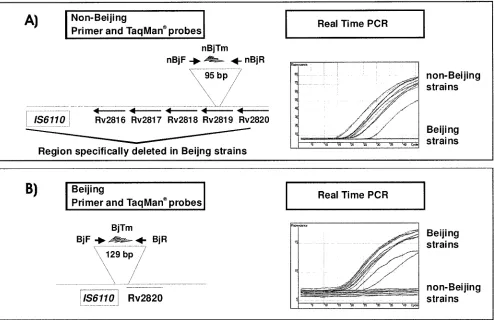
Based on the nucleotide sequences of GenBank accession numbers BX842581 and AF390039, primers and fluorogenic 5⬘ nuclease (TaqMan) probes for real-time PCR assays specific for Beijing and non-Beijing strains, respectively, were designed (Table 1). (Primers and probes were synthesized by ABI and TibMolBiol, respectively.) Analysis with BLASTN demon-strated that hypothetical DNA fragments generated with prim-ers nBjF/nBjR (non-Beijing) and BjF/BjR (Beijing) are iden-tical with a fragment of M. tuberculosis H37Rv or M.
tuberculosisSAWC0780 (Beijing), respectively. The detection
of the distinct PCR fragments is based on specific TaqMan probes labeled with different fluorescent dyes. Probe BjTM that binds to the 129-bp fragment generated by the primers nBjF/nBjR (Table 1 and Fig. 1) was labeled with a 5⬘ FAM (6-carboxyfluorescein) label and a 3⬘TAMRA (6-carboxytet-ramethylrhodamine) quencher. Conversely, nBjTM that binds to the 95-bp fragment generated by primers nBjF/nBjR with a 5⬘ Yakima Yellow label and a 3⬘ DABCYL [4-(4⬘ -dimethyl-aminophenylazo)benzoic acid] quencher (Table 1 and Fig. 1). The performance of the real-time PCRs and the specificity of the primer-probe sets were initially tested by analysis of 10 randomly chosen Beijing and 10 non-Beijing strains, classified by IS6110DNA fingerprinting and spoligotyping. With an an-nealing temperature of 60°C and a maximum number of 50 PCR cycles, both real-time assays yielded only fluorescence when DNA from Beijing genotype strains or non-Beijing strains was analyzed, respectively (Fig. 1). No cross-reactivity of the Beijing real-time PCR assay for non-Beijing DNA or, vice versa, of the non-Beijing real-time PCR assay for Beijing DNA was observed. The identity of the PCR products with the
respective genomic fragments was confirmed by DNA se-quencing also (data not shown).
To estimate the detection limit of both PCR assays, dilution series of chromosomal DNA (over seven orders of magnitude) of the Beijing and non-Beijing strains were PCR amplified. Absolute gene copy numbers were estimated based on spec-trophotometric measurement of DNA concentration (UV ab-sorption at 260 nm) and the assumption that one genome ofM.
tuberculosishas a molecular weight of 4 fg. Standard curves for
each target sequence with defined quantities of DNA were obtained for each experiment (using a 1:10 dilution series, beginning with 107 copies), consistently providing significant
correlations (r2values always of⬎0.99; data not shown). The
sensitivity of both PCRs was very high, since the detection limits of the PCRs could be calculated to 5 and 10 copies of chromosomal DNA for the non-Beijing PCR and the Beijing PCR, respectively.
Since the real-time PCR machine is able simultaneously to measure multiple dyes with distinct emission wavelengths, a multiplex PCR assay applying both PCRs in one reaction was established. To test whether the multiplex PCR worked prop-erly, primers and probes were tested by analyzing 10 DNA samples containing either Beijing or non-Beijing DNA and 10 samples with mixtures of non-Beijing and Beijing DNA (ratio of 1:1 to 1:100). In all cases, clear signals in the respective fluorescence detecting channels were obtained when Beijing or non-Beijing DNA was present only, while when mixtures of both DNA types were analyzed, signals in both channels were obtained (data not shown). Thus, no cross-reaction of the Beijing PCR probe system for non-Beijing DNA or of the non-Beijing PCR probe system for Beijing DNA was observed. The detection limit of the multiplex PCR for Beijing and non-Beijing DNA was then determined by analyzing DNA samples containing a fixed amount of Beijing DNA (106
cop-ies) mixed with DNA from a 1:10 dilution series of non-Beijing DNA (beginning with 106copies) and vice versa. Accordingly,
[image:2.585.46.543.80.182.2]the detection limits of the multiplex real-time PCR assay were calculated to (i) one copy of Beijing DNA in approximately 1,000 copies of Beijing DNA and (ii) one copy of non-Beijing DNA detected in approximately 2,000 copies of non-Beijing DNA.
TABLE 1. Sequences of primers and TaqMan probes used for detection of Beijing and non-Beijing type strains
Primers and probe for
target strains Name Sequence
Non-Beijing strainsa
Forward primer nBjF 5⬘-AAGCATTCCCTTGACAGTCGAA-3⬘
Fluorogenic probe nBjTM 5⬘-6FAM-TCCAAGGTCTTTG-MGB-NFQ-3⬘c
Reverse primer nBjR 5⬘-GGCGCATGACTCGAAAGAAG-3⬘
Beijing strainsb
Forward primer BjF 5⬘-CTCGGCAGCTTCCTCGAT-3⬘
Fluorogenic probe BjTM 5⬘-YAK-AACGCCAGAGACCAGCCGCCGGCT-DB-3⬘d
Reverse primer BjR 5⬘-CGAACTCGAGGCTGCCTACTAC-3⬘
aThe primers and probe for non-Beijing strains were based on GenBank accession no. BX842581, nucleotides 7896 to 7990. The fragment generated by the primers
was 95 bp in length.
bThe primers and probe for Beijing strains were based on GenBank accession no. AF390039, nucleotides 820 to 948. The fragment generated by the primers was
129 bp in length.
cMGB-NFQ, minor groove binding, nonfluorescent quencher. dYAK-DB, Yakima yellow-DABCYL (nonfluorescent dark quencher).
on May 16, 2020 by guest
http://jcm.asm.org/
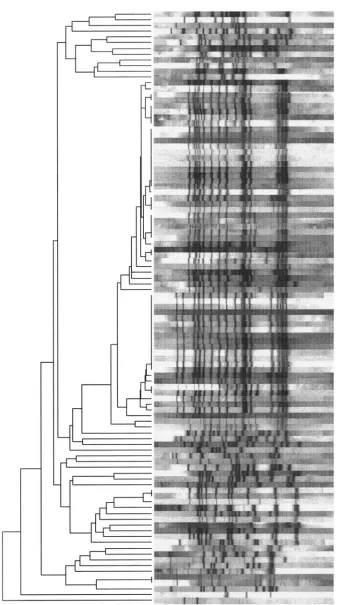
The capability of the multiplex PCR assay for the rapid identification of clinical Beijing and non-Beijing strains was tested by blinded analyses of a collection of 103 MDR strains isolated in Germany in 2001 for which stratification into Bei-jing and non-BeiBei-jing strains had already performed based on spoligotyping and IS6110 DNA fingerprinting data (5). The population structure based on IS6110DNA fingerprinting is shown in Fig. 2. Based on identical IS6110DNA fingerprint patterns, 47 of the 103 isolates were grouped in 10 different clusters comprised of from 2 to 14 isolates. The multiplex real-time assay correctly identified 62 isolates as Beijing geno-type and 41 isolates as non-Beijing genogeno-type. No false-positive signals were observed for Beijing and non-Beijing strains, al-though the PCR was proven to be highly sensitive. Overall, a 100% concordance between the new real-time PCR and geno-typing data based on spoligogeno-typing and IS6110 DNA finger-printing was obtained. Thus, the specificity and sensitivity of the multiplex PCR assay for the detection of Beijing and non-Beijing strains were calculated to be 100% in this investigation. The established real-time PCR assay allows for the rapid and sensitive detection of Beijing and non-Beijing strains in a one-tube reaction without any further working steps. The sim-plicity of this test allows for analysis of samples on various real-time PCR machines. The major advantages of this test in comparison to other methods used for identification of Beijing
strains are its simplicity and sensitivity and the fact that am-plification and detection occur within one reaction tube.
[image:3.585.47.541.72.392.2]In contrast, the “gold standard” IS6110 DNA fingerprint method requires several working steps, a well-grown bacterial culture, and analysis with 19M. tuberculosisBeijing reference strains when optimal classification is required (4). In addition, IS6110DNA fingerprinting must be performed by applying a highly standardized methodology and also involves analysis with a sophisticated software program allowing normalization of restriction fragment length polymorphism patterns (11). The PCR-based techniques described so far, spoligotyping (3) and the method described by Warren et al. (14), allow much easier detection of Beijing strains; however, in both cases fur-ther analysis of PCR products is necessary. Using the latter method, these additional working steps may pose a high risk of contamination, especially when the detection of small amounts of DNA in clinical samples is desired. This potential risk can be completely avoided by the established real-time assay, which has a further advantage that it allows quantification of the relative amounts of Beijing and non-Beijing DNA in a given sample. The high sensitivity and specificity in combination with the simplicity of the method make the Beijing and non-Beijing real-time PCR assay a very useful tool that will facilitate im-proved studies of different aspects of theM. tuberculosis Bei-jing genotype in the future.
FIG. 1. Schematic localization of primers and probes and PCR results of 10 randomly chosen Beijing and non-Beijing strains of the established
Beijing and non-Beijing real-time PCR assays.
on May 16, 2020 by guest
http://jcm.asm.org/
FIG. 2. IS6110DNA fingerprint patterns of the 103 MDR strains analyzed. The IS6110banding patterns are ordered by similarity in a dendrogram. The position of each IS6110band is normalized so that banding patterns of all strains are mutually comparable. The scale depicts similarity of IS6110patterns calculated with the Dice coefficient and the unweighted-pair group method using average linkages method.
on May 16, 2020 by guest
http://jcm.asm.org/
ACKNOWLEDGMENTS
The authors thank I. Radzio, B. Schlu¨ter, T. Ubben, and P. Vock for excellent technical assistance.
Parts of this work were supported by the Robert-Koch Institute, Berlin, Germany.
REFERENCES
1.Bifani, P. J., B. Mathema, N. E. Kurepina, B. N. Kreiswirth.2002. Global dissemination of theMycobacterium tuberculosisW-Beijing family strains. Trends Microbiol.10:45–52.
2.Glynn, J. R., J. Whiteley, P. J. Bifani, K. Kremer, D. van Soolingen.2002. Worldwide occurrence of Beijing/W strains ofMycobacterium tuberculosis: a systematic review. Emerg. Infect. Dis.8:843–849.
3.Kamerbeek, J., L. Schouls, A. Kolk, M. van Agterveld, D. van Soolingen, S. Kuijper, A. Bunschoten, H. Molhuizen, R. Shaw, M. Goyal, J. D. A. van Embden.1997. Simultaneous detection and strain differentiation of Myco-bacterium tuberculosisfor diagnosis and epidemiology. J. Clin. Microbiol.
35:907–914.
4.Kremer, K., J. R. Glynn, T. Lillebaek, S. Niemann, N. E. Kurepina, B. N. Kreiswirth, P. J. Bifani, D. van Soolingen.2004. Definition of the Beijing/W lineage ofMycobacterium tuberculosison the basis of genetic markers. J. Clin. Microbiol.42:4040–4049.
5.Kubica, T., S. Ru¨sch-Gerdes, S. Niemann.2004. The Beijing genotype is emerging among multidrug-resistantMycobacterium tuberculosisstrains from Germany. Int. J. Tuberc. Lung Dis.8:1107–1113.
6.Lopez, B., D. Aguilar, H. Orozco, M. Burger, C. Espitia, V. Ritacco, L. Barrera, K. Kremer, R. Hernandez-Pando, K. Huygen, D. van Soolingen.
2003. A marked difference in pathogenesis and immune response induced by differentMycobacterium tuberculosisgenotypes. Clin. Exp. Immunol.133:30– 37.
7.Manabe, Y. C., A. M. Dannenberg Jr., S. K. Tyagi, C. L. Hatem, M. Yoder, S. C. Woolwine, B. C. Zook, M. L. Pitt, W. R. Bishai.2003. Different strains
of Mycobacterium tuberculosiscause various spectrums of disease in the rabbit model of tuberculosis. Infect. Immun.71:6004–6011.
8.Moss, A. R., D. Alland, E. Telzak, D. Hewlett Jr., V. Sharp, P. Chiliade, V. LaBombardi, D. Kabus, B. Hanna, L. Palumbo, K. Brudney, A. Weltman, K. Stoeckle, K. Chirgwin, M. Simberkoff, S. Moghazeh, W. Eisner, M. Lutfey, B. Kreiswirth.1997. A city-wide outbreak of a multiple-drug-resistant strain of
Mycobacterium tuberculosisin New York. Int. J. Tuberc. Lung Dis.1:115– 121.
9.Narvskaya, O., T. Otten, E. Limeschenko, N. Sapozhnikova, O. Graschen-kova, L. Steklova, A. Nikonova, M. L. Filipenko, I. Mokrousov, B. Vysh-nevskiy. 2002. Nosocomial outbreak of multidrug-resistant tuberculosis caused by a strain ofMycobacterium tuberculosisW-Beijing family in St. Petersburg, Russia. Eur. J. Clin. Microbiol. Infect. Dis.21:596–602. 10.van Crevel, R., R. H. Nelwan, W. de Lenne, Y. Veeraragu, A. G. van der
Zanden, Z. Amin, J. W. van der Meer, D. van Soolingen.2001. Mycobacte-rium tuberculosisBeijing genotype strains associated with febrile response to treatment. Emerg. Infect. Dis.7:880–883.
11.Van Embden, J. D. A., M. D. Cave, J. T. Crawford, J. W. Dale, K. D. Eisenach, B. Gicquel, P. Hermans, C. Martin, R. McAdam, T. M. Shinnick, P. M. Small.1993. Strain identification ofMycobacterium tuberculosisby DNA fingerprinting: recommendations for a standardized methodology. J. Clin. Microbiol.31:406–409.
12.van Soolingen, D., L. Qian, P. E. de Haas, J. T. Douglas, H. Traore, F. Portaels, H. Z. Qing, D. Enkhsaikan, P. Nymadawa, J. D. A. van Embden.
1995. Predominance of a single genotype ofMycobacterium tuberculosisin countries of east Asia. J. Clin. Microbiol.33:3234–3238.
13.van Soolingen, D., K. Kremer, E. Vynycky.2003. New perspectives in the molecular epidemiology of tuberculosis, p. 17–45.InS. H. E. Kaufmann and H. Hahn (ed.), Mycobacteria and TB, vol. 2. Karger, Basel, Switzerland. 14.Warren, R. M., T. C. Victor, E. M. Streicher, M. Richardson, N. Beyers, N. C.
van Pittius, P. D. van Helden.2004. Patients with active tuberculosis often have different strains in the same sputum specimen. Am. J. Respir. Crit. Care Med.169:610–614.
on May 16, 2020 by guest
http://jcm.asm.org/
0095-1137/06/$08.00⫹0 doi:10.1128/JCM.01491-06
ERRATUM
Rapid Detection of
Mycobacterium tuberculosis
Beijing Genotype Strains
by Real-Time PCR
Doris Hillemann,
1Rob Warren,
2Tanja Kubica,
1Sabine Ru
¨sch-Gerdes,
1and Stefan Niemann
1Forschungszentrum Borstel, National Reference Center for Mycobacteria, D-23845 Borstel, Germany,1and MRC Centre for
Molecular and Cellular Biology, Department of Medical Biochemistry, University of Stellenbosch, Tygerberg 7505, South Africa2
Volume 44, no. 2, p. 302–306, 2006. Page 302: The affiliation line should read as given above.
Page 303, Table 1: The sequence of the fluorogenic probe nBjTM should read as follows: 5⬘ -6FAM-TCCAAGAGGGTCTTTG-MGB-NFQ-3⬘c.