http://dx.doi.org/10.4236/jtr.2014.23012
How to cite this paper: Salee, P., Harrison, L., Dionne, K., McArthur, C. and Parrish, N. (2014) Combination of the MODS Assay with the Sensititre™ MYCOTB Plate for Rapid Detection of MDR- and XDR-TB. Journal of Tuberculosis Research, 2, 101-105. http://dx.doi.org/10.4236/jtr.2014.23012
Combination of the MODS Assay with the
Sensititre™ MYCOTB Plate for Rapid
Detection of MDR- and XDR-TB
Parichat Salee
1,2, La’Chia Harrison
2, Kim Dionne
2, Carole McArthur
3, Nicole Parrish
2*1Chiang Mai University, Chiang Mai, Thailand 2The Johns Hopkins University, Baltimore, USA 3University of Missouri, Kansas City, USA
Email: *[email protected]
Received 23 May 2014; revised 4 July 2014; accepted 21 July 2014
Copyright © 2014 by authors and Scientific Research Publishing Inc.
This work is licensed under the Creative Commons Attribution International License (CC BY).
http://creativecommons.org/licenses/by/4.0/
Abstract
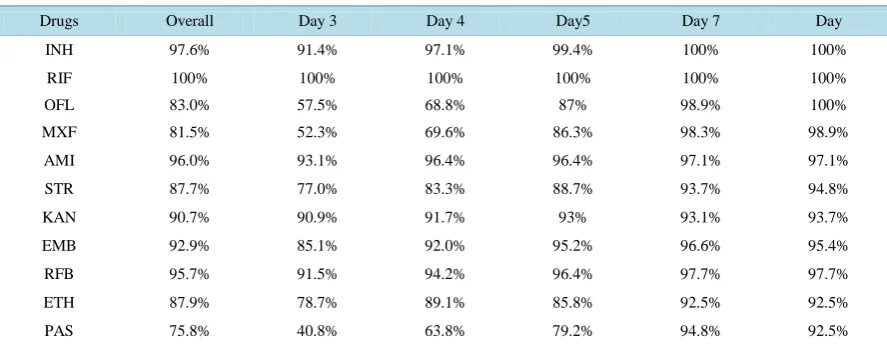
We combined the new Sensititre™ MYCOTB test with the MODS assay for detection of MDR- and XDR-TB. Categorical agreement of the MODS assay with the critical concentrations at 3 days of in- cubation was highest for INH (91.4%) and RIF (100%) and at 5 days 86.7% and 94.6% for the flu- oroquinolones and aminoglycosides, respectively. By combining these two methods, it is possible to identify MDR-TB in as little as 3 days and XDR- or pre-XDR-TB within 5 days.
Keywords
Tuberculosis, Susceptibility Testing, MODS, MYCOTB, MDR-TB, XDR-TB
1. Introduction
Multidrug resistant tuberculosis (MDR-TB), extensively drug resistant (XDR-TB), and more recently, pre-XDR- TB threaten public health worldwide [1] [2]. MDR-TB is defined as TB resistant to isoniazid (INH) and rifam- pin (RIF) whereas XDR-TB is defined as TB resistant to INH and RIF plusany fluoroquinolone and at least one of three injectable second-line drugs (amikacin, kanamycin, or capreomycin). Pre-XDR TB is a relatively new category defined as TB resistant to INH and RIF and either a fluoroquinolone or a second-line injectable agent but not both. These threats are the largest in developing countries with limited resources. Unfortunately, drug susceptibility testing (DST) for detection of XDR-TB and pre-XDR-TB are not routinely performed in many settings in which TB is endemic.
A relatively new susceptibility assay, the Sensititre™ MYCOTB plate (TREK Diagnostics), has been devel- oped which provides for susceptibility testing of Mycobacterium tuberculosis (MTB) against twelve first- and second-line drugs in a 96-well, microtiter broth format. Drugs are lyophilized in the plates in a range of concen- trations and are stable for up to 2 years at ambient temperature [3] [4]. Assay endpoints provide an actual mini- mum inhibitory concentration (MIC) versus testing of one or two critical concentrations typically used for other broth-based MTB susceptibility testing platforms. Determination of susceptibility or resistance is achieved by comparing the MYCOTB plate MIC to established critical concentrations for each drug using the following cri- teria: resistance to a given agent is indicated if the MIC result is greater than the broth-based, critical concentra- tion; susceptibility is indicated if the MIC is less than or equal to the critical concentration. Recent studies have confirmed the performance characteristics of the MYCOTB plate assay including categorical agreement predic- tive of susceptibility or resistance which ranged from 96% to 100% for three first-line drugs, and 94% to 100% for nine second-line drugs. In addition, the sensitivity, specificity and precision of the MYCOTB plate assay were comparable to other commercially available susceptibility testing platforms [3] [4]. Reconstitution of the MYCOTB plates is done using a suspension of MTB in broth media followed by incubation and manual exami- nation of the wells for growth using a mirror box and ambient light [3] [4]. Reading of the plates typically re- quires an average of 14 days for development of adequate growth in the wells visible to the naked eye. Such visible growth is necessary for accurate interpretation of results. Earlier visualization of growth in these plates using a more sensitive method than the naked eye, such as inverted light microscopy, would permit more rapid detection of MDR-, XDR- and pre-XDR-TB. Such a method has been in use for many years in resource-limited regions of the globe with a high burden of TB and is commonly known as the Microscopic Observation Drug- Susceptibility (MODS) assay [5] [6]. This assay involves cultivation of MTB in broth media either from growth in culture (indirect MODS) or from patient specimens (direct MODS) plus and minus various antibiotics such as INH and RIF with subsequent visualization of growth using an inverted light microscope [5] [6]. Use of an in- verted light microscope permits visualization of MTB significantly earlier than can be done with the naked eye [5] [6]. Even though the MODS assay has proven to be an effective susceptibility test method, there are limita- tions to its use. Preparation of plates is labor intensive and requires quality control of the antibiotics being used [5] [6]. In addition, many laboratories do not have access to all first-and second-line drugs, thus only INH and RIF are typically tested [5] [6]. As a result, MDR-TB can be detected, whereas, XDR-TB or pre-XDR-TB may be missed.
In this study, we combined the MODS assay with the MYCOTB plate to assess the feasibility of using the two methods together. We postulated that application of the MODS assay, i.e. use of an inverted light micro- scope to examine the drug-containing and control wells in the MYCOTB plate, would permit more rapid deter- mination of an MIC in ≤5 days versus the standard MYCOTB plate protocol which requires an average of 14 days for visualization of growth with the naked eye. Early determination of an MIC could then be compared to established critical concentrations for each drug to predict susceptibility or resistance to a given agent.
2. Methods
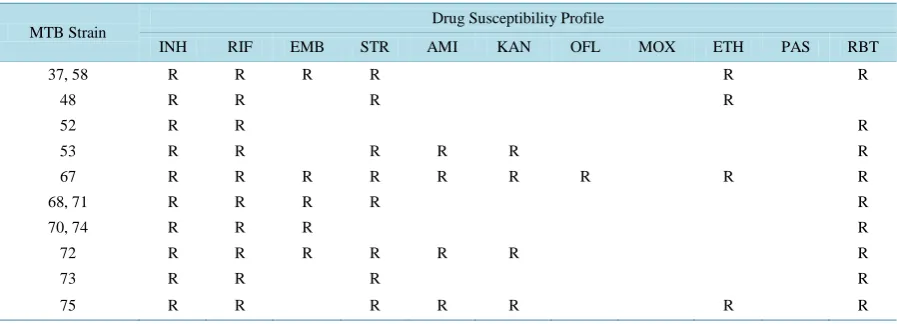
Table 1. Susceptibility profiles for MDR/XDR-TB/pre-XDR-TB strains used in this study.
MTB Strain Drug Susceptibility Profile
INH RIF EMB STR AMI KAN OFL MOX ETH PAS RBT
37, 58 R R R R R R
48 R R R R
52 R R R
53 R R R R R R
67 R R R R R R R R R
68, 71 R R R R R
70, 74 R R R R
72 R R R R R R R
73 R R R R
75 R R R R R R R
the wells) using a mirror box per the manufacturer’s instructions on days 10, 14 and 21 [7]. MICs for the S-MYCOTB assay were recorded when control wells contained sufficient growth as to be easily visible with the mirror box (typically on day 14) and were defined as the lowest concentration of each drug which completely inhibited growth [5]-[7]. For the combined MODS-MYCOTB assay (M-MYCOTB), plates were read with an inverted light microscope (Olympus CK2) using the 20X objective on days 1 through 10 to determine the earli- est time-point each drug could be read which correlated with results obtained using the S-MYCOTB assay. Growth in the positive control wells on each day was compared to growth in the drug-containing wells and the M-MYCOTBMIC was defined as the well with the lowest concentration of drug exhibiting nearly complete in- hibition (>80%) versus the untreated controls. All MODS-based MICs were recorded and compared to those obtained with the S-MYCOTB plate protocol for days 10, 14, or 21. Susceptibility or resistance for each strain- drug combination was determined by comparing individual MICs from both the S-MYCOTB and M-MYCOTB methods with critical concentrations for each drug established with commercial shorter incubation liquid media systems such as the Mycobacterial Growth Indicator Tube (MGIT 960, Becton Dickinson, Sparks, Maryland) [8]. Strains were considered resistant if the MIC result was greater than the broth-based, critical concentration; sus- ceptible if the MIC was less than or equal to the critical concentration. For the M-MYCOTB assay, this process was repeated and the optimal time-point determined for each individual drug and first- and second-line drugs considered together. All assays were performed in duplicate and all plates for both the S-MYCOTB and M-MYCOTB methods were blinded and examined by two independent technologists.
3. Results
Overall agreement for determination of an MIC (±1 doubling dilution) using the S-MYCOTB protocol and the M-MYCOTB assay was 91.1%. However, this agreement did vary by time-point and drug. For instance, overall agreement on Days 3, 4, 5, 7, and 10 was 79.5%, 86.5%, 93.8%, 94.9%, and 99.7%, respectively. Overall agree- ment was highest for INH (94%), RIF (92.5%), RFB (93.5%), AMI (95.2%), STR (91.6%), and KAN (95.9%). For the FQ’s, MOX and OFL, agreement was 84.3% and 86.2%, respectively. Similar agreement was observed for ETH (88.7%), EMB (88.7%), and CYC (85.0%). The lowest agreement was noted for PAS (73.9%).
Table 2. Percent agreement for the M-MYCOTB assay versus critical concentrations predictive of susceptibility or resis- tance.
Drugs Overall Day 3 Day 4 Day5 Day 7 Day
INH 97.6% 91.4% 97.1% 99.4% 100% 100%
RIF 100% 100% 100% 100% 100% 100%
OFL 83.0% 57.5% 68.8% 87% 98.9% 100%
MXF 81.5% 52.3% 69.6% 86.3% 98.3% 98.9%
AMI 96.0% 93.1% 96.4% 96.4% 97.1% 97.1%
STR 87.7% 77.0% 83.3% 88.7% 93.7% 94.8%
KAN 90.7% 90.9% 91.7% 93% 93.1% 93.7%
EMB 92.9% 85.1% 92.0% 95.2% 96.6% 95.4%
RFB 95.7% 91.5% 94.2% 96.4% 97.7% 97.7%
ETH 87.9% 78.7% 89.1% 85.8% 92.5% 92.5%
PAS 75.8% 40.8% 63.8% 79.2% 94.8% 92.5%
4. Discussion
Early detection of MDR- and XDR-TB is essential for effective clinical management of active TB and initiation of appropriate treatment. Rapid, inexpensive diagnostic assays are thus necessary to provide for timely diagnosis and prevention of transmission. The MODS assay is simple to perform and only requires the use of an inverted light microscope to visualize growth days earlier than can be done with the naked eye. For this reason, the MODS assay is currently used in many TB endemic, resource-poor settings [3] [4]. Limitations include too few drugs in the plates, especially with regard to second-line agents, the labor required for preparation, and issues related to quality assurance. Until now, no commercial platform was available which provided the number of anti-TB drugs contained in the MYCOTB plates. Determination of an MIC with subsequent comparison to es-tablished critical concentrations for each drug with other broth-based methods provides for determination of ca- tegorical agreement for the combined (M-MYCOTB) assay. By combining these two methods, it is possible to identify MDR-TB in as little as 3 days and XDR- or pre-XDR-TB within 5 days. The faster turn-around-time and concomitant testing of 1st and 2nd-line drugs in a single platform provides for more rapid detection of MDR-, XDR-, and pre-XDR-TB, resulting in more targeted treatment regimens, decreased morbidity and mortality, and improved TB control.
Acknowledgements
We would like to thank Trek Diagnostics for supplying the reagents used in this study.
References
[1] World Health Organization (2012) Global Tuberculosis Report. World Health Organization, Geneva.
[2] Abuali, M.M., Katariwala, R. and LaBombardi, V.J. (2012) A Comparison of the Sensititre MYCOTB Panel and the Agar Proportion Method for the Susceptibility Testing of Mycobacterium tuberculosis. European Journal of Clinical Microbiology & Infectious Diseases, 31, 835-839. http://dx.doi.org/10.1007/s10096-011-1382-z
[3] Hall, L., Jude, K., Clark, S., Dionne, K., Merson, R., Boyer, A., Parrish, N. and Wengenack, N. (2012) Evaluation of the Sensititre® MYCOTB MIC Plate for the Susceptibility Testing of Mycobacterium tuberculosis Complex against First and Second Line Agents. Journal of Clinical Microbiology, 50, 3732-3734.
http://dx.doi.org/10.1128/JCM.02048-12
[4] Caviedes, L., Lee, T.S., Gilman, R.H., Sheen, P., Spellman, E., Lee, E.H., Berg, D.E. and Montenegro-James, S. (2000) Rapid, Efficient Detection and Drug Susceptibility Testing of Mycobacterium tuberculosis in Sputum by Microscopic Observation of Broth Cultures. Journal of Clinical Microbiology, 38, 1203-1208.
[6] Sensititre™ MYCOTB Plate Procedure (2010) Trek Diagnostic Systems, Port Matilda, Pennsylvania.
[7] Rodrigues, C., Jani, J., Shenai, S., Thakkar, P., Siddiqi, S. and Mehta, A. (2008) Drug Susceptibility Testing of Myco- bacterium tuberculosis against Second-Line Drug Using the Bactec MGIT 960 System. International Journal of Tu- berculosis and Lung Disease, 12, 1449-1455.