
Web based Reachability Testing for Hetergeneous
Application using Nash Equilibrium
S. Preetha,
Research Scholar, Karpagam University, Coimbatore
M. Punithavalli,
Director, Sri Ramakrishna Engineering College, Coimbatore
ABSTRACT
Reachability testing is a mixture strategy, combine non-deterministic and non-deterministic testing accomplishes a test run deterministically up to a definite point and then allow synchronized program to work non-deterministically. A game theoretic approach is the learning approach of mathematical models of variance and collaboration between intellectual rational decision-makers. To overcome the conflicts arises in the game theoretic approach, the previous work considered the fault discovery of reachability testing from a game theoretic point of view. But the downside of the previous work is that it supports only homogeneous applications rather than heterogeneous and web applications.
Proposal in this work presented a web based reachability testing model encompassing a state of Nash equilibrium for heterogeneous applications. Heterogeneous application comprises of parallel and divertive function which have contributory influence over one another at different instances. The proposal adopts game theoretic approach which supports parallel and diversive functions by maintaining equilibrium state for contra functions. Evaluation of reachability test is conducted on to testify the integrity of newer functions with previous versions of the program. Simulations are conducted with web and heterogeneous application to evaluate the performance of proposed web based reachability testing model for both homogeneous and heterogeneous applications. The reliability of our proposal model shows improvement minimal testing time i.e., nearly 16%, and memory usage i.e nearly 17% compared to the existing reachability testing methods.
Keywords
Reachability testing, game theoretic approach, heterogeneity, fault detection, web applications.
1.
INTRODUCTION
Reachability testing of concurrent program includes a set of supportive threads or processes multithreaded programs and the threads are coordinated by admitting shared memory dispersed programs. This threads synchronization completed by switching over messages is pervasive in contemporary software development with enhanced resource exploitation by growing computing efficiency to definite problems in the non-deterministic behavior. Reachability testing strategies are of two types, one is non-deterministic testing which accomplish the similar program with the similar input for many times. It is simple, but ineffective because some errors cannot be identified. Another strategy is Deterministic testing which choose a set of test series and then force them to be worked out. It can identify more subtle errors, but needs further effort for test series selection and runtime control. A Prefix-based testing is a mixture of non-deterministic and deterministic testing which accomplishes the task deterministically at the beginning and then proceeds non-deterministically.
A game consists of players, a set of moves available to those players, and a specification of payoffs for each combination of strategies. The games are represented in different forms. They are Extensive form, Normal form, Characteristic function form, Partition function form.The extensive form (Fig 1.1) formed games with a time series of moves. Games here are played on like a tree structure. Each vertex (or node) tells a point of choice for a player. The normal (fig 1.2) game is presented by a matrix which identifies the players, approaches, and pay-offs. More specifically, it can be presented by function that integrates a payoff for each player for a possible combination of actions
Fig 1.1 Extensive Form of game Fig 1.2 Normal Form of game
A heterogeneous environment is an environment which has different set of functions with different set of tasks. The previous work controls the progression of the system and selects whether and when a fault occurs while performing feature adding to game theoretic approach and the discovery of the errors done only in a homogeneous environment. To make the game theoretic approach more effective, in this work
without affecting the older set of functions already detached in it.
2.
LITERATURE REVIEW
For serving the services for web based application, many researchers have developed a technique for providing the services to improve the scalability of the system. To improve the services of concurrent programs, [1] developed a new algorithm for providing services to the concurrent programming events. To resolve the conflicts arise in the game theoretic approach, reachability testing [2] is performed for avoiding the impacts.
To implement the reachability testing to hybrid games [3], logical methods have been chosen to improve the events occurring in the process of testing the scalable approach. To identify the fault [4] occurring in the reachability testing strategy, a localization method is chosen for the corresponding strategy. A game theoretic approach [5], which can be used to identify the differences, arises in the game. A game theoretic approach has been applied in different applications [9]. The game theoretic approach is a mathematical model which gives a solution for distributed systems [10]. Game-theoretic approaches for distributed power control [6] in interference relay channels are also be processed under different schemes.
Normally, Game theoretic approach is serviced under homogeneous applications and it could be used for reachability testing to identify the lost services and controls of the environment. To improve the game theoretic approach
more scalable, in this work we present a game theoretic approach for heterogeneous environment and providing services to web based applications.
3.
REACHABILITY TESTING WITH
GAME THEORETIC APPROACH
FOR HETEROGENEOUS
ENVIRONMENT
The proposed Game theoretic approach with reachability testing which supports set of functions from heterogeneity environment. The Proposed Game theoretic approach with reachability testing is also being supported with web applications. Game Theory affords mathematical approaches for evaluating and choosing upon deliberate situations. Such a condition contains two or more players, which have an individual strategies and incentives. To play a particular game approach, a player obtains a reward based on the strategy preferred by other players.
3.1 Reachability Testing Scenario
[image:2.595.155.443.388.478.2]The reachability testing is solution formation of game theory representing the most positive strategies for all players to diverge from the reachability testing since one player can not develop better payoffs by choosing a diverse approach when all the other players decide the approaches given by the profile. Consider a set of players as S, Fi as a finite strategy set and Pi as a payoff function. A reachability testing process is applied to four processes P1, P2, P3 and P4.
Fig 3. Reachability testing scenario
In order to circumvent the same SYNC-events more than one time, all the previous reachability testing algorithms require keeping the history of SYNC-events. This game theoretic approach does not need any modification to the Java virtual machine or to the primary operating system.
3.2 Reachability Testing with Game
Theoretic Approach
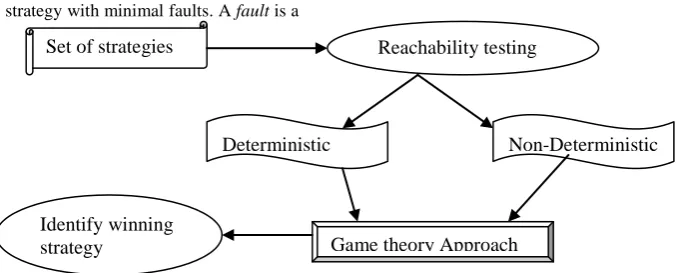
The game theoretic approach consists of set of strategies used to find out a winning strategy with minimal faults. A fault is a
discrepancy of the system structure from an insignificant situation. This entails that the system will have a performance which is unlike from the regular one after the occurrence of a fault.
Fig 4. Architecture of game theoretic approach
Set of strategies Reachability testing
Deterministic Non-Deterministic
Game theory Approach Identify winning
[image:2.595.130.469.603.739.2]The fundamental principles of game theory is that
1. Each node achieves the best possible move.
2. Each node recognizes that the opponent is also moving the best possible move.
When new features are added into an old program, it is possible to loss the old feature of that program. While using the reachability testing to the game theoretic approach, it greatly avoids the side effects. So, the old program will retain the new program with new features to achieve an equilibrium state and to diminish the error rate using the following formulation:
The strategic form of game is defined as the set of N players, let the sets of strategies be S1,…,Sn and the pay offs for those strategies be p1(s1,…sn), p2(s2..sn)…
A game is zero sum if
∑ pi (s1,s2,…sn) = 0 ---qn(1)
where i = 1,2,..n and s1 € S1 ,s2 € S2 ,sn € Sn.
For each player i and alternate strategy S we have that
[image:3.595.56.507.249.479.2]pi(s1,s2…sn) >= pi‟(s1‟,s2‟….sn‟) ---eqn(2)
Table 1 Parametric values’ description
Parameter Description
N Set of players
S Strategies used by n players
pi Pay-offs of strategies
Pi Number of i processes
Fi Finite strategy
3.3 Reachability Testing with Game
Theoretic Approach in Heterogeneous
Environment
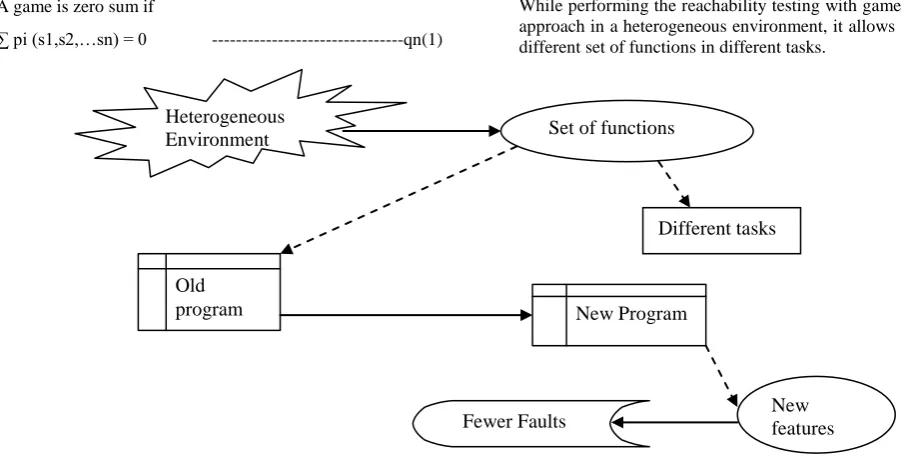
While performing the reachability testing with game theoretic approach in a heterogeneous environment, it allows accepting different set of functions in different tasks.
Fig 5. Architecture of game theoretic approach in heterogeneous environment
Consider a set of heterogeneous functions as f1, f2,…,fn which has different tasks. Consider an old program is O and if the set of functions approached the old program O, then the impact of O should retain the same ole features without any modification. While adding the new set of functions, the old version of program O is embedded as new version of program N but the old version O is retained by applying reachability testing. The number of events are identified in the heterogeneous functions fn and the SYNC events , the communication behavior also be noticed with pre-defined events to improve the scalability of the web based applications.
To attain Equilibrium (Nash)
Consider a strategy O for old program. Let e be the expected value. The expected payoffs for different strategies of new feature add on using game theory will be pO. The best strategy can be obtained by
O > = 0 --- eqn(3)
∑ Oi = 1 --- eqn(4)
(pO)j >= e for all j --- eqn(5)
4.
EXPERIMENTAL EVALUATION
Widespread experimental studies have been conducted to observe the proposed game theoretic approach using reachability testing in heterogeneous environment. We have implemented the game theoretic approach using reachability testing in heterogeneous environment in Java, and approved out a series of performance experiments in order to monitor the effectiveness of the approaches. The experiments were run on an Intel P-IV machine with 2 GB memory and 3 GHz dual processor CPU. The proposed game theoretic approach using reachability testing in heterogeneous environment are used for real web applications like e-learning system, e-commerce and so on. The proposed work identified accurately the number of multi-threaded events occurred for a particular interval of time. By using reachability test measure, the numbers of SYNC events are identified and the communication behavior is also being noted. When a game theoretic approach is applied with reachability testing in heterogeneous environment, the numbers of heterogeneous functions are found with predefined events and abnormal events are also identified. The performance of the proposed game theoretic approach using reachability testing in heterogeneous environment is measured in terms of
1. execution time Heterogeneous
Environment Set of functions
Different tasks
Old
program New Program
2. Memory usage
3. Testing error rate
4. State of equilibrium
The execution time is the time taken to perform the given event and also it identifies the SYNC events and abnormal events. The consumption of memory is less for storing the predefined multi-threaded events. The testing error rate is the rate which describes the number of abnormal events raised. Even though an infinite number of optimal strategies for the player changes, the state of equilibria is stable in the proposed game theoretic approach using reachability testing in heterogeneous environment.
5.
RESULTS AND DISCUSSION
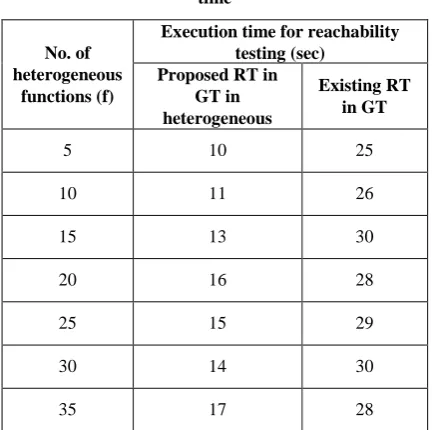
[image:4.595.321.538.89.304.2]In this work, we have seen how a different set of heterogeneous functions approached the game theoretic model without any impact arise in older version of program with a set of strategieswritten in mainstream languages such as Java. We run real web applications like e-commerce, e-learning, online student sdmission independently with different types of heterogeneous functions, by each feature to 20 heterogeneous functions per client. The previous took reachability testing model with game theory approach 30-35 seconds to perform the job whereas the proposed reachability testing model with game theory approach in heterogeneous environment completed the same job in 10 seconds.
Table 5.1 No. of heterogeneous functions vs. Execution time
No. of heterogeneous
functions (f)
Execution time for reachability testing (sec)
Proposed RT in GT in heterogeneous
environment
Existing RT in GT
5 10 25
10 11 26
15 13 30
20 16 28
25 15 29
30 14 30
35 17 28
The above table (table 5.1) describes the time taken by the reachability testing in game theoretic approach, when more number of heterogeneous functions approached the game players.
0 5 10 15 20 25 30
Execution time for reachability testing
(s)
5 10 15 20 25
No. of heterogeneous functions (f)
[image:4.595.85.510.373.521.2]Proposed RT with game theory in heterogeneous environment Existing RT using game theory approach
Fig 5.1 No. of heterogeneous functions vs. Execution time
[image:4.595.326.535.575.731.2]Fig 5.1 describes the time consumption to perform the reachability testing in the heterogeneous environment. The various number of web applications are used in the experimentation to validate the proposed reachability testing model with game theory approach in heterogeneous environment. Comparison result of the proposed reachability testing model with game theory approach in heterogeneous environment with the previous work reachability testing model with game theory approach based on execution time consumption variance, measured in terms of seconds(s). When number of heterogeneous functions applications increases in the web application, the execution time taken for the reachability testing is less in the proposed reachability testing model with game theory approach in heterogeneous environment contrast to an exisitng reachability testing model with game theory approach. The variance in the execution time consumption for reachability testing would be 20-25% low in the proposed reachability testing model with game theory approach in heterogeneous environment.
Table 5.2 No. of events vs. Memory Usage
No. of events (e)
Memory usage (KB)
Proposed RT in GT in heterogeneous
environment
Existing RT in GT
5 12 18
10 15 22
15 20 25
20 19 23
25 22 26
30 21 29
35 25 32
heterogeneous functions approached in heterogeneous web applications.
0 5 10 15 20 25 30
Memory usage (KB)
5 10 15 20 25
No. of events (e)
[image:5.595.83.511.87.236.2]Proposed RT with game theory in heterogeneous environment Existing RT using game theory approach
Fig 5.2 No. of events vs. Memory usage
[image:5.595.327.528.310.466.2]Fig 5.2 describes the usage of memory to perform the reachability testing fot the events occurring in the heterogeneous environment. Various number of predefined are used in the experimentation to validate the proposed reachability testing model with game theory approach in heterogeneous environment. Comparison result of the proposed reachability testing model with game theory approach in heterogeneous environment with the previous work reachability testing model with game theory approach based on memory usage variance, measured in terms of kilobyte(KB). When number of events which has heterogeneous functions increases in the web application, the usage of memory is less in the proposed reachability testing model with game theory approach in heterogeneous environment contrast to an exisitng reachability testing model with game theory approach. The variance in the memory usage for reachability testing would be 10-15% low in the proposed reachability testing model with game theory approach in heterogeneous environment.
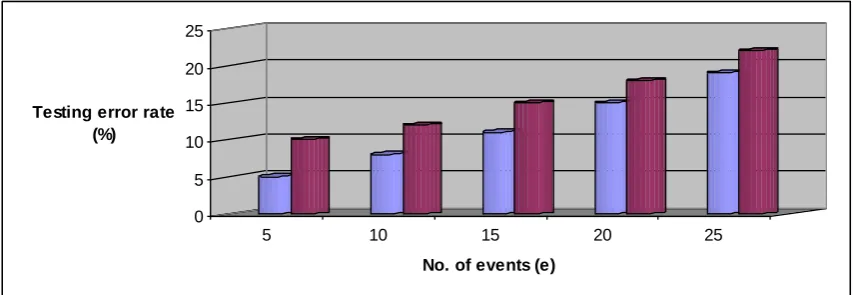
Table 5.3 No. of events vs. testing error rate (%)
No. of events (e)
Testing error rate (%)
Proposed RT in GT in heterogeneous
environment
Existing RT in GT
5 5 10
10 8 12
15 11 15
20 15 18
25 19 22
30 21 25
35 23 27
The above table (table 5.3) describes the error rate of testing by the number of pre-defined events taking place in game theoretic approach, when more number of heterogeneous functions approached in heterogeneous web applications.
0 5 10 15 20 25
Testing error rate (%)
5 10 15 20 25
No. of events (e)
[image:5.595.84.511.563.710.2]Proposed RT with game theory in heterogeneous environment Existing RT using game theory approach
Fig 5.3 describes the error rate to perform the reachability testing fot the events occurring in the heterogeneous environment. Comparison result of the proposed reachability testing model with game theory approach in heterogeneous environment with the previous work reachability testing model with game theory approach based on error rate testing, measured in terms of rate(%).The variance in the error rate for reachability testing would be 10-13% low in the proposed reachability testing model with game theory approach in heterogeneous environment.
Compared to an existing reachability testing model with game theory approach, in the proposed reachability testing model with game theory approach in heterogeneous environment the state of equilibria is stable for more number of events occurring in the heterogeneous environment. Finally, it is observed that the proposed reachability testing model with game theory approach in heterogeneous environment performed the modification in the older version of program with less impact.
6.
CONCLUSION
Web based reachability testing is done on heterogeneous application of functional diversity. It fulfils interoperability and scalability of application functionality both to standalone and web platforms. The proposed testing model efficiently accepts the heterogeneous events and processed the events with game theoretic approach. The impacts of the application‟s functional integrity are testified with previous versions. The performance of our work is measured in terms of testing time, error rate, memory usage, states of equilibrium. Standard web applications (i.e., commerce, e-learning etc.,) are used to conduct the performance evaluation of the proposed reachability testing model. The results showed that the proposed reachability testing model on different sets of parallel and divisive functional integration of heterogeneous application is nearly 60% better in accepting the heterogeneous events and efficient test case for multiple services.
7.
REFERENCES
[1] Y. Lei and R. Carver, “A New Algorithm for Reachability Testing of Concurrent Programs,” Proc. Int‟l Symp. Software Reliability Eng., pp. 346-355, 2005.
[2] Yu Lei and Richard H. Carver, “Reachability Testing of Concurrent Programs” IEEE TRANSACTIONS ON SOFTWARE ENGINEERING, VOL. 32, NO. 6, JUNE 2006.
[3] P. Bouyer, T. Brihaye & F. Chevalier (2010): O-Minimal Hybrid Reachability Games. Logical Methods in Computer Science 6(1:1), pp. 1–48.
[4] G. Fey, S. Staber, R. Bloem & R. Drechsler (2008): Automatic Fault Localization for Property Checking. Computer-Aided Design of Integrated Circuits and Systems, IEEE Transactions on 27(6), pp. 1138 –1149.
[5] B. Jobstmann, S. Staber, A. Griesmayer & R. Bloem (2011): Finding and Fixing Faults. Journal of Computer and System Sciences (JCSS)
[6] Yi Shi; Jiaheng Wang et. Al., “A game-theoretic approach for distributed power control in interference relay channels ”, IEEE Transactions on Wireless Communications, June 2009
[7] Yong Xiao; Guoan Bi et. Al., „Game Theoretic Analysis for Spectrum Sharing with Multi-Hop Relaying‟, IEEE Transactions on Wireless Communications,2011
[8] Niyato, D.; Ping Wang et. Al., “Exploiting Mobility Diversity in Sharing Wireless Access: A Game Theoretic Approach”, IEEE Transactions on Wireless Communications, 2010
[9] Zhen Yang; Huadong Ma, “Hotspot Avoidance for P2P Streaming Distribution Application: A Game Theoretic Approach”, Parallel and Distributed Systems, IEEE Transactions on 2009
[10]Yi Shi; Jiaheng Wang; et. Al., “A game-theoretic approach for distributed power control in interference relay channels” IEEE Transactions on ”, Wireless Communications, 2009
[11]C. Flanagan and P. Godefroid, “Dynamic Partial Order Reduction for Model Checking Software,” Proc. 32nd Symp. Principles of Programming Languages (POPL), pp. 110-121, 2005.
[12]P. Godefroid, “Software Model Checking: The VeriSoft Approach,” Formal Methods in System Design, vol. 26, no. 2, pp. 77- 101, 2005.
![Di μ aqua bis{triaqua[5 (1 oxopyridin 4 yl)tetrazol 1 ido]sodium}](data:image/gif;base64,R0lGODlhAQABAIAAAP///wAAACH5BAEAAAAALAAAAAABAAEAAAICRAEAOw==)