Acquisition of Linguistic Patterns for Knowledge-Based Information Extraction
Sanda M. Harabagiu, Steven J. Maiorano
Department of Computer Science and Engineering Southern Methodist University
Dallas, TX 75275-0122, U.S.A.
fsanda, [email protected]
Abstract
In this paper we present a new method of automatic acquisition of linguistic patterns for Information Extraction, as implemented in the CICERO system. Our approach combines lexico-semantic information available from the WordNet database with collocating data extracted from training corpora. Due to the open-domain nature of the WordNet information and the immediate availability of large collections of texts, our method can be easily ported to open-domain Information Extraction.
1.
The Problem
The Message Understanding Conferences (MUCs) and the TIPSTER program gave great impetus to research in In-formation Extraction (IE). The systems that participated in the MUCs have been quite successful at extracting infor-mation from newswire messages and filling templates with the information pertaining to prespecified events of inter-est. Typically, the templates model queries regarding who did what to whom, when and where, and sometimes how.
During the past years, the performance of some of the IE subtasks has reached near-human precision. For exam-ple, current IE systems are capable of recognizing named entities with over 90% precision. The broader task of event recognition (i.e. filling in scenario templates) results in 60% recall and 70% precision, which is comparable with human interannotator agreement ranging between 65% and 80%. These achievements are explained by two factors: (1) usage of the finite-state technology and (2) the availability of domain-dependent knowledge.
The usage of finite-state transducers (Pereira and Wright 1997) has emerged as a dominant technology in the IE field. Finite-state automata, frequently cascaded, are capable of recognizing linguistic constructs ranging from low-level syntactic expressions (e.g. noun groups and verb groups) to higher-level, domain relevant clausal patterns. The recognition of events and entities of interest is based on linguistic patterns representing the domain knowledge. Although there have been several remarkable efforts to ac-quire domain linguistic patterns automatically, some of the most successful systems still employ manually crafted do-main rules.
The availability of the WordNet lexico-semantic database (www.cogsci.princeton.edu/wn) and our previ-ous success in deriving textual implicatures (Harabagiu et al.1996) prompted this research. The extensive semantic net encoded in WordNet can be mined for concepts and lexico-semantic relations relevant to a domain. The re-sulting concepts and their interrelations are validated by domain- relevant corpora, enabling the discovery of their syntactic contexts. Our novel method generates linguistic patterns for a domain as production rules induced when us-ing the principle of maximal coverage of collocatus-ing do-main concepts.
The rest of the paper is organized as follows. Section 2 contrasts several other methods for automatic acquisition of linguistic patterns with our approach. Section 3 details the representation of domain semantic spaces and the tech-niques used to create and mine them from online resources. Section 4 reports and discusses the experimental results and Section 5 summarizes the conclusions.
2.
Acquisition of linguistic patterns
The portability of IE systems across different domains is hindered by the need of new linguistic patterns for each novel domain. The development of regular patterns for a new domain is time-consuming and relies on compu-tational linguistic expertise (e.g. porting BBN’s PLUM systems from the Joint Venture domain (MUC-5)(MUC-5) to the Microelectronics domain (MUC-5) (MUC-5) took 3 person weeks). Many systems, including those from NYU(Grishman 1995),BBN(Weishedel 1995),SRI (Ap-pelt et al.1995), SRA (Krupka 1995), MITRE (Aberdeen et al.1995) and University of Massachusetts (Fisher et al.1995) have taken steps to simplify the acquisition of domain-specific patterns.Researchers have considered two different ways of tack-ling the domain knowledge problem:
(1) the automatic acquisition of linguistic patterns from training corpora and
(2) the development of a specification language that allows the developer to write regular productions in the most eco-nomical way.
The latter endeavor is illustrated by FASTSPEC (Appelt et al.1995), a linguistic pattern specification language de-veloped at SRI International that translates any regular ex-pression into a finite state machine using an optimizer com-piler. The acquisition of domain patterns was considered in many systems, starting withAuto-Slog(Riloff 1993), PALKA(Kim and Moldovan 1995) andCRYSTAL (Soder-land et al.1995). All these systems learn linguistic patterns in the format of semantic case frames using different learn-ing strategies. In addition they all rely on pre-processed domain knowledge:
annotated texts corpora (e.g. in the case ofAuto-Slog 1
ac-all noun phrases that should be extracted are annotated in the texts) or
manually constructed concept hierarchies (e.g. for CRYSTAL orPALKA). These hierarchies also encode se-lectional constraints.
WordNet was used recently in two linguistic pattern ac-quisition systems. Califf and Mooney’s RAPIERsystem (Califf and Mooney 1997) learns unboundedELIZA-like patterns (Weizenbaum 1966) by using limited syntactic in-formation (i.e. the output of Brill’s part-of-speech tagger (Brill 1992)) and semantic class information from Word-Net. RAPIERwas used to extract information regarding job offerings, a domain that does not include scenario tem-plates of MUC-like complexity. Unlike any of the other systems, RAPIERlearns rules that specify constraints at the word level rather than at the constituent level.
The second study, presented in (Bagga et al.1997), as-sesses the role of WordNet in learning general patterns by using subsumption operators along the noun hierarchies of WordNet. In this pattern acquisition system, the semantic ambiguity of the head-words is resolved by human inter-vention. Moreover, similar toPALKA, initial patterns are entered by a user (with the help of aGUIinspired bySRA’s HASTENsystem (Krupka 1995)).
Our experiments in domain-knowledge acquisition for IE using WordNet, built upon all these previous systems. In our approach we:
1. minimize human intervention by enhancing WordNet with knowledge imposed by the pattern acquisition process;
2. produce patterns in the FASTSPEC language, thus granting optimal regular productions; and
3. develop an acquisition methodology that does not re-quire semantic disambiguation of the trigger words. Moreover, we aimed to produce a semantic space of Word-Net concepts and relations that can be used to recognize relevant linguistic expressions from any text corpora, even from the Internet.
3.
Domain Knowledge for IE
Our method of acquiring linguistic patterns was devised as a three step process:
Step 1. First, we create a semantic space that models the
domain via WordNet concepts and relevant connections be-tween them. Building a semantic space for a domain of in-terest provides means for (a) finding all linguistic patterns that cover the relevant textual information in documents and moreover (b) enables the interpretation of the interre-lations between different relevant textual expressions from the same document or even across documents (i.e. docu-ment threading).
A semantic space corresponding to a certain domain contributes to the resolution of some of the problems that still hinder the performance of current IE systems:
1. event recognition (also known as template merging), 2. the inference of implicit arguments, and
cording to the relevance to the domain of interest. Auto-Slog-TSinstead relies on a set of heuristics derived from the patterns induced byAuto-Slogfor that domain. In a final stage, patterns are statistically filtered.
3. the interpretation of non-literal textual expressions of relevance to a given domain.
Step 2. In the second phase, we scan the phrasal parses of
texts from theMUCcorpora for collocating domain concepts that are connected in the domain semantic space. Produc-tion rules are induced using the principle of maximal cov-erage of collocating concepts. The phrasal parser imple-mented in ourCICEROIE system generates correct syntac-tic links emerging from domain concepts, and thus enables the derivation ofFASTSPEC-like linguistic patterns.
Step3. Finally, the patterns are classified against the
Word-Net hierarchies and only the most general linguistic domain patterns are retained. The results matched all the linguistic patterns hand-crafted previously forCICEROand produced several new patterns.
Similar to other knowledge-based tasks, this method of automatically acquiring domain linguistic patterns has had a large start-up effort. This included the need for an unsupervised method of encoding morphological links in WordNet as well as heuristics for reformatting the informa-tion from conceptual definiinforma-tions. However, the high per-formance of this linguistic pattern-acquisition method in-dicates that it is a valuable tool for building ontologies of domain patterns, and extremely useful for indexing digital libraries as well.
3.1. Initial experiments
Our initial experiments of mining the WordNet lexical database for domain-dependent lexico-semantic informa-tion revealed two interesting facts. First, we expected to de-rive patterns of interrelated lexical concepts from the large WordNet semantic net and to obtain a high recall. However, we noticed that concepts relevant for a variety of domains were encoded in WordNet, and there were indirect relations among them. Thus we learned that linguistic patterns can be retrieved, but with the price of semantic processing.
In our quest for retrieving linguistic patterns directly from the WordNet semantic network, we experimented with three domains: (1) the management succession events, tested during the MUC-6 competition; (2) aircraft crashes, used for training in MUC-7; and (3) corporation joint ven-tures, tested in MUC-5. For each of these domains we re-lied on the scenario template keys to identify the domain concepts in the texts. In addition, we employed the MINI-PAR named entity recognizer (Lin 1994) to distinguish the names of persons, organizations and locations.
Named entities were replaced by the class they represent. The results showed that less than 8% of the relations were accounted for in WordNet.
For example, the following template key, represents a management succession event extracted from the Wall Street Journal document with ID 9404250043. We were able to identify the text fragment where the event is de-scribed by retrieving the sequence of sentences that contain any of the slot values of the template. The template is:
_________________________________________________________ <SUCCESSION_EVENT-9404250043-1> :=
SUCCESSION_ORG: <ORGANIZATION-9404250043-1> POST: "chairman"
IN_AND_OUT: <IN_AND_OUT-9404250043-1> <IN_AND_OUT-9404250043-2> VACANCY_REASON: DEPART_WORKFORCE
COMMENT: "Purdum out, Haley in as chmn of Armco" <ORGANIZATION-9404250043-1> :=
ORG_NAME: "Armco Inc." ORG_ALIAS: "Armco"
ORG_DESCRIPTOR: "Steelmaker" / "The specialty steelmaker"
ORG_TYPE: COMPANY <IN_AND_OUT-9404250043-1> :=
IO_PERSON: <PERSON-9404250043-2> NEW_STATUS: OUT
ON_THE_JOB: NO COMMENT: "Purdum out"
/ "ON_THE_JOB: ’retired’" <IN_AND_OUT-9404250043-2> :=
IO_PERSON: <PERSON-9404250043-1> NEW_STATUS: IN
ON_THE_JOB: UNCLEAR
OTHER_ORG: / <ORGANIZATION-9404250043-2> REL_OTHER_ORG: / OUTSIDE_ORG
COMMENT: "Haley in -- came from differ-ent org, but this may be nonrelevant since he re-tired from there and has since then been on the Armco
board"
<PERSON-9404250043-1> := PER_NAME: "John C. Haley" PER_ALIAS: "Haley" PER_TITLE: "Mr." <PERSON-9404250043-2> :=
PER_NAME: "Robert L. Purdum" PER_ALIAS: "Purdum"
PER_TITLE: "Mr."
_________________________________________________________
The corresponding retrieved text fragment is:
At its annual meeting, Armco also named John C. Haley, 64 years old, chairman. Mr. Haley’s appointment is for a one-year term, during which Armco’s board will study the concept of a nonexecutive chairman. Mr. Haley, an
Armco board member since 1975, is retired chairman and
chief executive officer of closely held Business International Corp. He succeeds Robert L. Purdum, 58, who retired.
The parser, in conjunction with the named entity recognizer, identified the following SVO patterns from the above text fragment:
“Armco[ORGANIZATION] named John Haley[PERSON] chairman[POSITION]”
Pattern 1:[Subject=Organization][Verb=name] [Object1=Person][Object2=Position]
Mr. Haley[PERSON] is retired chairman[POSITION] of Business International Corp.[ORGANIZATION]” Pattern 2:[Subject=Person][Verb=be][Object1=Position]
[Preposition=fofg][Preposition-object=Organization]
In WordNet 1.6 there is no relation between organiza-tion and any of the senses of the verb name, nor between name and any concept subsumed by position. Similarly, for pattern 2, no connections between its concepts could be found in WordNet.
However we also noticed that WordNet encodes a wealth of verbal concepts. Since each domain is charac-terized by a number of lexicalizations of the most relevant events, actions or states, we can access relations among these verbal concepts. For example, in the MUC-6 do-main, verbs such as fire and hire are directly connected as antonyms. Many more domain verbs are connected, albeit indirectly. The latter category of verbs has the property that they share many common concepts in their defining glosses. For example, the verb appoint, with the semantic sense 2 in WordNet is defined as assigning a position, but is not re-lated to any of the senses of the verb assume. However, the relationship between appoint and assume is transcended by the relation between giving and taking, already encoded in WordNet as an entailment.
In a second set of experiments, we have found that if we start with a predefined set of linguistic rules, expressed as subject-verb-object (SVO) patterns, the above observations help enhance the set with additional rules. Thus we noticed that novel connections between domain concepts do not re-sult directly from available WordNet relations, but they are rather combinations of WordNet relations mixed with :
(i) lexico-semantic relations implicit in the conceptual definitions (known as glosses in WordNet);
(ii) morphologically cued relations;
(iii) concept-identity relations established between a synset and all its usages in the gloss of other synsets; and
(iv) collocational relations, connecting multi-word synset elements with the synsets of each word2(e.g. synsetftake officeghas collocating relations to synsetsffill, takegand
foffice, position, post, berth, spot, place, situationg). Our general conclusion after these experiments was that although WordNet displays a magnitude of linguistic in-formation, acquiring domain knowledge for IE involves a complex search and the derivation of several additional forms of connections among concepts. For example, a new pattern for theMUC-6 domain was found because pf the connection between the trigger words take and helm (as a form of position of leadership). TheFASTSPEC represen-tation of this new pattern is:
[Subject=Person][Trigger-phrase=take the helm] [Preposition=fatjofg][Preposition-object=Organization]
This pattern extends the general SVO structure of the linguistic patterns implemented in IE systems, allowing more complex triggers. The acquisition of this pattern is derived by the WordNet relations between synsetsfassume, take on, take overgandfposition, office, place, post, slotg. Synsetftake officegcan be reached via:
(a) concept-identity relations, since the concepts assume and office are both used in the gloss of take office.
(b) a collocational relation, generated by the same sense of office in the synsetsfposition, office, place, post, slotgand
ftake officeg.
Moreover, synset ftake officeg is used to define synset
faccede to, enter upong, a hyponym offsucceed, come af-ter, followg. Therefore we infer that a succession event can
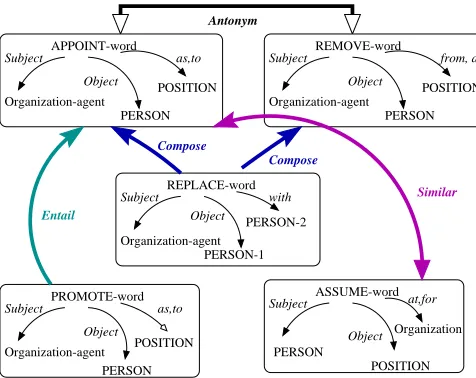
Organization-agent Subject
Object
as,to
Organization-agent Subject
Object PROMOTE-word
PERSON POSITION
as,to Subject
ASSUME-word
PERSON
POSITION Object Organization
at,for
Antonym
APPOINT-word
Compose
Organization-agent Subject REPLACE-word
PERSON-1 Object PERSON-2
with
PERSON PERSON
POSITION Organization-agent
Subject
Object REMOVE-word
from, as
POSITION
Compose
Entail
Similar
Figure 3: Contextual connections in the MUC-6 domain
all propositions holding in a contextC
1 hold also in C
2(and vice versa), we establish a similar connection betweenC
1 and C
2. Figure 3 illustrates several con-textual connections typical for theMUC-6domain.
Contexts are semantic objects encompassing : (a)
con-cepts, (b) thematic and subsumption connections and (c) conditions that enable their inter-connections. Contexts model various ways of expressing information regarding events of interest in a given domain, and are a means of cap-turing the relationship between these events. For example, in theMUC-6domain, the event of appointing a person to a new managerial position can be expressed by stating that the respective person has been promoted, or by announc-ing the person’s new position, or by statannounc-ing that the person became or is the executive in that position, or by stating that the person stepped into the new position. Since pro-moting (or becoming, stepping in or being) cannot always be viewed as a form of appointing, we consider entailment (or implication) connections between these events (mod-eled by different contexts). Figure 4 illustrates an example of the general conditions under which connections between contexts hold.
Conditions: person(appoint)=person(step-in) position(appoint)=position(step-in) Org-agent(appoint)=Org-agent(step-in) Similar to: Step-in Context
APPOINT-context
Composed by: Replace Context
Conditions: person(appoint)=person2(replace) position(appoint)=position(replace) Org-agent(appoint)=Org-agent(replace)
Figure 4: Conditions set on contextual connections: An ex-ample
This model of contextual objects based on knowledge from WordNet is in accordance with the formal theories of contexts reported in (McCarthy 1993) and (Buva˘c 1996).
When the domain of interest is defined as a natural lan-guage text, with a structured sequence of words, (e.g. a complex nominal =management succession in the case of
MUC-6or aircraft crashes for the dry-run ofMUC-7)4, the semantic space is acquired by the following algorithm:
Algorithm 1 (Builds semantic spaces)
Input: Sequence of words:fword k
g Output:<concepts, connections, contexts>
5
Procedure:
For every word defining the domain
1. Retrieve all the morphological variations and the WordNet synsets containing the word. 2. Classify the synsets according to maximal
coverage of relations between concepts. 3. Search for common concepts related to synset
classes corresponding to different domain words. 4. If no common concepts are found then
goto 5. else
4.1. Discard all other classes 4.2. Derive thematic and
subsumption connections 5. Expand each synset class along:
(a) IS-A links (and antonyms in the case of collocational synset entries) (b) WordNet meronymic relations
(e.g. is-member or is-part)
(c) synsets that contain collocations of concepts from that class
(d) gloss geni not contained in the class
(e) gloss concepts densely connected in the class 6. Repeat steps 2.–4. until only
one semantic class corresponds to each word. 7. Derive contexts (and subsumption
and thematic connections).
8. Specialize every context in the domain by 8.1. taking all hyponyms having
subjects, objects or prepositional relations to common concepts
8.2. retrieving concepts that
have the common concepts in their glosses 9. Generalize all classes of events or
entities in every context.
10. Derive contextual connections.
3.3. Walk-Through Example
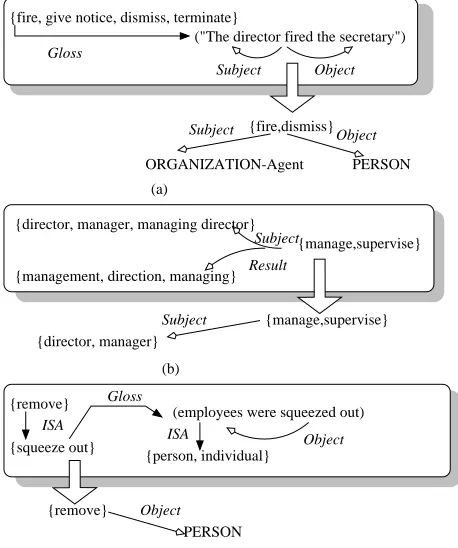
The first step of acquiring a semantic space for the MUC-6domain described by the complex nominal “man-agement succession” produces morphological derivations as a side effect of classification in clusters of highly re-lated synonyms sets. We have studied the heuristics that connect synsets containing words produced by derivational morphology in WordNet 1.6. We have found that words having the same morphological root, but different parts-of-speech tend to be interrelated by one of several functions. For example, nouns derived from a verb (i.e. nominaliza-tions) may
(a) reflect the function of the action itself, thus are act-nominalizatons, or
4The methodology can be extended easily when the domain is defined by a list of keywords or by several free text paragraphs, as was the case forTREC-6orTREC-7
5
(b) represent the agents of the action lexicalized by the verb, thus are subject-nominalizations or
(c) represent the effects of the action, thus are result-nominalizations.
Examples of heuristics that establish the function of the morphological derivation, and hence an interrelation be-tween the corresponding synsets are:
Heuristic 1 A noun synsetS
N is an act-nominalization of a verb synsetS
V when the gloss of S
N has a genus of the form “the action of<verb s>, where verb s is a member of
S V.
An example is rendered by sense 3 of the nominalization succession, which is the act-nominalization of sense 2 of the verb succeed.
Heuristic 2 A noun synsetS
N is a subject-nominalization of a verb synsetS
V if the genus of the gloss of S
N (or of one of its hypernyms) is the subject of verb s, where verb s is an element ofS
V or of any of its hypernyms.
An example is sense 1 of the noun manager, whose hyper-nymfadministrator, decision makerghas the gloss (some-one who administers a business), with the verb administer, belonging to the same WordNet hierarchy as sense 2 and 4 of the verb manage.
Heuristic 3 A noun synsetS
N is a subject-nominalization of a verb synsetS
V if in the hierarchy of S
N we find an-other subject-nominalization of a verb from the same hier-archy asS
V.
This heuristic makes sense 1 of manager a subject-nominalization of senses 2 and 4 of the verb manage be-cause we have administrator from the hierarchy of man-ager#1 a subject-nominalization of administer from the hi-erarchy of manage#2. Each of these heuristics retrieves morphological relations, producing the results of the first step of Algorithm 1.
A group of synsets linked by morphological relations define a class of synsets. They represent the output of the
second step of Algorithm 1. A remarkable side-effect of the application of these heuristics is the clustering of Word-Net semantic senses. One of the main criticism of WordWord-Net is its fine granularity of the definition of semantic senses. From the definitions of the WordNet senses for all morpho-logical variations of management and succession we find that in theMUC-6domain both senses 1 and 4 or the noun succession are applicable to the changes made in manage-ment position. Similar senses 2 and 4 of the verb manage describe the activity of a person holding a managerial posi-tion. They represent the results of the second step of Algo-rithm 1.
In the third step of Algorithm 1, we seek common con-cepts related to any of classes for management or succes-sion. The search is performed along:
(1) collocation entries containing words from the hierar-chies of both words;
(2) the genus hierarchies; or
(3) along the concepts directly related to the geni of the con-ceptual glosses (usually via subject, object or prepositional relations.)
This search produced several common concepts between Class 1-management and Class 1-succession: the concepts take office and leave office. Finding concepts connected
to both management and succession produces also a shal-low interpretation of the complex nominal “management succession”. Because the common concepts were found as special cases (i.e. hyponyms) of the actions lexicalized by the verb succeed, the meaning of the complex nominal becomes the event of succeeding by taking or leaving posi-tions of management. This interpretation generates the first contextual object of the semantic space: the Succession-Context.
Following the discovery of the common concepts at step 4.1, all the other classes of synsets are discarded. Step 4.2. of Algorithm 1 derives the subsumption and thematic connections. The thematic connections for the Succeed-Context are derived from sense 2 of successor and from the gloss offposition, officeg, a synset collocating in both take office and leave office. Thematic connections are prop-agated along the subsumption chains.
Step 5 of Algorithm 1 expands the semantic space with novel domain concepts, which populate the contextual ob-jects derived at step 7. Some of conceptual obob-jects de-rived from the initial common concepts are : the ftake office, assumegcontext and thefstep down, leave officeg context. The antonymy WordNet relation between these two concepts translates into distinct Person fillers. Con-cepts subsumed byfstep down, leave officegin the Leave office-Context are connected to concepts from the Remove-Context. In WordNet 1.6, the sense of the verb retire sub-sumed by leave office is also entailed by another sense of the verb retire, whose hypernym isfremoveg. These rela-tions translate into an Entailment connection between the two contexts.
The verb fire, subsumed by remove has an antonym: verb hire. The latter concept is subsumed by verb ap-point. Both the Appoint-Context and the Remove-Context are linked through Compose-connections to the Replace-Context. The latter context was inferred from the codifica-tion in WordNet of two senses of the verb replace: one that subsumes verb succeed, the other one entailing it. Conse-quently, the Succeed-Context and the Replace-Context are similar as they refer to the same event, but employ different themes.
The inference of these conceptual connections takes place in step 10 of Algorithm 1. In steps 8 and 9 special-izations and generalspecial-izations take place in every context, as a side effect of the inference of subsumers.
Further specializations and generalizations of each con-text are performed in an empirical way, by combining the hierarchical organization of WordNet with the information provided by theMUC-6text corpus.
4.
Empirical Analysis
The methodology of creating a semantic space needs to be validated by a corpus-based empirical test. Table 1 lists the number of domain concepts, contextual objects, sub-sumption and thematic connections as well as the number of contextual connections obtained for theMUC-6domain. Three problems arise when using the domain contextual objects to devise linguistic patterns:
Nr. words Nr. concepts Nr. contextual Nr. subsumption Nr. thematic Nr. contextual
objects connections connections connections
245 81 20 45 104 32
Table 1: Cardinality of the semantic space built forMUC-6
objects contain entries that are not used in the respec-tive domain.
2. Thematic relations were induced only from the con-ceptual glosses. Text describing events from a given domain generally display far more thematic relations than those from the definitions of concepts. These re-lations should be incorporated in the linguistic rules.
3. The degree of generality of concepts from every con-text has to be done in harmony with the generality of the concepts employed in real world texts for the do-main of interest.
These problems are resolved as a by-product of a corpus-based procedure that acquires the domain linguistic patterns.
Algorithm 2 (Finds domain linguistic patterns)
Input: Contexts from the semantic space, Text corpora. Output: Linguistic rules.
Procedure:
1. For every Contextual object from the semantic space of the domain
2. For everyVverb or Act-nominalization 3. Scan all texts and gather the phrasal context
whereVor any concept subsumed by it occur 4. If (there is a phrasal context
where a new thematic role forVexists) 5. If (all the other roles ofVare encountered
in that phrasal context as well) 6. Create a new contextual object forV. 7. If (the filler of the new role subsumes
any of the existing fillers)
8. Add the new prepositional-role for that filler. 9. For every Contextual object from the semantic space
of the domain
10. Find the most general filler.
11. Find the synset elements that were retrieved from phrasal contexts.
12. Create a linguistic rule and mark its label with RULE-label.
13. Mark the verbal concepts encountered in text with the RULE-label-Vattribute.
14. Mark the thematic filler words encountered in text with the RULE-label<theme>attribute. 15. Translate the themes inFASTSPEC.
Table 2 illustrates the results of this procedure applied to the MUC-6 domain. The MUC-6 corpus was prepro-cessed with theCICEROphrasal parser. We have devised only one novel context (and consequently a new rule) since promote, a subsumer of appointwas found to have a supplementary theme provided by the previous position of the promoted executive. Moreover, we have automati-cally produced all the linguistic patterns that were manually
crafted for CICEROand came up with several novel lin-guistic rules, corresponding to the Step-down and Take-the-helm contexts. In addition, by combining the knowledge from WordNet with the experience of buildingCICEROwe have devised a methodology that creates rapidly and easily linguistic patterns for any new domain. The existence of the semantic space (and its contextual connections) provides with the relational semantics between the events extracted from texts, and makes possible event correference (or merg-ing) and threading across documents. We contemplate the usage of the semantic space for information retrieval from the Internet and to the task of summarization.
Nr. rules Nr. thematic connections Nr. words encountered in texts
21 209 193
Table 2: Attributes of linguistic rules derived forMUC-6
5.
Conclusions
This paper describes an implementation of a system that acquires domain linguistics rules for IE with the use of the WordNet lexico-semantic database. Two different al-gorithms that participate in the acquisition are presented. The first algorithm generates a semantic space for each do-main. This semantic space is an important resource that can be used for other aspects of the IE process as well. For ex-ample, the event merging, i.e. the process of recognizing the same event in a text, could greately benefit from such a resource. Similarly, coreference resolution in IE systems can be enhanced when a semantic space is available.
For the particular case of linguistic pattern acquisition, we showed that this method generates very rich seman-tic spaces that are used by the second algorithm to gener-ate set of linguistic patterns. This methodology contrasts with recent approaches that use machine learning to si-multaneously learn patterns and dictionaries for IE, as pre-sented in (Riloff and Jones 1999). Mining a large dictionary like WordNet proves to bring forward very useful domain knowledge. In the future, we plan to integrate this approach with bootstrapping techniques, similar to those reported in (Riloff and Jones 1999).
6.
References
John Aberdeen, John Burger, David Day, Lynette Hirshman, David D. Palmer, Patricia Robinson and Marc Vilain. Descrip-tion of the ALEMBIC System Used for MUC-6. In Proceed-ings of the Sixth Message Understanding Conference (MUC-6), pages 141–155. San Mateo, Morgan Kaufmann, 1995. Douglas E. Appelt, Jerry R. Hobbs, John Bear, David Israel,
Megumi Kameyama, and Mabry Tyson. The SRI MUC-5 JV-FASTUS Information Extraction System. In Proceedings of the Fifth Message Understanding Conference (MUC-5), 1993. Douglas E. Appelt, Jerry R. Hobbs, John Bear, David Israel,
Myers and Mabry Tyson. Description of the FASTUS System Used for MUC-6. In Proceedings of the Sixth Message Un-derstanding Conference (MUC-6), pages 237–248. San Mateo, Morgan Kaufmann, 1995.
Amit Bagga, Joyce Yue Chai and Alan Biermann. The Role of WordNet in The Creation of a Trainable Message Undestanding System. In Proceedings of the 14th Conference on Artificial Intelligence (AAAI/IAAI-97), 941–948.
John Bear and Jerry R. Hobbs. Localizing expression of ambi-guity. In Proceedings of the Second Conference on Applied Natural Language Processing, Association for Computational Linguistics, pages 235–242, 1988.
Richard Bobrow, Ron Ingria and David Stallard. The Mapping Unit Approach to Subcategorization. In Proceedings of the Speech and Natural Language Workshop, 1991.
Eric Brill. A simple rule-based part of speech tagger. In Pro-ceedings of the Third Conference on Applied Natural Language Processing, pages 152–155, 1992.
Sasa Buva˘c. Quantificational logic of context. In Proceedings of the 13th National Conference on Artificial Intelligence (AAAI-96), pages 600–606, Portland, OR, 1996.
Mary Elaine Califf and Raymond J. Mooney. Relational Learn-ing of Pattern-Match Rules for Information Extraction. In Pro-ceedings of the ACL Workshop on Natural Language Learning, pages 9–15, 1997.
Michael Collins. A New Statistical Parser Based on Bigram Lex-ical Dependencies. In Proceedings of the 34st Annual Meet-ing of the Association for Computational LMeet-inguistics, ACL-96, pages 184–191, 1996.
David Fisher, S. Soderland, J. McCarthy, F. Feng and Wendy Lehnert. Description of the UMass System Used for MUC-6. In Proceedings of the Sixth Message Understanding Con-ference (MUC-6), pages 127–140. San Mateo, Morgan Kauf-mann, 1995.
Paul J. Grice. Logic and conversation. In P. Cole and J. Morgan, editors, Syntax and Semantics Vol.3: Speech Acts, pages 41–58. Academic Press, New York, 1975.
Ralph Grishaman. New York University PROTEUS System: MUC-4 Test Results and Analysis. In Proceedings of the Sixth Message Understanding Conference (MUC-6), pages 124–127. San Mateo, Morgan Kaufmann, 1995.
Sanda Harabagiu, Dan Moldovan and Takashi Yukawa. Testing Gricean constraints on a WordNet-based Coherence Evaluation System. In Working Notes of the AAAI-96 Spring Symposium on Computational Approaches to Interpreting and Generating Conversational Implicature, pages 31–38, 1996.
Jerry R. Hobbs, Douglas E. Appelt, John Bear, David Israel, Megumi Kameyama, Mark Stickel and Mabry Tyson. FAS-TUS: A Cascaded Finite-State Transducer for Extracting In-formation from Natural-Language Text. In Finite State Lan-guage Processing, edited by Emmanuel Roche and Yves Sch-abes, MIT Press, 1997.
Jun-Tae Kim and Dan I. Moldovan. Acquisition of Linguistic Pat-terns for Knowledge-Based Information Extraction. In IEEE Transactions on Knowledge and Data Engineering, 75(5):713– 724, 1995.
George Krupka. Description of the SRA System as Used fro the MUC-6. In Proceedings of the Sixth Message Understand-ing Conference (MUC-6), pages 221–235. San Mateo, Morgan Kaufmann, 1995.
Dekang Lin. Principar - an efficient, broad coverage, principle-based parser. In Proceedings of the 15th International Confer-ence on Computational Linguistics, COLING-94, pages 482– 488, Kyoto, Japan, 1994.
John McCarthy. Notes on formalizing context. In Proceedings
of the 13th International Joint Conference on Artificial Intelli-gence (IJCAI-93), pages 555–560, 1993.
George A. Miller. WordNet: a lexical database for English. In Communications of the ACM, Vol.38, No.11:39–41, 1995. Proceedings of the Fourth Message Understnading Conference
(MUC-4). San Mateo. Morgan Kaufmann, 1992.
Proceedings of the Fifth Message Understnading Conference (MUC-5). San Mateo. Morgan Kaufmann, 1993.
Proceedings of the Sixth Message Understnading Conference (MUC-6). San Francisco. Morgan Kaufmann, 1995.
Fernando Pereira and Rebecca Wright. Finite-state approximation of phrase-structure grammars. In Finite State Language Pro-cessing, edited by Emmanuel Roche and Yves Schabes, MIT Press, 149–179, 1997.
Ellen Riloff. Automatically Constructing a Dictionary for Information-Extraction Tasks. In Proceedings of the 11th Na-tional Conference on Artificial Intelligence (AAAI-93), 1044– 1049.
Ellen Riloff and Rosie Jones. Learning dcitionaries for Informa-tion ExtracInforma-tion by multi-level bootstrapping. In Proceedings of the 16th National Conference on Artificial Intelligence (AAAI-99).
Stephen Soderland, David Fisher, Jonathan Aseltine and Wendy Lehnert. CRYSTAL: Inducing a Conceptual Dictioanry. In Proceedings of the 14th International Joint Conference on Ar-tificial Intelligence (IJCAI-95), Montreal, Canada, 1314–1319, 1995.
Beth Sundheim. Overview of the MUC-6 evaluaiton. Proceed-ings of the Sixth Message Understnading Conference (MUC-6). San Francisco. Morgan Kaufmann, pages 13–32, 1995. Ralph Weischedel. Description of the PLUM System as Used for
MUC-6. In Proceedings of the Sixth Message Understanding Conference (MUC-6), pages 55–69. San Mateo, Morgan Kauf-mann, 1995.